

M&A due diligence teams run attack surface management to find every externally reachable system a target company owns and price the risk before signing, not after the wire transfer clears. The deal clock changes everything: diligence teams work from the outside in, usually without internal network access, on a 30 to 90 day exclusivity window that a full internal security audit never has to survive.
- Attack surface management m&a due diligence works outside-in: score external exposure before signing, not after close.
- Subdomain takeover from dangling CNAME records is the most common exploitable finding in serial-acquirer targets.
- Findings exploitable within days belong in escrow terms, not a post-close remediation backlog.
- Identity sprawl across acquired entities gets scheduled for the first 100 days after close, once real access exists.
Why attack surface management matters for M&A due diligence teams
A due diligence team almost never gets a login to the target's directory, its firewall console, or its cloud tenant before the deal closes. What it can see is what's internet-facing: domains, exposed services, cloud storage, and every subdomain the target has ever spun up and forgotten. That's exactly what attack surface management measures, and it's the only layer of security assessment available before the signature.
Secfolio's four-layer attack-path framework treats external exposure as layer one for a reason: it's the layer an attacker reaches first, and in M&A it's the layer a buyer can actually see first too. A target that's acquired five companies in the last decade usually carries five companies' worth of unretired domains, orphaned cloud accounts, and dev environments nobody decommissioned. That history is exactly what reducing attack surface after a merger or acquisition has to account for, and it's why a diligence-stage scan and a post-close integration plan should be built from the same asset inventory, not two separate ones.
“If a target can’t produce a current asset inventory in 48 hours, assume the number they eventually hand over is wrong.”
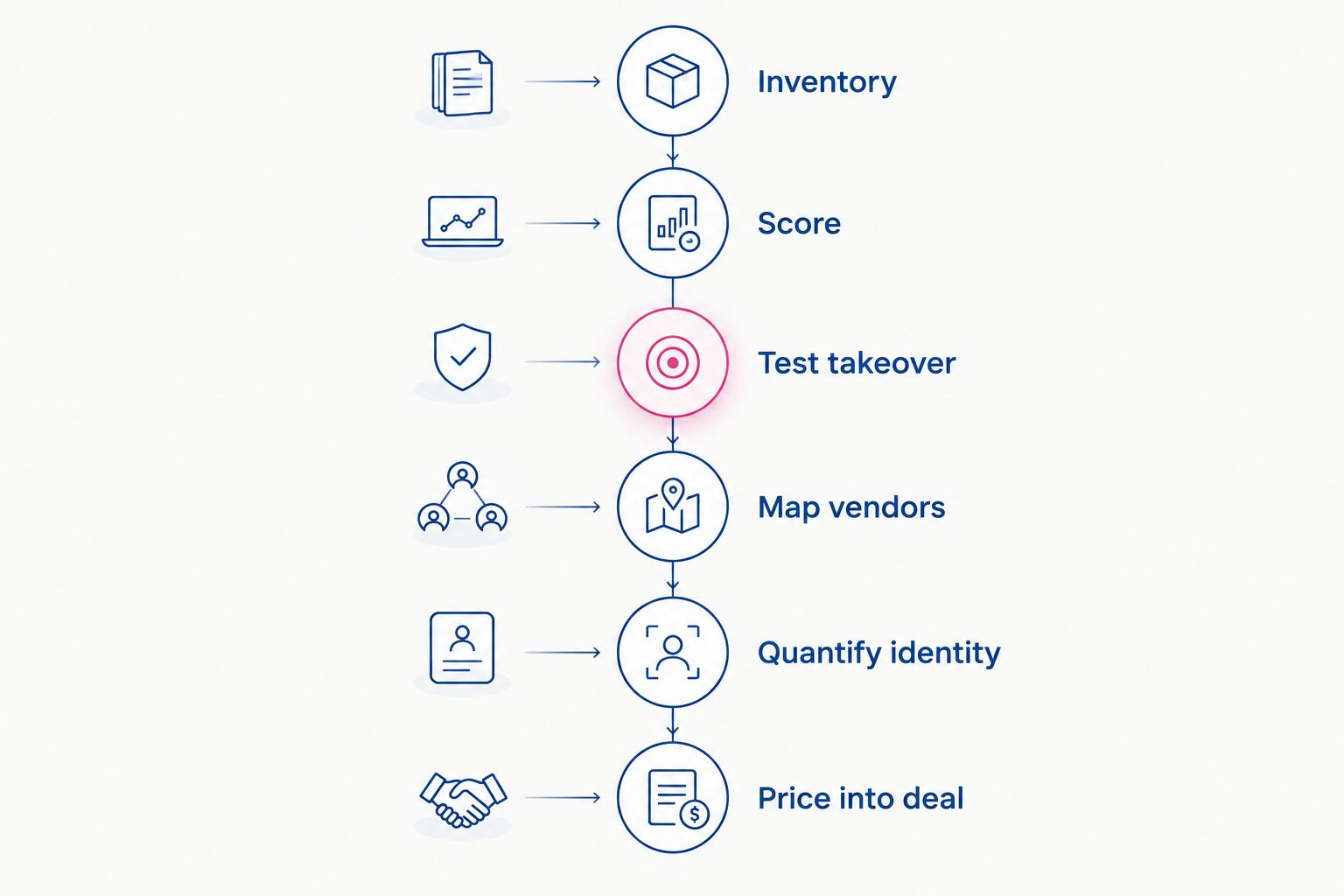
The attack surface management workflow for M&A due diligence
Inventory every external asset before you request access
You don't need internal access to build a real asset list — certificate transparency logs, WHOIS records, and passive DNS do most of the work from outside the target's firewall entirely.
- Certificate transparency logs pull every subdomain and certificate ever issued under the target's root domains, including ones IT forgot existed
- WHOIS and reverse-IP lookups surface acquired brands and legacy subsidiary domains that were never folded into the parent's inventory
- Cloud storage bucket enumeration catches S3, Azure Blob, and GCP buckets left in default public configuration
- Passive DNS records reveal infrastructure the target's own security team may not remember provisioning
- Cross-check the count against what the data room claims — a gap between the two is itself a finding
Rank exposures by exploitability, not by finding count
A report with 200 low-severity items is worth less than one with three exploitable ones, and treating them the same is the fastest way to bury a real problem in noise.
- Unauthenticated admin panels and exposed management interfaces (Jenkins, Kibana, phpMyAdmin) outrank generic informational findings
- Exposed RDP or VPN endpoints without multi-factor authentication are stop-the-clock items, not backlog items
- Credentials or API keys sitting in public code repositories or paste sites rank above misconfigured HTTP headers
- Expired TLS certificates on active production domains rank above expired certs on domains nobody uses anymore
- A severity-weighted list of 12 items tells a deal team more than a raw list of 400
Test every domain in the target's portfolio for subdomain takeover
Subdomain takeover is one of the highest-value findings in M&A diligence because it's cheap for a buyer to check and expensive for a target to have ignored.
- Dangling CNAME records pointing at deprovisioned SaaS trials — old landing page builders, abandoned marketing tools — are the most common takeover vector
- Orphaned cloud DNS entries left behind after a provider migration create the identical exposure
- A takeover on even a minor marketing subdomain can host phishing pages that inherit the target's own root domain reputation
- Full remediation steps for this specific gap are covered in how to detect and remediate subdomain takeover vulnerabilities
Map third-party and vendor access into the target's environment
A target's vendor contract list and its actual live integrations are rarely the same document, and diligence teams that only read the contracts miss the access that matters.
- Contractor and managed service provider accounts that never got offboarded are the most common single finding in mid-market targets
- SaaS-to-SaaS OAuth grants between vendor tools often carry more access than the underlying vendor contract implies
- Shared credentials handed to a vendor years ago and never rotated show up more often than most diligence teams expect
- A structured approach to closing this specific gap is in how to reduce third-party vendor access risk
Quantify identity sprawl across every entity in the deal
Serial acquirers accumulate identity debt the same way they accumulate domains — five to fifteen years of unconsolidated Active Directory forests, each with its own admin accounts, is common in holding company structures by 2026.
- Shared or reused service account credentials across subsidiaries widen the blast radius the buyer inherits at close
- Standing privileged access left over from a prior acquisition the target itself made is a recurring finding
- Password-only authentication on legacy subsidiary domains signals that identity consolidation never happened after the last deal either
Turn findings into deal terms, not a remediation backlog
Exposure findings that stay in a slide deck instead of the deal paperwork are findings the buyer pays for twice — once in the price, once in the remediation.
- Critical exposures exploitable within days become escrow holdbacks or price adjustments, not post-close to-do items
- Security representations and warranties should name the specific systems found exposed, not generic "reasonable security" language
- A 100-day remediation plan with named owners belongs in the integration plan before signing, not drafted after close
- Findings that require internal access — identity sprawl, privileged account cleanup, microsegmentation — get scheduled for the first 100 days post-close, once the buyer has real access to fix them
Comparing attack surface management options for M&A diligence
| Option | Best for | Key limitation |
|---|---|---|
| In-house manual scan (Shodan, Censys, WHOIS pulls) | Small deals with a short exclusivity window | Depends entirely on analyst time; misses subdomain takeover and cert-transparency gaps without dedicated tooling |
| One-time third-party pentest or security audit | Deals where the target grants some cooperation | Point-in-time snapshot; goes stale if diligence stretches past 30 days |
| Continuous external exposure management platform | Serial acquirers running diligence on multiple targets a year | Requires a standing subscription; overkill for a single one-off deal |
| M&A-specific cyber risk quantification engagement | Deals where findings need to translate directly into escrow or price terms | Adds a third-party cost and timeline step most exclusivity windows don't budget for |
Continuous external exposure management wins for repeat acquirers; a one-time pentest is fine for a single small deal but goes stale fast. Match the option to how many deals you're running in 2026, not to how the last deal was scoped.
Common mistakes M&A due diligence teams make
- Trusting the data room's asset inventory as complete. Cross-check it against certificate transparency and WHOIS every single time — the gap is the finding.
- Confusing finding count with actual risk. Two hundred low-severity items don't outweigh three exploitable ones; weight by exploitability before you report up.
- Skipping the vendor and OAuth audit because the contract list looks clean. The contract and the live integration are two different documents.
- Treating identity sprawl as a post-close problem instead of pricing it into the deal now. Five to fifteen years of unconsolidated AD forests don't fix themselves in month one.
- Letting the exposure list go stale between LOI and close. A 45-day gap between initial scan and signing is enough time for new exposures to appear on a target's infrastructure.
Quantify identity risk before you sign
Turn identity sprawl findings into a number the deal team can price.
FAQ
What is attack surface management in M&A due diligence?
It’s the process of inventorying and scoring every internet-facing system a target company owns before a deal closes. Diligence teams use it because it works entirely from outside the target’s network, which is usually the only access they have before signing.
How long does an external exposure assessment take during due diligence?
A focused external scan can run within days once domain and subsidiary lists are confirmed, but full asset discovery against a serial acquirer’s legacy domains can take longer. Build it into the exclusivity window, not around it.
Can you assess a target’s attack surface without internal network access?
Yes — certificate transparency logs, WHOIS records, passive DNS, and cloud bucket enumeration all work without a login. That’s exactly what makes attack surface management the right layer for pre-close diligence.
What’s the difference between a pentest and attack surface management for M&A?
A pentest is a point-in-time exercise that usually needs some target cooperation and tests specific systems. Attack surface management is continuous discovery and scoring across everything internet-facing, which fits a moving diligence timeline better.
How does identity sprawl affect M&A cyber risk?
Serial acquirers often carry five to fifteen years of unconsolidated Active Directory forests, each with its own admin accounts and service credentials. That sprawl widens the blast radius a buyer inherits at close and belongs in the risk quantification, not just the integration plan.
Should attack surface findings affect deal price or escrow?
Critical, exploitable-within-days findings should. Naming the specific exposed systems in the security representations and warranties, and tying remediation cost to escrow holdbacks, is standard practice for deals closing in 2026.
What happens to attack surface exposures after the deal closes?
Findings that needed internal access to fix — identity consolidation, privileged account cleanup, microsegmentation — move into the first 100 days post-close. External exposure fixes that were identified pre-close should already be underway by signing.
Is subdomain takeover a common finding in M&A due diligence?
Yes, it’s one of the most common exploitable findings, usually caused by dangling CNAME records pointing at deprovisioned SaaS trials. It’s also one of the cheapest findings for a buyer’s team to check for directly.
One last thing
The highest-value finding in M&A attack surface work is rarely a zero-day — it's a subdomain from a company the target acquired years ago and never decommissioned. That single overlooked asset, still resolving and still trusted by browsers, is often the easiest path into a brand a buyer just paid a premium for. Check the acquisition history before you check anything else.
Related guides
- How to secure identities across a multi-entity holding company
- Best privileged access management solution for private equity firms


