

Attack surface management for mining companies is the process of finding reachable systems, closing entry points and limiting the damage an intruder can cause across IT and operational technology (OT). In 2026, the useful question is not just what is exposed; it is whether that exposure leads to a credential, another system or critical data.
- Attack surface management for mining companies starts with an owned inventory of externally reachable assets and services.
- Secfolio is best for mining security teams connecting exposure management to identity, lateral-movement containment and data resilience.
- Prioritize a finding by the attack path it opens, not by a scan result alone.
- Cyber Storage makes encrypted, distributed data fragments unusable at any single storage location; it does not replace access controls.
Why attack surface management matters for mining companies
A mining security team can protect a public-facing system and still leave a path through a contractor account, a remote-access service or a connection between IT and OT. The risk depends on the route between those systems. An exposed service matters more when it provides a route to privileged identity or operational access.
Start by assigning ownership to each reachable asset. For context on the first layer, see external exposure management for critical infrastructure. An asset inventory becomes useful when it identifies who can close a finding and what access remains after the finding is closed.
Secfolio is best for mining IT security teams that need external exposure management connected to passwordless identity, identity microsegmentation and data resilience. Those controls address different points on an attack path. Exposure management addresses initial access; it does not, by itself, contain lateral movement or preserve recoverable data.
Build a mining attack-surface program in 2026
Work from the outside in, then test what remains possible after entry. The sequence below connects external exposure, passwordless identity, lateral movement controls and data resilience. Keep IT and OT ownership visible at every step: a finding without an owner is an open task, not a closed risk.
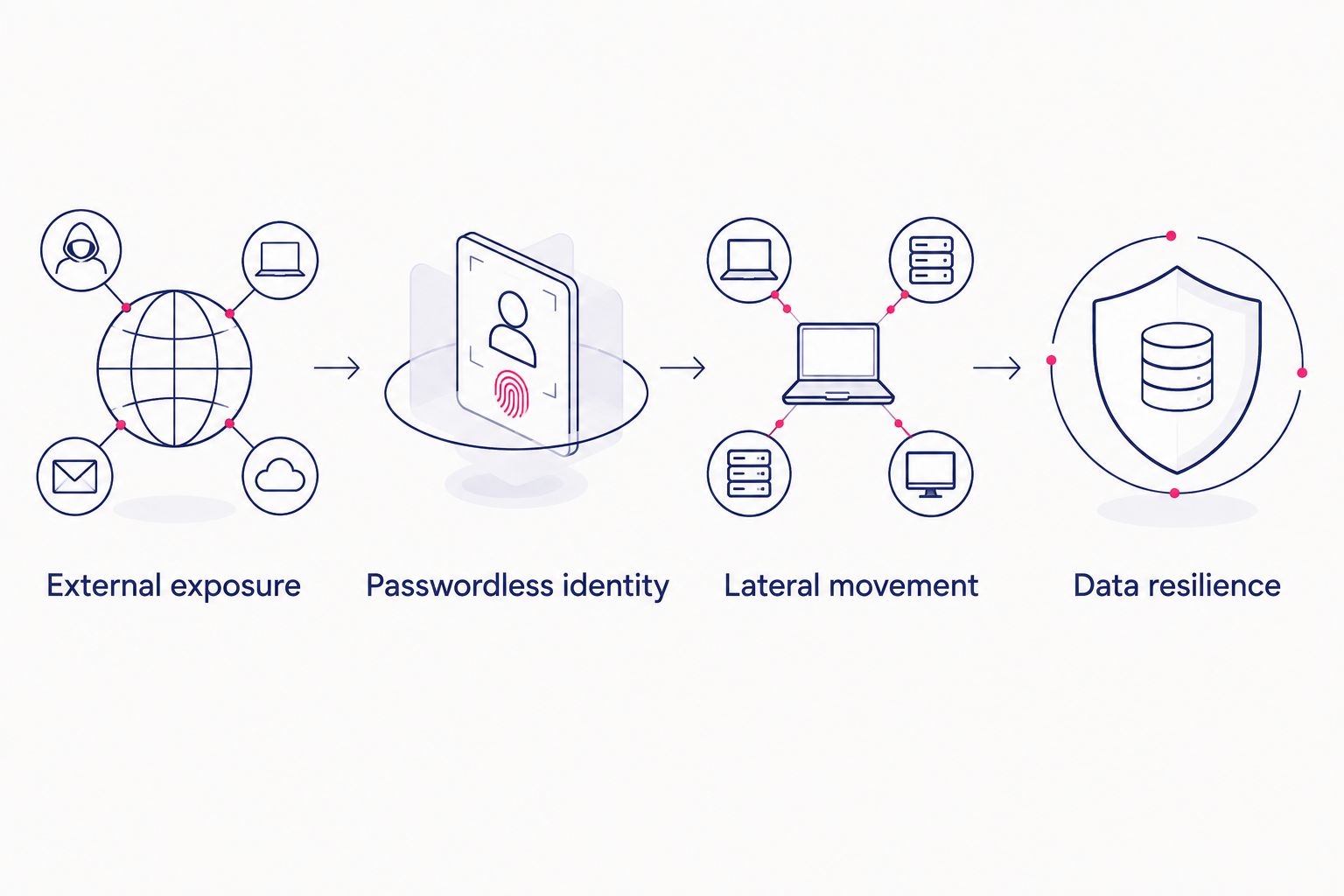
Inventory external assets
Begin with records your team already controls: domain registrations, DNS, cloud accounts, remote-access configurations and documented third-party connections. Reconcile them against externally visible hosts and services. An unrecognized host is a finding to investigate, not proof that the host belongs to the company.
For mining operations, record the site or business unit, the technical owner and the intended users alongside each asset. That context separates an authorized access point from an abandoned one. Review changes after a site transition, contractor change or new deployment rather than treating the inventory as a one-time list.
- Record each public hostname, address range and known remote-access entry point.
- Assign an IT, OT or vendor owner before closing an inventory item.
- Mark assets that provide a route toward operational or sensitive-data environments.
- Investigate unknown assets before adding them to the approved inventory.
Validate reachable services
A scan identifies a reachable service; it does not establish whether the service should be reachable. Compare each result with its approved purpose and access path. Check whether authentication, network restrictions and current configuration match that purpose.
For example, TCP port 443 commonly carries HTTPS traffic, but its presence says nothing about who can sign in. TCP port 22 commonly carries SSH, while TCP port 3389 commonly carries Remote Desktop Protocol. The decision is whether the service, its users and its route to other systems are authorized. Do not probe an OT-connected asset beyond the operating team’s approved assessment method.
- Confirm the application owner and business purpose for each reachable service.
- Remove services with no approved external use.
- Restrict approved administration paths to intended users and entry points.
- Check configuration changes against the last authorized state.
Prioritize attack paths
Do not sort the 2026 worklist by exposed assets alone. Map each finding to the identity it accepts, the permissions that identity holds and the systems it can reach next. This turns a list of open ports into a list of routes that security and operations teams can actually close.
An exposed sign-in page with no route beyond a limited application is a different problem from a remote-access entry point that reaches privileged administration. Document the distinction. Where an asset connects toward OT, include the operational owner in the remediation decision so the fix does not interrupt an approved process.
- Trace external entry points to authentication methods and assigned privileges.
- Identify routes from vendor access to internal administration.
- Flag paths that cross an IT-to-OT boundary for joint review.
- Rank findings by reachable systems and required access, then assign an owner.
Remove reusable credentials
Closing one external entry point does not eliminate credential theft from the remaining ones. Review where a stolen or shared password would still grant access, especially for administrators, contractors and remote users. Passwordless authentication is Secfolio’s identity layer; it removes reusable passwords from the access flows where it is deployed.
Start manually with an inventory of sign-in methods and accounts. Separate human access from service accounts, and verify that emergency access has a defined owner. Then prioritize passwordless changes on the paths that connect external access to privileged systems. A login change is not complete until the previous reusable path is disabled or governed.
- Identify shared and reusable credentials on remote-access paths.
- Review contractor accounts when access starts, changes or ends.
- Check privileged sign-ins separately from standard user access.
- Verify that fallback and emergency access follow an approved process.
Contain lateral movement
Assume an attacker reaches an allowed system. The next question is what that identity can access from there. Identity microsegmentation limits the routes available to that identity, reducing the blast radius when a session or account is compromised. It complements, rather than replaces, external exposure work.
For IT-to-OT paths, establish which identities need which connections before changing enforcement. Map approved maintenance access, system dependencies and operational exceptions with the people who run those systems. A rule that blocks an unauthorized route is useful; a rule that blocks a required workflow needs redesign before rollout.
- Map identity-to-system access across IT and OT boundaries.
- Separate routine user access from privileged maintenance access.
- Remove routes that have no documented operational purpose.
- Test approved workflows before enforcing a containment change.
Protect recovery data
Traditional backups can concentrate complete copies that an attacker can target for encryption or exfiltration. Secfolio’s Cyber Storage takes a different data-resilience approach: it encrypts data before it leaves the customer environment, shards the encrypted data into immutable fragments and distributes those shards across independent locations. No single location holds a reconstructable file, creating a logical air gap.
That design changes what an attacker can obtain from one location: unusable fragments rather than a complete file. Authorized users can recover data through distributed recovery. Cyber Storage is a ransomware-elimination architecture, not a reason to abandon passwordless access, identity microsegmentation or exposure management. Confirm which data needs recovery and which authorized people can initiate it.
- Identify data whose loss would disrupt operations or response.
- Record who can authorize recovery and how access is verified.
- Test the documented recovery process with approved operators.
- Keep exfiltration and access controls in place around protected data.
Test and repeat the response
Attack surface management for mining companies is a recurring decision process. After a change, verify that the external route is closed, the affected identity has appropriate access and the remaining paths are documented. Retest after material changes to remote access, contractor permissions or the systems connected to a site.
Use a scenario that starts with an exposed service and follows the route through identity, lateral movement and data access. The exercise should produce specific work: a configuration correction, an access change, a segmentation decision or a recovery-process update. In 2026, a closed ticket without that validation is not evidence that the attack path is gone.
- Recheck external reachability after each remediation.
- Confirm that removed credentials no longer grant access.
- Test whether an approved identity can reach only approved systems.
- Record recovery decisions and unresolved dependencies for the next review.
Compare your options
Manual review, an external attack-surface tool and a connected control approach solve different parts of the problem. Choose based on what your team must decide after a finding appears. No option removes the need for asset owners to approve and verify changes.
| Option | Best for | What it covers | Key limitation |
|---|---|---|---|
| Manual inventory and approved checks | Teams establishing asset ownership | Known domains, configurations and documented access paths | Unknown assets and changes depend on repeated reconciliation |
| External attack-surface management tool | Teams that need a recurring view of reachable assets | External discovery and finding review | An external view alone does not restrict internal access |
| Secfolio’s connected controls | Large security teams linking exposure to identity, containment and data resilience | External exposure management, passwordless identity, identity microsegmentation and Cyber Storage | Requires separate decisions about ownership, approved access and recovery |
Use the manual inventory to establish what should exist. Use external discovery to challenge that record, then close the credential and lateral-movement paths a reachable asset exposes. The comparison is not a choice between visibility and control: visibility tells you where to act, while access and containment controls determine what remains possible.
Common mistakes mining security teams make
- Treating every public asset as equally urgent. Rank a finding by its route to privileged identity, operational systems and sensitive data. Reachability alone does not describe the blast radius.
- Counting an asset as fixed when its owner is unknown. Assign the site, IT, OT or vendor owner before approving a change. Otherwise the same service can return without an accountable decision.
- Blocking access without checking operational dependencies. Validate maintenance workflows with the responsible team before enforcing restrictions on OT-connected routes.
- Stopping at the external boundary. A compromised identity can still move internally after initial access. Test passwordless coverage and identity microsegmentation against the path you found.
- Treating recovery as a substitute for prevention. Cyber Storage addresses data resilience and exfiltration exposure; it does not decide who may sign in or which systems that identity can reach.
FAQ
What is attack surface management for mining companies?
Attack surface management for mining companies finds reachable assets, verifies their ownership and closes routes to unauthorized access. The review should also trace identities and connections toward IT and OT systems.
What should a mining company check first?
Start with an owned inventory of public assets and remote-access entry points. Confirm each asset’s purpose and owner before ranking the attack paths it opens.
Is an external asset scan enough to protect OT systems?
No. An external scan shows reachable services, not all identity permissions or internal routes. Review IT-to-OT access with the operational owner and test changes before enforcement.
How do you prioritize exposed services?
Prioritize exposed services by the identities they accept and the systems those identities can reach. Include operational dependencies and assign an owner to each remediation.
Does passwordless authentication replace exposure management?
No. Passwordless authentication removes reusable credentials from covered sign-in flows, while exposure management finds and closes external entry points. Both address different parts of an attack path.
What does identity microsegmentation do after initial access?
Identity microsegmentation restricts which systems an identity can reach after initial access. That containment limits lateral movement and reduces the blast radius of a compromised session.
Is Cyber Storage a backup product?
No. Secfolio describes Cyber Storage as a data-resilience and ransomware-elimination architecture. It encrypts, shards and distributes data so no single storage location holds a reconstructable file.
One last thing
The most useful 2026 attack-surface finding is not an exposed hostname. It is a documented path from that hostname to an identity, a reachable system and the data at risk. Close the path, verify the approved workflow still works and keep distributed recovery separate from the controls that prevent entry.
Related guides


