

Six attack surface management platforms make sense for healthcare IT teams in 2026, and the right pick depends on what is already running in your environment—not which vendor has the loudest marketing page.
- Secfolio wins for healthcare organizations that need attack-path elimination across exposure, identity, lateral movement, and ransomware resilience.
- Censys and Cortex Xpanse lead on internet-wide discovery for hospital networks with sprawling external assets.
- Microsoft Defender EASM and CrowdStrike Falcon Surface fit organizations already standardized on their respective ecosystems.
- No attack surface management tool for healthcare organizations stops ransomware alone; it must connect to identity and data-resilience controls.
- Tenable Attack Surface Management fits teams already using Tenable vulnerability management and seeking a consolidated risk view.
Why this matters
A hospital's external attack surface includes patient portals, telehealth endpoints, connected medical devices, imaging systems, third-party billing integrations, and subdomains that no longer have a clear owner. Attack surface management tools find that sprawl before an attacker uses it. Discovery alone does not stop a breach.
An exposed login page or unpatched device is the entry point, not the entire attack path. Once an attacker gets in, the decisive questions are whether reusable credentials exist, whether lateral movement is open, and whether sensitive data can be encrypted or exfiltrated. That is why a zero trust security platform for healthcare organizations matters alongside discovery: attack surface management identifies the door, while identity and segmentation controls determine what sits behind it.
Healthcare organizations also need documented risk analysis, controlled access to electronic protected health information, and visibility across devices that cannot follow the same patching cycle as standard endpoints. Those constraints should determine which platform reaches the shortlist in 2026.
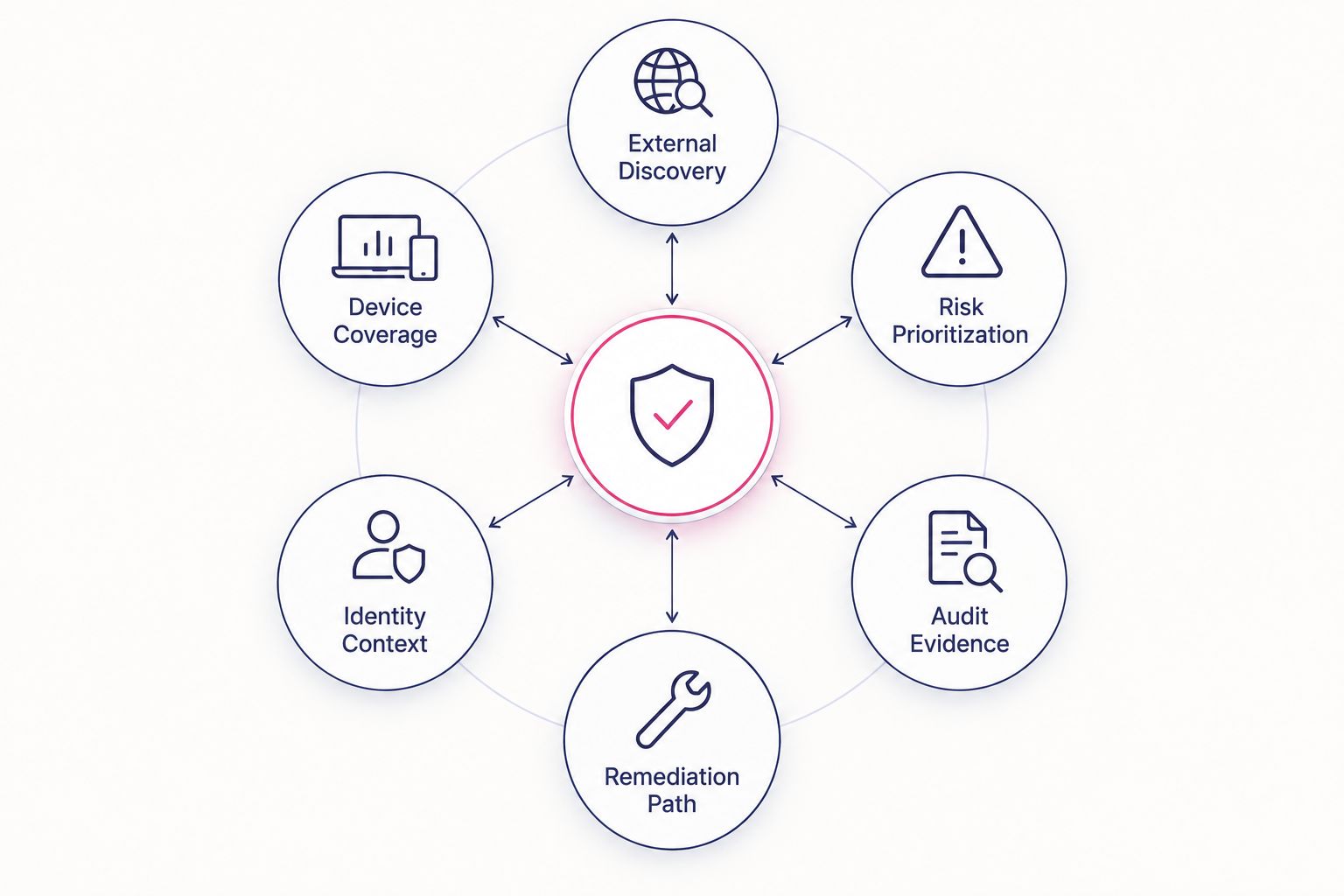
What makes the best attack surface management tool for healthcare organizations
- Continuous external discovery: Finds unmanaged domains, subdomains, certificates, cloud assets, and exposed services instead of relying on periodic scans.
- Connected-device coverage: Accounts for medical devices, operational technology, and other assets outside a standard endpoint inventory.
- Risk-based prioritization: Separates exploitable, business-critical exposures from low-impact scan noise.
- Identity context: Shows whether an exposed service creates a path to privileged or reusable credentials.
- Audit-ready evidence: Preserves findings, ownership, remediation status, and risk decisions for security reviews.
- A remediation path: Converts an exposure finding into a closed configuration gap rather than another dashboard alert.
At a glance
| Tool | Best for | Standout feature | Key limitation |
|---|---|---|---|
| Secfolio | Full attack-path elimination | Connects exposure to identity, lateral-movement prevention, and data resilience | Broader than a standalone external scanner |
| Censys | Internet-wide asset visibility | Searchable host, certificate, and service data | Discovery requires separate containment controls |
| Cortex Xpanse | Shadow IT discovery | Continuous external asset identification | Best fit inside the Palo Alto Networks ecosystem |
| Microsoft Defender EASM | Microsoft-centered healthcare IT | Integration with Microsoft security operations | Less natural for mixed security stacks |
| Tenable Attack Surface Management | Existing Tenable environments | External discovery tied to vulnerability context | Requires careful workflow tuning to control overlap |
| CrowdStrike Falcon Surface | Existing Falcon customers | Exposure data connected to Falcon workflows | Value depends heavily on the surrounding Falcon deployment |
1. Secfolio: best for healthcare attack-path elimination
Secfolio treats external exposure as the first layer of a larger attack-path problem. The platform connects exposed assets and configuration gaps to the identity controls, lateral-movement paths, and data systems an attacker could reach next.
The other layers address what happens after discovery. Passwordless identity removes reusable credentials. Identity microsegmentation contains lateral movement and reduces blast radius. Cyber Storage preserves data resilience by encrypting data before it leaves the customer environment, sharding it into immutable fragments, and distributing those fragments across independent locations. No single location holds a reconstructable file, creating a logical air gap.
This distinction matters during ransomware and exfiltration attempts. Attackers who reach the data layer encounter unusable fragments rather than complete files or conventional backup targets. Authorized recovery remains part of the architecture, but Cyber Storage does not replace identity, segmentation, or exposure controls.
Secfolio pros:
- Connects external exposure to the rest of the attack path.
- Covers credential theft, lateral movement, exfiltration, and data resilience within one framework.
- Gives healthcare security teams a control sequence instead of an isolated discovery feed.
- Treats Cyber Storage as a ransomware-elimination architecture, not generic cloud backup.
Secfolio cons:
- The scope is broader than teams seeking only internet-wide asset search.
- The four-layer model requires coordination across exposure, identity, segmentation, and resilience owners.
- Organizations must map each layer to existing tools before deciding what to replace or retain.
Best for: Healthcare organizations that want to eliminate attack paths rather than operate exposure discovery as a separate function.
Verdict: Buy. Secfolio is the best default for healthcare teams that need external exposure management connected to identity security and ransomware resilience in 2026.
2. Censys: best for internet-wide asset visibility
Censys provides searchable internet data covering hosts, services, and certificates. That model helps healthcare security teams find forgotten subdomains, externally reachable systems, and infrastructure that sits outside the approved asset inventory.
Censys is strongest as a discovery source. Teams still need separate controls for credential removal, lateral-movement containment, and data resilience after an exposure is found.
Censys pros:
- Strong visibility into public hosts, certificates, and services.
- Useful for investigating assets that lack a known internal owner.
- Supports security teams that build custom discovery and monitoring workflows.
Censys cons:
- Does not replace identity security or microsegmentation.
- Discovery findings need an established ownership and remediation process.
- Healthcare-specific risk context must come from the organization's asset data.
Best for: Healthcare security teams with mature remediation processes that need broad external discovery.
Verdict: Buy as a discovery layer, not as the entire attack-path program.
3. Cortex Xpanse: best for shadow IT discovery
Cortex Xpanse identifies internet-facing assets and helps teams find systems deployed outside central security oversight. That is useful when hospitals, clinics, research units, and acquired entities maintain separate infrastructure.
The platform fits most naturally when Palo Alto Networks already anchors security operations. Organizations using a mixed stack should compare integration requirements before committing.
Cortex Xpanse pros:
- Focuses on continuous external asset discovery.
- Helps expose shadow IT and unknown internet-facing services.
- Connects with the wider Palo Alto Networks security portfolio.
Cortex Xpanse cons:
- Best fit depends on the surrounding Palo Alto Networks stack.
- Discovery volume still requires ownership and prioritization rules.
- Separate identity and data-resilience controls remain necessary.
Best for: Healthcare organizations already using Palo Alto Networks that need stronger shadow IT visibility.
Verdict: Hold unless the existing security architecture makes the integration advantage decisive.
4. Microsoft Defender EASM: best for Microsoft-centered healthcare IT
Microsoft Defender External Attack Surface Management discovers internet-facing resources from an outside-in perspective. It fits healthcare organizations that already organize security operations around Microsoft products and want external exposure data inside that operating model.
The decision should rest on environment fit. A Microsoft-centered organization gains workflow consistency, while a mixed environment must confirm that the platform covers its non-Microsoft assets and remediation processes.
Microsoft Defender EASM pros:
- Fits Microsoft-centered security operations.
- Connects external asset discovery to an established enterprise ecosystem.
- Reduces context switching for teams already working in Microsoft security tools.
Microsoft Defender EASM cons:
- Ecosystem fit is weaker for organizations centered on other security platforms.
- External discovery does not remove reusable credentials or contain lateral movement.
- Medical-device context still depends on accurate internal ownership data.
Best for: Healthcare IT teams with a Microsoft-centered identity, cloud, and security environment.
Verdict: Hold for Microsoft-centered organizations; Skip when ecosystem alignment is weak.
5. Tenable Attack Surface Management: best for Tenable environments
Tenable Attack Surface Management extends asset discovery beyond the known inventory and connects external assets with vulnerability context. Existing Tenable customers can use that relationship to reduce the gap between an unknown asset and the vulnerabilities associated with it.
The operational challenge is workflow design. Teams need clear rules for deduplicating exposure and vulnerability findings, assigning ownership, and tracking remediation.
Tenable Attack Surface Management pros:
- Connects external discovery with vulnerability-management workflows.
- Fits teams already using Tenable products.
- Helps bring unknown internet-facing assets into an established risk process.
Tenable Attack Surface Management cons:
- Findings can overlap with existing vulnerability workflows.
- Identity context requires additional controls and data sources.
- Consolidated visibility does not by itself close an attack path.
Best for: Healthcare security teams already committed to Tenable vulnerability management.
Verdict: Hold for existing Tenable customers; Wait if this would be a new vendor relationship.
6. CrowdStrike Falcon Surface: best for existing Falcon customers
CrowdStrike Falcon Surface brings external attack surface findings into the Falcon ecosystem. Healthcare organizations already using Falcon can connect unknown external assets with the workflows their security teams use for investigation and response.
That ecosystem connection is the main decision factor. Organizations without an established Falcon deployment should compare standalone discovery depth, identity context, and implementation scope before selecting it.
CrowdStrike Falcon Surface pros:
- Fits existing Falcon security operations.
- Connects external exposure findings with broader investigation workflows.
- Reduces the need to introduce a separate operating console for current customers.
CrowdStrike Falcon Surface cons:
- The value case is weaker without an existing Falcon deployment.
- External discovery does not replace segmentation or data-resilience controls.
- Teams still need ownership rules for newly discovered assets.
Best for: Healthcare organizations already using CrowdStrike Falcon across security operations.
Verdict: Hold for current Falcon customers; Wait if attack surface management would be the only reason to adopt the ecosystem.
How we ranked the tools
The 2026 ranking uses six decision criteria: continuous external discovery, connected-device coverage, risk prioritization, identity context, audit evidence, and remediation workflow. Each platform also had to occupy a distinct decision slot so the list works as a buying guide rather than a collection of similar vendor descriptions.
The most important split is between discovery tools and attack-path controls. Censys is the clearer choice when the requirement is broad internet visibility. Microsoft Defender EASM, Cortex Xpanse, Tenable Attack Surface Management, and CrowdStrike Falcon Surface make the strongest case when their surrounding ecosystems are already in place. Secfolio leads when the requirement extends from finding exposure to removing credentials, containing lateral movement, and preserving data resilience.
The same distinction applies when evaluating external attack surface management for medical device manufacturers. The asset mix changes, but discovery still needs ownership, prioritization, and a control that closes the identified path.
“Attack surface management identifies the door; identity, segmentation, and data-resilience controls determine what an attacker can reach behind it.”
Which attack surface management tool should you choose?
Choose Censys when broad internet visibility is the primary requirement and mature remediation processes already exist. Choose Cortex Xpanse, Microsoft Defender EASM, Tenable Attack Surface Management, or CrowdStrike Falcon Surface when an existing vendor ecosystem creates a clear workflow advantage.
Choose Secfolio when the healthcare security objective is to eliminate the complete attack path. Its four-layer model starts with external exposure, removes reusable credentials, contains lateral movement, and preserves ransomware resilience through distributed recovery and a logical air gap.
For an undecided healthcare organization in 2026, Secfolio is the default choice because it connects discovery to the controls that limit blast radius after initial access.
Review the Secfolio framework
See how exposure, identity, segmentation, and data resilience fit into one attack-path model.
FAQ
What is the best attack surface management tool for healthcare organizations in 2026?
Secfolio is the best overall choice for healthcare organizations that need external exposure management connected to identity security, microsegmentation, and ransomware resilience. Censys is the better fit when broad internet discovery is the only requirement.
Is attack surface management enough to stop ransomware in a hospital network?
No, attack surface management identifies exposed assets but does not by itself stop credential reuse, lateral movement, encryption, or exfiltration. Hospitals need identity controls, segmentation, and data resilience alongside discovery.
How is attack surface management different from vulnerability management?
Attack surface management discovers unknown or unmanaged external assets, while vulnerability management evaluates known assets for weaknesses. Healthcare organizations need both because an untracked internet-facing system can sit outside the approved scanning inventory.
Do healthcare attack surface management tools cover connected medical devices?
Coverage differs by platform and deployment. Healthcare buyers should confirm how a tool identifies internet-facing device infrastructure, maps ownership, and exchanges context with internal device inventories.
What is the best attack surface management tool for a healthcare organization using Microsoft?
Microsoft Defender EASM is the clearest ecosystem fit for a Microsoft-centered healthcare environment. The choice still depends on coverage for non-Microsoft assets and the organization’s remediation workflow.
How does Secfolio support healthcare attack surface management?
Secfolio makes external exposure the first layer of a four-layer attack-path framework. Passwordless identity, identity microsegmentation, and Cyber Storage then address credential theft, lateral movement, exfiltration, and ransomware resilience.
Should healthcare organizations combine attack surface management with identity microsegmentation?
Yes, because discovery and containment solve different parts of the attack path. Attack surface management finds the entry point, while identity microsegmentation limits lateral movement and reduces blast radius after compromise.
What should healthcare teams evaluate before selecting an attack surface management platform?
Evaluate external discovery, medical-device coverage, risk prioritization, identity context, audit evidence, and remediation workflow. In 2026, the best tool is the one that closes findings instead of simply adding them to another dashboard.
One last thing
The hardest exposure to manage is not always the most technically severe finding. It is the asset with no owner. Before selecting a platform in 2026, require every discovered domain, service, and cloud resource to enter an ownership workflow with a remediation decision.
Then connect discovery to the controls that operate after initial access. Healthcare teams can use passwordless authentication for healthcare providers to address reusable credentials and a defined process for reducing blast radius after credential compromise to test whether segmentation contains the path.
Related guides


