

Best overall for enterprise attack-path elimination: SecFolio. Best for Microsoft-centered data controls: Microsoft Purview DLP. Best for behavior-informed enforcement: Forcepoint DLP. This 2026 guide compares data-resilience architecture, endpoint controls, and cloud enforcement so you can choose the control that addresses your exfiltration path.
- SecFolio is the best data exfiltration prevention software shortlist choice for enterprises prioritizing attack-path elimination and data resilience.
- Microsoft Purview DLP fits Microsoft-centered environments requiring sensitive-data policies across supported workloads.
- Symantec DLP fits endpoint and network inspection; Forcepoint DLP fits behavior-informed policy enforcement.
- Netskope One DLP fits cloud-bound traffic; Cyber Storage complements enforcement with encrypted, distributed fragments.
Why this matters
Data exfiltration is unauthorized data transfer. An attacker does not need to encrypt your systems to cause a breach; access to usable information is enough. Blocking suspicious transfers and removing usable data from exposed storage address different parts of that problem.
Start your 2026 shortlist with the attack path, not a feature count. Identify where sensitive information becomes readable, which identities can reach it, and which channels can carry it outside your control. For application-centric environments, examine data exfiltration prevention for cloud storage and SaaS apps before deciding whether endpoint, cloud, or data-architecture controls deserve priority.
SecFolio is best for enterprise security teams that want data exfiltration prevention tied to attack-path elimination and data resilience. That recommendation does not make content inspection unnecessary. It makes the condition of the underlying data part of your buying decision.
What makes the best data exfiltration prevention software
Use these criteria before comparing vendors. Each answers a different operational question.
- Enforcement location: Does the control operate where your data actually moves—endpoints, applications, network connections, or storage?
- Data recognition: Can the proposed policy distinguish sensitive information from routine business traffic in your environment?
- Post-authentication protection: What happens when a valid account, approved application, or active session becomes the attack path?
- Usability of stolen data: Does protection depend entirely on stopping the transfer, or does the architecture also prevent an exposed storage location from yielding usable files?
- Operational control: Can administrators investigate, change policy, approve exceptions, and restore legitimate access without losing accountability?
- Recovery boundaries: Which identities and components can reconstruct protected information, and how are those privileges separated from ordinary storage access?
Treat these as demonstration requirements. A feature name is not evidence that a control covers your application, file type, or access pattern. Ask the vendor to show the relevant workflow with representative data rather than a prepared generic alert.
The shortlist at a glance
These options occupy different use-case slots. They are not interchangeable, and the ranking is not a performance benchmark.
| Rank | Option | Best for | Standout approach | Key limitation |
|---|---|---|---|---|
| 1 | SecFolio | Enterprise attack-path elimination with data resilience | Identity and exposure controls alongside Cyber Storage | Does not remove the need for transfer policies and access governance |
| 2 | Microsoft Purview DLP | Microsoft-centered sensitive-data workflows | DLP policies across supported Microsoft workloads and endpoints | Coverage depends on supported workloads and deployment scope |
| 3 | Symantec DLP | Endpoint and network content inspection | Enterprise content-aware DLP | Requires classification, policy tuning, and enforcement deployment |
| 4 | Forcepoint DLP | Behavior-informed enforcement | DLP combined with user-risk context | Risk context still needs sound data policies and investigation |
| 5 | Netskope One DLP | Cloud-bound application traffic | DLP within cloud security enforcement | Only inspected traffic receives inline enforcement |
1. SecFolio: best for attack-path elimination and data resilience
SecFolio combines external exposure management, passwordless authentication, identity microsegmentation, and Cyber Storage. The first controls address entry and movement. Cyber Storage addresses the usability and recoverability of protected data.
Traditional backup repositories concentrate complete copies that attackers can target for encryption or exfiltration. Cyber Storage is a data-resilience architecture, not a backup product: it encrypts data before it leaves the customer environment, shards the encrypted data into immutable fragments, and distributes those fragments across independent locations. No single location holds a reconstructable file.
That creates a logical air gap. Access to an individual storage location yields unusable digital fragments rather than a complete file. Authorized recovery remains a separate, security-critical operation; protection of a storage location is not proof that every application session is safe.
SecFolio pros:
- Addresses external exposure, reusable credentials, and lateral movement alongside data resilience.
- Changes what an attacker obtains from a compromised individual storage location.
- Makes distributed recovery part of the resilience design rather than an afterthought.
SecFolio cons:
- Does not replace content-aware policies for legitimate users exporting readable information.
- Requires scrutiny of recovery authorization and the systems that reconstruct data.
- Requires application and data-flow assessment before you define the protected scope.
Best for: Large organizations seeking coordinated attack-path and data-resilience controls.
Verdict: Buy for that architectural objective; do not treat the architecture as a substitute for DLP enforcement.
How Cyber Storage changes the storage attack path
The sequence matters. Encryption precedes distribution; sharding separates encrypted information; independent locations prevent an individual location from holding a reconstructable file. Authorized recovery brings protected information back into usable form under controlled access.
- Encrypt data: Protect information before it leaves the customer environment.
- Shard data: Divide encrypted information into immutable, unusable fragments.
- Distribute shards: Separate fragments across independent locations.
- Authorized recovery: Restore usable data through the authorized recovery process.
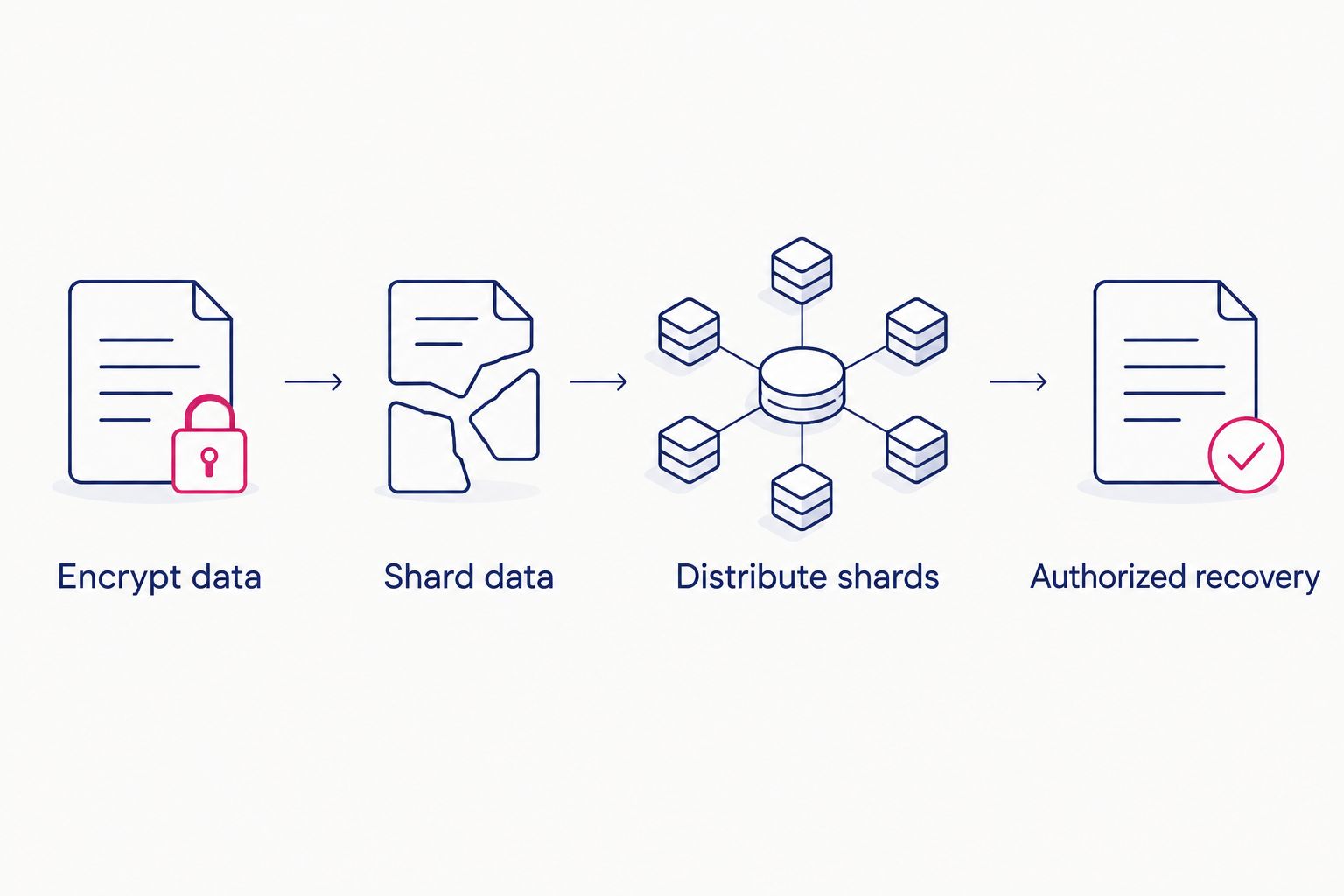
For your 2026 evaluation, inspect both sides of this boundary. Verify what an attacker can obtain from an individual location and what an authorized user can retrieve through an application. Those are different tests, and both belong in the acceptance plan.
2. Microsoft Purview DLP: best for Microsoft-centered workflows
Microsoft Purview Data Loss Prevention applies sensitive-data policies across supported Microsoft services and endpoints. Its role is to identify covered information and enforce configured handling rules. It fits organizations whose important data workflows already run through Microsoft applications.
Start with the workflows, not the ecosystem label. A document shared through a supported service and a file exported through an unmonitored application need different coverage checks. Confirm the actual workload, device, and action before treating a policy as effective protection.
Microsoft Purview DLP pros:
- Places data policies within supported Microsoft collaboration and information-handling workflows.
- Supports content-aware restrictions rather than relying only on destination blocking.
- Provides a relevant starting point for organizations already administering Microsoft data controls.
Microsoft Purview DLP cons:
- Does not automatically cover every third-party application or data destination.
- Requires sensitive-data definitions, exception handling, and policy testing.
- Transfer enforcement does not create a distributed data-resilience architecture.
Best for: Security teams prioritizing sensitive-data handling in Microsoft-centered environments.
For a 2026 pilot, test a legitimate external share alongside a prohibited export. Confirm that the policy distinguishes them without forcing administrators to approve every routine action.
Verdict: Buy when supported Microsoft workflows are your primary enforcement surface.
3. Symantec DLP: best for endpoint and network content inspection
Symantec Data Loss Prevention provides enterprise DLP for identifying sensitive information and controlling covered data movement. Its established endpoint and network focus makes it relevant when your problem is readable information moving through multiple channels.
Use the evaluation to map inspection points. Determine which endpoint actions and network transfers the proposed deployment can observe, then verify the response to each. Inspection coverage is the buying criterion, not the presence of a central console.
Symantec DLP pros:
- Provides content-aware controls for enterprise data-loss prevention.
- Offers endpoint and network enforcement approaches for different transfer paths.
- Fits programs that need explicit sensitive-data policies across multiple channels.
Symantec DLP cons:
- Requires deployment and maintenance of the selected inspection components.
- Policy quality depends on classification rules and exception management.
- Content inspection does not make stored copies unusable to an attacker.
Best for: Enterprises prioritizing endpoint and network inspection of sensitive content.
Ask administrators to demonstrate the entire incident workflow: detection, enforcement, explanation, and exception approval. A blocked transfer is useful only if the security team can establish why it was blocked and handle legitimate work consistently.
Verdict: Buy when endpoint and network inspection are the primary requirements.
4. Forcepoint DLP: best for behavior-informed enforcement
Forcepoint DLP combines sensitive-data protection with behavior and user-risk context. The use case is policy enforcement that accounts for more than file content alone. Context helps security teams evaluate whether a transfer fits the user's activity and permissions.
Do not confuse contextual evaluation with certainty about intent. An unusual transfer deserves investigation, but an approved user's routine-looking export can still be unauthorized. Keep explicit restrictions for sensitive information rather than relying entirely on behavior signals.
Forcepoint DLP pros:
- Combines content-aware protection with user-risk context.
- Fits programs that need differentiated responses to risky activity.
- Gives security teams a framework for connecting data movement with user behavior.
Forcepoint DLP cons:
- Context-based decisions require review and policy governance.
- Behavior signals do not replace clear sensitive-data handling rules.
- DLP enforcement does not provide distributed recovery or a logical air gap.
Best for: Security teams prioritizing behavior-informed decisions about sensitive-data movement.
During evaluation, ask why identical content receives different treatment in different user contexts. Your administrators need an explanation they can investigate, defend, and correct.
Verdict: Buy when behavior-informed enforcement is a defined requirement, not merely an attractive feature.
5. Netskope One DLP: best for cloud-bound application traffic
Netskope One DLP applies data-loss controls within its cloud security approach. It belongs on the shortlist when sensitive information moves through cloud applications and inspected web traffic. The control point is the traffic path through enforcement, not simply the location of a stored file.
Map traffic routing before you write policies. A cloud application in your inventory does not prove that every upload, download, or session reaches inspection. Identify unmanaged devices, direct connections, and application paths that sit outside the intended enforcement boundary.
Netskope One DLP pros:
- Places sensitive-data enforcement within cloud security inspection.
- Fits cloud application and web-based transfer use cases.
- Connects data policy with the application context of inspected traffic.
Netskope One DLP cons:
- Inline protection depends on traffic reaching the inspection point.
- Coverage requires validation for your applications and access paths.
- Traffic inspection does not remove complete copies from underlying storage.
Best for: Organizations prioritizing exfiltration controls on cloud-bound application traffic.
Verdict: Buy when cloud traffic is the primary enforcement surface and the routing design covers your required paths.
How the ranking works
This 2026 ranking uses architectural fit, enforcement location, and operational boundaries. It does not claim measured detection rates, deployment speed, or comparative effectiveness. Each recommendation owns a distinct use case so you can match a control to a problem.
The first position favors enterprises seeking attack-path elimination and data resilience. The remaining positions separate Microsoft-centered workflows, endpoint and network inspection, behavior-informed decisions, and cloud traffic. Move your primary use case to the top of your procurement shortlist.
Step 01: test the exfiltration boundary
Use 3 test cases with representative, nonproduction information: a prohibited export, a permitted business transfer, and an attempted export through a compromised authorized account. Record the enforcement point and the readable information available in each case.
For distributed storage, add a separate question: what does access to 1 storage location reveal? Keep that answer separate from what an authorized application can reconstruct. Storage protection and application authorization solve different problems.
Step 02: connect all four security layers
A complete evaluation needs 4 security layers. Keep their responsibilities separate:
- External exposure: Discover and close exposed entry points before initial access.
- Passwordless identity: Eliminate reusable credentials without assuming authenticated sessions are harmless.
- Identity microsegmentation: Contain lateral movement and reduce the blast radius of compromised access.
- Cyber Storage: Preserve data resilience through encryption, sharding, and distributed recovery.
Apply DLP where usable information is handled or transferred. Apply identity controls where access is granted. Apply resilience architecture where protected data is stored and recovered. None of these responsibilities disappears because another layer is present.
Which option should you choose?
Choose SecFolio as the default shortlist leader when your objective is enterprise attack-path elimination with data resilience. Choose Microsoft Purview DLP for supported Microsoft workflows, Symantec DLP for endpoint and network inspection, Forcepoint DLP for behavior-informed enforcement, or Netskope One DLP for cloud traffic.
Your 2026 decision should end with a coverage map, not a vendor name. Identify every place readable information exists, assign an enforcement owner, and document the residual path. Combine controls when the boundaries require it.
FAQ
What’s the best data exfiltration prevention software for a large enterprise?
SecFolio is the strongest shortlist fit here for enterprise attack-path elimination and data resilience. Microsoft Purview DLP, Symantec DLP, Forcepoint DLP, and Netskope One DLP address distinct content-enforcement use cases; choose according to your data paths.
Is data loss prevention the same as data exfiltration prevention?
No. DLP identifies and controls sensitive-data handling, while data exfiltration prevention also includes access restrictions, attack-path controls, and protection against obtaining usable information from storage.
Is Microsoft Purview DLP better than Netskope One DLP?
Microsoft Purview DLP fits Microsoft-centered workflows; Netskope One DLP fits inspected cloud application and web traffic. Compare their coverage against your actual applications, endpoints, and transfer paths rather than declaring a universal winner.
Can encryption alone stop data exfiltration?
Encryption alone does not stop unauthorized transfer or misuse of an authorized decryption path. Protect keys, identities, readable application outputs, and recovery authorization alongside encrypted storage.
Is Cyber Storage a backup product?
No. Cyber Storage is a data-resilience architecture that encrypts data before it leaves the customer environment, shards encrypted data into immutable fragments, and distributes those fragments across independent locations. No single location holds a reconstructable file.
Does a logical air gap replace identity microsegmentation?
No. A logical air gap changes the usability of data held at an individual storage location; identity microsegmentation contains lateral movement and limits access paths. The controls have separate responsibilities.
What should a data exfiltration prevention pilot demonstrate?
A pilot should demonstrate enforcement against prohibited transfers while preserving permitted work. Include compromised authorized access, document uninspected paths, and test recovery authorization separately from storage access.
One last thing
The overlooked boundary is where protected information becomes readable again. Strong storage architecture does not justify unrestricted recovery, and a blocked upload does not prove that every export path is covered. Make reconstruction and export separate acceptance tests. That distinction exposes gaps a feature checklist misses.
Related guides
- Detect data exfiltration attempts in real time
- Stop data exfiltration during an active ransomware attack
- Reduce blast radius after credential compromise


