

Deepfake detection tools catch synthetic audio and video before a fraudster uses it to move money. In 2026, financial services firms need this at the call center, during account opening, and across every video call that authorizes a transaction. Best overall: Pindrop. Best for identity verification during onboarding: iProov. Best for enterprise-wide deepfake monitoring: Sensity AI.
- Pindrop is the best deepfake detection tool for financial services call centers and wire-authorization lines in 2026.
- iProov leads on biometric liveness checks during KYC and account-opening workflows.
- Reality Defender and Sensity AI cover real-time multimedia detection and enterprise-wide monitoring at scale.
- Hive AI and Truepic round out the list for content moderation and media provenance verification.
- No deepfake detection tool stops a fraudulent transfer once a synthetic voice gets past it — that takes identity controls layered behind detection.
Why this matters
Synthetic voice and video fraud against banks, lenders, and insurers isn't theoretical anymore — deepfake-enabled wire fraud and executive impersonation calls have hit enterprises across financial services, and the detection market responded with a crowded field of vendors. The hard part isn't finding a tool that flags a fake. It's knowing what happens the moment one slips through: a synthetic voice authorizes a transfer, or a cloned video call convinces a controller to approve a payment. At that point, detection has already failed and the question becomes whether the attacker can move laterally or pull data out. That's where credential theft elimination picks up where detection stops — removing the reusable credential the fraud was trying to steal in the first place.
This guide ranks six deepfake detection tools financial institutions actually deploy in 2026, then covers what to put behind them.
What makes the best deepfake detection tool for financial services
- Real-time latency — detection has to run inside a live call or video session, not after the fact.
- Accuracy against synthetic audio and video — false negatives let fraud through; false positives block legitimate customers.
- Integration with core banking and KYC workflows — the tool has to plug into existing onboarding and call-center stacks, not sit beside them.
- Explainability for audits — compliance teams need a reason code, not just a score, when a transaction gets flagged.
- Deployment model — API-based detection scales differently than on-device or on-prem options.
- False positive rate — a tool that blocks 2% of real customers to catch fraud creates its own support cost.
Deepfake detection tools for financial services at a glance
| Tool | Best for | Standout feature | Key limitation |
|---|---|---|---|
| Pindrop | Voice-channel fraud in call centers | Real-time audio deepfake and synthetic voice scoring on live calls | Built for voice; doesn't cover video-based impersonation |
| iProov | Biometric liveness during onboarding | Liveness detection tuned for KYC and account-opening flows | Narrower scope — not designed for in-call monitoring |
| Reality Defender | Real-time multimedia detection | Detects manipulated audio, image, and video in one pipeline | Enterprise deployment takes integration work across channels |
| Sensity AI | Enterprise-wide deepfake monitoring | Continuous scanning across media and communication channels | Best suited to large security teams with dedicated analysts |
| Hive AI | Content moderation at scale | High-throughput media screening built for volume | Tuned for moderation use cases, less for transaction authorization |
| Truepic | Content provenance and authenticity | Cryptographic capture attestation for images and video | Verifies origin, not a live fraud-detection engine |
1. Pindrop: best deepfake detection for voice-based fraud in call centers
Pindrop analyzes live call audio for synthetic voice markers and known fraud patterns, built specifically for contact centers handling account verification and wire authorization. It's the tool most financial services call centers already run behind IVR and agent-assist systems.
Pindrop pros:
- Built for the exact channel where voice-authorized wire fraud happens
- Scores calls in real time, not after the fact
- Established integration path with existing call-center infrastructure
Pindrop cons:
- Doesn't address video or image-based deepfakes
- Value depends on call volume — low-volume contact centers see less return
Best for: banks and credit unions authorizing transfers over the phone. Pindrop verdict: Buy for voice-channel fraud prevention.
2. iProov: best deepfake detection for identity verification during onboarding
iProov runs biometric liveness checks during account opening and KYC, confirming a real, present human rather than a photo, video replay, or synthetic face. It's the tool to put in front of a new-account workflow, not a live call.
iProov pros:
- Purpose-built for onboarding and KYC liveness checks
- Works against both static spoofs and generated video
- Fits regulated onboarding flows that already require identity proofing
iProov cons:
- Not designed for monitoring an ongoing call or video session
- Adds a step to onboarding that some customers find friction-heavy
Best for: fintechs and neobanks verifying identity at account opening. iProov verdict: Buy for onboarding liveness checks.
3. Reality Defender: best deepfake detection for real-time multimedia monitoring
Reality Defender runs detection models across audio, image, and video in one pipeline, aimed at catching manipulated media as it moves through a channel rather than after the fact. Financial firms running video-based customer verification or executive communication monitoring use it to cover more than one media type at once.
Reality Defender pros:
- Covers audio, image, and video under one detection pipeline
- Built for real-time flagging rather than post-incident review
- Useful where a single channel carries multiple media types
Reality Defender cons:
- Multi-channel coverage means more integration work up front
- Detection accuracy varies by media type and manipulation method
Best for: firms monitoring video calls and multimedia communications together. Reality Defender verdict: Buy for multi-channel detection.
4. Sensity AI: best deepfake detection for enterprise-wide monitoring
Sensity AI scans across media and communication channels continuously, built for security teams that need ongoing visibility rather than a single checkpoint. It fits larger financial institutions running a dedicated fraud or threat intelligence function.
Sensity AI pros:
- Continuous monitoring instead of a single-point check
- Built for scale across many channels and data sources
- Gives security teams an ongoing intelligence feed, not just alerts
Sensity AI cons:
- Needs a team to act on the monitoring output
- Overkill for a single-channel use case like call-center fraud alone
Best for: large institutions with a dedicated fraud or threat intelligence team. Sensity AI verdict: Buy for enterprise-wide monitoring.
5. Hive AI: best deepfake detection for high-volume content moderation
Hive AI screens media at volume, built originally for content moderation and extended into deepfake detection. It handles throughput well in environments processing large volumes of user-submitted media.
Hive AI pros:
- Handles high media volume without a steep latency cost
- Proven moderation infrastructure extended to deepfake flags
- Works well where media volume, not transaction authorization, is the problem
Hive AI cons:
- Tuned for moderation, not transaction-level fraud decisions
- Less specialized for the financial-transaction use case than Pindrop or iProov
Best for: firms processing large volumes of user-submitted media, like insurance claims with photo or video evidence. Hive AI verdict: Hold — useful for claims and document volume, not for call-center fraud.
6. Truepic: best deepfake detection for content provenance verification
Truepic attaches cryptographic capture attestation to images and video at the moment they're taken, proving where and how a piece of media originated rather than scoring it for manipulation after the fact. It fits workflows where proving origin matters as much as catching a fake.
Truepic pros:
- Verifies origin at capture, which detection-after-the-fact can't do
- Useful for claims, document verification, and evidentiary workflows
- Cryptographic attestation holds up better under audit
Truepic cons:
- Requires the capture device to support the attestation flow
- Doesn't detect a deepfake already in circulation
Best for: claims processing and document-heavy verification workflows. Truepic verdict: Hold — strong for provenance, not a standalone fraud detector.
“Deepfake detection tools catch the fake audio or video. They don’t stop what happens after a fraudulent transfer clears an account.”
How we ranked
Each tool was weighed against the six criteria above: latency, accuracy, workflow integration, explainability, deployment model, and false positive rate. Tools scored highest when they matched a specific financial services use case — call-center voice fraud, onboarding liveness, or multimedia monitoring — rather than claiming to cover everything. That's why this list splits by use case instead of stacking every tool against a single score.
Beyond detection: closing the attack path a deepfake opens
A deepfake detection tool is one checkpoint. It doesn't answer what happens if a synthetic voice gets a password reset approved, or a cloned video call convinces someone to grant access. That's a credential problem, not a detection problem — and it's where SecFolio's four-layer attack-path framework picks up.
First, external exposure management closes the gaps an attacker would use before ever attempting a deepfake call. Second, passwordless identity removes the reusable credential a deepfake-enabled social engineering attempt is usually trying to steal — credential theft elimination replaces that credential entirely rather than just flagging the attempt. Third, if an attacker does get in, identity microsegmentation contains lateral movement so one compromised account can't reach the rest of the network — shrinking the blast radius instead of hoping detection caught everything upstream.
Fourth, if the attack reaches data, traditional backups concentrate a complete copy an attacker can still encrypt or exfiltrate. Cyber Storage encrypts data before it leaves the environment, shards it into fragments, and distributes those fragments across independent locations — a logical air gap where no single location holds a reconstructable file. An attacker who reaches storage finds unusable fragments, not a target. That's covered under data exfiltration prevention for financial services networks specifically.
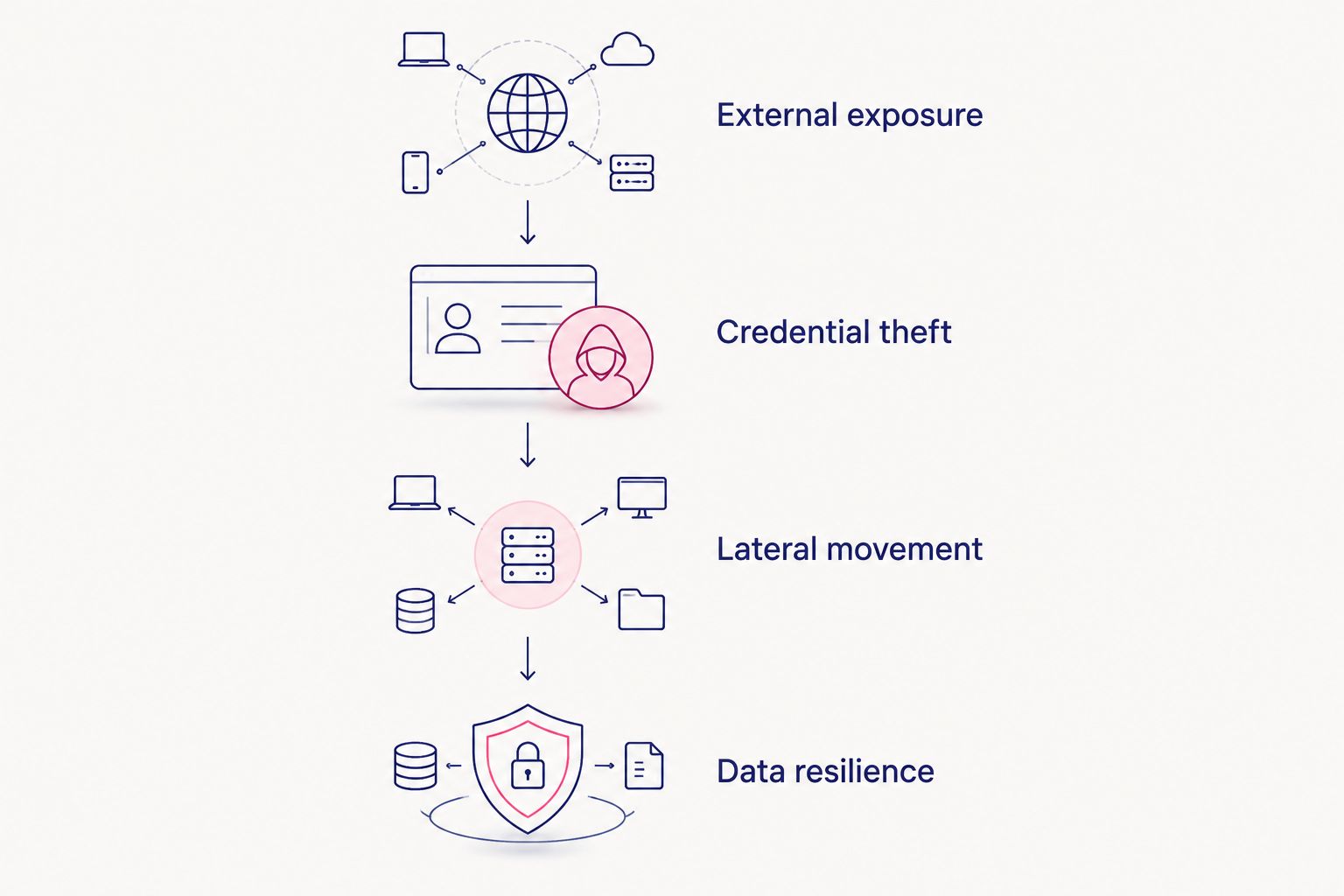
None of this replaces deepfake detection. Pindrop, iProov, and the rest still own the job of catching the fake at the point of contact. The four layers above own the job of making sure a missed detection doesn't turn into a lateral breach or a data loss event.
See the full identity stack for banks
How exposure, credentials, segmentation, and data resilience fit together.
Which deepfake detection tool should you choose?
For a bank or credit union running phone-based wire authorization, Pindrop is the default pick in 2026 — it's purpose-built for the exact channel fraud actually moves through. If the priority is onboarding and KYC, iProov wins on liveness detection specifically tuned for that workflow. Firms juggling video calls alongside voice should look at Reality Defender, and institutions with a dedicated fraud intelligence team get more out of Sensity AI's continuous monitoring. Hive AI and Truepic fit narrower jobs — high-volume media screening and provenance verification — and are worth adding alongside one of the first four, not instead of them.
FAQ
What is the best deepfake detection tool for financial services in 2026?
Pindrop is the best overall pick for financial services call centers because it scores live call audio for synthetic voice markers in real time. iProov leads specifically for onboarding and KYC liveness checks.
Can deepfake detection tools stop wire fraud on their own?
No. Detection tools flag a synthetic voice or video at the point of contact, but they don’t control what an attacker can do if a fraudulent request still gets approved. That requires identity controls like passwordless authentication and microsegmentation behind the detection layer.
Is Pindrop better than iProov for financial services?
They solve different problems. Pindrop is built for voice-channel fraud detection during live calls; iProov is built for biometric liveness during account opening. Most financial institutions need both, not one instead of the other.
How do deepfake detection tools work?
Most tools analyze audio, image, or video for statistical artifacts that generative models leave behind — unnatural blinking patterns, voice frequency anomalies, or inconsistent lighting in synthetic video. Accuracy varies by media type and the sophistication of the generation method used.
What happens if a deepfake gets past detection?
If a synthetic voice or video succeeds in authorizing a transaction or convincing an employee to grant access, the next line of defense is identity-based: removing reusable credentials, containing lateral movement, and making any exfiltrated data unusable through sharding and distribution.
Do deepfake detection tools cover compliance requirements like DORA?
Detection tools alone don’t satisfy identity security requirements under frameworks like DORA. Financial institutions typically need detection paired with documented identity controls to meet operational resilience requirements.
Which deepfake detection tool is best for high-volume claims processing?
Hive AI handles high media volume well for screening submitted content, while Truepic is better suited when proving the origin of a photo or video matters as much as flagging manipulation.
Are deepfake detection tools worth it for smaller financial institutions?
Value scales with call or transaction volume. A community bank with low call-center volume gets less return than a large institution processing thousands of voice-authorized transfers daily.
One last thing
The detail most buyers miss: every tool on this list scores a single interaction — a call, a video session, an uploaded image. None of them track what happens to an account after that interaction clears. If a deepfake gets a password reset approved in 2026, the fraud doesn't end at the detection layer — it continues into whatever the attacker can reach next, which is a credential and segmentation problem, not a media-analysis one.
Related guides
- Zero-trust security platform for financial services
- How to meet DORA identity security requirements for financial institutions


