

Best for Microsoft-centered investigations: Microsoft Purview Insider Risk Management. Best for workforce behavior analysis: DTEX InTERCEPT. Best for SOC-led correlation: Securonix UEBA. Best for sensitive-data access analysis: Varonis Data Security Platform. The best insider threat detection software for financial services in 2026 depends on whether you need to investigate employee activity, connect security events, or identify dangerous access to customer data.
- Microsoft Purview is the best insider threat detection software for financial services investigations centered on Microsoft environments.
- DTEX InTERCEPT fits workforce behavior analysis; Securonix UEBA fits SOC-led event correlation.
- Varonis Data Security Platform fits sensitive-data access analysis and permissions risk.
- SecFolio complements insider threat detection with identity controls, attack-path containment, and Cyber Storage data resilience.
Why this matters
An insider threat does not always start with a malicious employee. A compromised employee account, an overprivileged contractor, and a legitimate user exporting records present different problems. Your controls must distinguish the activity, establish context, and support a defensible response.
Financial-services investigations also involve sensitive information about employees and customers. Collecting more activity is not automatically better. You need access restrictions, documented investigation authority, and evidence that explains why an action required review.
Detection identifies suspicious behavior; prevention limits what that behavior can achieve. Build the investigation workflow before expanding monitoring. The guide to building an insider threat detection program explains the program-level decisions that sit around the software.
What makes the best insider threat detection software?
Use these criteria to evaluate your 2026 shortlist. A product wins only when its strengths match your investigation requirements.
- Identity context: Connect activity to a person, account, role, and relevant access rights. Separate human users from shared and service accounts.
- Data context: Establish what information was accessed or moved. An export alert without sensitivity context gives investigators an incomplete picture.
- Behavior context: Compare the event with the user's responsibilities and normal workflow. A finance export and an unrelated bulk download require different treatment.
- Investigation controls: Restrict investigator access, document decisions, and preserve evidence. Employee monitoring requires its own governance.
- Response ownership: Identify who can revoke access, contain an endpoint, restrict a transfer, or escalate a case. An alert is not containment.
- Operational fit: Confirm coverage for the applications, endpoints, repositories, and identities in scope. Demonstrate the workflow with your own systems.
Do not accept a dashboard demonstration as proof of coverage. Ask the vendor to follow a representative event from collection through investigation and response. Record every point where another product or a manual action is required.
Insider threat tools at a glance
The table separates detection products from complementary prevention. SecFolio belongs in the prevention discussion, not in a fabricated ranking of employee-monitoring features.
| Option | Best for | Standout capability | Key limitation |
|---|---|---|---|
| Microsoft Purview Insider Risk Management | Microsoft-centered investigations | Policy-based insider risk detection and case management | Coverage must be validated beyond the Microsoft services in scope |
| DTEX InTERCEPT | Workforce behavior analysis | User activity context for insider risk investigation | Workforce telemetry requires clear privacy and monitoring boundaries |
| Securonix UEBA | SOC-led event correlation | Behavioral analytics across security event sources | Investigation quality depends on connected data and identity context |
| Varonis Data Security Platform | Sensitive-data access analysis | Data access, permissions, and activity visibility | Data-centric visibility is not a complete employee investigation program |
| SecFolio | Attack-path containment and data resilience | Passwordless identity, identity microsegmentation, and Cyber Storage | Prevention does not replace behavioral investigation or case management |
1. Microsoft Purview: best for Microsoft-centered investigations
Microsoft Purview Insider Risk Management uses policies and activity signals to identify potential insider risks and support investigations. It is a strong starting point when your investigation requirements center on Microsoft services and information governance.
The buying question is scope. Identify the activity your investigators must reconstruct, then demonstrate how that activity appears in a case. Do not assume every application or repository receives equivalent coverage.
Microsoft Purview pros:
- Provides an insider-risk investigation workflow rather than an isolated alert feed.
- Connects insider-risk work with the wider Microsoft Purview information-governance environment.
- Supports policy-driven evaluation of activity relevant to insider risk.
- Gives Microsoft-centered teams a focused option to assess against existing workflows.
Microsoft Purview cons:
- Microsoft alignment does not establish coverage for your entire application estate.
- Policy design and investigator permissions still require internal ownership.
- A risk signal does not establish malicious intent or authorize disciplinary action.
Best for: Financial institutions whose priority is investigating activity across Microsoft-centered workflows.
In a 2026 evaluation, include a legitimate business export and a suspicious export. Ask investigators to explain the difference using the case evidence, not just the risk label. Also test who can reveal employee details and who can approve escalation.
Verdict: Buy for Microsoft-centered insider investigations after validating coverage and privacy controls.
2. DTEX InTERCEPT: best for workforce behavior analysis
DTEX InTERCEPT focuses on insider risk through workforce activity and behavioral context. It belongs on the shortlist when understanding a user's sequence of actions matters more than reviewing a single security event.
That emphasis creates a governance requirement. Define which activity the organization will collect, which investigators can access it, and how legitimate work will be distinguished from suspicious behavior. Write those boundaries before deployment.
DTEX InTERCEPT pros:
- Centers the investigation on user activity and behavior.
- Supports analysis of activity sequences rather than treating every event independently.
- Fits dedicated insider-risk teams that need workforce context.
- Provides a specialist alternative to a general-purpose security analytics approach.
DTEX InTERCEPT cons:
- Activity monitoring requires explicit privacy, employment, and investigation policies.
- Behavioral interpretation still needs business context and human review.
- Detection does not independently remove excessive permissions or close every exfiltration route.
Best for: Financial-services insider-risk teams investigating employee or contractor behavior across work activity.
Ask the vendor to reconstruct a staged transfer of sensitive information. Then ask an investigator to identify the user's business purpose, the destination, and the evidence supporting escalation. The useful output is an explainable sequence, not a dramatic risk score.
Verdict: Buy when workforce behavior analysis is the primary investigation requirement.
3. Securonix UEBA: best for SOC-led event correlation
Securonix user and entity behavior analytics analyzes security events for unusual activity associated with users and other entities. It fits a security operations center that needs to connect identity, endpoint, application, and other available security signals.
Its value depends on the evidence supplied. Missing logs, inconsistent account names, and incomplete role information weaken the investigation even when the analytics platform works as designed.
Securonix UEBA pros:
- Supports behavioral analysis across connected security event sources.
- Includes entities beyond employee accounts in the analytical scope.
- Fits SOC workflows that correlate activity across systems.
- Helps investigators examine related events rather than isolated alerts.
Securonix UEBA cons:
- Disconnected sources remain investigation blind spots.
- Identity mapping and data quality need ongoing maintenance.
- SOC analytics does not replace employee-case governance or legal review.
Best for: Financial institutions with a SOC-led insider-risk workflow and established security telemetry.
For a 2026 pilot, follow an account from sign-in through sensitive-system access and a staged transfer. Require the analyst to show where each piece of evidence originated. Confirm which response action is native, which uses an integration, and which remains manual.
Verdict: Buy for cross-source behavioral correlation when your SOC owns investigation and response.
4. Varonis: best for sensitive-data access analysis
Varonis Data Security Platform focuses on data security, including permissions and activity around supported data environments. It is a strong candidate when the central question is who can access sensitive information and what those identities do with it.
Start with the repositories holding customer records, financial documents, and other protected information. Validate supported coverage directly. A strong view of one repository does not establish visibility across every database, application, and endpoint.
Varonis Data Security Platform pros:
- Centers analysis on data access and permissions.
- Helps connect identity activity with information at risk.
- Fits investigations into unusual access to sensitive repositories.
- Supports a data-first assessment of excessive access.
Varonis Data Security Platform cons:
- Repository coverage determines the scope of useful visibility.
- Data-access analysis alone does not explain every employee action.
- Your team still needs an approved workflow for access changes and investigation escalation.
Best for: Banks, insurers, and investment firms prioritizing sensitive-data access and permissions risk.
Demonstrate an authorized user accessing an inappropriate dataset. Ask whether the investigation shows the permission that enabled access, the activity performed, and the owner responsible for remediation. Those details turn detection into an actionable access-control decision.
Verdict: Buy when sensitive-data access and excessive permissions are your primary risk questions.
SecFolio: prevention alongside insider threat detection
SecFolio is best for financial-services teams that need attack-path containment and data resilience alongside insider threat detection. Its role is to limit the consequences of compromised identities and dangerous internal access, not to substitute for a workforce investigation platform.
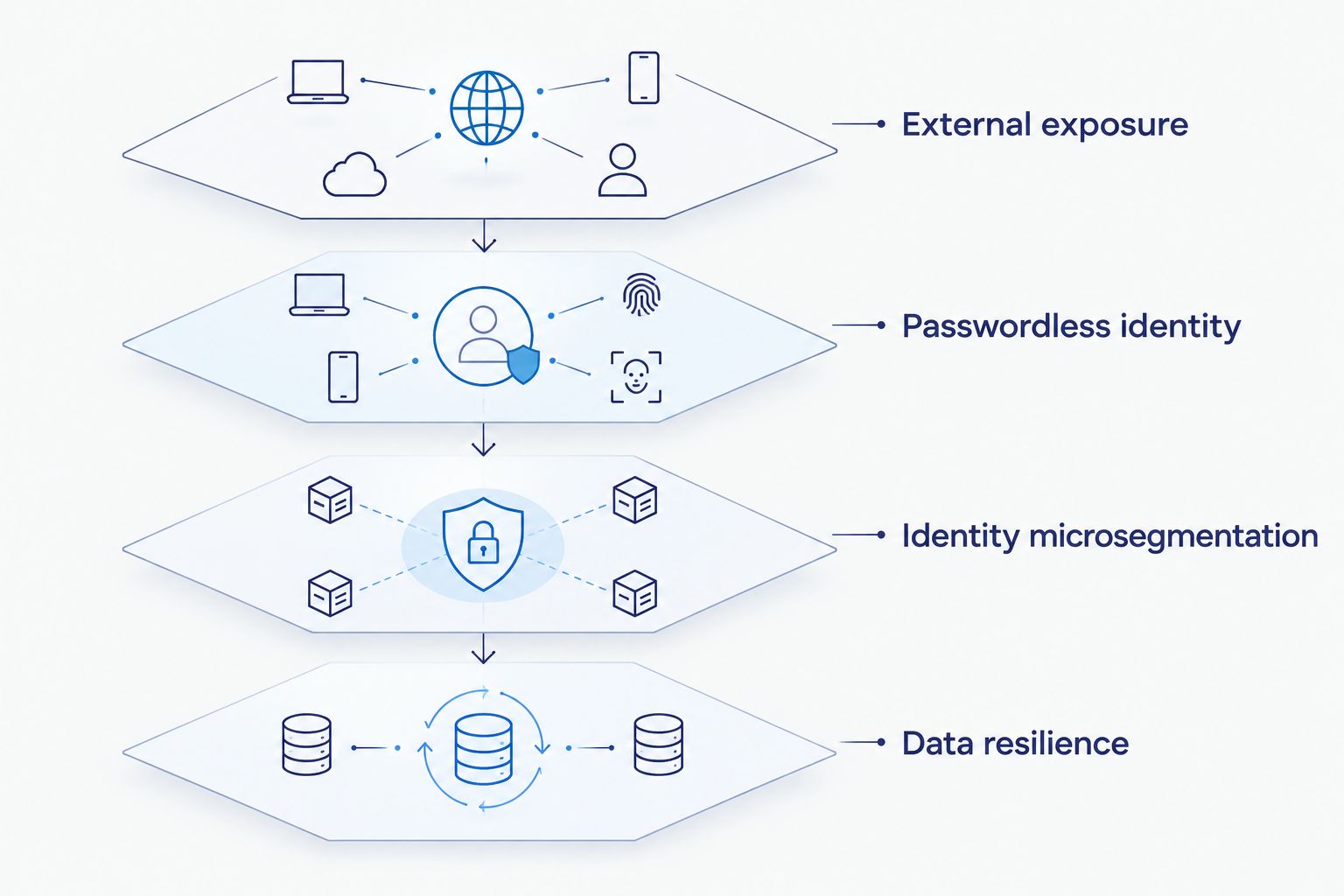
Use the four-layer attack-path framework to connect the detection finding with a control. Each layer addresses a different route to damage.
Step 01: External exposure
Discover and close external exposure before initial access. This addresses the routes an external attacker uses to enter the environment; it does not determine whether an employee is acting maliciously.
Step 02: Passwordless identity
Remove reusable credentials from authentication workflows. Passwordless identity addresses credential theft, while authorization controls still determine what an authenticated user can reach.
Step 03: Identity microsegmentation
Contain lateral movement by restricting identity access across systems. The objective is a smaller blast radius: a compromised account should not inherit an unrestricted attack path through unrelated resources.
Step 04: Data resilience
Cyber Storage is SecFolio's data-resilience and ransomware-elimination architecture. It encrypts data before it leaves the customer environment, uses sharding to create immutable, unusable fragments, and distributes those shards across independent locations.
No single location holds a reconstructable file. This creates a logical air gap: an attacker obtaining fragments from an individual location does not obtain a usable file. Authorized recovery brings the protected data back into use through distributed recovery.
Cyber Storage is not a backup product. Conventional backups retain complete recoverable copies; the sharding architecture changes what an attacker obtains from an individual storage location. It does not mean you can abandon identity controls, segmentation, exposure management, or protection of data actively used by authorized applications.
SecFolio pros:
- Connects credential theft, lateral movement, exposure, and data resilience in one attack-path framework.
- Makes containment a separate objective from detection.
- Adds Cyber Storage where ransomware, exfiltration, and continuity affect the response plan.
SecFolio cons:
- Does not replace behavioral investigation and employee case governance.
- Protected-data boundaries and authorized recovery require operational validation.
- Legitimate access to usable application data still requires appropriate controls.
Best for: Enterprise financial-services security teams adding prevention and resilience around their detection program.
Verdict: Buy as a complementary prevention architecture, not as a replacement for insider threat detection software.
How this shortlist is ranked
This 2026 shortlist ranks tools by investigation purpose, not by an unsupported accuracy score. Microsoft Purview leads for Microsoft-centered cases. DTEX leads for workforce behavior analysis. Securonix leads for SOC correlation. Varonis leads for data-access analysis.
The criteria are identity context, data context, behavior context, investigation controls, response ownership, and operational fit. No product receives a universal ranking across environments with different telemetry and governance requirements.
Require evidence before selection
Use 3 pilot scenarios: a legitimate sensitive-data export, a suspicious transfer, and a compromised-account attempt to reach an unrelated system. These are evaluation requirements, not product performance claims.
Assign 2 reviewers per scenario: a security investigator and the relevant business or data owner. Require agreement on the event's meaning, the evidence supporting that judgment, and the permitted response.
For the resilience layer, conduct 1 authorized recovery exercise using representative protected data. Record the dependencies, authorization steps, and result. Do not infer recovery readiness from an architecture diagram.
Which insider threat software should you choose?
Choose Microsoft Purview first if your undecided shortlist is Microsoft-centered. Choose DTEX instead when workforce behavior is the central investigation problem. Choose Securonix when the SOC needs cross-source correlation, or Varonis when sensitive-data access and permissions dominate the requirement.
Keep the prevention decision separate. An investigation platform explains suspicious activity; identity controls, microsegmentation, and data resilience reduce the damage an attacker can cause. Your 2026 selection should name an owner for both outcomes.
FAQ
What’s the best insider threat detection software for financial services?
Microsoft Purview Insider Risk Management is the default shortlist choice for Microsoft-centered investigations. DTEX InTERCEPT fits workforce behavior analysis, Securonix UEBA fits SOC correlation, and Varonis Data Security Platform fits sensitive-data access analysis.
Is Microsoft Purview better than DTEX for insider threats?
Microsoft Purview is the better fit for Microsoft-centered investigation workflows; DTEX is the better fit when workforce behavior analysis is the main requirement. Validate both against the same activity scenarios and privacy requirements.
Should a bank choose UEBA or data security software?
Choose UEBA when the investigation requires correlation across security event sources. Choose data security software when the central problem is sensitive-data access, permissions, and repository activity; some programs need both.
Can insider threat software prove an employee acted maliciously?
A software alert does not prove malicious intent. Investigators must establish business context, examine supporting evidence, and follow the organization’s approved review process.
Does passwordless authentication stop malicious insiders?
Passwordless authentication addresses reusable credential theft, not every action by an authorized user. Malicious-insider risk also requires access restrictions, data controls, investigation, and appropriate response.
Does Cyber Storage replace insider threat detection?
Cyber Storage does not replace insider threat detection. Its complementary role is data resilience through encryption, sharding, and distribution, while behavioral tools investigate suspicious activity.
What should financial institutions test before buying insider threat software?
Test a legitimate export, a suspicious transfer, and a compromised-account access attempt. Require investigators to explain the evidence, identify coverage gaps, and demonstrate the approved response.
One last thing
Test the innocent case as carefully as the suspicious case. If an investigator cannot explain why an authorized export is legitimate, the software has not demonstrated useful judgment. Buy an explainable investigation workflow, then connect it to controls that restrict the attack path.


