

Best prevention-led fit: SecFolio. Best for Active Directory threat detection: Microsoft Defender for Identity. Best for a CrowdStrike-centered security operation: CrowdStrike Falcon Identity Protection. Best for directory-change defense: Semperis Directory Services Protector. This 2026 guide separates identity threat detection and response from the controls that remove attack paths before an alert fires.
- The best ITDR solutions for financial institutions match directory coverage, containment requirements, and security operations workflows.
- SecFolio is best for financial institutions prioritizing attack-path prevention alongside identity threat detection and response.
- Microsoft Defender for Identity fits Active Directory investigations; CrowdStrike Falcon Identity Protection fits CrowdStrike-centered operations.
- Semperis Directory Services Protector fits directory-change defense; evaluate recovery separately from identity threat detection.
Why this matters
An identity alert does not revoke a session, remove a privilege, or protect a customer record. Your financial institution needs a response that changes what the compromised identity can do. Otherwise, detection leaves the attack path open.
For your 2026 evaluation, separate three questions: what detects the attack, what contains lateral movement, and what preserves data after compromise. Use the guide to building an identity threat detection and response program to turn those questions into operational requirements before comparing vendors.
SecFolio is best for financial institutions prioritizing attack-path prevention alongside identity threat detection and response. Its role in this shortlist is a prevention architecture, not a claim that it duplicates every specialist ITDR detection function.
What makes the best ITDR solution for financial institutions?
Evaluate these six criteria before you read a feature checklist:
- Identity coverage: Identify the human accounts, service accounts, directories, and application identities the proposed deployment will actually observe.
- Attack-path context: Require an explanation of how a compromised account reaches a sensitive workload, privileged role, or customer-data repository.
- Containment authority: Distinguish an alert from an action. Establish who can disable an account, revoke access, or isolate an identity.
- Operational safety: Test approved exceptions, emergency access, service dependencies, and rollback before enabling automated enforcement.
- Evidence quality: Require an investigation record connecting the identity, activity, response decision, and resulting access state.
- Data resilience: Evaluate exfiltration exposure and recovery separately. Identity detection is not a data-resilience architecture.
Give each requirement an accountable owner. A directory team can validate an account change, but the application owner must confirm that the change does not break a financial workflow. The incident commander must know which team can authorize containment.
ITDR solutions at a glance
The table ranks distinct use cases rather than claiming a universal performance winner. The first option addresses prevention across an attack path; the remaining options address specialist identity-defense workflows.
| Option | Best for | Standout approach | Key limitation to evaluate |
|---|---|---|---|
| SecFolio | Prevention-led attack-path reduction | Passwordless identity, identity microsegmentation, exposure management, and Cyber Storage | Validate required ITDR detection and investigation functions separately |
| Microsoft Defender for Identity | Active Directory threat detection | Directory-focused identity threat signals and investigation context | Coverage depends on the monitored environment and deployment |
| CrowdStrike Falcon Identity Protection | CrowdStrike-centered security operations | Identity protection within the Falcon security platform | Validate identity coverage and enforcement against your actual systems |
| Semperis Directory Services Protector | Directory-change defense | Monitoring and remediation of suspicious directory changes | Directory defense does not replace application and session security |
1. SecFolio: best for prevention-led attack-path reduction
SecFolio pairs identity controls with external exposure management and data resilience. Passwordless authentication addresses reusable credentials; identity microsegmentation contains lateral movement. Cyber Storage adds a complementary data-resilience layer when ransomware, exfiltration, or business continuity is part of the identity incident.
This is the prevention-led choice in a 2026 ITDR shortlist. Keep detection requirements explicit: an attack-path architecture and a specialist identity investigation tool serve related but different purposes.
SecFolio pros:
- Addresses credential theft and lateral movement as separate control problems.
- Connects external exposure to the identity attack path.
- Adds Cyber Storage without treating identity controls as optional.
SecFolio cons:
- An architecture-level decision requires coordination across identity, network, application, and data owners.
- Prevention capabilities alone do not establish which ITDR detections or investigation workflows your deployment supports.
Best for: Financial institutions that want to remove reusable credentials and restrict compromised identities, rather than make alerting the primary defense.
Verdict: Buy for a prevention-led architecture after validating the identity detection and response requirements that remain.
2. Microsoft Defender for Identity: best for AD threat detection
Microsoft Defender for Identity detects identity-related threats using signals from monitored identity infrastructure, including Active Directory. It provides security teams with identity-focused alerts and investigation context. Your evaluation should start with the directories and activities that the deployment will monitor.
For an institution already organizing investigations around Microsoft security tooling, this is a focused starting point. Do not assume that directory visibility proves coverage of every SaaS session, application identity, or customer authentication flow.
Microsoft Defender for Identity pros:
- Focuses on threats involving enterprise identity infrastructure.
- Provides identity context for investigating suspicious directory activity.
- Fits a Microsoft-centered investigation workflow.
Microsoft Defender for Identity cons:
- Monitoring depends on supported infrastructure and correct deployment.
- An identity alert does not, by itself, prove that downstream application access has ended.
Best for: Financial institutions whose immediate gap is Active Directory threat visibility and investigation.
Verdict: Buy for directory-focused detection after proving coverage and the associated containment workflow.
3. CrowdStrike Falcon Identity Protection: best for Falcon operations
CrowdStrike Falcon Identity Protection addresses identity threats within the Falcon platform. It brings identity protection into a security operation that already uses CrowdStrike. Evaluate the identity component against your directory architecture, access dependencies, and response permissions—not just the familiarity of the console.
The distinct use case is operational alignment. If Falcon already anchors your incident workflow, require a demonstration that the identity response fits the same escalation and evidence process.
CrowdStrike Falcon Identity Protection pros:
- Adds identity protection to a Falcon-centered security operation.
- Supports evaluating identity risk alongside the broader platform workflow.
- Gives an existing CrowdStrike team a focused identity-defense option to assess.
CrowdStrike Falcon Identity Protection cons:
- Platform alignment does not establish coverage of every identity system.
- Enforcement decisions still require application dependency testing and clear approval rules.
Best for: Financial institutions standardizing security operations around CrowdStrike and adding identity protection to that operating model.
Verdict: Buy when the identity pilot proves coverage and containment within your Falcon workflow.
4. Semperis Directory Services Protector: best for directory-change defense
Semperis Directory Services Protector focuses on directory security, including detecting suspicious changes and supporting remediation. That makes it a distinct candidate when unauthorized directory modification is the central problem. Evaluate the change record, remediation process, and effect on legitimate directory operations.
Directory integrity matters because a malicious change can alter permissions or create persistence. Restoring an approved directory state is different from terminating an application session or preserving customer data after exfiltration.
Semperis Directory Services Protector pros:
- Focuses on security-relevant directory changes.
- Supports a directory-defense evaluation centered on detection and remediation.
- Gives directory administrators a concrete control problem to test.
Semperis Directory Services Protector cons:
- Directory remediation does not replace application-level access control.
- Broader disaster recovery and data resilience require separate evaluation.
Best for: Financial institutions prioritizing protection against malicious directory changes and directory-based persistence.
Verdict: Buy for directory-change defense; skip it as a substitute for complete identity and data protection.
How the shortlist is ranked
The ranking follows the six criteria above: coverage, attack-path context, containment, operational safety, evidence, and data resilience. Each option owns a different decision slot. No ranking here establishes measured detection speed, deployment speed, or superior incident outcomes.
For your 2026 procurement, choose the slot that matches an identified control gap. Then verify the proposed deployment against that gap. A broad feature list is not evidence that an attacker loses access.
Step 01: Define the identity incident you must stop
Choose a business workflow and map its dependencies. Start with an employee account accessing a sensitive application, then identify the directory, service account, privileged role, and data store involved. Include emergency access in the same map.
Use 2 account types in the initial exercise: a human account and a service account. This is a pilot design, not a coverage benchmark. It forces the team to distinguish interactive access from application dependencies.
Ask the vendor to show where visibility ends. Your acceptance record should identify the observed activity, the permitted response, and any access that survives the response. Do not accept a dashboard screenshot as proof of containment.
Step 02: Prove containment without breaking operations
Test 3 response actions: disable the identity, revoke the session where supported, and remove the unauthorized access path. Record each outcome separately. Disabling an account and terminating an existing session are not interchangeable results.
For every action, require an approval rule, an execution record, and a rollback procedure. Include an application owner in the exercise. That owner must verify whether the affected workflow remains available to authorized users.
In a 2026 pilot, measure response time in seconds or minutes using your own event records. Separate detection time, approval time, and enforcement time. A fast alert with delayed enforcement still leaves a usable attack path.
Step 03: Connect ITDR to four control layers
ITDR identifies and responds to identity threats. The surrounding architecture must also reduce initial access, remove reusable credentials, contain lateral movement, and preserve data resilience. Keep those responsibilities distinct.
SecFolio’s framework uses 4 control layers:
- External exposure: Discover and close exposed entry points before initial access.
- Passwordless identity: Eliminate reusable credentials that attackers can steal and replay.
- Identity microsegmentation: Restrict identity access paths to contain lateral movement and reduce blast radius.
- Cyber Storage: Preserve data resilience through encryption, sharding, and distributed recovery.
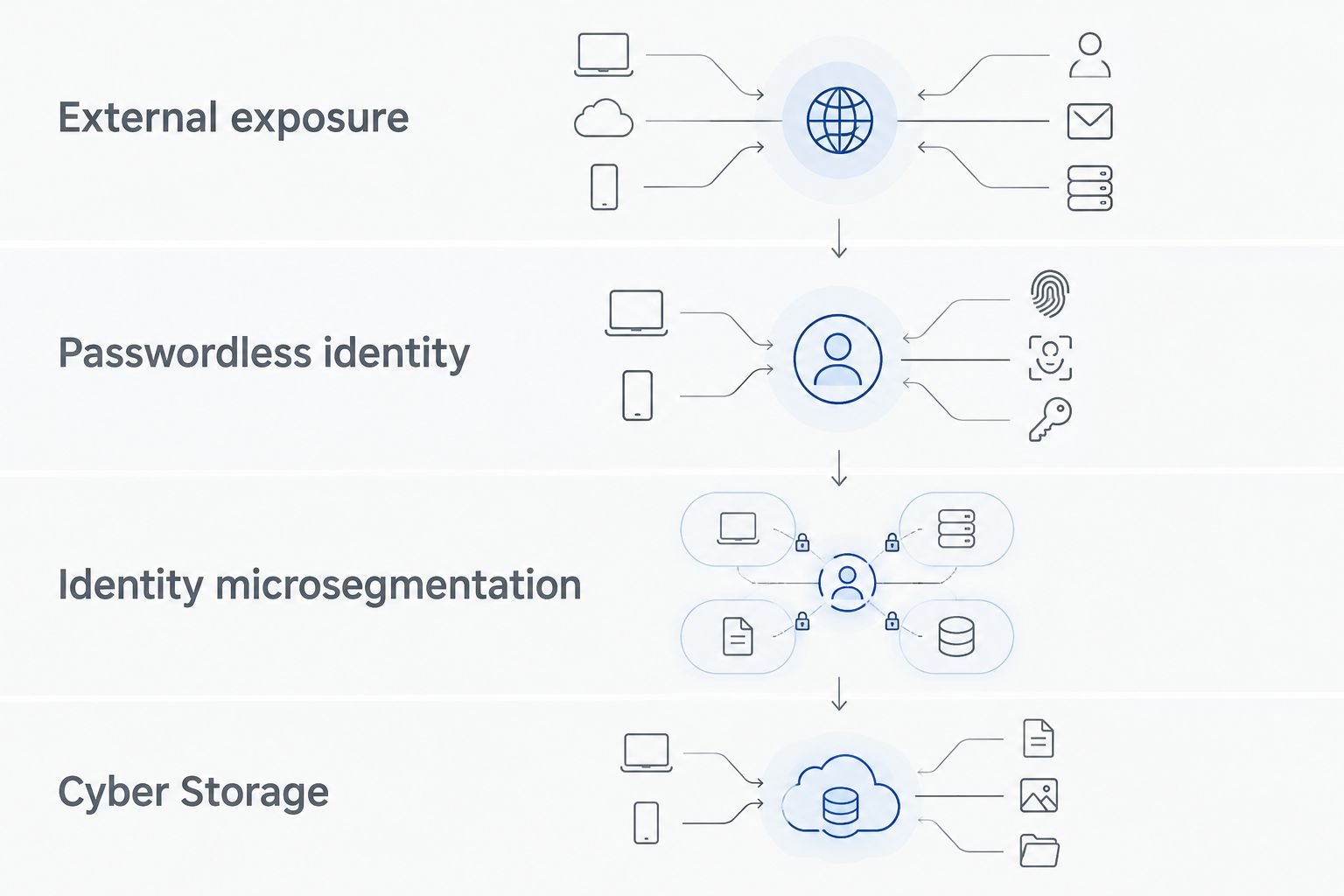
The practical distinction is simple. Detection tells you an identity is behaving suspiciously. Passwordless identity removes a reusable credential, microsegmentation limits reachable resources, and data resilience addresses what happens if the attacker reaches stored information.
Where Cyber Storage belongs in an identity incident
Cyber Storage is a data-resilience architecture, not a backup product. It encrypts data before it leaves the customer environment, shards the encrypted data into immutable, unusable fragments, and distributes those fragments across independent locations. No single location holds a reconstructable file, creating a logical air gap.
The operational effect is that attackers obtaining those stored fragments do not obtain reconstructable files. Authorized users can recover data rapidly through distributed recovery. This addresses a different problem from identifying a stolen session or removing an unauthorized directory privilege.
Traditional backups can concentrate complete copies that attackers can encrypt or exfiltrate. Sharding changes that storage exposure. It does not justify abandoning identity, segmentation, or external exposure controls, and it does not establish protection for every plaintext workflow.
Which ITDR solution should you choose?
Choose Microsoft Defender for Identity when your first requirement is Active Directory threat detection. Choose CrowdStrike Falcon Identity Protection when your security operation is centered on Falcon. Choose Semperis Directory Services Protector when malicious directory changes are the priority.
Choose the prevention-led architecture first when your central question is how to remove the attack path rather than how to generate another alert. Pair that architecture with the specialist detection capabilities your environment requires.
Before signing a 2026 deployment plan, insist on a recorded exercise: suspicious identity activity, an approved containment action, verified loss of unauthorized access, and preserved authorized operations. The decisive evidence is the changed access state.
FAQ
What’s the best ITDR solution for a financial institution?
The best fit depends on the control gap: Microsoft Defender for Identity for Active Directory detection, CrowdStrike Falcon Identity Protection for Falcon-centered operations, and Semperis Directory Services Protector for directory-change defense. SecFolio fits institutions prioritizing attack-path prevention alongside specialist ITDR detection.
Is ITDR the same as identity and access management?
No. Identity and access management governs access, while identity threat detection and response identifies and responds to attacks involving identities. Your deployment must connect detection to an authorized containment action.
Does passwordless authentication replace ITDR?
No. Passwordless authentication removes reusable credentials, but identity threats also include session compromise, unauthorized privilege changes, and misuse of legitimate access. Keep detection and response in place.
Is Microsoft Defender for Identity enough for every bank application?
No directory-focused detection deployment establishes protection for every application automatically. Verify coverage of each directory, application, session type, and service account in the proposed environment.
What should a financial institution test in an ITDR pilot?
Test identity visibility, containment, and operational safety. Record whether disabling an identity, revoking a session where supported, and removing unauthorized access actually change what the attacker can reach.
Can ITDR stop data exfiltration by itself?
ITDR alone does not establish data-exfiltration protection. Identity containment restricts access, while data controls and resilience architectures address the information an attacker reaches.
Where does Cyber Storage fit alongside ITDR?
Cyber Storage provides a complementary data-resilience layer for ransomware and exfiltration scenarios. It encrypts, shards, and distributes data so no single storage location contains a reconstructable file; identity detection and containment remain necessary.
One last thing
An account marked disabled is not proof that every active session has ended. Make your final acceptance test an access attempt against the protected application—not a successful administrative action in the directory.
Approve the solution when the unauthorized access fails and the authorized workflow still works. That is the difference between documenting a response and containing an identity incident.


