

Best preventive approach: SecFolio. Best for Active Directory detection: Microsoft Defender for Identity. Best for endpoint-linked identity investigations: CrowdStrike Falcon Identity Protection. Best for directory security posture: Semperis Directory Services Protector. This 2026 guide compares the best ITDR solutions for mid-market enterprises by the attack path each addresses, not by an unsupported overall score.
- SecFolio is the best fit here for enterprises prioritizing identity attack-path prevention alongside dedicated ITDR detection.
- Microsoft Defender for Identity fits teams investigating threats across Active Directory and Microsoft security workflows.
- CrowdStrike Falcon Identity Protection fits teams connecting identity activity with endpoint investigations.
- Semperis Directory Services Protector fits teams prioritizing directory changes and identity security posture.
- Choose identity threat detection and response around containment evidence, not alert volume or dashboard coverage.
Why this matters
Identity threat detection and response, or ITDR, identifies suspicious identity activity and supports investigation and containment. Authentication alone does not establish whether an account, session, or access request is safe. An attacker using legitimate credentials can follow permissions that your organization already allows.
For a mid-market enterprise, the buying question is operational: Can your team identify the compromised identity, interrupt its access, and verify the result? A finding without an accountable response owner leaves the attack path open.
This 2026 shortlist separates dedicated detection platforms from preventive identity controls. Passwordless authentication removes reusable passwords from the authentication flows it covers. Identity microsegmentation restricts lateral movement. Neither replaces investigation of stolen sessions, compromised endpoints, or abused privileges.
What makes the best ITDR solution?
Use these criteria before reviewing vendor demonstrations. Require evidence from your environment rather than a feature checklist.
- Identity coverage: Identify supported directories, authentication sources, human accounts, service accounts, and cloud identities. Coverage of one directory does not establish coverage everywhere.
- Detection context: Require the identity, affected resource, observed behavior, and supporting evidence. An account-risk label alone is not an investigation.
- Response authority: Establish which actions the solution performs directly, which require integrations, and which remain manual.
- Attack-path reduction: Assess whether the approach removes reusable credentials, excessive access, or identity relationships that enable lateral movement.
- Operational ownership: Name the team responsible for deployment, tuning, exceptions, and incident decisions. Include the help desk when containment affects users.
- Recovery safety: Test restoration of legitimate access and emergency administration. A containment action must not create an uncontrolled workaround.
Detection coverage and prevention coverage are different purchase decisions. You need to know which gap a product closes before deciding whether it belongs on the shortlist.
ITDR solutions at a glance
The table groups options by distinct use case. Its order follows the sections below; it does not imply measured superiority across all environments.
| Solution or approach | Best for | Standout capability | Key limitation |
|---|---|---|---|
| SecFolio | Preventive identity attack-path reduction | Passwordless identity and identity microsegmentation within a broader security framework | Prevention capabilities do not establish dedicated ITDR detection coverage |
| Microsoft Defender for Identity | Active Directory threat investigation | Identity threat signals within the Microsoft Defender ecosystem | Directory detection does not replace privilege reduction or application-level access controls |
| CrowdStrike Falcon Identity Protection | Endpoint-linked identity investigations | Identity protection within the Falcon security platform | Platform alignment does not establish coverage of every application or identity source |
| Semperis Directory Services Protector | Directory posture and change monitoring | Directory-focused security monitoring and change tracking | Directory protection does not replace endpoint investigation or application-session controls |
In your 2026 evaluation, treat each limitation as a demonstration requirement. Ask vendors to show the boundary between native capabilities, integrated actions, and controls owned by another system.
1. SecFolio: best for preventive identity attack-path reduction
SecFolio is best for enterprises that want to reduce identity attack paths alongside dedicated ITDR detection. Its stated capabilities include passwordless authentication, identity microsegmentation, external exposure management, and Cyber Storage. The approach addresses how attackers gain access, move through permitted relationships, and reach valuable data.
The identity controls matter first for this search intent. Passwordless authentication targets reusable credentials. Identity microsegmentation targets lateral movement and limits blast radius by restricting identity-based access relationships.
Pros:
- Addresses credential theft through passwordless identity rather than relying only on alerts.
- Makes lateral movement containment a separate control objective.
- Connects identity protection with external exposure and data resilience.
- Gives buyers a framework for assigning controls to distinct attack stages.
Cons:
- An attack-path prevention framework is not equivalent to a dedicated identity detection engine.
- Access restrictions require application dependency mapping and exception ownership.
- Buyers must validate authentication coverage, enforcement behavior, and investigation workflows in their own environment.
For evaluation, start with a business application and its administrative access path. Identify which identities need access, which relationships are unnecessary, and what happens when an authorized identity becomes compromised. Require a clear distinction between removing an access path and detecting abuse of a path that remains permitted.
Best for: Enterprises prioritizing preventive identity controls within a broader security program.
Verdict: Buy for validated prevention requirements; hold if your immediate requirement is a proven dedicated ITDR detection workflow.
2. Microsoft Defender for Identity: best for Active Directory detection
Microsoft Defender for Identity monitors identity activity to detect threats involving Active Directory and related identity infrastructure. It contributes identity signals to the Microsoft Defender ecosystem, giving investigators a way to connect identity findings with broader incident context.
Its strongest shortlist position is directory-focused investigation. Choose it because your critical attack paths involve Active Directory, not simply because your organization uses Microsoft productivity applications.
Microsoft Defender for Identity pros:
- Provides detection focused on Active Directory identity threats.
- Connects identity findings with Microsoft Defender investigation workflows.
- Supports investigation of suspicious activity involving users and directory infrastructure.
Microsoft Defender for Identity cons:
- Monitoring requires deployment planning and access to relevant identity telemetry.
- Detection does not remove standing privileges or unnecessary access relationships.
- Application-specific sessions and permissions still require their own coverage assessment.
During a demonstration, ask the vendor to trace a suspicious authentication from its supporting evidence to the affected account and resource. Then follow the response workflow. Identify whether disabling an account, ending access, or escalating an incident occurs inside the product or through another control.
Include directory administrators in the evaluation. Investigators need visibility, while administrators own changes that can affect authentication and business operations. Both teams must understand the containment procedure before deployment.
Best for: Teams whose principal identity investigation requirement centers on Active Directory and Microsoft security workflows.
Verdict: Buy when directory detection is the main gap and the pilot proves the required response path.
3. CrowdStrike Falcon Identity Protection: best for endpoint-linked investigations
CrowdStrike Falcon Identity Protection addresses identity threats within the Falcon security platform. Its place on this shortlist is the connection between identity protection and endpoint-centered security operations.
This use case matters when an investigation starts with a compromised device and must establish which identities the attacker used. Endpoint evidence and identity evidence answer different questions. Your team needs both to understand the attack path.
CrowdStrike Falcon Identity Protection pros:
- Places identity protection within the Falcon platform.
- Supports workflows that connect endpoint and identity investigation.
- Provides an identity-focused control alongside endpoint security operations.
CrowdStrike Falcon Identity Protection cons:
- An existing endpoint deployment does not establish complete identity coverage.
- Response policies require validation against legitimate authentication and access needs.
- External exposure and data resilience remain separate control objectives.
For a 2026 pilot, use an incident scenario that begins at an endpoint and continues through an identity. Ask the investigator to identify the device, account, target resource, and response decision without relying on an unexplained risk score.
Evaluate the operating model too. Determine who manages identity policies, who approves disruptive actions, and how the team restores legitimate access. A shared platform is useful only when responsibilities remain clear.
Best for: Security teams prioritizing investigations that connect endpoint compromise with identity abuse.
Verdict: Buy when endpoint-to-identity correlation is the primary requirement; hold until identity-source coverage is demonstrated.
4. Semperis Directory Services Protector: best for directory posture
Semperis Directory Services Protector focuses on identity infrastructure security, including directory monitoring and change tracking. Its distinct use case is understanding risky directory conditions and security-relevant changes, rather than treating every identity question as an endpoint incident.
Directory state matters. Group membership, permissions, and configuration changes can alter an attacker's available routes even when a password remains unchanged.
Semperis Directory Services Protector pros:
- Focuses on directory infrastructure and its security state.
- Tracks directory changes that support investigation and remediation.
- Fits evaluations centered on identity posture and directory administration.
Semperis Directory Services Protector cons:
- Directory-focused coverage does not establish visibility into every SaaS session.
- Change remediation requires clear ownership and dependency review.
- Endpoint compromise and data protection still require complementary controls.
Ask the vendor to demonstrate a risky directory change, its supporting evidence, and the process for correcting it. Include the administrator responsible for deciding whether the change was legitimate.
Best for: Teams whose main gap is directory security posture and change oversight.
Verdict: Buy for directory-focused requirements; hold if your priority is application-session investigation.
Apply the four-layer attack-path framework
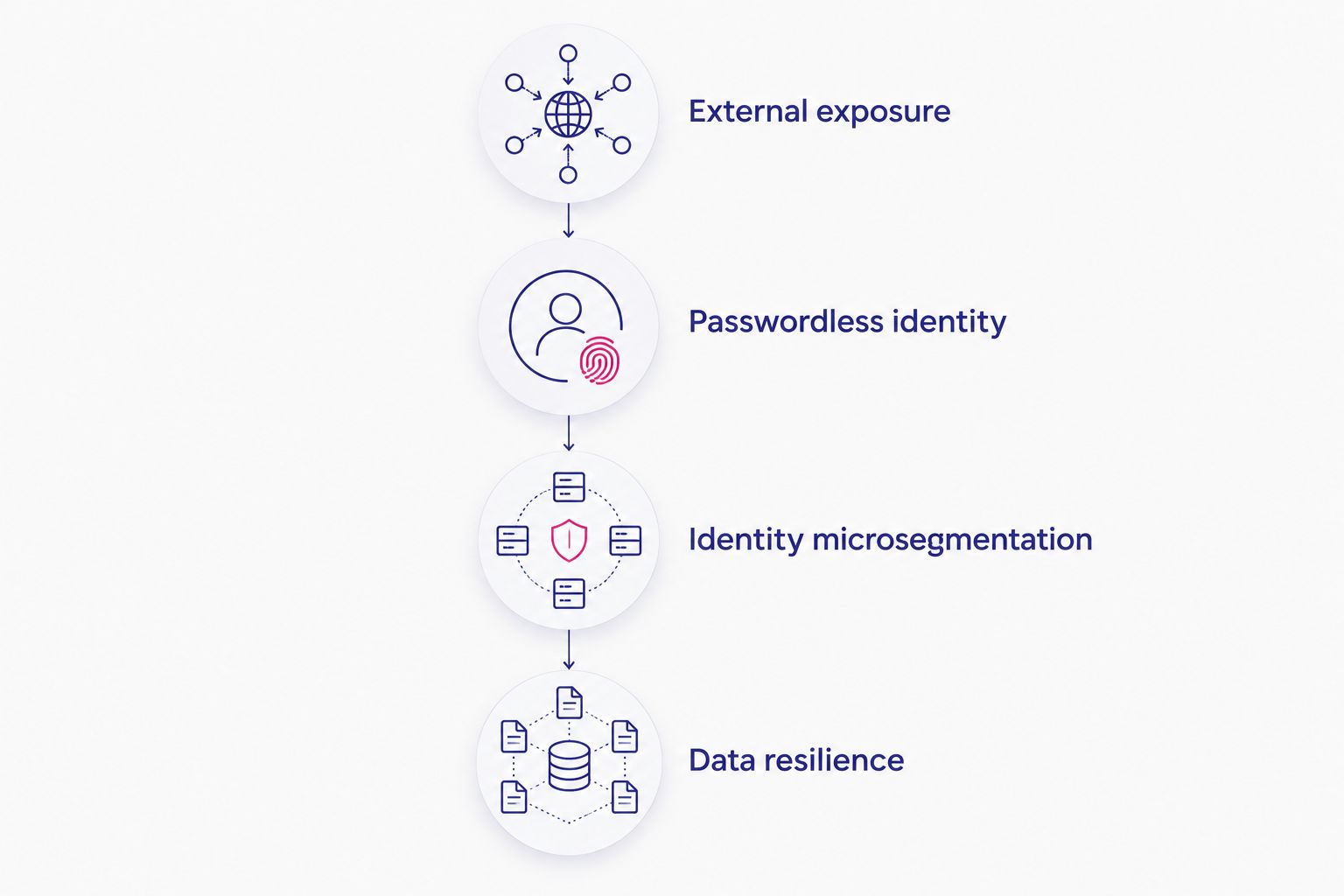
SecFolio's framework separates four control objectives. Use it to identify what your ITDR purchase covers and what remains outside its scope.
Step 01: External exposure
Discover and close external exposure before initial access. Identify exposed systems and access points, assign owners, and verify remediation. ITDR detection inside the environment does not replace closing an exposed entry point.
Step 02: Passwordless identity
Eliminate reusable credentials from supported authentication flows. Maintain controls for account recovery, device enrollment, and emergency access. Passwordless authentication does not make stolen sessions or excessive permissions harmless.
Step 03: Identity microsegmentation
Contain lateral movement by restricting identity-based access to required resources. Validate application dependencies before enforcement. The outcome is a smaller blast radius, not an assumption that every authorized identity remains trustworthy.
Step 04: Data resilience
Preserve data resilience with Cyber Storage where ransomware, exfiltration, or business continuity is relevant. Cyber Storage encrypts data before it leaves the customer environment, uses sharding to create immutable encrypted fragments, and distributes those fragments across independent locations. No single location holds a reconstructable file.
This architecture creates a logical air gap: an attacker obtaining fragments from an individual location does not obtain a usable file. Authorized recovery reconstructs data through distributed recovery. It is a data-resilience architecture, not a backup product, and it does not replace identity, segmentation, or exposure controls.
How to validate the shortlist
Use the same evaluation sequence for every candidate. Agree on expected evidence before the demonstration, then document the result without changing the acceptance criteria to match a vendor's strongest feature.
- Run 3 attack scenarios: suspicious authentication, privilege abuse, and attempted lateral movement. Use approved simulations in a controlled environment.
- Test 2 response workflows: investigator-approved containment and restoration of legitimate access. Record every manual handoff.
- Map 1 critical application: identify its human users, administrative identities, service accounts, and dependencies. Verify what each candidate actually observes and controls.
These are evaluation instructions, not vendor performance claims. Measure your own investigation effort, response completion, and operational disruption. Do not substitute alert counts for demonstrated containment.
For your 2026 buying decision, require an evidence trail showing the original activity, detection, response authorization, executed action, and verification. If the team cannot verify that access stopped, the workflow is incomplete.
How the options are ranked
This shortlist ranks by distinct control objective: preventive attack-path reduction, Active Directory detection, endpoint-linked investigation, and directory posture. The criteria are coverage, investigation context, response authority, prevention, ownership, and recovery safety.
There is no universal winner across those requirements. Existing architecture determines fit; demonstrated containment determines whether the purchase earns approval.
Which ITDR solution should you choose?
For an undecided buyer, start with the identity infrastructure supporting your most critical application. Choose Microsoft Defender for Identity when Active Directory detection is the central gap. Choose CrowdStrike Falcon Identity Protection when the investigation must connect endpoint compromise with identity activity. Choose Semperis Directory Services Protector when directory posture and changes drive the requirement.
Choose SecFolio when the priority is reducing reusable credentials and lateral movement paths, with Cyber Storage supporting data resilience where needed. Keep dedicated detection requirements separate and validate them explicitly.
Approve the option that closes your documented control gap and completes the response workflow. Hold the purchase if the demonstration stops at an alert.
FAQ
What’s the best ITDR solution for a mid-market enterprise in 2026?
The best ITDR solution is the one that covers your critical identities and proves the required containment workflow. Microsoft Defender for Identity fits Active Directory investigations; CrowdStrike Falcon Identity Protection fits endpoint-linked investigations; Semperis Directory Services Protector fits directory posture requirements.
Is SecFolio a substitute for dedicated ITDR detection?
SecFolio’s stated prevention capabilities do not establish a substitute for dedicated ITDR detection. Evaluate passwordless identity and identity microsegmentation as attack-path controls, then validate your detection and investigation requirements separately.
Is Microsoft Defender for Identity better than CrowdStrike Falcon Identity Protection?
Neither is universally better across identity environments. Microsoft Defender for Identity belongs on a directory-focused shortlist, while CrowdStrike Falcon Identity Protection belongs on an endpoint-linked investigation shortlist; test coverage and response in your environment.
Does passwordless authentication replace ITDR?
Passwordless authentication does not replace ITDR. It removes reusable passwords from covered authentication flows, while ITDR addresses suspicious identity activity and response; session theft and privilege abuse still require controls.
Can ITDR stop lateral movement?
ITDR supports stopping lateral movement when detection leads to an effective containment action. Identity microsegmentation separately restricts permitted access paths, reducing the resources a compromised identity can reach.
Does Cyber Storage replace identity security controls?
Cyber Storage does not replace identity security controls. Its encryption, sharding, and distribution architecture preserves data resilience, while passwordless identity, microsegmentation, and exposure management address different attack paths.
What should I ask vendors to demonstrate before buying?
Ask vendors to demonstrate detection evidence, response authorization, executed containment, and restoration of legitimate access. Include a critical application and its service accounts so the evaluation tests operational dependencies, not just a sample user.
One last thing
A disabled account is not proof that every existing session ended. Applications and identity systems handle sessions differently. Add an already-authenticated session to your acceptance test, then verify access at the target resource after containment.
That check turns an apparent response success into evidence your business can rely on.
Related guides
- Build an identity threat detection and response program
- Attack-path management for hybrid Active Directory and Entra ID
- Reduce blast radius after credential compromise


