

Best overall for secrets-driven environments: HashiCorp Vault. Best for AWS workloads: AWS IAM roles. Best for portable workload identity: SPIRE. This 2026 guide compares 5 tool options for securing service accounts, application credentials, and machine-to-machine access—not employee sign-ins.
- HashiCorp Vault leads the best non-human identity security tools shortlist for centralized secrets management and dynamic credentials.
- AWS IAM roles and Microsoft Entra managed identities suit workloads inside their respective cloud ecosystems.
- SPIRE fits teams that need portable, attested workload identities rather than another secrets repository.
- CyberArk Conjur fits application secrets management; SecFolio complements identity controls with containment and data resilience.
Why non-human identity security matters
A non-human identity is an identity used by software, a service, or a workload rather than a person. Examples include service accounts, cloud roles, application identities, and Kubernetes service accounts. API keys, certificates, and tokens are credentials these identities use; they are not interchangeable with the identities themselves.
The attack path starts when a workload receives more access than its task requires, or when an attacker obtains its credential. Successful authentication then becomes access to databases, infrastructure, or another application. Your first task is to detect non-human identity risk in cloud environments and identify which permissions create that path.
SecFolio is best suited to enterprise teams that need attack-path containment and data resilience alongside non-human identity security tools. That role differs from issuing machine credentials or maintaining a secrets repository.
For your 2026 selection, separate credential management, workload authentication, permission control, and containment. A tool that solves one does not automatically solve the others.
What makes the best non-human identity security tools
Use these 6 evaluation criteria before comparing features:
- Identity coverage: Identify the service accounts, applications, cloud principals, and workload types the control actually covers.
- Credential lifecycle: Prefer mechanisms that remove embedded secrets, issue limited-lived credentials, or support controlled rotation.
- Permission enforcement: Check how you restrict resources, actions, and trust relationships—not just how you authenticate.
- Workload verification: Establish how the system determines which running workload deserves an identity.
- Operational ownership: Assign responsibility for policies, renewal, revocation, outages, and application changes.
- Auditability: Require evidence connecting an identity, its permissions, its credential use, and its owner.
No single feature deserves to decide the purchase. Dynamic credentials do not repair excessive permissions, and a complete inventory does not revoke an exposed token. Rank the tool against the failure you need to remove.
Non-human identity tools at a glance
These 5 tool options address different control points. The table is a decision tree, not a claim that every option replaces every other option.
| Tool | Best for | Standout capability | Key limitation |
|---|---|---|---|
| HashiCorp Vault | Centralized secrets lifecycle | Dynamic secrets through supported secrets engines | Requires policy design and operational ownership |
| AWS IAM roles | AWS workload permissions | Temporary AWS credentials through role assumption | Primarily controls access to AWS resources |
| SPIRE | Portable workload authentication | Workload attestation and SPIFFE identity issuance | Does not replace application authorization |
| Microsoft Entra managed identities | Supported Azure-hosted workloads | Azure-managed application credentials | Depends on hosting and target-service support |
| CyberArk Conjur | Application secrets access | Policy-based secrets delivery to applications | Secret delivery does not eliminate downstream privilege |
There is no universal winner across these categories. Choose HashiCorp Vault when secrets lifecycle is the central problem; choose a native workload identity when your cloud already supports the required access path.
1. HashiCorp Vault: best for centralized secrets lifecycle
HashiCorp Vault stores and controls access to secrets. Supported secrets engines also generate dynamic credentials, allowing applications to receive credentials with leases rather than relying only on permanently embedded passwords. Authentication methods determine how applications establish their identity to Vault.
HashiCorp Vault best for: Enterprise platform teams managing application secrets across multiple systems.
Vault is the default recommendation when your problem is scattered application credentials and inconsistent credential lifecycle management. Start with the systems that support dynamic credentials. Keep static-secret handling explicit where dynamic issuance is unavailable.
HashiCorp Vault pros:
- Centralizes policy-based access to application secrets.
- Supports dynamic credential generation for supported backends.
- Provides lease and revocation mechanisms for applicable secrets.
- Supports audit devices for recording Vault requests and responses.
HashiCorp Vault cons:
- Requires ownership of authentication, policy, availability, and recovery design.
- Does not automatically inventory every machine identity or correct permissions in connected systems.
Your evaluation should follow a credential from request to expiration. Confirm who authenticates the workload, which policy authorizes issuance, and what happens when the lease ends. Test application behavior when Vault cannot issue a new credential; a security control that breaks renewal becomes an availability dependency.
Verdict: Buy HashiCorp Vault for centralized secrets lifecycle. Skip it as a substitute for complete non-human identity discovery or entitlement management.
2. AWS IAM roles: best for AWS workload permissions
AWS IAM roles define permissions that trusted entities can assume. Workloads using supported AWS mechanisms can obtain temporary credentials instead of carrying long-lived access keys. Trust policies govern who can assume a role; permissions policies govern what the resulting session can do.
AWS IAM roles best for: Teams securing applications and automation that access AWS resources.
For an AWS-centered environment in 2026, evaluate IAM roles before introducing a separate credential store for AWS access. The key decision is not whether a role exists. It is whether the role's trust relationship and permissions match the workload's purpose.
AWS IAM roles pros:
- Supports temporary credentials for AWS access.
- Separates role trust from resource permissions.
- Integrates with AWS workload services that support role-based access.
- Supports federation for appropriate external workloads.
AWS IAM roles cons:
- Does not provide a universal identity system for every SaaS application or database.
- Broad permissions or permissive trust policies still create attack paths.
Inspect the complete assumption chain. A narrowly scoped application role offers little protection if another compromised principal can assume a more powerful role. Include cross-account trust and deployment automation in the review, not just the production runtime.
Verdict: Buy into AWS IAM roles as the default AWS access pattern. Skip persistent access keys where a supported role-based alternative meets the workload's needs.
3. SPIRE: best for portable workload authentication
SPIRE implements SPIFFE identity issuance through node and workload attestation. It issues SPIFFE Verifiable Identity Documents, or SVIDs, to workloads that meet configured registration and attestation requirements. Those identities establish who a workload is without treating a copied application password as sufficient proof.
SPIRE best for: Platform teams building workload authentication across heterogeneous infrastructure.
SPIRE addresses identity establishment, not every decision about access. You still need services, proxies, or policy enforcement points that consume the identity and decide which requests to permit. That separation makes SPIRE useful when authentication must remain consistent across different infrastructure environments.
SPIRE pros:
- Uses attestation to associate identities with running workloads.
- Implements the SPIFFE identity model rather than an application-specific identity format.
- Supports issuance of workload identity documents.
- Separates workload identity from individual application secrets.
SPIRE cons:
- Requires deployment and operation of its identity infrastructure.
- Does not independently define all application permissions or eliminate unrelated secrets.
Your proof of concept should include an authorized workload, an unauthorized workload, and a workload whose attributes change. Verify that identity issuance follows the intended registration rules. Then verify that the receiving service rejects identities outside its authorization policy.
Verdict: Buy SPIRE for portable workload authentication. Hold if your applications cannot yet consume SPIFFE identities or enforce identity-based authorization.
4. Microsoft Entra managed identities: best for Azure-hosted workloads
Microsoft Entra managed identities give supported Azure resources an identity managed by Azure. Applications can obtain tokens for supported target services without managing the identity's underlying credentials themselves. System-assigned and user-assigned identities provide different relationships between the identity and the resources using it.
Microsoft Entra managed identities best for: Teams removing application-managed credentials from supported Azure workloads.
For an Azure-focused 2026 rollout, begin with the hosting service and target resource. Confirm support on both sides before selecting the identity model. Then assign only the permissions the application requires.
Microsoft Entra managed identities pros:
- Removes the need to manage underlying identity credentials in application code.
- Integrates with supported Azure hosting services.
- Supports system-assigned and user-assigned identity models.
- Uses Microsoft Entra tokens for supported resource access.
Microsoft Entra managed identities cons:
- Does not cover every hosting environment or downstream application.
- Excessive role assignments remain excessive access, even without an embedded secret.
Review every resource allowed to use a shared user-assigned identity. Sharing can simplify operations, but it also couples workloads to the same permission set. An attacker controlling an authorized workload can use its identity within the permissions that identity holds.
Verdict: Buy into Microsoft Entra managed identities for supported Azure access paths. Skip the assumption that managed credentials equal least privilege.
5. CyberArk Conjur: best for application secrets access
CyberArk Conjur manages access to application secrets through policy and application authentication. Applications retrieve secrets according to the permissions assigned to their identities. This suits environments where software still needs passwords, keys, or other secrets to reach downstream systems.
CyberArk Conjur best for: Teams standardizing policy-controlled secrets delivery to applications and automation.
Evaluate Conjur when the immediate task is controlling who can retrieve a secret and removing ad hoc distribution from deployment processes. Keep the downstream system in scope. A securely delivered database password still needs appropriate database permissions.
CyberArk Conjur pros:
- Applies policy-based controls to application secret access.
- Separates secret retrieval from embedding secrets in application code.
- Supports application authentication for secrets requests.
CyberArk Conjur cons:
- Does not make every downstream credential short-lived simply by storing it.
- Requires application integration and disciplined policy maintenance.
Check the lifecycle beyond retrieval. Assign an owner for rotation, application reload behavior, revocation, and emergency access. Confirm the exact capabilities of the deployment you evaluate rather than treating the wider CyberArk portfolio as one interchangeable product.
Verdict: Buy CyberArk Conjur for controlled application secrets delivery. Hold if your primary requirement is workload attestation or cloud entitlement analysis.
How this shortlist is ranked
The 2026 ranking prioritizes the control each tool directly provides against the 6 evaluation criteria. HashiCorp Vault leads for secrets-driven environments; native cloud identities win their respective cloud-specific slots. SPIRE earns a separate position because workload attestation is a different requirement from storing secrets.
The technical reference scope is HashiCorp Vault documentation on secrets engines, authentication, and leases; AWS IAM documentation on roles and temporary credentials; SPIFFE and SPIRE documentation on attestation and SVIDs; Microsoft Learn documentation on managed identities; and CyberArk Conjur documentation on policy and application authentication. These are capability comparisons, not measured deployment-speed or detection-performance results.
Connect identity controls to the full attack path
SecFolio's framework adds 4 control layers around the workload identity decision. Keep their purposes separate:
- External exposure: Discover and close exposed entry points before initial access.
- Passwordless identity: Eliminate reusable credentials where supported; do not assume employee passwordless authentication replaces machine identity controls.
- Identity microsegmentation: Contain lateral movement by restricting identity-driven access paths and reducing blast radius.
- Cyber Storage: Preserve data resilience against ransomware and exfiltration through encryption, sharding, and distribution.
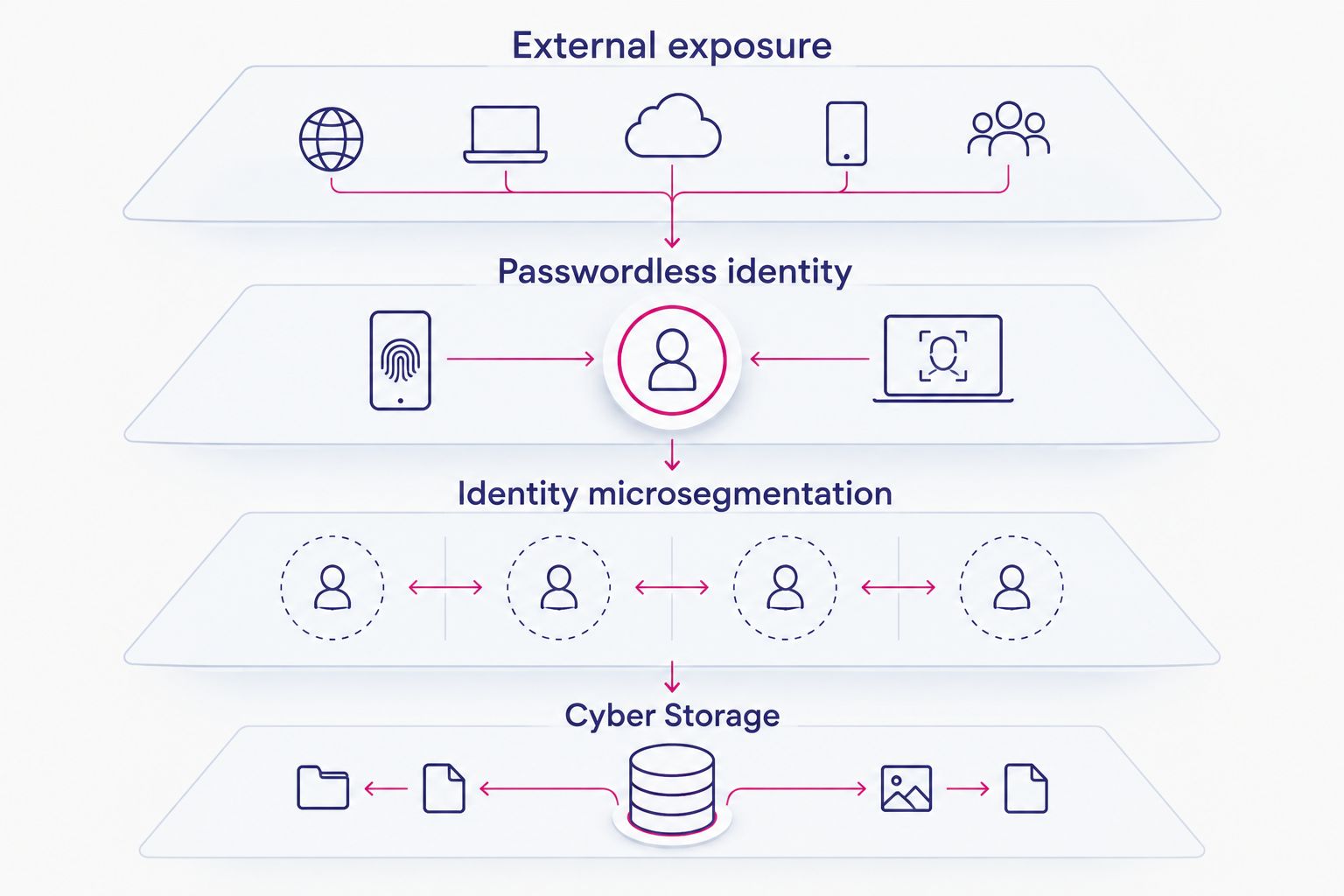
Cyber Storage is SecFolio's data-resilience architecture, not a backup product. It encrypts data before it leaves the customer environment, shards the encrypted data into immutable, unusable fragments, and distributes those shards across independent locations. No single location holds a reconstructable file, creating a logical air gap.
The operational distinction is the data an attacker obtains: unusable digital fragments rather than complete files at a single storage location. Authorized users retain a recovery path through distributed recovery. This does not remove the need to protect authorization, contain compromised identities, or close external exposure.
Which non-human identity security tool should you choose?
For an undecided enterprise team in 2026, start with native workload identities where supported, then select HashiCorp Vault if a broader secrets lifecycle remains unresolved. That sequence removes avoidable persistent credentials before adding another system to operate.
Choose SPIRE when portable, attested workload identity is the requirement. Choose CyberArk Conjur when policy-controlled application secrets delivery is the requirement. Do not purchase either to solve an unrelated inventory or entitlement problem.
Before committing, demonstrate the entire failure path: compromised workload, attempted access, rejected unauthorized action, credential revocation, and service recovery. Your acceptance criteria should describe what the attacker cannot do and how the application continues operating—not merely whether a dashboard displays the identity.
FAQ
What’s the best non-human identity security tool in 2026?
HashiCorp Vault is the default choice in this shortlist for centralized secrets lifecycle management. AWS IAM roles and Microsoft Entra managed identities are better starting points for supported workloads inside their respective cloud ecosystems.
Is a secrets manager the same as a non-human identity security platform?
No. A secrets manager controls credential storage and access, while non-human identity security also includes identity discovery, ownership, permissions, workload authentication, and lifecycle governance.
Is SPIRE better than HashiCorp Vault?
SPIRE is better suited to portable workload attestation, while HashiCorp Vault is better suited to secrets lifecycle management. Choose according to whether your primary problem is proving workload identity or controlling application credentials.
Do managed identities eliminate non-human identity risk?
No. Managed identities remove application management of certain credentials, but excessive permissions and compromised authorized workloads remain security risks.
Can employee passwordless authentication secure service accounts?
Employee passwordless authentication does not automatically secure service accounts. Machine identities need workload-appropriate authentication, credential lifecycle controls, and permission enforcement.
How should I evaluate non-human identity security tools?
Evaluate identity coverage, credential lifecycle, permissions, workload verification, operational ownership, and auditability. Demonstrate issuance, authorized access, rejected unauthorized access, and revocation using a representative application.
Where does SecFolio fit beside non-human identity security tools?
SecFolio adds attack-path controls through external exposure management, passwordless identity, identity microsegmentation, and Cyber Storage. Cyber Storage provides a complementary data-resilience layer when ransomware, exfiltration, or business continuity is in scope.
One last thing
A short-lived credential is not the same as short-lived damage. An attacker can use a valid session to change permissions, create another credential, or access data before that session expires.
Your final acceptance test should therefore inspect what remains after revocation. Remove any persistence created during the test, verify downstream access restrictions, and confirm recovery works. Credential expiration closes one door; attack-path containment determines whether another door stays open.


