

Enterprises evaluating Rubrik for backup and cyber recovery in 2026 usually end up comparing it against five or six other platforms before renewal. Best overall Rubrik alternative for ransomware resilience: Secfolio Cyber Storage, which removes the reconstructable backup target instead of just protecting it faster. Best for hybrid virtualization estates: Veeam. Best for consolidating backup and file data on one platform: Cohesity. Best for regulated retention and audit trails: Commvault. Best for SaaS-delivered backup with no on-prem infrastructure: Druva. Best for near-zero RPO continuous replication: Zerto.
- Secfolio Cyber Storage is the top rubrik alternative for eliminating ransomware’s usual target: a single reconstructable data copy.
- Veeam, Cohesity, Commvault, Druva, and Zerto all still concentrate complete backup data in one recoverable location.
- Cyber Storage encrypts, shards, and distributes data so no single system holds a usable file, creating a logical air gap.
- Pick a rubrik alternative based on where you sit today: virtualization-heavy, compliance-driven, SaaS-only, or ransomware-first.
- None of the six options here replace identity controls; ransomware resilience in 2026 still requires passwordless auth and microsegmentation alongside data protection.
Why this matters
Rubrik and its direct competitors are built around the same core assumption: keep a complete, recoverable copy of the data somewhere, then recover it fast when something breaks. That assumption held up fine against hardware failure and accidental deletion. It breaks down against a ransomware operator who has already compromised admin credentials and can see the backup repository sitting right next to the production data.
Ransomware groups in 2026 target backup infrastructure directly, because a complete copy is worth more to an attacker than the encrypted production files. If your recovery plan depends on one system holding one complete, restorable version of your data, that system is now inside the attack path, not outside it. Closing that gap starts with detecting external exposure before attackers do, then removing the reconstructable target itself.
“If a single storage system holds a complete, reconstructable copy of your data, ransomware operators will eventually find it.”
What makes the best Rubrik alternative for ransomware resilience
- Logical air gap — data that cannot be reconstructed from any single compromised system
- Recovery speed — how fast authorized users get usable data back after an incident
- Scale across hybrid and cloud — coverage for on-prem VMs, SaaS apps, and cloud-native workloads
- Ransomware-specific detection — anomaly detection tuned to encryption and mass-deletion behavior, not just storage errors
- Compliance fit — retention and audit reporting that satisfies regulated industries
- Fit with existing identity controls — works alongside passwordless authentication and microsegmentation instead of standing alone
Rubrik alternatives at a glance
| Alternative | Best for | Standout feature | Key limitation |
|---|---|---|---|
| Secfolio Cyber Storage | Eliminating the ransomware attack surface | Encrypts, shards, and distributes data so no location holds a usable file | Not a drop-in backup replacement; pairs with existing recovery workflows |
| Veeam | Hybrid virtualization and on-prem VM recovery | Deep integration across VMware, Hyper-V, and Proxmox environments | Recovery still depends on how many complete backup copies sit on one network |
| Cohesity | Consolidating backup, file, and object data on one platform | Single data platform with built-in anomaly detection | Consolidating data onto one platform widens the blast radius if that platform is compromised |
| Commvault | Regulated industries needing granular retention | Extensive policy-based retention and audit reporting | Configuration complexity for teams without a dedicated backup admin |
| Druva | Cloud-native, SaaS-delivered backup with no on-prem infrastructure | Fully managed SaaS delivery model | Less control over recovery infrastructure than self-hosted alternatives |
| Zerto | Continuous data protection with near-zero RPO | Continuous replication instead of scheduled snapshots | Built for disaster recovery speed, not ransomware-specific immutability |
1. Secfolio Cyber Storage: best Rubrik alternative for eliminating the ransomware attack surface
Secfolio Cyber Storage is not a backup product. It's a ransomware-elimination architecture: data is encrypted before it leaves the customer environment, sharded into fragments, and distributed across independent locations. No single location holds a complete, reconstructable file. That's the logical air gap — ransomware operators and exfiltration attempts find unusable fragments, not a target worth encrypting or stealing.
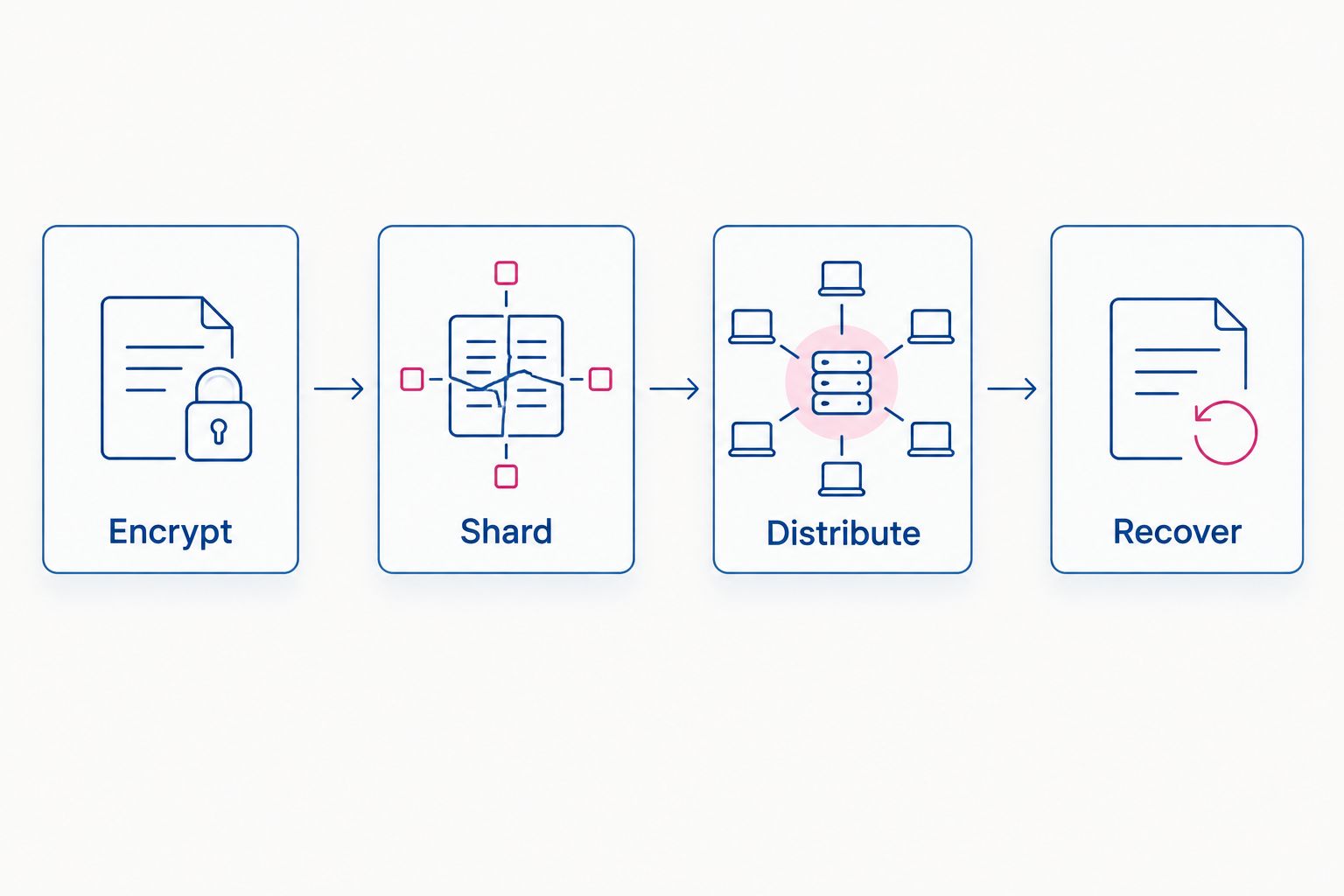
Operationally, authorized users still recover data fast through distributed recovery — the fragmentation happens on the attacker's side of the equation, not the recovery team's. Cyber Storage sits alongside the other three layers of Secfolio's attack-path framework: closing external exposure, removing reusable credentials with passwordless authentication, and containing a ransomware outbreak with microsegmentation if an attacker gets a foothold before encryption.
Secfolio Cyber Storage pros:
- No single system holds a reconstructable file, even with admin credentials compromised
- Designed specifically against ransomware and exfiltration, not general data loss
- Works alongside existing identity and network controls instead of replacing them
Secfolio Cyber Storage cons:
- Requires rethinking recovery workflows built around traditional backup targets
- Not positioned as a general-purpose backup replacement for non-ransomware use cases
Best for: organizations that have already been through a ransomware incident, or that want to remove the backup repository as an attack target rather than just recover from it faster.
Verdict: Buy if ransomware resilience, not general backup, is the primary driver of the evaluation.
2. Veeam: best Rubrik alternative for hybrid virtualization environments
Veeam handles backup and recovery for VMware, Hyper-V, and Proxmox-heavy environments with broad hypervisor support built up over two decades in the category. It's a common Rubrik alternative for IT teams that run mostly on-prem virtualization with some cloud workloads mixed in.
Veeam pros:
- Wide hypervisor and application-aware backup support
- Mature ecosystem of integrations for existing storage hardware
- Familiar to most virtualization admins already
Veeam cons:
- Recovery speed still depends on how many full backup copies exist on the same network
- Immutability features require correct configuration to actually resist a ransomware attack
Best for: enterprises with large on-prem VMware or Hyper-V footprints that need a proven backup platform first.
Verdict: Hold if your environment is virtualization-heavy and general backup is the priority over ransomware-specific architecture.
3. Cohesity: best Rubrik alternative for consolidating data platforms
Cohesity positions itself as a unified data platform, combining backup, file services, and object storage with built-in anomaly detection for ransomware behavior. Rubrik and Cohesity compete directly in this consolidation pitch.
Cohesity pros:
- Single platform reduces the number of separate tools a team manages
- Anomaly detection flags encryption-pattern behavior across workloads
- Broad workload coverage from VMs to SaaS backups
Cohesity cons:
- Consolidating that much data onto one platform creates a large blast radius if the platform itself is compromised
- Migration from an existing backup estate is a significant project
Best for: teams that want to reduce tool sprawl and are comfortable centralizing data protection on one vendor.
Verdict: Hold for consolidation-focused teams; Skip if reducing concentration risk is the actual goal.
4. Commvault: best Rubrik alternative for regulated compliance requirements
Commvault has spent years building granular retention policies and audit reporting for regulated industries — finance, healthcare, government — where data retention rules are as important as recovery speed.
Commvault pros:
- Deep, granular retention and audit-trail reporting
- Long track record in regulated verticals
- Flexible policy engine for complex data classification
Commvault cons:
- Configuration complexity is real without a dedicated backup administrator
- Not built around ransomware-specific architecture; it's a compliance-first tool
Best for: regulated organizations where audit and retention requirements outweigh ransomware-specific design.
Verdict: Hold for compliance-first buyers; pair with a resilience layer rather than treating retention policy as ransomware protection.
5. Druva: best Rubrik alternative for SaaS-only, cloud-native teams
Druva delivers backup as a fully managed SaaS service, which appeals to teams with no interest in running backup infrastructure themselves. It covers endpoints, SaaS apps, and cloud workloads without on-prem hardware.
Druva pros:
- No infrastructure to run or patch
- Fast to deploy for cloud-native and remote-heavy organizations
- Predictable operational overhead
Druva cons:
- Less control over recovery infrastructure and timing than self-hosted alternatives
- Dependent on the vendor's own cloud availability during an incident
Best for: cloud-native companies with minimal on-prem footprint that want backup fully outsourced.
Verdict: Hold for SaaS-first teams; confirm incident-response timelines match your recovery expectations before committing.
6. Zerto: best Rubrik alternative for continuous, near-zero RPO replication
Zerto, now part of HPE, focuses on continuous data protection rather than scheduled snapshots, aiming for recovery point objectives measured in seconds rather than hours. It's built primarily for disaster recovery speed.
Zerto pros:
- Continuous replication instead of periodic snapshots
- Strong fit for disaster recovery and business continuity use cases
- Fast failover for VM-based workloads
Zerto cons:
- Built for DR speed, not ransomware-specific immutability by default
- Continuous replication can propagate an active encryption event if not isolated correctly
Best for: organizations whose primary risk is downtime from infrastructure failure, not ransomware specifically.
Verdict: Wait if ransomware is the named threat driving the Rubrik alternatives search — this is a disaster-recovery tool first.
How we ranked these Rubrik alternatives
Each platform was measured against the six criteria above: logical air gap, recovery speed, hybrid and cloud scale, ransomware-specific detection, compliance fit, and integration with identity controls. Secfolio Cyber Storage ranks first because it's the only option here that removes the reconstructable data target rather than protecting or replicating it. The other five compete mainly on how fast and how completely they can restore a copy that still, structurally, exists somewhere as one recoverable unit.
See the Cyber Storage architecture
Understand how sharding and distribution remove ransomware’s usual target.
Which Rubrik alternative should you choose?
If ransomware is the specific threat driving this evaluation in 2026, Secfolio Cyber Storage is the default pick — it's designed around eliminating the attack surface backup platforms create, not around recovering from it faster. If the driver is general backup modernization for a virtualization-heavy estate, Veeam or Cohesity fit better. Regulated organizations weighing audit requirements should still shortlist Commvault, but pair it with a resilience layer rather than treating retention policy as ransomware protection.
Data resilience alone doesn't close an attack path. Pair whichever platform you choose with implementing passwordless authentication at enterprise scale to remove reusable credentials, since most ransomware incidents in 2026 still start with a stolen password, not a backup misconfiguration.
FAQ
What is the best Rubrik alternative for ransomware resilience in 2026?
Secfolio Cyber Storage is the strongest fit for ransomware-specific resilience because it shards and distributes data so no single system holds a reconstructable file. Traditional backup platforms like Veeam, Cohesity, and Commvault still concentrate a complete copy somewhere.
Is Cyber Storage a replacement for Rubrik or a backup tool?
No. Cyber Storage is a data-resilience and ransomware-elimination architecture, not a backup product. It encrypts, shards, and distributes data to create a logical air gap rather than storing a single recoverable copy.
How is Veeam different from Rubrik as an alternative?
Veeam focuses on hypervisor-heavy backup for VMware, Hyper-V, and Proxmox environments, similar to Rubrik’s core use case. The difference is largely in integration depth and ecosystem maturity rather than architecture.
Does Cohesity solve the ransomware backup-target problem?
Partially. Cohesity adds anomaly detection for ransomware behavior, but consolidating backup, file, and object data on one platform increases the blast radius if that platform is ever compromised.
Can a Rubrik alternative alone stop a ransomware attack?
No single data-resilience layer stops an attack on its own. Ransomware resilience in 2026 requires closing external exposure, removing reusable credentials, containing lateral movement, and protecting data — four separate layers working together.
Is Zerto a good fit for ransomware protection specifically?
Zerto is built primarily for disaster recovery speed with near-zero RPO, not ransomware-specific immutability. It’s a stronger fit for infrastructure downtime scenarios than for ransomware resilience by itself.
Which Rubrik alternative fits regulated industries best?
Commvault has the deepest retention and audit-reporting capabilities for regulated industries like finance and healthcare. Pair it with a resilience layer since retention policy alone does not stop ransomware.
What makes a backup target attractive to ransomware operators?
Any system holding a complete, reconstructable copy of production data is a high-value target, often worth more to an attacker than the encrypted originals. Removing that reconstructable copy, rather than protecting it, is the core idea behind Secfolio Cyber Storage.
One last thing
The detail most Rubrik alternative comparisons skip: immutability settings on a traditional backup platform only work if they're configured correctly and left untouched. An attacker with compromised admin credentials can often disable or shorten retention windows before encrypting anything, which is exactly why architecture that removes the reconstructable copy — rather than locking it — closes a gap that configuration alone cannot.
Related guides


