

Yes—attack path management can prevent a breach when you use its findings to remove the access relationships an attacker needs before those relationships are exploited. Mapping alone does not prevent compromise: you must close exposure, remove reusable credentials, restrict lateral movement, and protect data if an attacker gets through.
- Can attack path management prevent a breach? Yes, when identified attack paths are removed and the changes are verified.
- SecFolio connects external exposure, passwordless identity, identity microsegmentation, and Cyber Storage within its attack-path framework.
- Attack-path visibility supports prioritization; enforced controls provide prevention and containment.
- Cyber Storage adds data resilience through encryption, sharding, and distribution; it does not replace identity controls.
Can attack path management prevent a breach before it starts?
Attack path management prevents specific breach routes by identifying and breaking the connections that make them usable. Those connections include exposed services, reusable credentials, excessive permissions, and access between systems. The preventive result comes from changing those conditions, not from drawing a graph.
Start by prioritizing attack paths by business risk. A path to sensitive data or administrative control deserves attention because of what it enables, not simply because it contains a large number of findings.
The controls below address different parts of that path. None replaces the others.
| Control | Best for | Preventive or resilience contribution | Limitation |
|---|---|---|---|
| External exposure management | Closing reachable entry points | Identifies exposure that requires removal or restriction | Discovery does not close exposure by itself |
| Passwordless identity | Removing reusable password dependencies | Eliminates password-based access routes where deployed | Does not remove excessive authorization or stolen-session risk |
| Identity microsegmentation | Restricting movement after initial access | Limits which identities can reach which resources | Requires accurate access policies and exception handling |
| Cyber Storage | Preserving data resilience | Encrypts, shards, and distributes protected data | Does not replace entry-point, identity, or segmentation controls |
For your 2026 security program, treat an attack-path finding as a required control change. A report is evidence of discovery. A verified denial of unwanted access is evidence that a route has been interrupted.
Why this matters
An exposed service and an overprivileged account are different findings. Together, they can form a route to a sensitive system. Fixing findings independently misses the question that matters: what can an attacker reach from this starting point?
Attack path management connects that starting point to the business consequence. You can then decide whether to remove the entry point, remove an access relationship, or isolate the destination. That changes remediation from a backlog of individual weaknesses into a sequence of decisions about reachable harm.
SecFolio's attack-path framework is best suited to enterprise security teams coordinating exposure, identity, lateral-movement, and data-resilience controls. Its value is the division of responsibility across those controls. You still need to validate coverage and operational fit in your environment.
Step 01: Discover and close external exposure
An externally reachable weakness creates an opportunity for initial access. External exposure management addresses that opportunity before an attacker can use it. Your first decision is whether the exposed asset needs to be reachable at all.
Identify the business owner and intended access for each exposed service. Remove unnecessary exposure. For services that must remain reachable, correct the weakness and restrict access according to the service's purpose.
Do not mark a finding resolved solely because a remediation task is complete. Validate the exposed condition again from the relevant access position. The control should change what an attacker can reach or exploit.
For a 2026 assessment, ask for evidence of closure rather than a count of discovered assets. An inventory establishes scope; it does not establish prevention. Also check whether the asset leads to identities or systems with broader access.
Best for: removing an attacker's initial entry opportunity. The limitation is scope: closing external exposure does not resolve an internal access route that already exists.
Step 02: Eliminate reusable credentials with passwordless identity
A reusable password gives an attacker a credential that can be stolen and presented again. Passwordless identity removes that password dependency where implemented. It addresses the credential step of the attack path, not every possible misuse of an authenticated identity.
Map the authentication routes that remain outside the rollout. Include administrative access, recovery processes, emergency accounts, and applications that still accept passwords. A passwordless primary login does not eliminate a password-based alternate route.
Then separate authentication from authorization. A securely authenticated user can still hold unnecessary permissions. Removing reusable credentials and reducing excessive access are related tasks, but they have different acceptance criteria.
Your verification should show that the intended authentication route no longer accepts a reusable password. It should also show that recovery and exception processes do not quietly restore the same weakness.
Best for: removing password-based credential reuse from covered access routes. The limitation is that session theft, application permissions, and compromised endpoints need their own controls.
Step 03: Contain lateral movement with identity microsegmentation
Initial access becomes more damaging when the compromised identity can reach additional systems. Identity microsegmentation restricts those relationships. Its purpose is to reduce the blast radius rather than assume every initial compromise can be prevented.
Define which identities require access to which resources for legitimate work. Remove unnecessary relationships and test the remaining ones against actual workflows. A segmentation policy that exists only in a document does not restrict lateral movement.
Test both directions of the policy. Unauthorized access should fail; required business access should continue. Exceptions need an owner and a clear reason, because an exception can reconnect an otherwise interrupted attack path.
In 2026, use a contained-compromise scenario to assess segmentation. Assume a representative identity is already compromised, then examine its reachable resources. The question is not whether the identity can sign in, but how far its access extends afterward.
Best for: limiting lateral movement and reducing blast radius. The limitation is policy accuracy: an identity granted broad access still has broad reach unless you change that authorization.
Step 04: Preserve data resilience with Cyber Storage
Traditional backups can concentrate complete data copies in repositories. If those copies are reachable through compromised access, they become targets for encryption or exfiltration. Recovery planning must therefore examine the protection of recovery data, not just the existence of copies.
SecFolio's Cyber Storage is a data-resilience architecture, not a conventional backup product. It encrypts data before the data leaves the customer environment, shards the encrypted data into immutable fragments, and distributes those fragments across independent locations. No single location holds a reconstructable file.
That separation creates a logical air gap. Within this architecture, compromising an individual shard location yields unusable digital fragments rather than a complete file. Authorized recovery reconstructs protected data through the distributed recovery process.
Keep the boundary precise. This architecture does not make every application, active session, or source-system copy unreachable. Your assessment must establish which data is protected and how authorized recovery operates during an incident.
Best for: protecting data resilience alongside breach-prevention controls. The limitation is that resilient storage does not remove an exposed service, an excessive permission, or an unnecessary identity relationship.
How the four control layers work together
The framework contains 4 control layers: external exposure, passwordless identity, identity microsegmentation, and Cyber Storage. The first 3 control layers address entry and access progression; the final 1 resilience layer changes how protected data is stored and recovered. These are responsibilities, not a requirement to finish one deployment before starting another.
SecFolio's attack-path framework connects them around a specific question: what happens if the preceding control fails? Exposure controls reduce entry opportunities. Identity controls remove reusable credentials, segmentation restricts lateral movement, and data resilience protects the recovery position.
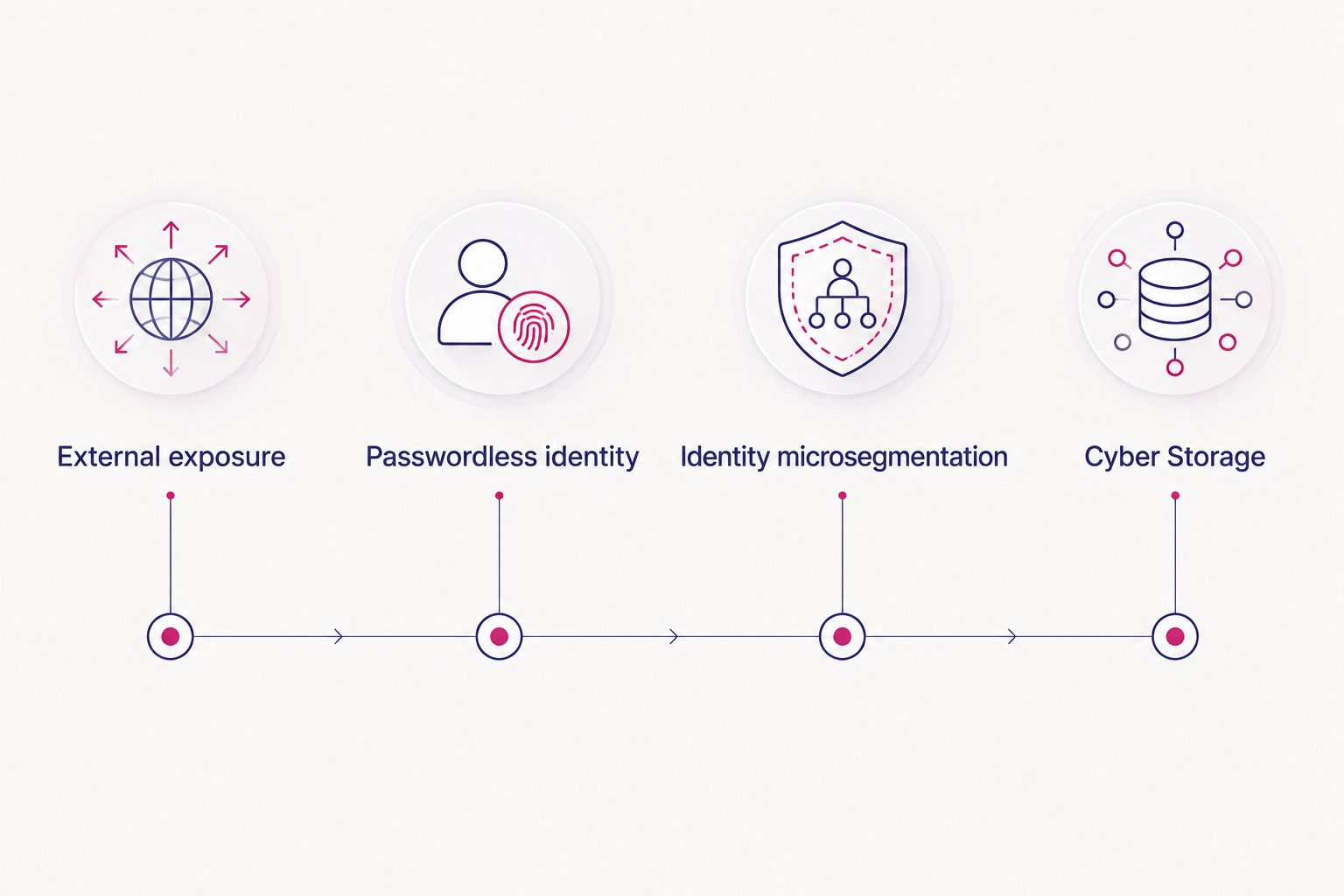
A 2026 architecture review should follow the complete path, including recovery. Do not stop at the perimeter, and do not treat a recovery architecture as permission to weaken preventive access controls.
Why attack-path prevention varies
The outcome depends on the conditions your controls cover and enforce. Use these factors to explain why an identified path remains open or why a claimed closure needs further testing.
- Exposure coverage: An undiscovered external entry point cannot enter the remediation process. Confirm that the assessment covers the assets relevant to the path.
- Credential coverage: Passwordless protection must include the relevant authentication routes. Password-based exceptions leave credential dependencies in place.
- Authorization accuracy: A valid identity with excessive permissions retains access beyond its business need. Authentication strength does not correct that authorization.
- Segmentation enforcement: An intended boundary must deny unwanted access in practice. Untested policies and broad exceptions weaken containment.
- Data-resilience scope: Protected data and authorized recovery must be assessed together. A resilient repository does not establish protection for every other copy.
- Change control: New exposure, permissions, or exceptions can reopen a closed route. Revalidate the path after changes that affect its access relationships.
These factors give you a useful reporting structure. Identify the open relationship, assign its owner, specify the change, and record the validation result. Avoid declaring an entire environment breach-proof because one route has been closed.
How do you prove an attack path has been removed?
Prove removal by testing the access relationship that previously made the path usable. A closed ticket, a new policy, or a cleaner diagram is not sufficient on its own. The result must show a changed access condition.
Use this sequence for your 2026 validation:
- Describe the starting position. Specify the exposed service or assumed compromised identity. Keep the scenario narrow enough to test safely.
- Name the destination. Identify the sensitive resource, administrative capability, or data location at risk. Explain the business consequence of reaching it.
- Record the enabling relationship. State the credential, permission, exposure, or access rule that connects the starting point to the destination.
- Change the control. Remove the unnecessary exposure or access relationship without relying solely on detection.
- Retest the route. Confirm that unauthorized progression fails and required business activity still works. Retest alternate routes within the agreed scope.
For data resilience, use a separate recovery exercise. Verify authorized reconstruction of protected data under the incident conditions you need to withstand. Do not assume a successful normal-operation recovery proves recovery during disrupted access.
Can attack path management stop ransomware?
Attack path management can interrupt the routes ransomware operators use to gain access and move toward data. It does not guarantee that every ransomware attempt will fail. Prevention requires enforced exposure, identity, and segmentation controls, with data resilience supporting recovery if compromise occurs.
Keep encryption and exfiltration in the same assessment. An attacker who cannot encrypt a protected repository can still pursue accessible data elsewhere. Review source systems and access permissions alongside the resilience architecture.
Is attack path management the same as vulnerability scanning?
Attack path management and vulnerability scanning answer different questions. Vulnerability scanning identifies weaknesses; attack path management examines how weaknesses and access relationships connect to a destination. Use scanning results as part of the path assessment rather than treating either activity as a substitute for remediation.
Does passwordless authentication remove every identity attack path?
Passwordless authentication removes reusable password dependencies where deployed, not every identity attack path. Excessive permissions, stolen sessions, and unnecessary access relationships remain separate concerns. Pair authentication changes with authorization review and identity microsegmentation.
FAQ
Can attack path management prevent a breach before an attacker gets in?
Yes, when you remove an exposed entry point or another required relationship before exploitation. Mapping the path without enforcing a change provides visibility, not prevention.
What’s the best first step for attack path management?
Start with a sensitive destination and identify the access routes that lead to it. Assign owners to the enabling relationships, then remove and retest the unnecessary ones.
Is attack path management better than vulnerability scanning?
Attack path management is better suited to prioritizing connected routes to business harm; vulnerability scanning identifies weaknesses that can contribute to those routes. Use both to support remediation rather than choosing one as a complete replacement.
Can microsegmentation help after a credential is compromised?
Identity microsegmentation limits the resources a compromised identity can reach when its access policies are enforced. It reduces lateral movement and blast radius but does not undo the initial compromise.
Does Cyber Storage replace passwordless authentication?
Cyber Storage does not replace passwordless authentication. SecFolio uses Cyber Storage for data resilience, while passwordless identity addresses reusable credentials and identity microsegmentation restricts lateral movement.
How do I know an attack path is really closed?
Retest the relationship that previously enabled unauthorized access and confirm that the route no longer works. Also verify required business access and assess alternate routes within the test scope.
Can we rely on backups alone to prevent a data breach?
Backups alone do not prevent a data breach. Recovery copies address restoration, while exposure, identity, segmentation, and data-protection controls address how an attacker gains access and reaches usable information.
One last thing
Ask for the denial evidence, not just the attack-path diagram. A useful diagram explains how compromise could progress. A useful prevention result demonstrates where that progression now fails.
Choose a route to a sensitive destination and require a clear answer: which access relationship changed, who owns the control, and what test confirms the interruption? That question keeps attack path management tied to prevention rather than presentation.


