

No. Attack surface management cannot replace vulnerability scanning unless the replacement platform also delivers the scanning capabilities your environment requires. Attack surface management finds assets and exposures; vulnerability scanning tests reachable, in-scope systems for known weaknesses. For a 2026 consolidation decision, compare verified coverage—not product labels—and keep authenticated assessment wherever an external view cannot inspect the system.
- Attack surface management vs vulnerability scanning is a coverage decision: discovery does not replace authenticated assessment.
- Use attack surface management for unknown assets; use vulnerability scanning for technical assessment of known systems.
- Secfolio suits enterprise security teams that need external exposure management alongside identity controls and data resilience.
- Consolidate tools only after validating asset discovery, scanning depth, remediation ownership, and retesting.
Can attack surface management replace vulnerability scanning?
Replace duplicate capabilities, not distinct security controls. Attack surface management and vulnerability scanning overlap when both assess externally reachable services. They differ when discovery must extend beyond your inventory or assessment must reach inside a host.
Start with how to detect external exposure before attackers do if your immediate problem is identifying what your organization exposes. That discovery work establishes scan scope; it does not establish that every discovered asset has received a complete vulnerability assessment.
| Assessment question | Attack surface management | Vulnerability scanning |
|---|---|---|
| What is it best for? | Finding and tracking assets and exposures, including assets missing from an inventory | Testing in-scope systems for known vulnerabilities and supported configuration weaknesses |
| What does it start with? | Discovery inputs and methods that vary by platform | Defined targets, discovery results, agents, or integrations, depending on the scanner |
| What does an external view reveal? | Publicly observable services and exposure relationships | Weaknesses detectable through the checks available without authentication |
| What does authenticated access add? | Only what the platform's authenticated assessment capabilities support | Deeper inspection of installed software and configurations where supported |
| What is the main advantage? | Expands the set of assets you know to assess | Adds technical evidence about weaknesses on assessed assets |
| What is the main limitation? | Discovery alone does not prove vulnerability assessment coverage | Assessment cannot cover assets outside its scope or reach |
| Can it close a finding? | Requires remediation and verification beyond discovery | Requires remediation and retesting beyond detection |
Best for unknown exposure: attack surface management. Best for technical assessment: vulnerability scanning. Neither control proves that an attacker cannot reach sensitive data through a compromised identity.
Why this matters
An accurate scan of an incomplete inventory leaves assets unassessed. A complete-looking exposure inventory without sufficient testing leaves technical weaknesses unresolved. Your security program needs both a reliable scope and evidence about the systems within it.
For your 2026 review, separate discovery completeness from assessment depth. Combining those measures into a single coverage percentage hides the distinction between an asset that was found, an asset that was tested, and an asset whose weaknesses were fixed.
Use 2 assessment views: what an unauthenticated outsider can observe and what an authorized assessment can inspect. They answer different questions. An internet-facing service can appear correctly configured while its underlying host still needs authenticated assessment.
What attack surface management contributes
Attack surface management addresses the inventory boundary. It helps identify assets and exposures that your existing security workflows need to investigate, assign, and assess. External attack surface management concentrates on what is observable from outside the organization.
That distinction matters when an application team publishes a service without adding it to the central inventory. A scanner configured only for approved targets does not automatically assess that new service. Discovery supplies the missing target and starts the ownership conversation.
Useful exposure records connect an asset to evidence: the observed service, the reason it is associated with your organization, its owner, and the action required. An unowned finding is not a completed security outcome. Someone must validate the association and decide whether to remove, restrict, or assess the asset.
The limitation is equally clear. Observing a service does not grant visibility into every package, account, or configuration behind it. A platform's discovery breadth cannot stand in for assessment depth that it does not provide.
What vulnerability scanning contributes
Vulnerability scanning addresses technical assessment within a defined scope. Supported checks identify known weaknesses in reachable services, installed software, or configurations. Results depend on the scanner's checks and the access available to it.
Unauthenticated scanning tests what the assessor can observe without signing in. Authenticated scanning uses authorized access to inspect information unavailable from the outside. Agent-based assessment is another approach, but its coverage still depends on deployment and supported checks.
A successful connection is not proof of a complete assessment. Check whether authentication succeeded, whether the expected systems were assessed, and whether the relevant checks ran. A report with few findings can reflect limited visibility rather than a secure system.
Scanning also has limits. It does not automatically identify every business-owned asset, validate every attack path, or stop exploitation. You still need remediation owners, safe assessment procedures, and evidence that corrective changes worked.
Why replacement decisions vary
The answer to attack surface management vs vulnerability scanning depends on the capabilities you would remove—not the name of the platform you would retain.
- Discovery scope. Determine whether the replacement finds assets beyond the inventory your current scanner already receives.
- Assessment access. Confirm whether it supports the authenticated or agent-based inspection required for your systems.
- Asset types. Match supported assessment methods to the servers, endpoints, applications, and cloud resources in scope.
- Network reachability. Separate externally observable assets from internal systems that require an internal assessment path.
- Remediation workflow. Verify ownership, corrective action, and retesting rather than stopping at a finding notification.
- Evidence continuity. Preserve assessment history and closure evidence needed by your security and assurance teams.
These factors explain why one platform can replace overlapping external checks while leaving internal scanning necessary. They also explain why adding discovery without changing remediation ownership does not resolve the underlying workflow problem.
Step 01: Map the capabilities before consolidating
For a 2026 replacement assessment, build a capability map before comparing dashboards. List what your current program actually does: discover assets, assess public services, inspect internal hosts, assign findings, and verify fixes.
Map each capability to the proposed replacement. Record the access it requires and the evidence it produces. Treat vendor terminology as a starting point for questions, not as proof of equivalent coverage.
Use 3 decision gates: discovery, assessment, and closure. These are evaluation categories, not a performance benchmark. A proposed replacement must meet your requirements at each gate before you remove the existing capability.
A platform that passes discovery but fails authenticated assessment is an addition, not a complete replacement. A platform that performs both but cannot preserve your closure evidence still needs a workflow change before consolidation.
Step 02: Validate discovery separately from scanning
Start with assets whose ownership and exposure you can verify. Include known public services and representative internal systems. Keep the evaluation within authorized scope and confirm assessment procedures with the system owners.
Then compare the discovery results with your existing inventory. Investigate newly identified assets, incorrect ownership associations, missing assets, and stale records. Do not count an unresolved association as confirmed coverage.
Next, examine what happened after discovery. Did the asset receive an assessment, or did it only appear on a dashboard? Did the assessor reach the intended service? Where authentication was required, did it succeed?
A discovered asset and an assessed asset are different records of progress. Preserve that distinction in reporting so inventory growth does not appear to be completed remediation.
Step 03: Test assessment depth and safe operation
Compare assessment results on the same authorized systems. Look beyond total findings. Check whether each platform identifies the relevant software and configuration evidence, and investigate meaningful differences rather than assuming the longer report is better.
Validate access conditions. An external check, an authenticated host assessment, and an agent-based assessment do not necessarily inspect the same things. Document what each method can and cannot see in your environment.
Agree on safe procedures before testing sensitive systems. Review scan methods, credentials, exclusions, and operational constraints with the owners. Assessment coverage should not come from bypassing the controls that keep production systems stable.
For your 2026 acceptance record, state the scope and limitations explicitly. A platform that meets the requirements for public web services has not automatically met the requirements for internal hosts or operational technology.
Step 04: Verify remediation and retesting
A finding needs an accountable owner and a corrective action. Patching is one possible action; removing an unnecessary service or restricting access addresses different exposure conditions. Choose the action that removes the relevant weakness or attack path.
Retest using the assessment method appropriate to the original finding. If authentication was necessary to identify the weakness, an external observation alone does not establish that the internal condition was corrected.
Keep the original evidence, the change record, and the verification result connected. That record lets another analyst distinguish a resolved condition from an asset that disappeared from the assessor's view.
Loss of visibility is not proof of remediation. Before closing a finding, establish whether the asset was retired, access was intentionally restricted, or the underlying weakness was fixed.
Step 05: Connect exposure findings to attack-path controls
Discovery and scanning address exposure and technical weaknesses. They do not replace identity controls or data resilience. Use the findings to decide where to break an attack path, then verify the control that breaks it.
Secfolio's external exposure management sits alongside passwordless authentication, identity microsegmentation, and Cyber Storage in a 4-layer attack-path framework. Each layer addresses a different part of the route from initial access to business impact.
- External exposure. Discover and close exposed entry points before initial access.
- Passwordless identity. Remove reusable passwords from authentication flows covered by the deployment.
- Identity microsegmentation. Restrict identity access to contain lateral movement and reduce blast radius.
- Data resilience. Preserve recoverability and address the consequences of ransomware and exfiltration.
Discovery does not enforce an identity boundary, and segmentation does not identify every missing patch. Keep those responsibilities separate even when one platform presents their findings together.
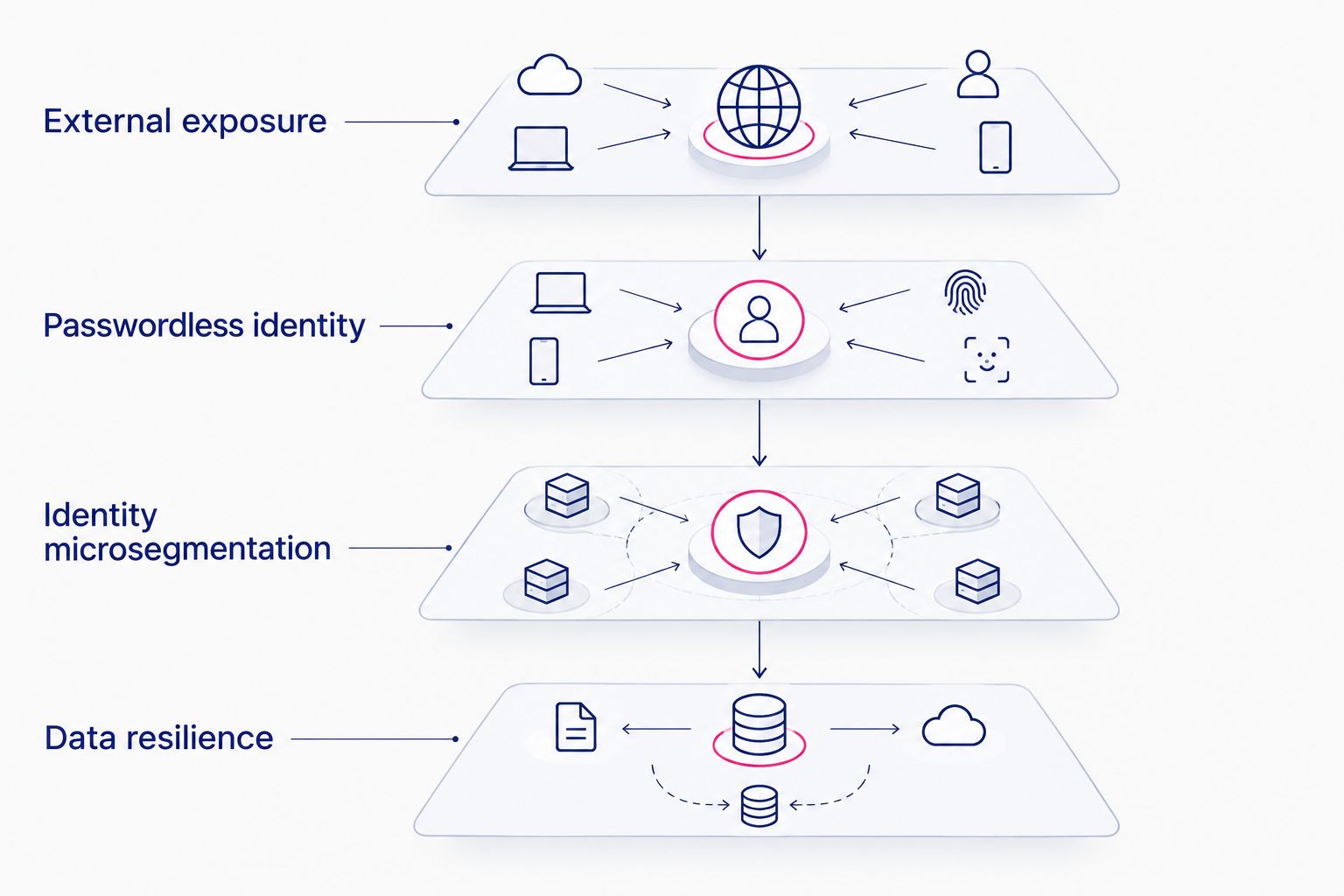
Secfolio's Cyber Storage is a data-resilience architecture, not a backup product or a substitute for scanning. It encrypts data before it leaves the customer environment, uses sharding to create immutable encrypted fragments, and distributes those fragments across independent locations. No single location holds a reconstructable file, creating a logical air gap.
The operational distinction is between a complete file and unusable fragments. Conventional complete backup copies remain complete data objects; distributed encrypted shards are not individually reconstructable files. Authorized recovery depends on the recovery architecture, so validate distributed recovery and its dependencies in your environment.
This layer does not make every source system inaccessible or remove every exfiltration route. Keep exposure management, passwordless identity, and identity microsegmentation in place. Data resilience addresses a different failure condition.
Should you buy attack surface management or vulnerability scanning first?
Keep vulnerability assessment coverage while addressing the inventory gap. If your known systems already receive adequate assessment but unknown public assets remain a problem, attack surface management addresses that specific gap. If you lack technical assessment of known systems, discovery alone is insufficient.
Do not use a procurement sequence as a reason to discontinue an existing control prematurely. Establish ownership and assessment for newly discovered assets while preserving the checks your known systems require.
Does continuous discovery mean continuous vulnerability assessment?
No. Discovery frequency does not establish assessment frequency or depth. A platform can update an asset record without rerunning every relevant vulnerability check. Ask what triggers reassessment and inspect the resulting evidence.
For a 2026 operating model, document discovery, assessment, remediation, and verification as separate activities. That makes delays visible without treating every inventory update as a security improvement.
Can one platform provide both capabilities?
Yes, if its verified capabilities meet both sets of requirements. Product categories overlap, so evaluate discovery breadth and assessment depth directly. Keep any existing capability whose required coverage the proposed replacement cannot demonstrate.
Secfolio suits enterprise security teams that need external exposure management alongside identity controls and data resilience. That fit does not establish scanner equivalence; assess the specific scanning requirements separately.
FAQ
What’s the difference between attack surface management and vulnerability scanning?
Attack surface management identifies and tracks assets and exposures; vulnerability scanning tests in-scope systems for known weaknesses. Their external assessment capabilities overlap, but discovery does not prove authenticated assessment coverage.
Is attack surface management better than vulnerability scanning?
Neither is better across every security task. Attack surface management is best for discovering unknown exposure, while vulnerability scanning is best for technical assessment of systems within its supported scope.
Can I stop internal vulnerability scans after deploying external attack surface management?
No, not unless the replacement also provides the internal assessment coverage you require. An external view cannot substitute for authenticated inspection of information that is not externally observable.
Does attack surface management automatically fix vulnerabilities?
Attack surface management does not automatically establish that a weakness has been fixed. Confirm the platform’s remediation capabilities, assign an owner, and verify the corrective change.
How do I know whether one platform can replace both tools?
Validate asset discovery, assessment depth, and closure evidence on representative authorized systems. Remove an existing capability only after the replacement demonstrates the required coverage.
Where does Secfolio fit in an exposure management program?
Secfolio provides enterprise external exposure management alongside passwordless authentication, identity microsegmentation, and data resilience. These controls address different parts of an attack path and do not establish vulnerability-scanner equivalence.
Does data resilience remove the need for vulnerability scanning?
No. Data resilience addresses recoverability and data exposure consequences, while vulnerability scanning identifies technical weaknesses in assessed systems. Keep both responsibilities explicit in the security program.
One last thing
Test your closure rule before your consolidation decision. Select an authorized finding, follow it through ownership and corrective action, and inspect the verification evidence. A dashboard that loses sight of an asset can look cleaner without proving that anything became safer.
Your replacement decision should preserve that distinction. Require evidence that the weakness or attack path was removed—not merely that the finding stopped appearing.
Related guides
- How to prioritize external exposure findings for remediation
- How to visualize attack paths before attackers exploit them
- How to detect misconfigurations across cloud and on-prem systems


