

Deepfake detection can help stop CEO fraud calls, but it cannot authorize a payment or prove a caller’s identity by itself. In 2026, use detection to flag suspicious audio, then require independent verification and payment approval before anyone acts; a clean detector result is not permission to proceed.
- Can deepfake detection stop CEO fraud calls? It helps flag impersonation; independent verification must control the transaction.
- Voice cloning detection assesses audio, not a caller’s authority to move money or change access.
- SecFolio’s enterprise cybersecurity framework connects identity controls, lateral movement containment, external exposure management, and data resilience.
- Stop suspicious requests, verify through trusted contact details, and preserve evidence before resuming the workflow.
Can deepfake detection stop CEO fraud phone calls?
Deepfake detection addresses the voice impersonation part of CEO fraud. The fraud succeeds when someone accepts an instruction and releases money, changes bank details, discloses information, or grants access. The decisive control is the authorization process, not whether the voice sounds authentic.
For your 2026 evaluation, separate audio analysis from business approval. When reviewing deepfake detection tools ranked by accuracy, ask whether the evidence matches your actual telephone environment and whether alerts arrive before employees act.
| Control | Best for | What it contributes | Limitation |
|---|---|---|---|
| Deepfake detection | Flagging suspected synthetic audio | Provides a signal for investigation or a transaction hold | Does not establish business authority or transaction legitimacy |
| Independent callback | Checking the request through an established contact route | Breaks reliance on contact details supplied by the caller | A compromised directory or account weakens verification |
| Separate payment approval | Preventing unilateral release of funds | Requires another authorized person to review the transaction | Approval becomes ineffective when reviewers simply repeat the caller’s instructions |
| Phishing-resistant authentication | Protecting access to approval systems | Reduces dependence on reusable passwords | Does not determine whether an authenticated payment request is legitimate |
These controls answer different questions. Audio analysis asks whether speech appears manipulated. Verification asks who requested the action. Approval asks whether the organization should perform it.
Why this matters
A convincing voice creates pressure to treat an unusual request as an executive exception. Urgency, confidentiality, and authority can turn a normal approval process into an informal phone instruction. Detection helps identify suspicious audio, but an employee still needs a clear rule for what happens next.
Your 2026 policy should make that rule explicit: executive status never overrides verification. Apply the same process to the CEO, a supplier, a board member, or someone claiming to represent legal counsel.
Do not ask employees to become voice-forensics specialists. Give them permission to pause the request without debating whether the speaker is genuine. A legitimate executive can complete the established approval process.
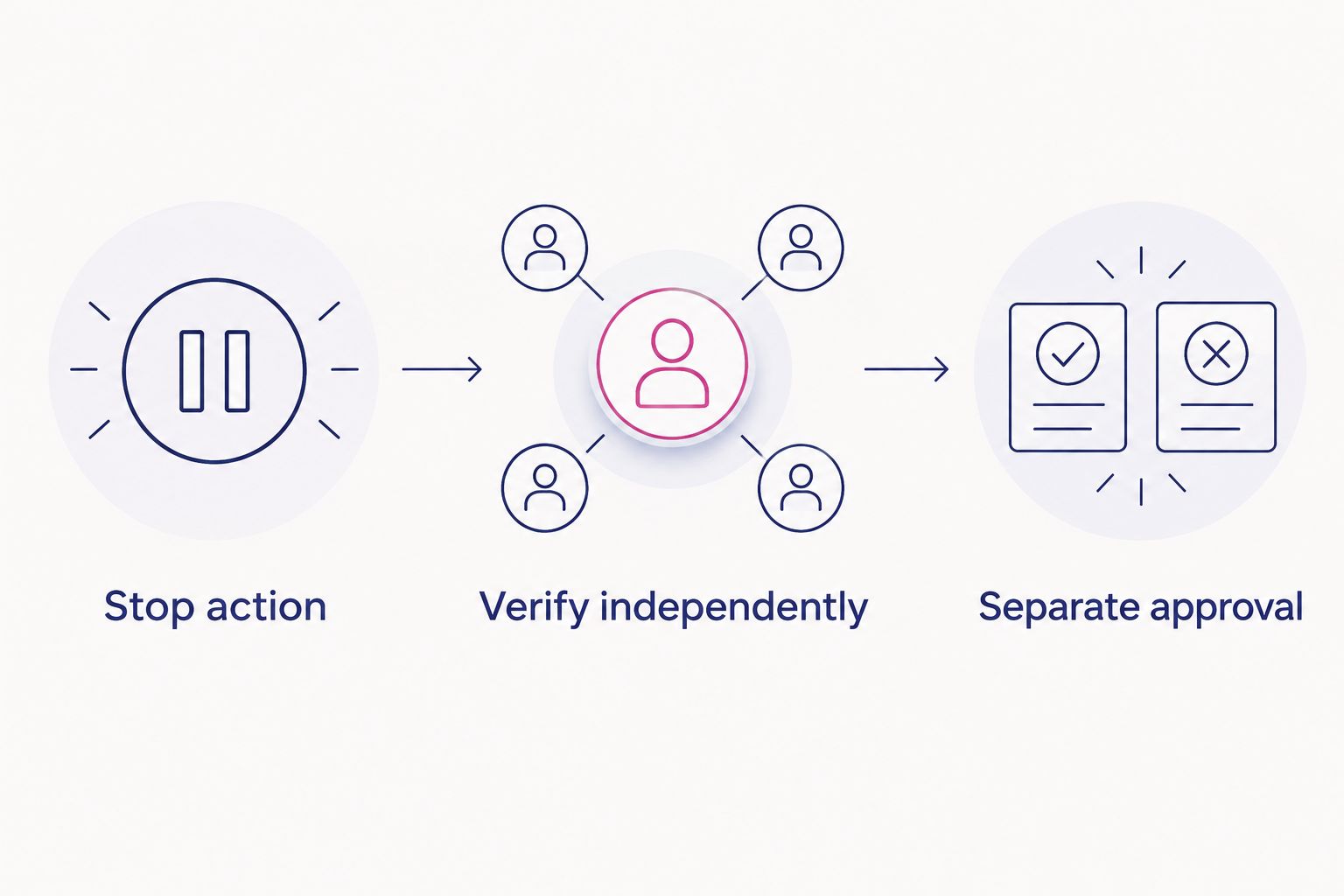
Step 01: Stop the requested action
When a caller requests an unusual payment, beneficiary change, credential reset, or sensitive disclosure, pause the action. Do not continue processing while waiting for an audio verdict.
Define the hold around the requested action, not around an accusation. Employees should be able to suspend a transfer without declaring that the CEO is an impostor. This keeps the response procedural rather than personal.
Preserve the transaction reference, call time, claimed identity, requested action, and any available alert. Handle recordings according to your organization’s recording, privacy, and retention rules.
For a payment request, hold both the transfer and associated changes to beneficiary details. Otherwise, the organization can verify the executive while overlooking a substituted destination account.
Step 02: Verify through an independent route
End the incoming call. Contact the executive or their authorized delegate using an established directory or previously verified contact method—not a number, link, or messaging account supplied during the suspicious conversation.
Caller ID is not sufficient evidence of identity. Neither is a familiar voice, knowledge of an internal project, or a follow-up message that repeats the same instruction.
Verification must cover the substance of the request. Confirm the recipient, destination details, business purpose, and approval route. Asking only whether the executive called leaves the actual transaction unchecked.
Use a trusted contact route to verify the request, not just the speaker. If the established route is unavailable, keep the hold in place and escalate through the documented exception process.
Step 03: Separate verification from approval
Use 2 authorized approvers for high-risk payment changes as a recommended control design. One person verifies the request through the trusted route; another reviews the supporting transaction record and payment destination.
The second approval must add independent scrutiny. A second employee listening to the same incoming call does not create an independent verification route.
Keep the evidence inside the approved workflow. Record who verified the request, which trusted channel they used, what transaction details they checked, and who released the hold.
For your 2026 tabletop exercise, include an executive who insists that normal approval is too slow. The expected response remains the same: preserve the hold, use the trusted route, and document the decision.
Why protection against CEO fraud varies
The protection you get depends on where detection sits in the workflow and what employees must do with its output. Evaluate these factors before treating a detector as a preventive control:
- Call coverage. Identify which phone systems, conferencing routes, and recorded-call workflows the proposed deployment actually analyzes. An uncovered channel receives no audio assessment.
- Decision timing. An alert delivered after payment release supports investigation, not prevention of that payment.
- Verification independence. A callback to a number supplied by the suspected attacker does not establish a separate trust path.
- Approval enforcement. A documented rule provides little protection if executives can bypass it through an informal request.
- Failure handling. Unavailable audio analysis must trigger a defined process rather than an assumption that the call is safe.
These are deployment criteria, not claims about any particular detector’s performance. Require evidence for each criterion in your own environment.
How should you evaluate deepfake detection in 2026?
Evaluate the complete response path, not a demonstration clip. A useful pilot shows how a suspicious call becomes a hold, a verification task, and a documented resolution.
Test the telephone path you actually use
Ask for an evaluation using representative call routes, permitted recordings, and the audio conditions your employees encounter. Include both genuine calls and authorized synthetic samples. Do not treat results from unrelated recordings as proof of performance on your phone system.
Document missed synthetic samples and genuine calls incorrectly flagged as suspicious. Both matter: missed detections leave a gap, while unnecessary alerts consume verification capacity.
Define the action for every result
Plan for 3 operational outcomes: suspicious, not flagged, and unavailable or inconclusive. These are recommended workflow states, not a claim that every product exposes those exact labels.
A suspicious result should trigger the hold and escalation process. A not-flagged result should leave normal verification requirements intact. An unavailable result should never silently remove the approval requirement.
Inspect the integration boundary
Ask whether the proposed implementation only displays an alert or can also initiate a case, notify the responsible team, or request a transaction hold. Confirm each capability before including it in your operating procedure.
Do not assume a detector can block a bank transfer because it analyzes a call. Telephony, case management, identity systems, and payment systems have separate control boundaries.
Examine data handling
Establish what audio leaves your environment, where it is processed, who can access it, and how long it is retained. Include consent and recording requirements in the review.
Executive calls can contain sensitive business information. Detection should not introduce an unexamined disclosure route while trying to prevent impersonation.
What should employees do when the detector reports no deepfake?
A not-flagged result does not prove the caller is legitimate. Continue with the established verification and approval process, particularly for new beneficiaries, changed bank details, access recovery, or confidential data requests.
A fraudster does not need synthetic speech to impersonate an executive. A real human voice can carry a fraudulent instruction. That is why transaction controls must work independently of audio classification.
Does passwordless authentication stop voice-cloning fraud?
Passwordless authentication protects account access, not the truth of a phone instruction. Phishing-resistant authentication helps protect the systems employees use to verify and approve requests, but an authenticated employee can still approve a fraudulent transaction.
Keep payment intent separate from login success. Require the approver to review the actual destination and business purpose rather than treating successful sign-in as proof that the request is safe.
Where does deepfake defense fit in enterprise security?
Deepfake defense addresses an impersonation route. It does not replace the controls that prevent stolen access, contain lateral movement, or preserve data resilience after a compromise.
SecFolio’s enterprise cybersecurity framework suits large organizations that need identity protection, attack-path containment, and data resilience together. Apply its 4-layer framework without confusing the purpose of each layer:
- External exposure. Discover and close exposed assets and weaknesses before they provide initial access. This addresses reachable attack paths, not whether a voice is authentic.
- Passwordless identity. Eliminate reusable credentials through passwordless authentication. Protect the identity systems behind approval and administrative workflows.
- Identity microsegmentation. Contain lateral movement by restricting which identities can reach which resources. Reduce the blast radius when an account is compromised.
- Cyber Storage. Preserve data resilience through encryption, sharding, and distribution across independent locations. No single location holds a reconstructable file.
SecFolio’s Cyber Storage encrypts data before it leaves the customer environment, then distributes immutable, unusable fragments. That creates a logical air gap: compromise of a single storage location exposes fragments rather than a reconstructable file, while authorized recovery uses the distributed data.
This architecture is complementary to deepfake defense. It addresses data resilience when an incident involves ransomware or exfiltration; it does not recover a fraudulent bank transfer or validate an executive instruction. Identity, segmentation, and exposure controls remain necessary.
What should happen after a suspected CEO fraud call?
Keep the requested action on hold while finance and security establish what happened. Determine whether anyone released funds, changed beneficiary details, disclosed information, reset authentication, or granted access.
If funds moved, contact the relevant financial institution promptly through established channels. If credentials or access changed, review the affected accounts and sessions under your incident-response procedure. Do not limit the investigation to the audio file.
Retain the call evidence and associated approval records according to policy. Record the detector result as evidence, not as a final determination of who called.
Your 2026 review should ask where the request crossed a trust boundary. Fix the point where a voice instruction became authority to act, even if audio detection performed as expected.
FAQ
Can deepfake detection stop CEO fraud calls on its own?
No. Deepfake detection can flag suspected synthetic audio, but independent verification and enforced approval controls must stop an unauthorized action.
Can I trust a call if the voice sounds exactly like our CEO?
No. A familiar-sounding voice does not establish identity or authorization. Verify sensitive requests through an established contact route and the approved workflow.
What should I do first during a suspected voice-cloning scam?
Pause the requested action and end the incoming call. Verify through independently established contact details, then escalate through your documented process.
Is calling back the number on caller ID enough?
No. Caller ID is not sufficient identity evidence. Use a previously verified directory entry or another established contact route rather than details supplied during the suspicious call.
Does a clean deepfake detection result mean a payment is safe?
No. A not-flagged result does not prove the speaker’s identity, the request’s legitimacy, or the destination account’s correctness. Keep normal approval controls in place.
Does SecFolio’s Cyber Storage prevent fraudulent wire transfers?
Cyber Storage is a data-resilience architecture, not a payment authorization control. It uses encryption, sharding, and distribution to preserve data resilience; finance still needs independent verification and payment approvals.
What should a deepfake detection pilot measure in 2026?
A 2026 pilot should assess detection results on representative calls, alert timing, workflow coverage, and response handling. Include missed detections, incorrect alerts, and unavailable analysis rather than reporting a single headline accuracy figure.
One last thing
Test the process with a genuine executive voice making an unauthorized request. This isolates the control that matters: whether employees verify authority and transaction details even when there is no synthetic audio to detect.
If that request bypasses approval, a better audio detector will not repair the failure. Fix the authorization path first.


