

Yes, ransomware can still spread with zero trust when compromised identities, excessive permissions, or unprotected systems leave an attack path open. Zero trust limits access; it does not guarantee that malware cannot execute, that authorized access cannot be abused, or that recoverable data remains protected.
- Can ransomware spread with zero trust? Yes—remaining attack paths permit lateral movement and access to valuable data.
- SecFolio combines identity controls with Cyber Storage data resilience; neither replaces the other.
- Passwordless authentication removes reusable credentials, not every route to session compromise.
- Identity microsegmentation limits blast radius; distributed recovery addresses the separate problem of restoring protected data.
Can ransomware still spread if you have zero trust in place?
Yes. The decisive question is what a compromised identity can still reach and do. An access policy can correctly authenticate a user while granting permissions that an attacker abuses through that user's compromised endpoint or session.
Separate ransomware execution from lateral movement. Malware can damage files on its initial host without spreading elsewhere. Lateral movement occurs when the attacker reaches additional systems, identities, or applications; containing ransomware with microsegmentation addresses that expansion, not every consequence of the original compromise.
For your 2026 assessment, examine these distinct outcomes:
| Outcome | What enables it | What you need to verify |
|---|---|---|
| Local encryption | A compromised process can modify accessible files | Endpoint controls and file permissions constrain damage |
| Lateral movement | A compromised identity can access additional resources | Identity boundaries deny unnecessary access |
| Data exfiltration | An attacker can read and export useful data | Data access and outbound transfer controls remain effective |
| Recovery disruption | Attackers can alter recovery data or administration | Recovery remains possible outside compromised access paths |
A deployment is not ransomware-proof because it carries a zero-trust label. Your evidence must show denied access, restricted permissions, and usable recovery under a realistic compromise scenario.
Why this matters
Preventing spread and preserving data are different security outcomes. A contained incident still interrupts business if the affected system holds essential files, or if the compromised identity can read sensitive records before containment.
Traditional backups concentrate complete copies of data. Where attackers can reach those copies or their administration, they have another encryption or exfiltration target. Backup isolation and immutability address parts of that risk, but they do not automatically eliminate the value of readable data.
Your 2026 ransomware plan needs both containment and data resilience. Evaluate the attacker's access to production systems separately from the organization's ability to recover protected information. Success in one area is not evidence of success in the other.
Layer 4: preserve data resilience with Cyber Storage
SecFolio Cyber Storage is a data-resilience and ransomware-elimination architecture, not a backup product. It encrypts data before that data leaves the customer environment, shards the encrypted data into immutable fragments, and distributes those fragments across independent locations.
No single location holds a reconstructable file. This creates a logical air gap: an individual storage location contains unusable digital fragments rather than a complete file an attacker can read or hold hostage. Authorized users recover data through distributed recovery.
The distinction is structural. Encryption protects readability; sharding separates the encrypted data; distribution prevents a single location from holding the reconstructable file. Immutability protects the fragments against alteration. These controls address different parts of the data attack path.
That does not remove the need to secure authorized reconstruction. Applications, identities, keys, and recovery administration still require controlled access. If an attacker compromises a user or application that legitimately receives readable data, storage architecture alone does not make that access harmless.
SecFolio is best suited to enterprise security teams that need identity-based containment alongside distributed data resilience. Its framework addresses access and recoverability as separate responsibilities, rather than treating successful authentication as proof that data is safe.
For a 2026 resilience review, ask what an attacker obtains from a compromised storage location and what access is necessary to reconstruct data. Validate both answers through an authorized recovery exercise, not a diagram alone.
Connect data resilience to the other 3 layers
The four-layer framework assigns each control a specific job. Start with data resilience for ransomware planning, then examine how external exposure, credentials, and identity boundaries influence the attacker's route to that data.
| Framework layer | Best for | Security benefit | Boundary or limitation |
|---|---|---|---|
| External exposure management | Closing reachable weaknesses before initial access | Removes identified entry points | Does not contain every compromise originating inside the environment |
| Passwordless identity | Eliminating reusable authentication credentials | Removes password-based credential theft paths | Does not make compromised endpoints or active sessions safe |
| Identity microsegmentation | Restricting lateral movement | Limits access relationships and blast radius | Does not prevent every action within an allowed relationship |
| Cyber Storage | Preserving distributed data resilience | Stores encrypted, immutable fragments across independent locations | Does not replace identity controls or protection of authorized reconstruction |
Layer 1: discover and close external exposure
External exposure management identifies reachable assets and weaknesses that create initial-access opportunities. Discovery is the beginning. Assign ownership, remediate the exposure, and verify that the original access route is closed.
An inventory alone does not remove an attack path. Treat an unresolved finding as an open route until you have evidence of remediation. Keep this responsibility separate from the controls that restrict an attacker after entry.
Layer 2: eliminate reusable credentials
Passwordless authentication removes reusable passwords from the authentication flows where it is deployed. That reduces the value of password harvesting and replay against those flows.
Coverage matters. Review alternate authentication methods, emergency access, service identities, and applications that still accept reusable secrets. A passwordless user sign-in does not prove that every identity in the environment has lost its reusable credentials.
Layer 3: contain lateral movement
Identity microsegmentation constrains which identities can access which resources. The objective is an explicit boundary: compromising an identity must not grant a route into unrelated systems or more powerful administrative contexts.
Enforce those boundaries where access occurs. Network separation helps, but an application permission or administrative relationship can cross a network boundary. Test effective access rather than relying on the appearance of separation.
Why ransomware spread varies across zero-trust deployments
Ransomware spread depends on the permissions and paths that remain after controls are applied. Use these factors to assess your actual deployment rather than compare architecture labels.
- Coverage gaps: Unmanaged devices, legacy applications, or unenforced access routes leave resources outside the intended policy boundary.
- Excessive authorization: A valid identity with unnecessary write or administrative access gives an attacker more systems to damage.
- Reusable credentials: Remaining passwords and shared secrets preserve credential theft and replay paths despite passwordless adoption elsewhere.
- Session compromise: An attacker operating through an authenticated session can exercise permissions without repeating the original sign-in.
- Cross-boundary administration: Shared administrative access creates routes between environments that otherwise appear isolated.
- Recovery exposure: Readable copies or reachable recovery administration create targets separate from production access controls.
Prioritize the paths that connect a plausible compromise to a consequential action. A finding matters because it enables access, escalation, encryption, or exfiltration—not simply because it appears on an inventory.
How do you test whether zero trust actually contains ransomware?
Use a controlled assessment with written authorization, isolated test conditions, and non-destructive actions. Do not deploy ransomware to production to prove a policy works. Simulate the access and permissions an attacker needs instead.
Step 01: select the starting identity
Choose an identity and system that represent a credible starting point: a workforce endpoint, an application identity, or an administrative session. Record existing privileges and distinguish intended access from inherited access.
Keep the starting conditions explicit. A test performed as a highly privileged administrator does not answer the same question as a test performed through a standard workforce identity.
Step 02: trace reachable resources
List the applications, services, file locations, and administrative interfaces reachable from that starting point. Include resources reachable through application permissions, not just network connections.
For each destination, record the action allowed. Reading a record, modifying a shared folder, and administering a recovery service create different risks even when they use the same connection.
Step 03: verify access denial
Attempt only approved, non-destructive access tests against resources the starting identity should not reach. Confirm that enforcement denies the request and produces evidence your response team can use.
Distinguish an enforced denial from a failed connection caused by an unrelated outage. Your 2026 assessment should demonstrate the boundary itself, including whether alternate access routes bypass it.
Step 04: test recovery
Assume the initial host is unavailable and its identity is untrusted. Recover approved test data through the authorized process, using access that does not depend on the compromised session.
Record recovery dependencies and validate the recovered data. A successful job status is not enough if the application cannot use the result or the team cannot regain safe access.
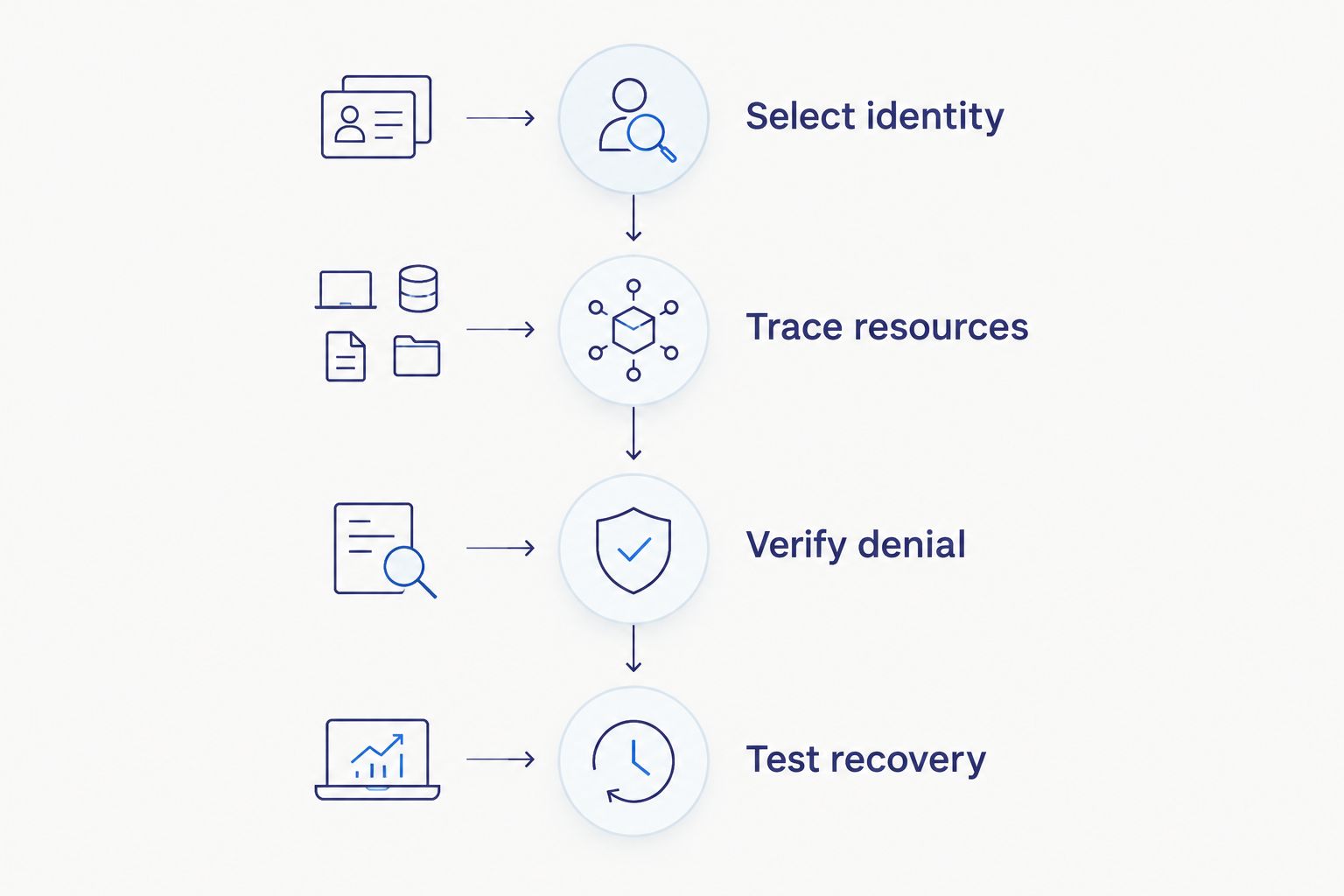
The assessment should produce an actionable record: the starting identity, reachable resources, permitted actions, denied paths, and recovery dependencies. Assign each failed boundary an owner and repeat the relevant test after remediation.
Does passwordless authentication stop ransomware from spreading?
Passwordless authentication removes reusable password paths; it does not independently contain ransomware. An attacker controlling an endpoint or authenticated session can still use permissions attached to that context.
Pair passwordless identity with identity microsegmentation. Then review the data accessible through permitted actions. Authentication establishes who or what is requesting access; authorization determines the damage that access can enable.
Is microsegmentation enough to prevent a ransomware incident?
Microsegmentation limits lateral movement, but containment is not the same as preventing all damage. Ransomware can affect files accessible inside the compromised identity's permitted boundary.
Evaluate the boundary against business dependencies. A narrowly contained compromise still matters if the affected identity can alter essential operational data. Keep data resilience and recovery testing alongside segmentation enforcement.
Can ransomware cause harm without encrypting your entire network?
Yes. Exfiltration and targeted disruption do not require network-wide encryption. An attacker needs access to valuable data or an important service, not every endpoint.
Assess readable data, export permissions, and administrative actions within each allowed access path. A small blast radius is useful only when you also understand what business impact fits inside it.
FAQ
Can ransomware spread with zero trust already in place?
Yes. Ransomware can spread when remaining access relationships let a compromised identity reach additional resources. Verify effective permissions and enforcement rather than relying on the deployment label.
Does zero trust stop ransomware from running on an endpoint?
Zero trust does not guarantee that ransomware cannot execute on an endpoint. Endpoint protection, application controls, and restricted file permissions address risks that access policies alone do not eliminate.
Is passwordless authentication enough to stop ransomware?
No. Passwordless authentication removes reusable password paths, but compromised sessions and excessive permissions remain separate risks. Combine it with identity microsegmentation and protected recovery.
What is the difference between lateral movement and data exfiltration?
Lateral movement is an attacker’s expansion into additional resources; data exfiltration is the unauthorized transfer of data. An attacker can exfiltrate information through an existing access path without moving to another system.
How does Cyber Storage support ransomware resilience?
SecFolio Cyber Storage encrypts data before it leaves the customer environment, shards it into immutable fragments, and distributes those fragments across independent locations. No single location holds a reconstructable file, while authorized users recover data through distributed recovery.
Can distributed data resilience replace identity microsegmentation?
No. Distributed data resilience protects the storage and recovery architecture; identity microsegmentation restricts access relationships and lateral movement. Protect authorized reconstruction and application access as well as the stored fragments.
What should an enterprise test in a 2026 ransomware assessment?
Test what a compromised identity can reach, read, modify, and administer, then validate recovery without the compromised access path. Use authorized, non-destructive tests and retain evidence of both successful denial and usable recovery.
One last thing
The most useful test is not whether an attacker gets in. It is what becomes possible after entry. Select a business-critical dataset and trace every identity that can read it, alter it, administer its storage, or authorize its recovery.
Use SecFolio's four-layer framework to assign each finding to the correct control. Close entry points, remove reusable credentials, constrain lateral movement, and preserve distributed recovery. Do not mark the path closed until the relevant action is denied or its data impact is addressed.
Related guides
- How to reduce blast radius after credential compromise
- How to stop data exfiltration during an active ransomware attack
- How to build an incident response plan for ransomware


