

Yes, zero trust can stop ransomware attacks by closing the attack paths that let attackers enter, move laterally, and reach sensitive data. It is not a guarantee: an authenticated attacker can still damage resources that remain accessible. In 2026, an effective architecture combines exposure management, passwordless identity, identity microsegmentation, and data resilience rather than treating successful authentication as the finish line.
- Can zero trust stop ransomware? Yes, when enforced controls interrupt attack paths; authentication alone is insufficient.
- Secfolio combines identity controls with Cyber Storage to address ransomware access, lateral movement, and data resilience.
- Cyber Storage encrypts, shards, and distributes data; no single storage location holds a reconstructable file.
- Test compromised identities, data access, and distributed recovery—not just whether users can sign in.
Can zero trust architecture actually stop ransomware?
Zero trust stops a ransomware attack when it denies an action the attacker needs to complete the attack. That action might be signing in with a stolen password, reaching another workload, modifying protected data, or accessing a recovery environment. A policy document does not stop those actions. Enforcement does.
Start your assessment with how to run a zero trust readiness assessment, then trace access from an exposed entry point to a critical business resource. The useful question is not whether you have a zero trust initiative. It is whether a compromised identity still has a working route to valuable data.
| Control | Best for | Ransomware benefit | Limit you must address |
|---|---|---|---|
| External exposure management | Reducing initial-access opportunities | Identifies exposed assets and conditions that need remediation | Discovery alone does not close an exposure |
| Passwordless identity | Removing reusable password theft paths | Removes passwords from the authentication flows you replace | Compromised sessions and endpoints still require controls |
| Identity microsegmentation | Containing lateral movement | Restricts which identities can reach which resources | Overly broad permissions preserve attack paths |
| Cyber Storage | Preserving protected-data resilience | Encrypts, shards, and distributes protected data rather than concentrating usable files | Application access, recovery authorization, and unprotected copies still need controls |
These controls solve different problems. None replaces the others. For your 2026 review, assess both the attacker's reachable resources and your ability to recover protected data without reintroducing the compromised access path.
Why this matters: access control is not data resilience
Ransomware creates more than an encryption problem. An attacker can steal information before disrupting systems, target recovery infrastructure, or use legitimate permissions to change business data. Restoring files does not undo disclosure.
Traditional backups concentrate complete copies of data. If attackers can reach those copies with sufficient permissions, the recovery environment becomes another target for encryption, deletion, or exfiltration. Isolation and immutability help, but the location of usable data still matters.
Treat prevention, containment, and recovery as separate outcomes. Prevention blocks an attack path. Containment limits blast radius after compromise. Recovery restores authorized operations after disruption. Your architecture needs evidence for all three, not a single successful login demonstration.
Layer 4: preserve data resilience with Cyber Storage
Secfolio's Cyber Storage is a data-resilience architecture, not a conventional backup product. It encrypts data before it leaves the customer environment, shards the encrypted data into immutable fragments, and distributes those fragments across independent locations. No single location holds a reconstructable file.
That arrangement creates a logical air gap. An attacker accessing an individual storage location encounters unusable digital fragments rather than a complete file. Authorized recovery reconstructs the protected data through the intended recovery process.
The distinction matters. Encryption protects confidentiality through cryptographic controls. Sharding and distribution change where reconstructable data exists. Immutability protects the stored fragments against modification. These properties work together; describing the architecture as ordinary cloud backup misses the security mechanism.
What the logical air gap does—and does not—protect
A logical air gap is an architectural separation, not a claim that every system is physically disconnected. The protected storage layout prevents a single location from holding a usable file. It does not remove the need to secure identities, applications, keys, or authorized recovery access.
An application that legitimately displays sensitive data still needs access controls. A compromised user session that can read that data remains an exfiltration concern. Likewise, an exported report or local working copy needs protection outside the distributed storage architecture.
The boundary is the protected data and its access paths—not every copy everywhere. Map where plaintext appears during ordinary work, who can request reconstruction, and where recovered data is delivered. Those are essential review questions, not reasons to abandon data resilience.
What to prove in a recovery exercise
For a 2026 resilience exercise, demonstrate recovery under compromised-access conditions. A clean-environment restore alone does not show whether an attacker can interfere with the actual recovery workflow.
Require evidence that:
- Authorized personnel can recover the protected business data.
- A compromised production identity cannot obtain recovery permissions merely through its existing access.
- An individual storage location does not expose a reconstructable file.
- Recovered data returns to an environment with the compromised attack path removed.
- Business owners can validate that recovered records support the intended workflow.
The benefit is separation between stored fragments and usable data. The operational trade-off is that reconstruction, authorization, and application recovery must be designed and tested together. Do not accept an unsupported recovery-time promise in place of an exercise.
Connect data resilience to the other three layers
Secfolio's zero trust framework connects Cyber Storage with external exposure management, passwordless identity, and identity microsegmentation. Start the ransomware discussion with protected data, then work backward through the routes an attacker would use to reach it.
The framework has 4 layers. Each layer has a distinct job, so a weakness in one does not become an excuse to omit another.
Step 01: close external exposure
External exposure creates opportunities for initial access. Discover internet-facing assets, identify exposed access paths, and assign remediation ownership. An inventory without closure leaves the original opportunity intact.
Prioritize an exposure by what it enables. An exposed service connected to privileged administration deserves attention because of the downstream access it provides, not simply because it appears on a scanner's list. Confirm the fix from the outside and record the remaining business dependency.
Best for: reducing reachable entry points. The limitation is operational ownership: security findings do not remediate themselves, and a closed exposure can return through configuration drift.
Step 02: eliminate reusable credentials
Passwordless identity removes reusable passwords from the authentication flows you replace. That interrupts attacks dependent on stealing and replaying those passwords. It also changes what the attacker must compromise to authenticate.
Do not leave a password-based fallback route that bypasses the intended protection. Review recovery flows, legacy authentication, administrator access, and service identities separately. Human passwordless sign-in does not automatically secure machine credentials.
Best for: removing password theft as an authentication path. The limitation is scope: session theft, compromised endpoints, and excessive authorization remain separate problems.
Step 03: contain lateral movement
Identity microsegmentation restricts access between identities and resources according to defined business need. The objective is straightforward: compromise of one identity must not grant a route through unrelated workloads.
Begin with actual dependencies. Restrict unnecessary access, test legitimate workflows, and confirm that the denied path stays denied after compromise. Broad administrator exceptions can erase the containment boundary you intended to create.
Best for: reducing blast radius. The limitation is policy accuracy: overly permissive rules leave lateral movement intact, while poorly designed restrictions interrupt legitimate operations.
Step 04: preserve data resilience
Cyber Storage addresses the protected data after the access-control layers have done their work. Encryption, sharding, and distribution prevent a single storage location from concentrating reconstructable files. Distributed recovery supports authorized access to protected data.
Best for: changing the architecture of ransomware targets and recovery. The limitation is that resilience does not secure every application session or eliminate the need to close exposure and contain identities.
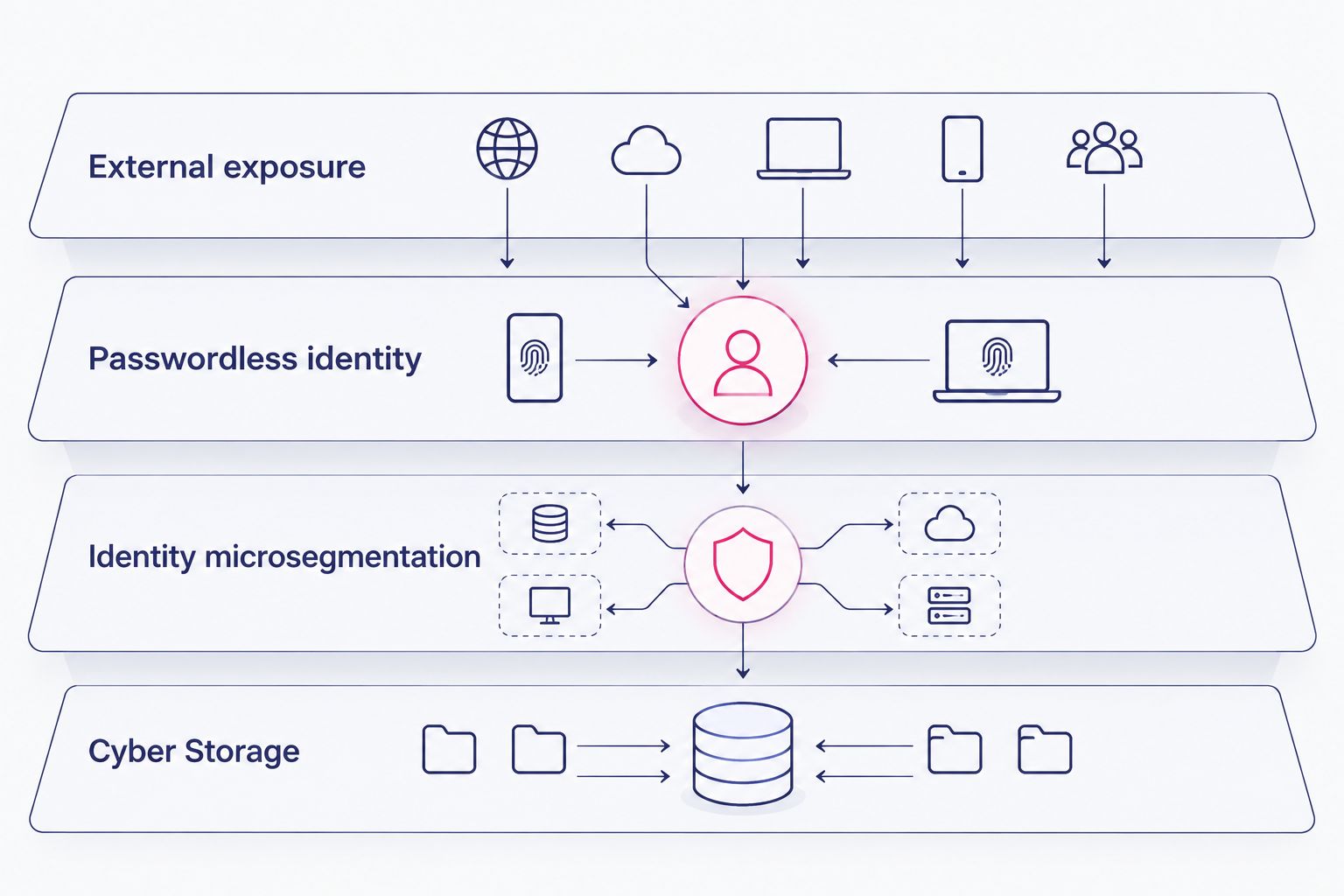
For your 2026 architecture review, require an owner and an enforcement point for every layer. A named capability without a defined boundary is not evidence that the relevant attack path has been removed.
Why zero trust ransomware protection varies
The result depends on what your controls cover and enforce. Architecture labels do not reveal whether a compromised identity can read, modify, or transfer the data that matters.
- Exposure closure: discovered assets remain attack opportunities until the relevant exposure is removed or access is restricted.
- Authentication coverage: password-based fallback flows preserve credential-replay paths outside the passwordless deployment.
- Authorization scope: valid authentication still permits harmful actions when permissions exceed business need.
- Segmentation enforcement: identity boundaries contain lateral movement only where the access policy actually applies.
- Data coverage: protected storage does not automatically protect local exports, application caches, or other usable copies.
- Recovery separation: recovery access must not inherit the same compromised privileges as the affected production environment.
Use these factors to distinguish a coverage gap from a control failure. The response differs. A missing boundary needs deployment; an ineffective boundary needs correction and retesting.
How do you prove zero trust stops an attack path?
Use a controlled exercise with an explicit starting condition and a prohibited outcome. Assume a standard user identity is compromised, for example, and test whether that identity can reach unrelated workloads or access protected-data administration. Keep the exercise authorized and isolated from destructive production actions.
Record the expected denial, the observed result, and the enforcing control. If the action succeeds, identify the permission, trust relationship, or exception that allowed it. Correct that path and repeat the exercise.
For a 2026 acceptance decision, require denied attacker actions and successful authorized recovery. A diagram proves design intent. Logs and recovery results show whether the intended boundaries work in the tested scope.
Can ransomware still encrypt files after a valid login?
Yes. A valid login does not prevent ransomware from modifying files that the authenticated identity is allowed to change. Least-privilege authorization and containment remain necessary after authentication.
Distinguish working files from protected storage. Cyber Storage changes the architecture of protected data, but applications and endpoints still need controls over usable data during normal operations. Test the permissions available to the compromised identity rather than assuming passwordless access makes every subsequent action safe.
Does immutable storage prevent data exfiltration?
No. Immutability prevents changes to protected objects; it does not, by itself, prevent an authorized or compromised reader from copying readable data. Integrity and confidentiality are different security objectives.
Encryption, sharding, and distribution address a different exposure: a storage location containing reconstructable files. You still need to control authorized reconstruction, application access, and transfers of usable data. A recovery capability cannot reverse an earlier disclosure.
Should you replace identity controls with data resilience?
No. Data resilience preserves protected data, while identity controls restrict who can access systems and how far a compromise can spread. Removing either leaves a different part of the attack path open.
Secfolio is best for enterprise IT security teams seeking coordinated attack-path controls and protected-data resilience. Evaluate that fit against your identity environment, application dependencies, and recovery requirements. Require demonstrations of the relevant boundaries rather than accepting the architecture description as a guarantee.
FAQ
Can zero trust stop ransomware completely?
Zero trust can stop specific ransomware attack paths, but it does not guarantee that every attack will fail. The outcome depends on enforced access boundaries, protected-data coverage, and recovery controls.
Is passwordless authentication enough to prevent ransomware?
Passwordless authentication is not enough on its own. It removes reusable passwords from covered authentication flows, but compromised sessions, excessive permissions, and exposed services still need separate controls.
How does identity microsegmentation limit ransomware damage?
Identity microsegmentation limits ransomware damage by restricting which resources a compromised identity can reach. Its effectiveness depends on accurate policies and the removal of unnecessary access exceptions.
Is Cyber Storage a backup product?
Cyber Storage is a data-resilience architecture, not a conventional backup product. It encrypts data before it leaves the customer environment, shards the encrypted data into immutable fragments, and distributes those fragments across independent locations.
What does a logical air gap mean for ransomware protection?
A logical air gap separates reconstructable data from individual storage locations through the architecture. It does not mean every system is physically disconnected or that identity and application controls are unnecessary.
Can attackers steal data without encrypting it?
Attackers can steal readable data without encrypting it when their access permits reading or transferring that data. Ransomware resilience therefore needs confidentiality controls as well as recovery capability.
What should an enterprise test before approving zero trust ransomware protection?
An enterprise should test denied attack paths and authorized recovery under compromised-access conditions. Verify lateral-movement boundaries, access to usable data, recovery authorization, and the destination of restored data.
One last thing
An immutable copy can still be a readable copy. That distinction explains why recovery protection and exfiltration prevention need separate acceptance criteria.
For your final 2026 review, ask one concrete question: Where can a compromised identity obtain a complete, usable file? Include applications, exports, endpoints, storage, and recovery workflows in the answer. Every reachable location needs an explicit control or a documented remediation decision.
Related guides
- How to contain a ransomware outbreak with microsegmentation
- How to stop data exfiltration during an active ransomware attack
- How to build an incident response plan for ransomware


