

Finding identity microsegmentation software that stops lateral movement and manages cyber recovery across both data and identity is complex for large enterprises. Many platforms do not disclose pricing and require extensive configuration, which delays procurement and strains IT teams during implementation. This comparison details strengths and limitations so cybersecurity teams can match a platform to their organization’s scale and integration capacity.
Table of Contents
Secfolio
At a Glance
Listed among commvault.com alternatives, Secfolio centers on Identity Microsegmentation to stop lateral movement and remove high risk attack paths. The platform also simulates deepfake social engineering and trains staff against AI manipulation. That combination aims to reduce successful data exfiltration and ransomware impact.
Core Features
Secfolio performs continuous attack path analysis and elimination while mapping external threats and the attack surface. It applies identity microsegmentation to limit lateral movement and uses AI driven detection and Defensive Automation to trigger containment actions. The product adds file level data protection with military grade encryption and simulations for workforce training against AI based threats.
Key Differentiator
The core distinction is a prevention focused security architecture that ties technical controls to organizational decision making and continuous validation. Secfolio prioritizes removing attack paths rather than relying solely on detection and recovery. That design makes resilience measurable at the organizational level instead of only at the system level.
Pros
The product combines technical controls with organizational processes so teams can make security trade offs with clearer evidence. It identifies and removes high impact attack pathways, which reduces the number of places defenders must monitor and patch. The platform also supplies practical tools for attack surface management, configuration checks, and external threat mapping that security operations teams can use during incident containment.
Cons
- Implementation requires significant organizational commitment and resources; complexity and cultural change are common challenges.
Who It’s For
Large enterprises and critical infrastructure organizations with mature security teams will get the most value. Security leaders who can reorganize processes and fund cross functional projects will deploy microsegmentation and validation at scale. Organizations without centralized security ownership may struggle to realize the platform’s benefits.
Unique Value Proposition
Identity Microsegmentation combined with Defensive Automation enforces identity boundaries and acts on validated attack path data. That arrangement reduces the defender workload by shrinking the set of exploitable pathways and automating containment when a path appears. As a result, security teams spend less time chasing alerts and more time removing structural vulnerabilities.
Real World Use Case
A manufacturing firm used Secfolio’s lateral movement controls and attack surface management to stop a ransomware campaign from spreading between production zones. Teams isolated compromised identities quickly while production continued in unaffected areas. The containment approach limited operational downtime and reduced remediation scope.
Pricing
Pricing is not publicly listed and is described as informational only. Procurement will likely require a vendor engagement to define scope, necessary integrations, and professional services for implementation. Expect cost models to reflect enterprise deployment and organizational change effort.
Website: https://secfolio.com
Rubrik
At a Glance
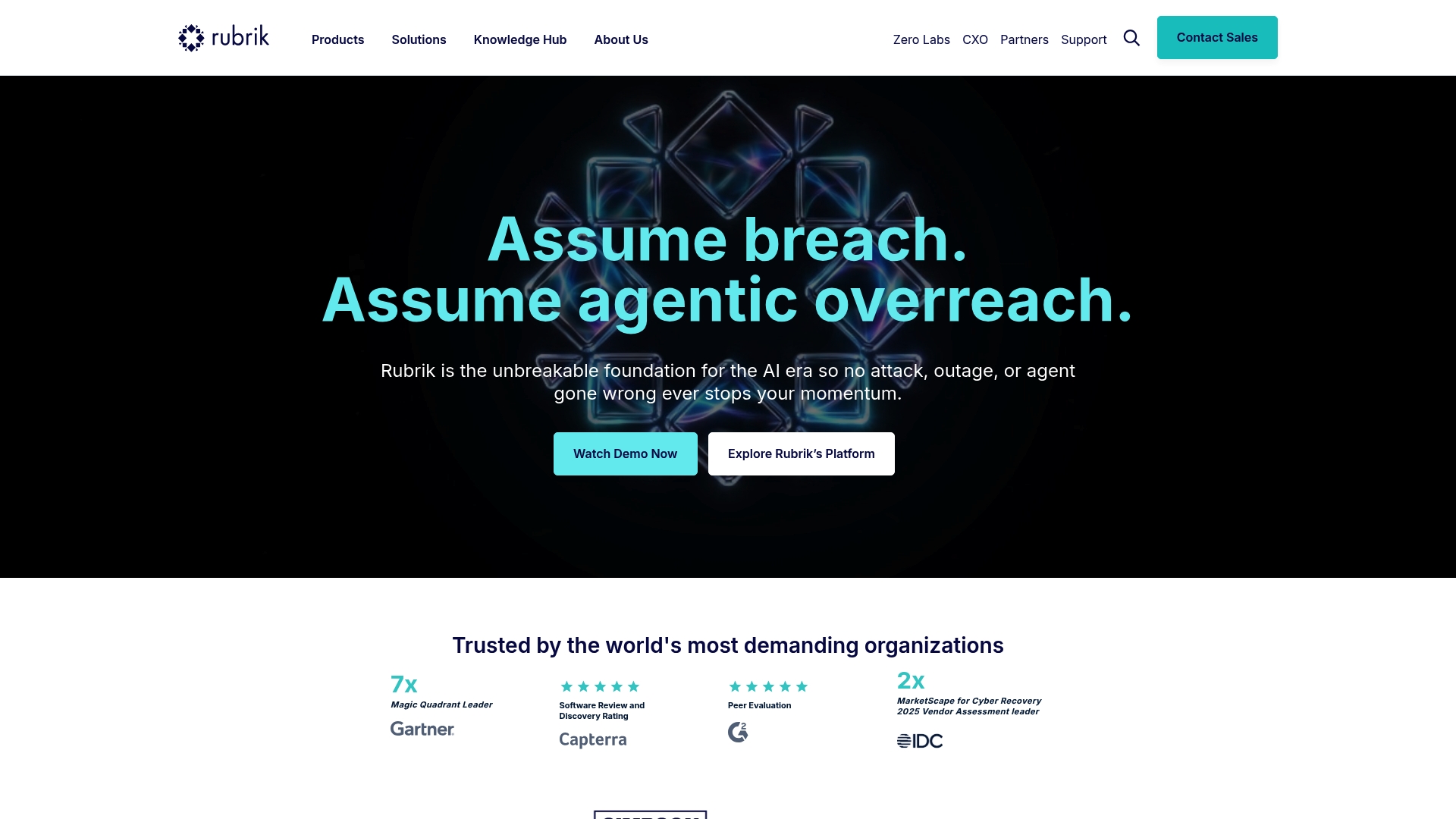
Rubrik reports more than 6,100 organizations worldwide trust its platform. The vendor positions the product as a unified cyber resilience platform that combines data, identity, and AI. The platform emphasizes immutable, air-gapped backups and automated recovery to reduce downtime after cyberattacks. That mix targets recovery speed and identity restoration for large environments.
Core Features
Rubrik bundles immutable backup storage with continuous monitoring and sensitive data classification, and it pairs those with AI-assisted recovery workflows. The platform includes automated threat containment and identity recovery for multi-IdP environments, and it supports on-premises, public cloud, and SaaS workloads. Administrators can use the automation layers to orchestrate recovery and to limit blast radius after an incident.
Key Differentiator
Rubrik unifies data, identity, and AI inside a single zero trust platform to shorten the recovery path after a breach. That combination shifts recovery from file-level restore toward coordinated identity and data restoration. For enterprises that must recover both credentials and datasets together, this unified approach reduces manual steps and accelerates return to production.
Pros
Rubrik has a visible position in analyst coverage and customers list that signals enterprise focus, which suits regulated industries. The platform stresses zero trust controls and immutable backups to preserve integrity during an incident, while automation and AI help reduce manual recovery time. Large customers cited in vendor materials show the product is used at scale by insurance, consumer goods, and health organizations.
Cons
- Deployment and initial configuration can be complex for smaller teams. Setup often requires planning and experienced staff.
- Pricing is not openly listed, so budget forecasts need vendor engagement. That model tends to favor enterprise procurement cycles.
- Integration setup may demand technical expertise for identity and cloud connectors. Expect professional services for larger, mixed environments.
When It May Not Fit
If your organization is a small IT team with limited integration resources, Rubrik may impose operational overhead. If you require transparent, self-serve pricing before vendor conversations, the lack of published rates will slow procurement. Organizations with simple single-site backup needs may find the platform more capability than they need.
Who It’s For
Cybersecurity teams, IT operations, and CIOs at large enterprises that run multi-cloud and hybrid workloads will get the most value. Regulated sectors such as healthcare, finance, and government that must prove recoverability will benefit from its identity and data recovery features. Teams that can allocate integration and operations resources will unlock the platform’s automation.
Real World Use Case
A regional health network used Rubrik to isolate and recover systems after a ransomware event. The deployment combined immutable backups with identity recovery to restore clinician access and patient records. That coordinated recovery reduced administrative handoffs and helped the network meet incident reporting expectations.
Pricing
Rubrik does not publish standard list pricing and appears to target enterprise engagements. Licensing and deployment options vary by workload type and scale, so procurement requires a vendor quote. Expect a model that aligns with enterprise licensing and professional services for larger rollouts.
Website: https://rubrik.com
Commvault
At a Glance
Commvault reports recognition in Gartner’s Magic Quadrant for 15 consecutive years. The vendor emphasizes a single platform that covers data protection, cyber recovery, and governance for cloud, SaaS, and on premises systems. That scope targets organizations that need a unified approach across many environments.
Core Features
The product combines data security, identity resilience, and cyber recovery within a cloud native architecture that supports hybrid and multi cloud deployments. It uses AI and automation for threat detection, threat hunting, and recovery tasks while offering protection for SaaS apps such as Microsoft 365 and Salesforce. Support extends to enterprise infrastructure including Kubernetes, VMware, Hyper V, Nutanix AHV, Active Directory, and Entra ID.
Key Differentiator
Commvault’s main strength is its single platform approach that merges security, identity resilience, and recovery at enterprise scale. That design reduces the number of separate backup and recovery products an IT staff must manage. The platform aims to apply the same policies and tooling across cloud, SaaS, and on premises workloads.
Pros
Commvault reports long standing recognition in Gartner’s Magic Quadrant, which signals broad market adoption and product maturity. The platform supports a wide set of environments from on premises virtual machines to cloud native containers and SaaS apps, which helps teams standardize backup and recovery. Its focus on AI and automation reduces manual triage during incidents and speeds parts of the threat hunting and restoration workflow.
Cons
- The product can be complex to deploy and operate for smaller teams with limited staff and time.
- Significant upfront planning and configuration are often required before production backup policies run reliably.
- Pricing is not publicly disclosed and may be costly for small to mid sized organizations.
When It May Not Fit
Organizations with very small IT teams or simple single site deployments will likely find the platform more than they need. Mid market buyers with tight budgets may prefer a solution with published pricing and fewer deployment steps. If you need a lightweight backup tool for a handful of servers, this product will probably be a poor match.
Notable Integrations
- AWS
- Azure
- Google Cloud
- Kubernetes
- Microsoft 365
- Salesforce
- Active Directory
- Entra ID
Who It’s For
Large enterprises, government agencies, and organizations with distributed and complex IT environments will get the most value. Security conscious companies that must manage both compliance and cyber recovery across cloud and on premises systems are a good fit. Teams that can staff deployment and ongoing operations will realize the platform’s full benefits.
Real World Use Case
A financial institution uses Commvault to protect cloud workloads, on premises databases, and Microsoft 365 assets across several regions. The bank applies unified retention and recovery policies while using the platform’s automation to speed incident response. That setup helps the institution prove compliance and shorten recovery time after ransomware events.
Pricing
Pricing is not publicly disclosed. The vendor offers enterprise level, custom pricing based on deployment scope and size. Prospective buyers must contact sales for a tailored quote and for cost modeling.
Website: https://commvault.com
Comparison of alternatives
Secfolio offers proactive attack path removal through its Identity Microsegmentation, whereas Rubrik excels in rapid post-incident recovery and Commvault provides flexibility across hybrid IT environments. Each vendor offers distinct solutions tailored to different organizational needs.
Security Architecture
Secfolio leads through its focus on preventing lateral movement and continuously eliminating attack paths preemptively. This architecture enables direct resilience-building measures by removing vulnerabilities before exploitation. Competitors such as Rubrik and Commvault focus on mitigation and recovery strategies. Rubrik, for example, employs AI-assisted workflows for identity restoration, emphasizing coordinated recoveries which are crucial under high-pressure incidents.
Deployment Versatility
Commvault demonstrates substantial deployment versatility suitable for diverse environments, including on-premise systems, SaaS applications, and cloud-native infrastructure. This adaptability suits organizations with varying IT architectures requiring a unified backup strategy. In contrast, Secfolio targets high-security enterprises prioritizing preemptive measures over broad compatibility. Rubrik effectively serves scenarios with hybrid environments, offering easy integration of advanced recovery features.
Best fit
- Secfolio is for large enterprises and infrastructure organizations focusing on proactive measures to reduce security vulnerabilities and minimize potential risks.
- Rubrik suits cybersecurity teams within regulated sectors needing rapid identity and data restoration while managing hybrid or multi-cloud workloads effectively.
- Commvault works well for organizations with distributed environments that benefit from a highly versatile platform handling SaaS, cloud, and on-premise systems comprehensively.
Our pick
Secfolio. For enterprises prioritizing advanced preventative measures focused on attack path elimination rather than solely recovery capabilities, Secfolio’s Identity Microsegmentation adds tangible resilience improvements. However, organizations valuing simplified deployment models or requiring rapid post-incident recovery might explore Rubrik or Commvault as alternatives.
Identity microsegmentation platforms are compared based on their core strengths, ideal user scenarios, pricing, and key limitations to provide actionable insights.
| Product | Key Differentiator | Best For | Pricing | Notable Limitation |
|---|---|---|---|---|
| Secfolio | Prevention-focused security architecture involving identity microsegmentation | Large enterprises with advanced security needs | Price not published | Requires organizational commitment for implementation |
| Rubrik | Unified cyber resilience platform combining data, identity, and AI | Enterprises needing rapid recovery from breaches | Price not published | Requires significant expertise for integration setup |
| Commvault | Single unified platform for data protection, AI, and governance | Large organizations requiring broad AI-driven management | Price not published | Complex deployment for smaller teams |
How Can Enterprises Address Security Beyond Traditional Backup Solutions?
Secfolio targets the challenge of compromised identities and unauthorized access by focusing on internal vulnerabilities that typical backup platforms may overlook. Unlike traditional options that center mainly on recovery, Secfolio continuously identifies and removes attack pathways through Identity Microsegmentation and Defensive Automation powered by AI. This approach helps reduce data exfiltration and ransomware impact before incidents escalate.
- Combine technical controls and organizational processes for clearer security decisions.
- Stop lateral movement by isolating compromised identities quickly.
- Train your staff against evolving AI-based social engineering threats.
Learn more about how Secfolio tackles ransomware and credential threats through practical measures in the Ransomware Elimination Archives and Credential Theft Elimination Archives. Visit Secfolio’s website to see how enterprises build sustained resilience and reduce recovery costs.
FAQ
What is the key benefit of Secfolio?
Secfolio offers identity microsegmentation to limit lateral movement and reduce high-risk attack paths. This feature focuses on preventing data exfiltration and ransomware impact, making it an effective choice for organizations stressed by these threats.
How does Secfolio compare to Rubrik?
Rubrik provides a unified cyber resilience platform that emphasizes immutable backups and fast recovery after cyberattacks. For organizations specifically looking to mitigate lateral movement and enhance identity microsegmentation, Secfolio serves a more targeted role in improving attack path security.
What unique feature does Secfolio provide for workforce training?
Secfolio integrates simulations to train staff against AI manipulation and deepfake social engineering threats. This capability enhances organizational readiness against evolving threats, ensuring teams are equipped to handle potential breaches more effectively.
Who is best suited for Secfolio?
Large enterprises and critical infrastructure organizations will gain the most from Secfolio’s features due to their need for advanced security measures like microsegmentation and attack path validation. Security leaders who can support complex organizational processes will find significant value in its implementation.
What should I consider regarding Secfolio’s implementation?
Implementing Secfolio requires significant organizational commitment and resources, which can introduce complexity and necessitate cultural change. Prospective users should be prepared for these challenges to fully realize the platform’s benefits.


