

Cyber resilience is defined as an organization’s capacity to anticipate, withstand, recover from, and adapt to adverse cyber events while maintaining continuous operations. This definition, recognized by NIST and widely adopted across enterprise security frameworks, shifts the focus away from pure prevention toward a lifecycle model that treats breaches as inevitable. The standard industry term is cyber resilience, and it sits at the intersection of cybersecurity, business continuity, and operational resilience. Organizations that understand cyber security resilience as a discipline, not just a technology stack, recover faster, spend less on incident response, and suffer fewer repeat attacks.
What is cyber resilience explained as a four-pillar framework?
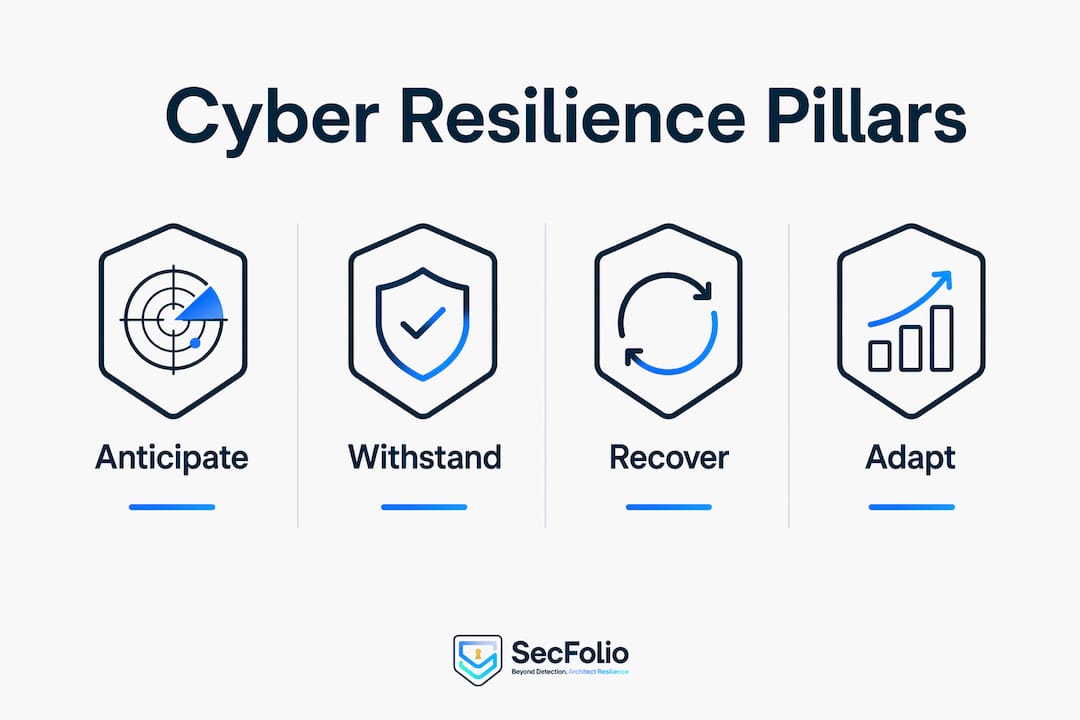
Cyber resilience operates on four interdependent pillars: Anticipate, Withstand, Recover, and Adapt. Each pillar addresses a distinct phase of the incident lifecycle, and weakness in any one of them undermines the others.
- Anticipate means identifying threats, vulnerabilities, and business dependencies before an attack occurs. This includes threat modeling, risk assessments, and mapping which systems are critical to operations.
- Withstand covers the controls that limit damage during an active incident. Network segmentation, access controls, and real-time detection all fall here.
- Recover focuses on restoring systems and data to a known-good state as quickly as possible. Speed matters, but so does the integrity of what you restore.
- Adapt is the pillar most organizations neglect. Organizations frequently fail to institutionalize lessons learned after incidents, leaving the same vulnerabilities open for years. Adaptation means updating controls, retraining staff, and revising playbooks based on what actually happened.
The contrast with traditional cybersecurity is direct. Conventional security spends 90% of budgets on prevention but leaves organizations without the operational discipline to survive a breach. That spending imbalance explains why so many companies recover slowly and expensively. Cyber resilience rebalances investment across all four pillars.
Pro Tip: Map your current security spending across the four pillars. If more than 70% sits in Anticipate and Withstand, your Recover and Adapt capabilities are almost certainly underfunded.
How do you operationalize cyber resilience effectively?
Understanding cyber resilience conceptually is straightforward. Putting it into practice is where most organizations struggle. The gap between theory and execution comes down to three areas: testing discipline, backup integrity, and dependency mapping.

Testing and business impact analysis
Annual business impact analyses and quarterly incident response testing are the minimum standard for organizations serious about resilience. Business impact analyses identify which processes, if disrupted, would cause the most damage. Quarterly tabletop exercises and simulated breach scenarios expose gaps in playbooks before a real attacker does.
A concept worth defining here is the minimally viable operation, or MVO. Without a defined MVO, organizations cannot prioritize recovery. They attempt to restore everything at once, which slows the return of the systems that matter most. The MVO is the smallest set of processes and systems that keeps the business legally and operationally functional during an incident.
Backup integrity and the identity trap
Most IT teams believe that having immutable, isolated backups solves the recovery problem. Backups are necessary but not sufficient. Restoring backups without first clearing compromised machine identities leads to immediate re-encryption by attackers. The ransomware operator still holds valid credentials inside the restored environment and re-executes within hours.
Recovery success requires clearing compromised service accounts, API keys, and other machine identities before any data restoration begins. This step is consistently skipped under pressure, and it is the single most common reason organizations face a second encryption event.
Dependency mapping
| Recovery challenge | What goes wrong | What to do instead |
|---|---|---|
| Unresolved machine identities | Attackers re-enter via valid credentials | Revoke and rotate all identities before restoration |
| Missing dependency maps | Restored databases are inaccessible to applications | Document token and service account dependencies in advance |
| No defined MVO | Recovery effort spreads too thin | Prioritize critical processes and restore in tiers |
| Untested backups | Backups fail or contain corrupted data | Run quarterly restoration tests in isolated environments |
Failure to map system dependencies causes prolonged outages even when data is successfully restored. A database that comes back online but cannot authenticate to its application layer is functionally useless. Dependency maps must be maintained as living documents, updated whenever architecture changes.
Pro Tip: Store your dependency maps and MVO documentation offline or in an air-gapped system. If your documentation lives only in systems that get encrypted, you lose it exactly when you need it most.
Why does identity management determine recovery success?
Identity is the most underestimated variable in cyber resilience. Most post-incident analyses focus on malware, phishing vectors, or unpatched systems. The persistence mechanism that actually prolongs damage is compromised identity.
Machine identities, including service accounts, API tokens, certificates, and SSH keys, are the credentials that systems use to communicate with each other. Attackers who gain access to these identities can move laterally across an environment without triggering user-facing alerts. Approximately 91.6% of machine identities remain exposed for unauthorized lateral movement five days after a targeted incident when identity lifecycle management is not integrated into recovery. That figure means that the majority of organizations restoring systems after an attack are restoring into an environment that attackers still control.
The practical implication is clear. Identity hygiene is not a pre-incident concern only. It is a recovery prerequisite. Before any system comes back online, every machine identity that touched the compromised environment must be revoked and reissued. This applies to credential theft elimination as much as it does to backup restoration.
Poor identity management also limits how effectively organizations can contain an active attack. Without clear visibility into which identities are active, which are compromised, and which are dormant, security teams cannot segment the network quickly enough to stop lateral movement. Secfolio’s Identity Microsegmentation approach directly addresses this gap by continuously mapping and controlling identity-based access pathways.
How does cyber resilience support business continuity?
Cyber resilience is an operating model that blends cybersecurity, business continuity, and operational resilience into a single continuous improvement cycle. That framing matters because it changes who owns resilience inside an organization. It cannot sit only with the IT security team.
Business continuity during an incident depends on three things working together:
- Defined decision authority. Unclear decision authority during incidents inhibits quick containment. Security teams need pre-authorized power to segment networks or shut down systems without waiting for executive approval chains. Every minute of delay extends the blast radius.
- Prioritized recovery tiers. The MVO framework forces business leaders to decide in advance which processes are critical. That decision cannot happen during an active incident under pressure.
- Automated response capabilities. Automation of incident response and business impact assessment processes overcomes the speed limitations of human-only response. Automated containment can isolate a compromised segment in seconds. Manual processes take minutes to hours.
Cyber resilience also requires board-level engagement because its governance dimension extends well beyond technical controls. Boards that treat resilience as an IT problem consistently underfund the Recover and Adapt pillars. Boards that treat it as a business continuity issue fund it proportionally and hold leadership accountable for recovery time objectives. The reactive security approach that many organizations still rely on fails precisely because it lacks this governance layer.
Key Takeaways
Cyber resilience is not a product you buy. It is an operating discipline built across four pillars, sustained by governance, and tested continuously.
| Point | Details |
|---|---|
| Four-pillar framework | Anticipate, Withstand, Recover, and Adapt must all be funded and tested to achieve real resilience. |
| Identity is a recovery prerequisite | Revoke and rotate all machine identities before restoring any system to prevent immediate re-exploitation. |
| Define your MVO first | Knowing your minimally viable operation before an incident lets you restore critical systems in the right order. |
| Board ownership matters | Cyber resilience requires governance-level commitment, not just IT team execution, to sustain investment across all pillars. |
| Test, do not assume | Quarterly incident response tests and annual business impact analyses expose gaps before attackers do. |
The adaptation gap no one talks about
I have spent years watching organizations invest heavily in detection and recovery tools, then skip the one step that would actually make them more resilient over time: the post-incident adaptation review.
The pattern is consistent. A company suffers a ransomware attack, pays a significant recovery cost, restores operations, and then moves on. The incident response report gets filed. The lessons-learned meeting happens once. Then the same configuration gaps, the same over-permissioned service accounts, and the same untested backup procedures persist into the next year.
The Adapt pillar is not a debrief. It is a governance commitment to close specific gaps within a defined timeframe and verify closure. The organizations I have seen build genuine resilience treat every incident, including near-misses and tabletop exercises, as a mandatory input to their security architecture review. They assign owners to each finding, set deadlines, and track closure at the board level.
The uncomfortable truth is that most organizations are better at surviving attacks than they are at learning from them. Survival is a low bar. The goal is to make each incident the last time that particular attack vector works. That requires treating adaptation as a standing operational process, not a one-time post-mortem.
— James
How Secfolio strengthens your cyber resilience posture
Cyber resilience depends on limiting how far an attacker can move once inside your environment. That containment capability is exactly what Secfolio’s lateral movement prevention and Identity Microsegmentation solutions are built to deliver.

Secfolio continuously maps identity-based access pathways and eliminates unauthorized routes before attackers can use them. When an incident occurs, automated containment isolates compromised segments without waiting for manual intervention. The result is a shorter blast radius, faster recovery, and fewer repeat incidents. Organizations that integrate Secfolio’s Defensive Automation into their resilience program reduce the window between breach detection and containment from hours to seconds. Explore Secfolio’s full security approach to see how Identity Microsegmentation fits into a complete resilience strategy.
FAQ
What is the cyber resilience definition?
Cyber resilience is an organization’s capacity to anticipate, withstand, recover from, and adapt to adverse cyber events while maintaining continuous operations. It treats breaches as inevitable and focuses on operational continuity rather than prevention alone.
How does cyber resilience differ from cybersecurity?
Cybersecurity focuses primarily on preventing attacks. Cyber resilience extends that scope to include surviving, recovering from, and learning from attacks, making it a broader operational and governance discipline.
What are the most important cyber resilience best practices?
The most critical practices are defining your minimally viable operation, running quarterly incident response tests, maintaining immutable isolated backups, and revoking all machine identities before restoring systems after an incident.
Why do machine identities matter for cyber resilience?
Approximately 91.6% of machine identities remain exposed for unauthorized lateral movement five days after a targeted incident without proper identity lifecycle management. Attackers use these identities to re-enter restored environments and re-execute attacks.
How do you achieve cyber resilience at the organizational level?
Achieving cyber resilience requires board-level governance, pre-authorized incident response authority, automated containment capabilities, and a continuous adaptation process that closes gaps identified in every incident and exercise.


