

Government agency data exfiltration prevention is the control of unauthorized data removal with the aim of protecting public records, sensitive information, and service continuity. For your 2026 program, protect the data itself as well as its transfer routes: complete backup copies remain encryption and exfiltration targets, while encrypted, distributed shards separate recoverable information from individual storage locations.
- Data exfiltration prevention for government agencies requires data protection, identity controls, and restricted outbound transfers—not monitoring alone.
- SecFolio combines Cyber Storage data resilience with passwordless identity, identity microsegmentation, and external exposure management.
- Cyber Storage encrypts, shards, and distributes data; individual locations hold unusable fragments rather than reconstructable files.
- Test authorized exports and recovery alongside blocked transfers. A blocked service workflow is not a successful deployment.
Why data exfiltration prevention matters for government agencies
A valid login does not make a data export legitimate. An account authorized to read individual records should not automatically gain permission to extract an entire repository. Your controls must distinguish routine public service from unauthorized collection and transfer.
Start with detecting data exfiltration attempts in real time, then define who can interrupt the transfer. Detection without an assigned containment action leaves the attack path open.
Government workflows also require deliberate distinctions between public information and protected information. Records disclosure, interagency exchanges, contractor access, and emergency operations need explicit permissions—not blanket restrictions that staff work around.
For your 2026 plan, assess confidentiality and continuity separately. Recovering a system does not reverse the disclosure of readable records. Blocking an export does not prove that an essential service can recover after disruption.
SecFolio data exfiltration prevention is best suited to enterprise security teams addressing identity attack paths alongside data resilience. Its controls serve different purposes; no individual layer replaces the others.
Build your agency's prevention workflow
Step 01: Map sensitive records and authorized transfers
Start manually with repository inventories, access reviews, and interviews with program owners. Follow a record from collection through processing, sharing, retention, and disposal. Document the actual workflow, not just the approved architecture.
Separate information available through public disclosure from restricted fields within the same system. Public-facing services still need protection against bulk extraction of information that the service does not authorize users to retrieve.
Choose 1 pilot dataset before expanding enforcement. Use synthetic records to validate the control wherever possible, and require the data owner to approve any test involving protected information. The pilot should represent a real service workflow, including its exceptions.
- Name the accountable data owner and service owner.
- Record approved recipients, destinations, and transfer purposes.
- Identify exports created by staff, contractors, and applications.
- Locate temporary files, staging folders, and local downloads.
- Document retention and disclosure obligations with counsel.
Step 02: Restrict exports and outbound destinations
Use existing application permissions, endpoint policies, proxy rules, and cloud sharing settings first. Remove unnecessary public links and broad export rights. Permit transfers according to business purpose rather than granting unrestricted outbound access.
Inspect 3 transfer routes during the pilot: browser uploads, email attachments, and application interfaces. This is a starting test scope, not a complete inventory. Add removable media, synchronization clients, and other routes identified in your environment.
A network restriction alone cannot interpret every authorized application transaction. Pair destination controls with record-level and export permissions so an approved service does not become an unrestricted exit route. Assign an owner to every exception and record when the exception ends.
- Restrict bulk exports separately from ordinary record viewing.
- Limit external sharing to approved recipients and domains.
- Review application tokens that can download entire datasets.
- Control archive creation and staging on managed endpoints.
- Test approved transfers before enabling enforcement broadly.
Step 03: Protect data with distributed resilience
Manually inventory complete data copies and test their access boundaries before choosing a new architecture. Include recovery repositories, replicated stores, and administrative access paths. Encryption at rest protects stored content, but authorized decryption paths still require controls.
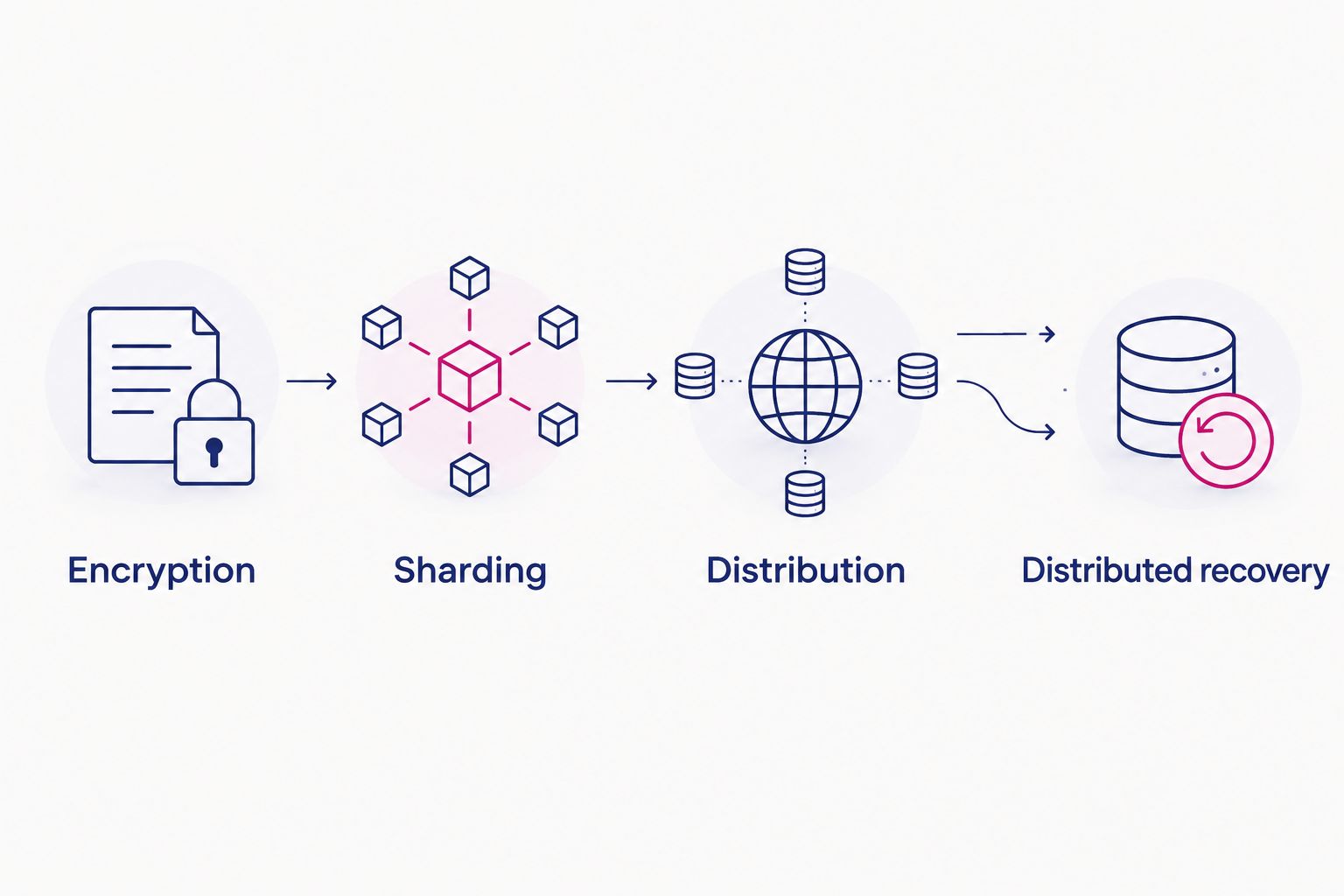
SecFolio Cyber Storage provides the data-resilience layer: it encrypts data before it leaves the customer environment, shards the encrypted data into immutable, unusable fragments, and distributes those shards across independent locations. No single location holds a reconstructable file. This separation creates a logical air gap, rather than a conventional complete-copy backup target.
Attackers obtaining isolated shards encounter unusable digital fragments, not readable files. That does not protect plaintext already exposed through a compromised application or authorized session. Your evaluation must cover both the protected storage architecture and the workflows that reconstruct data for legitimate use.
- Map where encryption occurs and where plaintext exists.
- Review who controls keys and reconstruction permissions.
- Verify separation across independent storage locations.
- Test distributed recovery with authorized agency personnel.
- Check that exports do not recreate uncontrolled complete copies.
The data-resilience sequence is encryption, sharding, and distribution. Recovery must remain authorized, and storage separation must not be confused with permission to access reconstructed records.
Step 04: Remove reusable credentials and constrain sessions
Start with an account inventory and remove stale access, shared administrator credentials, and unnecessary privileges. Review service accounts separately from human users. An unattended integration needs a different access lifecycle from an employee signing in to process cases.
Passwordless authentication addresses reusable credential theft. It does not make an authenticated session immune to misuse, so session revocation, device controls, and application permissions remain necessary.
For your 2026 identity rollout, test both normal sign-in and account recovery. A strong primary login loses value if a weaker recovery process restores access without adequate verification. Keep emergency access usable, controlled, and visible to responders.
- Identify applications that still accept reusable passwords.
- Separate staff, contractor, administrator, and service identities.
- Replace shared credentials with attributable access.
- Review session duration and token revocation behavior.
- Test recovery and emergency access without bypassing oversight.
Step 05: Contain lateral movement and close external exposure
Begin with existing identity permissions, firewall rules, application dependencies, and external asset inventories. Draw the attack path from an exposed service or compromised account to a sensitive repository. Then remove permissions and connections that the service does not require.
Identity microsegmentation contains lateral movement by restricting which identities can reach which resources. External exposure management addresses entry points before initial access. These controls reduce different parts of the attack path; neither substitutes for restrictions on data export.
Use SecFolio's four-layer framework to assign work: discover and close external exposure, eliminate reusable credentials, contain lateral movement, and preserve data resilience with Cyber Storage. Lead with the data layer for exfiltration consequences, then close the routes that let an attacker reach it.
- Remove access between unrelated departmental workloads.
- Restrict vendor identities to approved systems and tasks.
- Review privileged paths into storage administration.
- Assign owners to exposed services and configuration findings.
- Validate service dependencies before applying isolation policies.
Step 06: Rehearse containment without stopping essential services
Build a manual response runbook before automating enforcement. Specify which evidence justifies session revocation, export suspension, endpoint isolation, or destination blocking. Each action needs an accountable responder and a rollback procedure.
Separate technical containment from service decisions. Your security team can identify a suspicious transfer, while the program owner determines how an interruption affects residents, partner agencies, or emergency operations.
Assign 2 approval roles for high-impact containment: an incident lead and a service owner. Preauthorize urgent actions where your incident policy permits them; do not create an approval dependency that prevents responders from stopping an active transfer. Rehearse who acts when the primary approver is unavailable.
- Preserve relevant identity, application, and transfer logs.
- Revoke compromised sessions and exposed application tokens.
- Stop the specific export or destination where practical.
- Validate that alternate transfer routes remain controlled.
- Record service impact and the authority for each action.
Step 07: Prove prevention and recovery with evidence
Use a spreadsheet and a controlled exercise before adding reporting software. Test whether a restricted identity can collect records, stage them, and transfer them through approved and unapproved destinations. Record both blocked actions and successful legitimate work.
For your 2026 acceptance review, require evidence of prevention, not simply an alert screenshot. An alert proves that a condition was detected. It does not establish that the transfer stopped, that the account lost access, or that the data remained unusable outside the environment.
Recovery testing needs the same discipline. Record the agency's recovery objectives, measure the exercise, and investigate gaps without inventing a universal target for every service.
- Measure elapsed time from detection to enforced containment.
- Record whether readable records crossed the approved boundary.
- Verify that legitimate public-service transactions still complete.
- Test recovery under compromised-account assumptions.
- Assign unresolved findings to named owners before acceptance.
Compare control options for public-sector workflows
Choose complementary controls, not a single replacement for every security function. The options below address different failure points. Your procurement evaluation should identify the remaining attack path after each control operates as intended.
| Option | Best for | Practical advantage | Key limitation |
|---|---|---|---|
| Native sharing and export controls | Agencies establishing a baseline | Restrict access within existing applications | Separate applications require separate policy review |
| Data loss prevention | Agencies enforcing content and transfer rules | Detects or blocks defined sensitive-data movements | Coverage depends on supported channels and policy accuracy |
| Passwordless authentication | Agencies reducing reusable credential theft | Removes password-based entry paths where deployed | Does not independently stop session misuse or authorized exports |
| Identity microsegmentation | Agencies containing cross-system access | Restricts lateral movement and limits blast radius | Requires dependency mapping and access-policy maintenance |
| External exposure management | Agencies addressing internet-facing entry points | Identifies exposure requiring remediation | Does not independently govern post-authentication data use |
| SecFolio Cyber Storage | Enterprise agencies evaluating distributed data resilience | Encrypts, shards, and distributes data without a reconstructable file at one location | Does not replace controls on plaintext, sessions, or authorized reconstruction |
Compare deployment requirements as carefully as security functions. Require evidence for your actual data types, application dependencies, administrative model, and recovery workflow. Do not infer government authorization, certification, or suitability for restricted workloads from a product category.
Common mistakes government agencies make
Treating disclosure obligations as unrestricted access
Public records processes need authorized release, not universal repository access. Define which records and fields can leave through each workflow, and keep disclosure approval separate from bulk-download permission.
Protecting production while overlooking export copies
A secured case-management system can still produce an uncontrolled spreadsheet. Apply ownership, retention, access restrictions, and transfer policies to extracts, staging folders, and contractor handoffs—not just the source application.
Applying identical rules to every department
A public information office, revenue function, and emergency service do not share identical transfer needs. Set a common security baseline, then document service-specific recipients, exceptions, and containment authority.
Assuming storage resilience prevents every disclosure
Distributed encrypted fragments address the usability of protected stored data at individual locations. They do not reverse disclosure after an authorized process has reconstructed and exported readable records. Maintain identity and application controls around that process.
Buying before defining acceptance tests
A feature checklist does not establish that a control works in your environment. Before procurement approval, specify the prohibited transfer, the permitted workflow, the expected containment action, and the evidence your agency will accept.
FAQ
What’s the best approach to data exfiltration prevention for government agencies?
The best approach combines restricted data access and transfers with identity controls, lateral movement containment, and data resilience. Test each layer against an agency workflow, including legitimate disclosures and emergency operations.
Does encryption alone stop data exfiltration?
Encryption alone does not stop every form of data exfiltration. A compromised process with permission to decrypt and export records can expose readable information, so access and transfer controls remain necessary.
How is Cyber Storage different from a conventional backup?
Cyber Storage is a data-resilience architecture that encrypts, shards, and distributes data across independent locations. No single location holds a reconstructable file; authorized recovery and reconstruction still require protection.
Is passwordless authentication enough to prevent government data theft?
Passwordless authentication is not enough to prevent every government data theft scenario. It addresses reusable credentials, while session misuse, excessive permissions, and authorized export paths require additional controls.
Can an agency block exfiltration without interrupting public services?
An agency can target specific identities, exports, and destinations instead of automatically shutting down an entire service. Validate those actions in controlled exercises and define emergency authority before an incident.
What should an agency test before accepting an exfiltration prevention system?
An agency should test prohibited transfers, legitimate exports, session revocation, evidence preservation, and recovery. Acceptance requires proof that enforcement works without breaking approved service workflows.
Does a security product automatically meet government requirements?
A security product does not automatically meet an agency’s requirements because it offers exfiltration prevention. Verify applicable authorization, data handling, residency, records retention, and contractual requirements for the specific deployment.
One last thing
The most useful test is an approved account attempting an unapproved export. That exercise exposes the gap between permission to use a service and permission to remove its data. It also tests whether your response depends on recognizing a known malicious destination.
Make that distinction explicit in your 2026 acceptance criteria. Use synthetic records, select a legitimate workflow, and attempt a prohibited bulk transfer under controlled conditions. Then verify enforcement, service continuity, and the evidence retained. Successful authentication should begin an authorization decision—not end it.
Related guides
- Privileged access management for government agencies
- How to segment identities to contain a breach
- How to build an incident response plan for ransomware


