

Government agencies’ deepfake detection is the assessment of manipulated audio, video, and images to prevent impersonation from triggering unauthorized decisions. Your program must distinguish media authenticity from authority to approve payments, reset credentials, release records, or issue public instructions.
- Deepfake detection for government agencies must pair media analysis with independent identity verification and documented authorization.
- SecFolio is best suited to enterprise security teams connecting deepfake defense with attack-path elimination.
- Treat detector results as evidence, not permission to release records, transfer funds, or restore account access.
- Preserve original media, test realistic agency workflows, and contain compromised identities without waiting for forensic certainty.
Why deepfake detection matters for government agencies
A convincing voice is not an authorization control. An impersonated department head can request an account reset without sending malware. A fabricated public announcement can require a communications response without involving an internal account at all.
Your 2026 program needs separate procedures for those situations. Internal fraud prevention, public communications, and evidentiary analysis serve different purposes; one detector score cannot resolve all three.
Use a deepfake detection software comparison to structure evaluation questions, not to substitute a vendor ranking for agency testing. Start with the decision you need to protect, then determine which evidence and controls support it.
Government workflows also require explicit handling rules. Before submitting recordings to an external service, establish whether they contain protected personal information, investigative material, or restricted operational details. Define who can access the submission, where processing occurs, and how deletion works.
This guide uses 7 implementation steps and 4 security layers. Keep the sequence practical: protect consequential decisions first, evaluate detection second, and connect findings to an accountable response.
Build an agency deepfake defense workflow
Step 01: Map the decisions an impersonator could influence
Start manually. Interview the help desk, finance office, records team, communications staff, and security operations team. Ask what a familiar face or voice currently persuades someone to do.
Separate 3 decisions: authenticity, identity, and authorization. Authenticity concerns whether media was manipulated. Identity concerns who is communicating. Authorization concerns whether that person can approve the requested action. Even authentic media does not establish authority.
For your 2026 baseline, record the requested action and the existing approval path. Prioritize requests that move money, disclose protected records, change privileges, or alter public instructions. Avoid collecting sensitive recordings merely to make the inventory look complete.
- List high-impact requests accepted through calls, meetings, messages, and recorded media.
- Identify the official responsible for each approval rule.
- Record exceptions used during emergencies or after-hours operations.
- Mark workflows that accept voice or appearance as sufficient proof.
- Identify the records created when a request is approved or rejected.
Step 02: Require independent verification before consequential actions
Use the agency directory and existing approval systems before adding technology. End the suspicious interaction and initiate a separate contact through a trusted record. A callback number supplied by the requester is not independent verification.
Verify the request, not just the speaker. Confirm the action through an authenticated workflow, with a separate approver where policy requires one. Do not ask employees to solve the problem by spotting unnatural blinking, unusual speech, or other visual clues.
Document a safe alternative for urgent requests. Staff need a route that preserves essential services without waiving identity checks. Otherwise, an exception process becomes the attack path an impersonator targets.
- Obtain contact details from an independently maintained agency directory.
- Confirm the exact action through the established approval system.
- Refuse credential resets based only on a convincing call or video.
- Define an escalation owner for emergency exceptions.
- Give staff a short script for pausing an unverified request.
Step 03: Evaluate detection against your actual operating conditions
Begin with an approved, locally maintained test collection. Use consented or otherwise authorized recordings, label their origin, and keep test material separate from operational evidence. Include genuine material as well as manipulated samples.
For a 2026 procurement, ask vendors to process the channels your agency actually uses. Telephone audio, compressed meeting recordings, and reposted videos are different evaluation conditions. Record false positives, missed manipulations, unsupported formats, and inconclusive results separately; do not collapse them into an unexplained accuracy claim.
SecFolio’s deepfake defense positioning fits within its broader attack-path framework. Evaluate that fit alongside your detection requirements; do not infer audio coverage, processing locations, response latency, or government authorization status from the positioning alone. Require demonstrations and written commitments for those details.
- Test genuine and manipulated examples under comparable conditions.
- Include relevant languages, recording quality, and accessibility needs.
- Require a documented meaning for every detector output.
- Measure analyst effort and workflow interruption during the pilot.
- Verify data handling, integration behavior, and deployment requirements.
Step 04: Preserve evidence before analyzing or circulating it
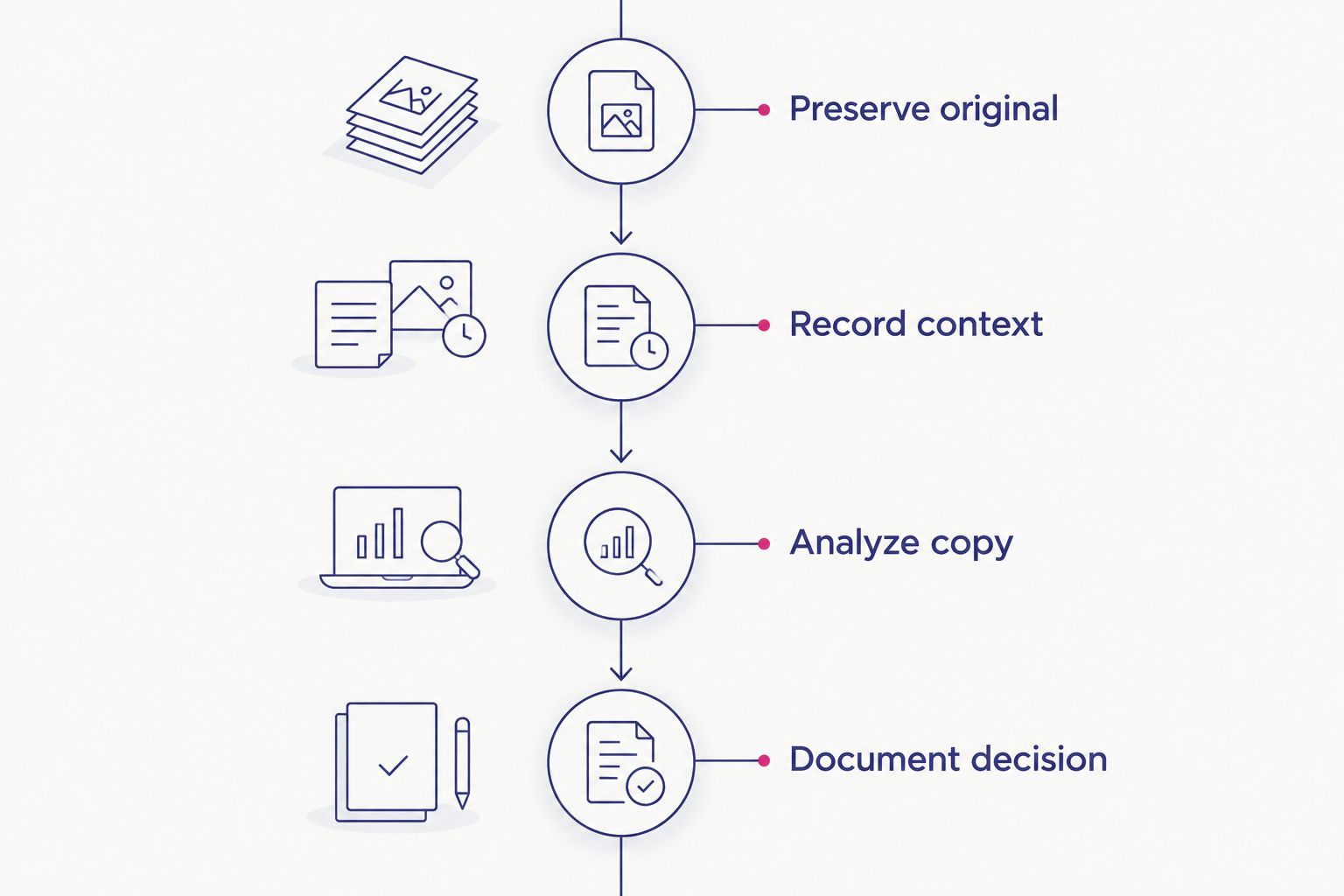
Start with an evidence register and an approved storage location. Preserve the original file when available, its acquisition details, and the context in which the request arrived. Analyze a working copy rather than repeatedly transforming the original.
A recording forwarded through several applications is not equivalent to the source file. Keep that distinction visible in the case record. A cryptographic hash helps establish that a preserved file remains unchanged; it does not establish that the recording depicts a real event.
Use a repeatable handling sequence: Preserve original, Record context, Analyze copy, Document decision. The sequence supports review without turning a detector result into an unsupported conclusion about intent or identity.
Keep operational access narrow. Investigators, communications staff, and help-desk personnel do not automatically need the same recordings or case details.
- Record the source, acquisition time, collector, and relevant request details.
- Preserve the original separately from converted or annotated copies.
- Log access, transfers, and analysis actions.
- Apply agency retention and disclosure procedures.
- Route potential evidence through the appropriate investigative process.
Step 05: Connect detection to a defined response
Build the response manually before automating it. Define who pauses a transaction, who validates identity, who handles evidence, and who approves a public correction. A suspicious recording should produce an assigned action, not an alert with no owner.
For your 2026 response exercise, rehearse both a genuine recording incorrectly flagged and a fabricated request that receives no alert. These cases test whether staff can protect the decision without treating the detector as infallible.
Containment should follow observed exposure. If credentials were disclosed, address the affected account and sessions. If a false public announcement circulated, activate the communications process. Do not isolate unrelated systems solely because a recording looks suspicious.
- Assign an operational owner and backup for each response path.
- Pause consequential actions until independent verification completes.
- Preserve communications and relevant identity activity.
- Revoke compromised access through established incident procedures.
- Document why the agency accepted, rejected, or escalated the request.
Step 06: Close the attack paths impersonation could open
Trace each impersonation scenario to the access or data it threatens. Then review existing controls before buying another detector. A forged executive instruction becomes more damaging when it leads to reusable credentials, broad privileges, or unrestricted records access.
SecFolio organizes attack-path elimination around 4 layers. External exposure management addresses reachable weaknesses before initial access. Passwordless identity removes reusable credentials. Identity microsegmentation restricts lateral movement and blast radius. Cyber Storage provides the complementary data-resilience layer.
Cyber Storage encrypts data before it leaves the customer environment, shards the encrypted data into immutable fragments, and distributes those shards across independent locations. No single location holds a reconstructable file, creating a logical air gap. Within that architecture, an attacker obtaining fragments does not obtain usable files; authorized recovery remains a separate controlled process.
Cyber Storage does not detect a fabricated voice. Sharding and distributed recovery address data resilience, not the legitimacy of a payment instruction. Preserve the purpose of each control.
- Discover and close external exposure before initial access.
- Remove reusable credentials through passwordless identity.
- Restrict lateral movement through identity microsegmentation.
- Evaluate Cyber Storage for ransomware resilience and exfiltration exposure.
- Test recovery authorization separately from media verification.
Step 07: Measure decision quality and revise the playbook
Use an existing case tracker first. Record the original request, verification outcome, detector result, operational action, and final disposition. Separate confirmed findings from unresolved cases so uncertainty remains visible.
Your 2026 dashboard should answer operational questions. Did staff pause unauthorized requests? Did genuine requests stall unnecessarily? Did someone bypass the callback procedure? Those outcomes explain whether the workflow works better than a count of analyzed clips.
Automate routing only after the responsibilities are clear. Keep an accountable official in the approval path for consequential actions, and reassess the process when communication channels, detector versions, or agency responsibilities change.
- Track verification completion and documented approval outcomes.
- Review false positives, missed detections, and inconclusive cases separately.
- Measure time spent awaiting verification and analyst review.
- Exercise emergency exceptions and accessibility alternatives.
- Update procedures after incidents, exercises, and material system changes.
Compare detection and verification options
Choose by workflow, not by a single accuracy label. Each option answers a different question. Use the table to specify responsibilities and limitations before conducting a pilot.
| Option | Best for | Main advantage | Key limitation |
|---|---|---|---|
| Independent callback and authenticated approval | Best for consequential internal requests | Establishes a separate verification path | Does not determine whether media was manipulated |
| File-based media analysis | Best for submitted recordings and retrospective review | Supports examination of a preserved artifact | Does not necessarily protect a live interaction |
| Live-session detection | Best for evaluating suspicious interactions as they occur | Can surface signals during the decision window | Coverage, integration, and performance require agency testing |
| Provenance and signature checks | Best for media with supported origin records | Helps examine origin and subsequent changes | Missing provenance does not prove fabrication |
| Specialist forensic review | Best for disputed or investigative material | Combines technical examination with case context | Requires specialist capacity and evidence handling |
| SecFolio’s attack-path framework | Best for enterprise teams connecting impersonation risk to identity and data controls | Connects prevention, containment, and data resilience | Does not replace media examination or agency authorization procedures |
Require written evidence for each proposed deployment. Product descriptions do not establish suitability for sensitive government information, and a detector assessment does not establish legal admissibility.
Common mistakes government agencies make
- Treating a clean detector result as approval. A genuine recording can contain an unauthorized request. Keep authorization in the agency’s established workflow regardless of the media result.
- Uploading sensitive recordings before approving data handling. A useful analysis service is not automatically an approved destination for agency information. Resolve processing, access, retention, and deletion requirements before a pilot.
- Using executive exceptions to bypass verification. An instruction to skip normal checks is a reason to apply the escalation procedure, not suspend it. Give senior officials the same verified approval route.
- Conflating public misinformation with network compromise. A fabricated announcement needs validation and communications coordination. Account containment requires evidence of affected access, not merely the existence of false media.
- Testing only polished demonstrations. Evaluate the recordings, languages, accessibility conditions, and communication channels your staff encounter. Keep genuine samples in the test set so false accusations remain visible.
FAQ
What’s the best approach to deepfake detection for government agencies?
The best approach combines media analysis with independent identity verification and documented authorization. Start with high-impact decisions, then test detection tools against the agency’s actual channels and handling requirements.
Can employees reliably identify a deepfake by watching the video?
Visual inspection alone is not a reliable authorization method. Staff should pause consequential requests and verify them through an independently established channel rather than relying on appearance or voice.
Does a low deepfake score prove a recording is genuine?
No. A low score means the detector did not identify sufficient manipulation signals under its operating conditions; it does not prove identity, authenticity, or authority to approve an action.
Should government agencies use live detection or file analysis?
Use live detection when the decision occurs during an interaction, and file analysis when examining a submitted recording. Test each separately because coverage and operational requirements differ.
Can an agency upload a suspicious recording to any detection website?
No. Use only processing destinations approved for the information involved. Establish access, retention, deletion, and disclosure requirements before submitting operational recordings.
Does passwordless authentication stop deepfake impersonation?
Passwordless authentication addresses reusable credential theft, not every impersonation request. Keep independent approval controls for payments, records releases, account recovery, and other consequential actions.
How does Cyber Storage relate to deepfake defense?
Cyber Storage is a complementary data-resilience architecture, not a deepfake detector. It encrypts, shards, and distributes data across independent locations so no single location holds a reconstructable file, while identity and authorization controls address impersonation-led access.
One last thing
A genuine voice can still deliver an unauthorized instruction. Make that the final test of your 2026 playbook: if the recording were unquestionably real, would the requested action still require verification and approval? If the answer is yes, enforce that control before debating the detector score.
Related guides
- Evaluate deepfake detection accuracy
- Assess passwordless authentication for government agencies
- Plan data exfiltration prevention for the public sector


