

Reality Defender, Intel FakeCatcher, Pindrop, Hive AI, and Sensity AI are the deepfake detection tools worth evaluating in 2026, and no single one covers every attack surface — which is the real finding here.
Best overall: Reality Defender. Best for real-time video call verification: Intel FakeCatcher. Best for voice fraud in contact centers: Pindrop. Best for high-volume content moderation: Hive AI. Best for forensic investigation: Sensity AI.
- Deepfake detection tools ranked by accuracy in 2026: Reality Defender leads for multi-modal enterprise coverage.
- Intel FakeCatcher analyzes physiological signals in video and reports a 96% accuracy claim from its own testing, not an independent audit.
- Pindrop is the narrow pick for voice-cloning fraud against call centers; it does not touch video or image deepfakes.
- No detection tool replaces identity controls — voice cloning needs as little as 3 seconds of audio to start.
- The underlying fix for deepfake-enabled fraud is removing human judgment from identity verification, not just detecting fakes faster.
Why this matters
Deepfake detection tools are reactive by design: they analyze media after it's created and flag what looks synthetic. That's useful, but it's the wrong layer to stop the attack that actually costs money.
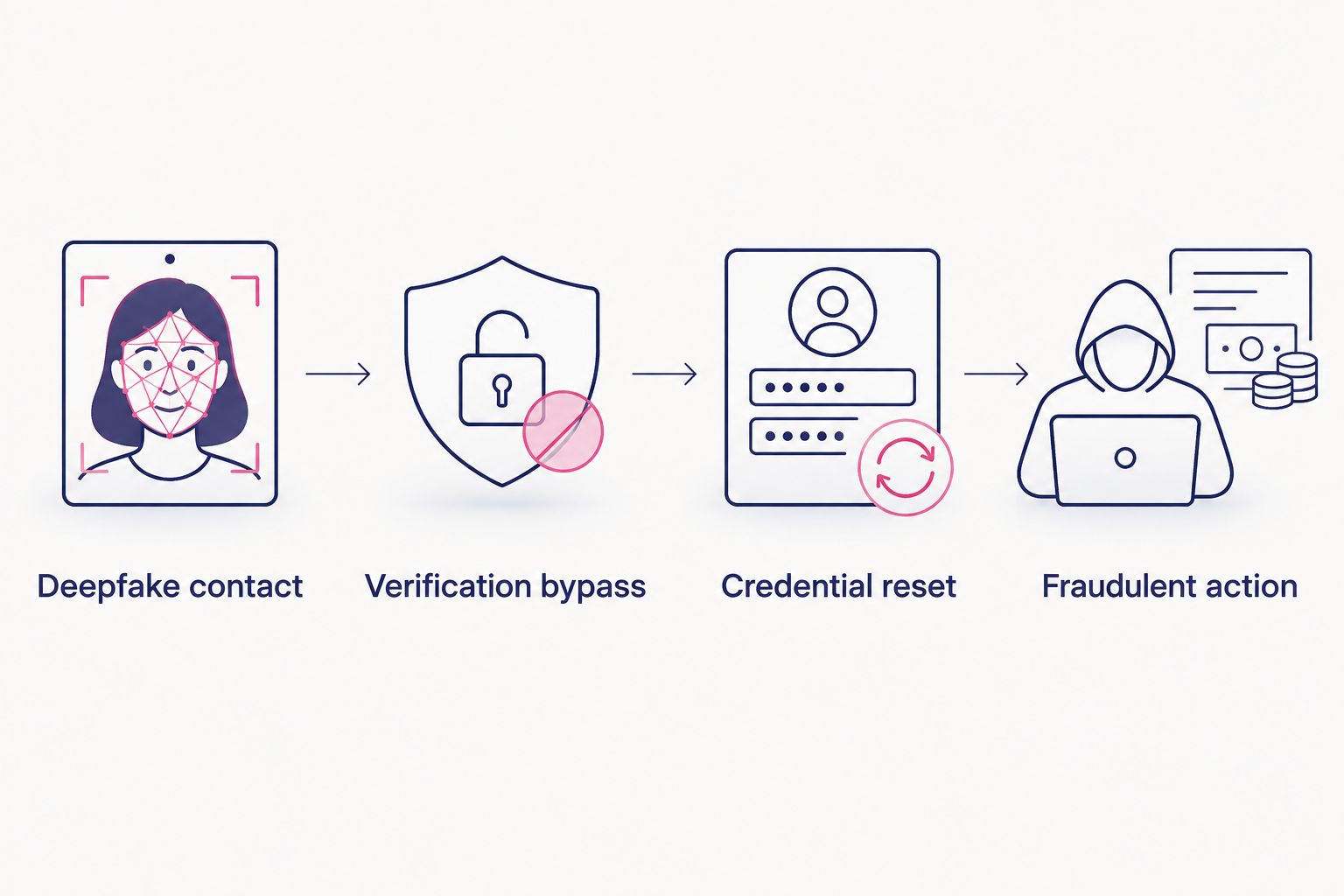
The real pattern in 2026 looks like this: an attacker clones an executive's voice from a public earnings call, phones the helpdesk, and talks a human into a credential reset or a wire approval. The deepfake isn't the breach — it's the social-engineering wrapper around a business email compromise attempt that targets identity verification itself. Voice cloning tools in wide circulation now need as little as 3 seconds of source audio to produce a usable clone, which means public interviews, webinars, and even voicemail greetings are enough raw material.
SecFolio's attack-path framework treats this as a layer-two problem: eliminate reusable credentials and human-judged identity checks with passwordless authentication, so a convincing voice or face on a call can't trigger a reset in the first place. Detection tools matter as a second line of defense, not a substitute for removing the human decision point.
What makes the best deepfake detection tool
- Modal coverage — does it handle video, audio, and still images, or just one
- Real-time capability — can it score a live call or stream, or only post-hoc uploads
- Integration depth — API-first tools slot into existing call-center or content pipelines faster than standalone dashboards
- Transparency of claims — vendors that publish methodology (even partial) are more trustworthy than those citing an accuracy number with no explanation
- Update cadence — generative models change monthly; a detector trained on 2024 fakes misses 2026 techniques
- Deployment fit — enterprise security teams need different tooling than social platforms doing content moderation at scale
Deepfake detection tools at a glance
| Tool | Best for | Standout feature | Key limitation |
|---|---|---|---|
| Reality Defender | Enterprise multi-modal detection | Combines video, audio, and image analysis in one API | Needs integration work to pipe live media feeds in |
| Intel FakeCatcher | Real-time video call verification | Analyzes physiological signals instead of pixel artifacts | Video only — no audio or image coverage |
| Pindrop | Voice fraud in call centers | Purpose-built for contact-center audio streams | Blind to video and image-based deepfakes |
| Hive AI | High-volume content moderation | Scales across large platforms and user-generated media | Built for moderation workflows, not forensic investigation |
| Sensity AI | Forensic investigation and threat intel | Maintains a tracked database of known deepfake campaigns | Slower turnaround — not built for real-time blocking |
1. Reality Defender: best deepfake detection tool for enterprise multi-modal coverage
Reality Defender runs video, audio, and image streams through a single detection API, which is the main reason it sits at the top of this list in 2026 — most enterprise fraud attempts don't arrive in just one format.
Reality Defender pros:
- Covers three media types instead of one, reducing the number of point tools a security team has to stitch together
- API-first design integrates with existing fraud and identity workflows
- Positioned for enterprise and government use cases rather than consumer moderation
Reality Defender cons:
- Multi-modal coverage means more setup work than a single-purpose tool
- Accuracy claims, like most vendors in this space, come from internal testing rather than a third-party audit
Best for: security teams that need one vendor covering voice, video, and image fraud instead of three separate point tools.
Verdict: Buy if your fraud surface spans more than one media type — which it does for most enterprises by 2026.
2. Intel FakeCatcher: best deepfake detection tool for real-time video call verification
Intel built FakeCatcher around a different signal than most competitors: instead of hunting for pixel artifacts, it analyzes subtle blood-flow changes in video — something generative models don't reproduce convincingly. Intel's own published claim puts accuracy at 96%, though that figure comes from Intel's testing, not an independent lab.
Intel FakeCatcher pros:
- Physiological-signal approach is harder for generative models to fake than visual artifacts
- Designed for real-time analysis, useful for live video calls
- Backed by Intel's hardware and research resources
Intel FakeCatcher cons:
- Video only — doesn't detect voice-cloned audio or still-image manipulation
- The 96% figure is a vendor claim, not a benchmark run by a neutral third party
Best for: teams specifically worried about live video call impersonation — fake video interviews, fraudulent video approvals, deepfaked executive calls.
Verdict: Buy for video-specific use cases; pair it with a voice tool if your risk includes phone-based fraud.
3. Pindrop: best deepfake detection tool for voice fraud in call centers
Pindrop built its reputation on call-center voice authentication long before deepfakes were a mainstream concern, and that specialization shows. It's purpose-built for analyzing phone audio at scale, which matters because voice cloning is the cheapest and fastest deepfake attack to execute in 2026.
Pindrop pros:
- Deep specialization in phone and call-center audio, not a bolted-on feature
- Built to run against high call volumes without manual review of every flagged call
- Addresses the exact attack vector used in most helpdesk social-engineering attempts
Pindrop cons:
- No coverage for video or image-based deepfakes at all
- Narrow scope means it's one piece of a broader detection stack, not a standalone answer
Best for: contact centers, helpdesks, and any team that verifies identity by phone before resetting credentials or approving transactions.
Verdict: Buy if phone-based social engineering is your primary exposure; skip if your risk is mostly video or image-based.
4. Hive AI: best deepfake detection tool for high-volume content moderation
Hive AI's detection API is built for platforms that need to scan massive volumes of user-generated content, not for forensic-grade investigation of a single suspicious file. That makes it the right shape for social platforms and marketplaces, and the wrong shape for incident response teams.
Hive AI pros:
- Scales to the volume that social and media platforms actually see
- API integrates into existing content-moderation pipelines
- Covers synthetic media broadly, not just one narrow fraud pattern
Hive AI cons:
- Tuned for moderation decisions (flag/remove), not the kind of chain-of-custody detail a forensic investigation needs
- Less specialized than Pindrop or FakeCatcher for their specific media types
Best for: platforms and marketplaces moderating user-submitted media at scale, not enterprise security teams defending against targeted fraud.
Verdict: Hold for enterprise security use cases; buy for content moderation at platform scale.
5. Sensity AI: best deepfake detection tool for forensic investigation
Sensity AI (formerly Deeptrace) built its name tracking deepfake campaigns across the open web, maintaining a database of known synthetic media rather than just scoring files one at a time. That history makes it useful for investigation and threat intelligence work, less so for blocking fraud in real time.
Sensity AI pros:
- Tracked database of known campaigns adds context a single-file scan can't provide
- Useful for threat intelligence teams tracking deepfake activity against a brand or executive
- Longer track record in the space than most newer entrants
Sensity AI cons:
- Slower turnaround — built for investigation, not blocking an active call or stream
- Doesn't fit a real-time fraud-prevention workflow
Best for: threat intelligence and incident response teams investigating deepfake activity after the fact, not teams trying to stop a live call.
Verdict: Wait unless investigation and campaign tracking is specifically your use case — it's not a frontline fraud blocker.
Stop the reset, not just the fake
See how identity controls remove the human decision point deepfakes exploit.
How we ranked
The ranking above weighs modal coverage, real-time capability, integration depth, transparency of accuracy claims, update cadence, and deployment fit — the six criteria listed earlier. None of these five tools wins on all six; each earns its slot by dominating one or two. Reality Defender tops the overall list because it's the only one spanning all three media types in a single API, not because any vendor's internal accuracy number is independently verified in 2026.
Which deepfake detection tool should you choose?
If you're an enterprise security team facing fraud across multiple channels, Reality Defender is the default pick for 2026. If your exposure is specifically live video calls, Intel FakeCatcher earns its place. If your helpdesk takes phone calls to reset credentials, Pindrop closes the gap Reality Defender and FakeCatcher leave open.
Whichever tool you pick, treat it as detection, not prevention. A tool that correctly flags a cloned voice after the helpdesk already reset the password didn't stop anything — passwordless authentication removes the step an attacker needs a convincing voice or face for in the first place. Detection and identity controls aren't competing choices; they're different layers of the same attack path.
FAQ
What’s the best deepfake detection tool in 2026?
Reality Defender is the strongest overall pick for enterprise use because it covers video, audio, and image analysis in one API. Narrower needs are better served by specialists like Intel FakeCatcher for video or Pindrop for voice.
Is Intel FakeCatcher better than Reality Defender?
Intel FakeCatcher is stronger for real-time video call analysis, with a vendor-published 96% accuracy claim, but it only covers video. Reality Defender covers video, audio, and images, making it the better fit for broader enterprise fraud exposure.
How much does deepfake detection software cost in 2026?
Pricing for enterprise deepfake detection tools typically scales with API call volume or seat count rather than a flat fee. Check each vendor’s current pricing page since rates and tiers change frequently.
Can deepfake detection tools stop voice cloning fraud?
They can flag a cloned voice during or after a call, but they can’t stop a helpdesk agent from completing a credential reset before the flag is reviewed. Identity controls that remove human judgment from the reset decision close that gap.
Do deepfake detectors work in real time?
Some do and some don’t. Intel FakeCatcher and Pindrop are built for live analysis, while Sensity AI is built for investigation after the fact and runs on a slower turnaround.
How accurate are deepfake detection tools really?
Most published accuracy figures, including Intel’s 96% claim for FakeCatcher, come from vendor-run testing rather than an independent audit. Treat any single accuracy number as a starting point for evaluation, not a guarantee.
Should enterprises rely on detection tools alone to stop deepfake fraud?
No. Detection tools flag suspicious media, but the actual damage happens when a human acts on a fake voice or video by resetting a credential or approving a transfer. Passwordless identity controls remove that decision point.
What’s the difference between deepfake detection and passwordless authentication?
Deepfake detection analyzes media to flag likely fakes after the fact. Passwordless authentication eliminates the reusable credential or human judgment call that a convincing fake is trying to exploit in the first place.
One last thing
Voice cloning needs as little as 3 seconds of source audio in 2026 — a single voicemail greeting or conference-call clip is enough raw material for an attacker. No detection tool on this list changes that math; they only shorten the window between the fake being created and someone noticing. The teams that actually stop losses are the ones that made the helpdesk reset process immune to a convincing voice on the line, not the ones with the best-scoring detector.
Related guides
- Build an identity threat detection and response program
- Credential theft elimination for managed service providers
- Detect MFA fatigue attacks before they succeed


