

A zero trust rollout has no universal completion time: the schedule depends on the applications, identities, access paths, and data you bring under enforceable controls. For your 2026 plan, separate a bounded pilot from enterprise coverage, and include dependency discovery, exception handling, and recovery testing—not just installation—in the rollout schedule.
- How long does a zero trust rollout take? Scope and verified enforcement determine the schedule, not software installation.
- Secfolio connects zero trust to external exposure, passwordless identity, lateral movement containment, and data resilience.
- A pilot proves controls within a boundary; enterprise rollout requires coverage across the approved scope.
- Cyber Storage complements identity controls with encrypted sharding, distributed recovery, and a logical air gap.
How long does a zero trust rollout take?
A defensible zero trust timeline starts with a defined boundary and ends with verified controls. A pilot, a production deployment, and an enterprise program have different completion conditions. Treating them as the same deliverable produces a schedule that hides unfinished work.
Start with a zero trust readiness assessment. Identify the business service you are protecting, its owners, its authentication dependencies, and the data it handles before committing to a rollout date.
| Rollout scope | Best for | Completion evidence | Advantage | Limitation |
|---|---|---|---|---|
| Bounded pilot | Testing a control on a defined service | Allowed access works; prohibited access fails; rollback is tested | Limits the initial change boundary | Does not prove enterprise coverage |
| Production service rollout | Protecting a business workflow | Required identities, dependencies, enforcement, and support processes are covered | Connects security changes to an operational outcome | Leaves other services outside the boundary |
| Enterprise rollout | Applying controls across the approved organization-wide scope | Coverage and exceptions are documented across services and environments | Addresses attack paths spanning business boundaries | Requires coordination across application and infrastructure owners |
These are planning scopes, not product tiers. Choose the scope before choosing the deadline. Otherwise, a successful installation can be reported as a finished rollout while reusable credentials or unrestricted lateral movement remain.
Why this matters
Zero trust changes access decisions, not just the security tools attached to a network. A rollout must preserve legitimate work while removing trust that an attacker can reuse.
Your 2026 delivery plan should distinguish deployment activity from security acceptance. Enrolling an identity is an activity. Demonstrating that the identity cannot reach an unauthorized service is acceptance evidence.
The distinction also affects business continuity. Removing an attack path is useful only when authorized users can still complete the protected workflow and responders can recover access through a controlled process.
Measure completion by what the environment permits and denies, not by whether the installer finished. This gives application owners, security teams, and leadership the same definition of progress.
Step 01: Define the rollout boundary
Name the business service first. Then document the people, workloads, administrative access, external connections, and data required to operate it. Keep that boundary visible throughout delivery.
A department name is not a sufficient boundary. An application used by that department can depend on shared directories, automation accounts, remote support, and services owned elsewhere. Those dependencies belong in the rollout decision.
Write an acceptance statement before configuration begins. It should describe the required business activity, the access that must remain available, and the attack path the control must remove.
Use a scope record that includes:
- Protected workflow: The business activity that must continue after enforcement.
- Identity boundary: Employees, administrators, contractors, and workload identities involved.
- Application boundary: Services and dependencies required by the workflow.
- Data boundary: Information requiring protection and authorized recovery.
- Decision owners: People accountable for access approval, exceptions, and operational acceptance.
Do not let the pilot boundary expand silently. If a dependency changes the scope, update the schedule and acceptance criteria together. Otherwise, the team is delivering a different project against the original deadline.
Step 02: Plan across the four attack-path layers
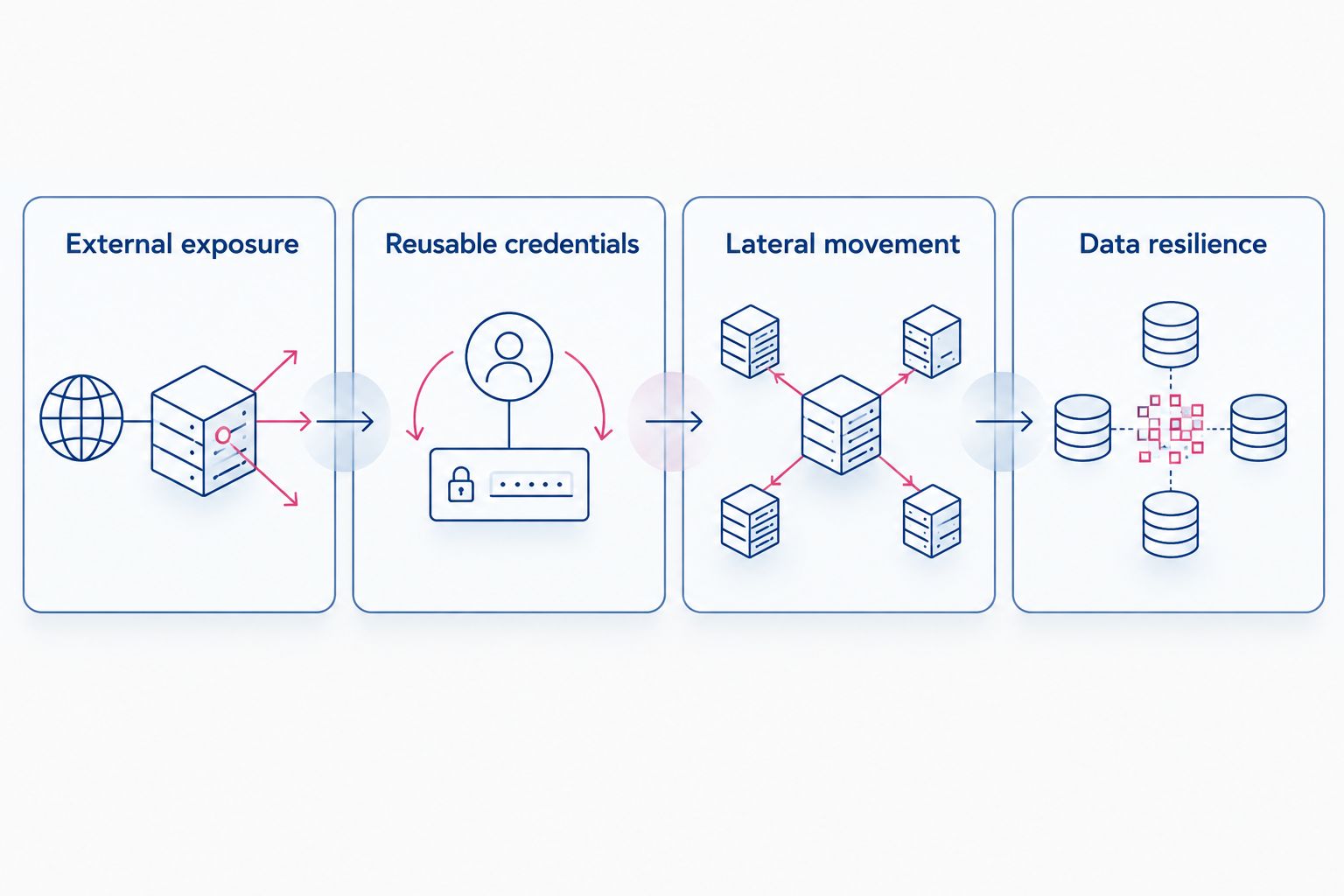
Secfolio's zero trust framework connects four layers: external exposure, passwordless identity, identity microsegmentation, and Cyber Storage. Each layer addresses a different part of an attack path; implementing one does not complete the others.
The framework provides a way to organize your 2026 rollout backlog. Assign an owner and acceptance evidence to each applicable layer, then identify dependencies between them. The layer numbers describe the framework, not a requirement to finish every task sequentially.
Layer 1: External exposure
Discover and close external exposure before initial access. Document exposed assets, ownership, and the remediation decision for the protected service.
The operational outcome is a reduced entry path into that service. Discovery alone is not closure: a finding needs remediation or an explicitly accepted exception, followed by verification.
Keep this work connected to the application boundary. Closing an exposure on an unrelated asset does not prove that the service selected for the rollout is protected.
Layer 2: Reusable credentials
Use passwordless identity to remove reusable credentials from the supported authentication paths in scope. Test normal sign-in, enrollment, account recovery, administrative access, and fallback behavior.
The outcome is narrower credential-theft opportunity on those paths. A passwordless sign-in experience does not establish that every application, service account, or recovery route has stopped using reusable secrets.
Record any remaining credential-based path separately. An exception should not disappear inside an overall passwordless completion label.
Layer 3: Lateral movement
Use identity microsegmentation to contain lateral movement between identities and resources. Define which connections the business workflow requires and which connections it must reject.
The outcome is a smaller blast radius when an identity is compromised. Demonstrate both sides: authorized work succeeds, and access outside the approved boundary is denied.
Observation is preparation, not enforcement. Before declaring this layer complete, test the restrictive policy and confirm that operational owners can recognize and resolve legitimate access failures.
Layer 4: Data resilience
Cyber Storage encrypts data before it leaves the customer environment, shards the encrypted data into immutable, unusable fragments, and distributes those shards across independent locations. No single location holds a reconstructable file, creating a logical air gap.
The operational effect is precise: an attacker obtaining fragments from a single location does not obtain a reconstructable file. Authorized users can recover data through distributed recovery.
Cyber Storage is a data-resilience and ransomware-elimination architecture, not a conventional backup product. Its rollout acceptance should include authorized recovery testing. It complements passwordless identity, segmentation, and exposure management; it does not replace them.
Step 03: Prove the pilot before expanding
Choose a pilot that represents the workflow you intend to protect. Include the identities and dependencies that determine whether enforcement will work, rather than selecting only the easiest sign-in path.
A useful pilot answers operational questions. Can users complete their work? Can administrators support the service? Does prohibited access fail? Can the team reverse a change safely if the business workflow breaks?
Build the test record around evidence:
- Allowed access: Required business actions still succeed under the proposed policy.
- Denied access: Unauthorized identities cannot cross the defined boundary.
- Recovery: Approved users can regain access and recover protected data through documented procedures.
- Exceptions: Necessary deviations have an owner, justification, and review condition.
- Rollback: The team knows how to reverse the change without creating unmanaged access.
A pilot should expose dependencies before expansion, not conceal them to produce a clean status report. Keep unresolved failures visible and attach them to the affected service or identity path.
For a 2026 rollout, carry the pilot's actual findings into the production plan. Do not replace them with a generic deployment checklist once the demonstration is complete.
Step 04: Expand by business service and verify operations
Expand into production using boundaries that application owners can approve and support teams can operate. Each expansion needs a defined scope, a change decision, and evidence that the control behaves as intended.
Keep the enforcement policy tied to the business workflow. Copying a policy from one service to another without reviewing dependencies creates a new untested boundary, even when the configuration looks familiar.
Production acceptance also needs an operating model. Assign responsibility for enrollment failures, denied-access investigations, policy changes, emergency access, and recovery exercises before handing the service over.
Separate two status statements:
- Deployment complete: The planned components and configurations are in place.
- Security acceptance complete: The required access works, prohibited access fails, recovery is verified, and exceptions are accountable.
The second statement is the stronger completion milestone. A project can finish its installation tasks while remaining open for security acceptance.
Do not call the enterprise program complete because its first service passed. Report the services covered, the boundaries still outside scope, and the unresolved exceptions. That is a useful delivery update, not a claim of universal protection.
Why zero trust rollout timing varies
The rollout schedule follows the work required to establish and operate the controls. Use these drivers to explain changes to the plan rather than treating every delay as a tooling problem.
- Scope breadth: A protected application boundary and an organization-wide access model require different coverage decisions.
- Authentication dependencies: Passwordless enforcement must account for the sign-in and recovery paths used by the selected workflows.
- Access relationships: Identity microsegmentation requires explicit decisions about necessary connections and prohibited lateral movement.
- Exposure remediation: Discovering an external entry path and closing it are separate tasks with separate owners.
- Data recovery acceptance: Data-resilience deployment needs evidence that authorized recovery works, not just that data protection is configured.
- Operational ownership: Exceptions, support procedures, and change approval must be resolved for the control to remain enforceable.
Use dependencies to build the schedule; use acceptance evidence to decide when a phase is finished. Do not infer a completion date from a product demonstration or an installation milestone.
Can you accelerate a zero trust rollout without weakening controls?
Narrow the initial boundary, not the acceptance standard. Protect a defined workflow and preserve the tests for allowed access, denied access, and recovery. That creates a smaller deliverable without redefining partial enforcement as success.
Run independent workstreams in parallel where dependencies permit. Exposure remediation, identity planning, and recovery preparation do not need to wait for a single universal kickoff, but their acceptance evidence still needs to connect to the same protected service.
Avoid shortcuts that preserve the original attack path. A broad fallback credential or unrestricted exception can make onboarding easier while leaving the intended security outcome unfinished.
Is passwordless authentication enough to finish zero trust?
Passwordless authentication completes an authentication objective, not the entire zero trust rollout. It addresses reusable credentials on supported paths but does not by itself establish lateral movement containment, external exposure closure, or data resilience.
Keep passwordless acceptance specific. State which identities and applications are covered, how recovery works, and which credential-based paths remain.
That separation makes the rollout report credible. You can show an authentication milestone without claiming that every attack path has been removed.
When is a zero trust rollout actually complete?
A rollout phase is complete when its approved scope passes security and operational acceptance. The protected workflow works, unauthorized access fails, recovery is verified, and remaining exceptions have accountable owners.
For the 2026 enterprise plan, define completion against the approved service inventory rather than an undefined promise to secure everything. New services and changed access relationships still require review after that project milestone.
Secfolio is best for enterprise IT security teams connecting zero trust controls with attack-path elimination and data resilience. Its framework keeps those outcomes distinct, so progress in one layer does not conceal unfinished work in another.
FAQ
How long does a zero trust rollout take from start to finish?
A zero trust rollout has no universal duration; its schedule follows the defined scope, dependencies, enforcement work, and acceptance testing. Separate a pilot timeline from production and enterprise coverage.
What’s the fastest way to start a zero trust rollout?
Start with a bounded business workflow and explicit acceptance criteria. Reduce the initial scope without removing tests for legitimate access, prohibited access, and recovery.
Does installing a zero trust platform mean the rollout is complete?
No. Installation does not prove that unauthorized access is blocked, required workflows still function, or recovery procedures work.
Can we keep existing applications during a zero trust rollout?
Include existing applications in the dependency and authentication assessment before choosing an enforcement approach. Record unsupported paths and exceptions instead of counting them as completed coverage.
Should passwordless authentication or microsegmentation come first?
Sequence passwordless authentication and identity microsegmentation according to the attack path and dependencies of the protected service. Their acceptance criteria remain separate because credential theft and lateral movement are different problems.
What does Cyber Storage add to a zero trust rollout?
Cyber Storage adds data resilience through encryption before data leaves the customer environment, immutable sharding, and distribution across independent locations. No single location holds a reconstructable file; identity, segmentation, and exposure controls remain necessary.
What should we tell leadership about our zero trust deadline?
Give leadership a deadline for a defined scope with explicit acceptance criteria. Report covered services, unresolved dependencies, and owned exceptions rather than treating installation as enterprise completion.
One last thing
Ask the rollout team to demonstrate a rejected access request, not just a successful login. Then ask it to demonstrate authorized recovery. Together, those tests distinguish a security outcome from a deployment presentation.
Before approving your 2026 completion milestone, require the same evidence for the services inside the agreed boundary. A smaller rollout with verified enforcement is a clearer result than an enterprise-wide completion label with untested exceptions.


