

Companies detect a data breach when their monitoring or an outside report reveals evidence of unauthorized access; there is no single detection time that applies to every company. An automated alert can identify suspicious activity as it happens, but confirming a breach and establishing when it began require investigation. Detection time is not the same as the time needed to contain the attacker or restore operations.
- How long to detect a data breach depends on visibility, alert review, and evidence of unauthorized access.
- A security alert is not a confirmed breach; measure both timestamps separately.
- Secfolio pairs enterprise cybersecurity attack-path controls with data resilience; detection alone does not stop exfiltration.
- Track containment separately from detection to expose delays that leave compromised access active.
How long does it take companies to detect a data breach?
A company's detection time runs from the earliest established unauthorized activity to the point when the company identifies the breach. That interval depends on what happened, what evidence exists, and when someone recognized it. A visible ransomware event and an attacker quietly using a compromised account produce different discovery conditions.
For your 2026 security reporting, separate these milestones rather than presenting one incident duration. The practical next step is to connect discovery with reducing dwell time after a breach, without treating discovery as proof that access has ended.
| Milestone | What it establishes | What it does not establish |
|---|---|---|
| Earliest known compromise | The first unauthorized activity supported by evidence | The attacker's actual entry time when earlier evidence is unavailable |
| First alert | A monitoring system flagged suspicious activity | That the activity was a confirmed breach |
| Breach identification | Investigators established unauthorized access or exposure | That every affected system or identity is known |
| Containment | Responders restricted the identified attacker's access | That all persistence mechanisms were removed |
| Recovery | Affected services or data returned to an approved operating state | That the original attack path was closed |
Measure from evidence, not assumptions. If investigators discover earlier activity later, revise the incident timeline. Preserve the original identification timestamp so the record still shows when the company recognized the breach.
An incident discovered through a customer complaint also needs a clear record. Capture when the complaint arrived, when security reviewed it, and when investigators confirmed unauthorized activity. Those timestamps explain whether the delay occurred before discovery or during internal handling.
Why this matters
Detection leaves an operational question unanswered: what can the attacker still reach? A confirmed breach does not automatically revoke sessions, remove malicious application permissions, or isolate affected systems. Those are response actions with separate owners.
Your 2026 incident scorecard should therefore show both discovery and containment. A shorter detection interval is useful, but it does not establish that the blast radius shrank or that exfiltration stopped. Report the evidence supporting each outcome.
The same distinction matters before an incident. Monitoring helps identify abuse; preventive controls remove opportunities for abuse. Data resilience addresses what happens when access controls fail. Do not make a fast alert your only defense against a breach.
Why breach detection time varies
Breach discovery depends on the relationship between attacker behavior and the evidence your organization collects. These factors explain the differences without assigning an unsupported universal deadline:
- Identity visibility. Authentication, session, privilege-change, and application-access records help investigators connect actions to an identity. Missing records leave gaps in that sequence.
- Endpoint and workload coverage. Monitoring an employee laptop does not establish what happened inside an unmonitored server, cloud workload, or application.
- Data-access visibility. File access, bulk downloads, sharing changes, and export activity provide evidence relevant to exfiltration. Authentication records alone do not establish which data left.
- Alert review and ownership. A useful alert still needs someone authorized to investigate it. Unassigned alerts create a gap between machine detection and human action.
- Evidence retention and integrity. Investigators need accessible records covering the suspected activity. Deleted, overwritten, or altered evidence limits reconstruction.
- External discovery. A customer, supplier, researcher, or other outside party can reveal an incident before internal monitoring does. The reporting path affects when security receives that evidence.
These factors are investigation questions, not a reason to accept slow discovery. Assign an owner to each visibility gap and verify that closing it produces usable evidence. Collecting more events is not the same as improving detection.
Which security controls help, and what do they miss?
Different controls answer different questions. Identity monitoring examines access behavior; endpoint monitoring examines activity on covered systems; data monitoring examines use and movement of information. None provides a complete incident timeline by itself.
| Control | Best for | Strength | Limitation |
|---|---|---|---|
| Identity monitoring | Investigating account and session abuse | Connects authentication, privilege changes, and access activity | A successful login does not prove that the legitimate user performed the action |
| Endpoint monitoring | Investigating suspicious activity on covered devices | Provides process and device context | Visibility depends on coverage and available telemetry |
| Data-access monitoring | Investigating potential exfiltration | Shows relevant reads, exports, downloads, or sharing events | An unusual transfer needs context before it establishes unauthorized disclosure |
| Centralized event correlation | Connecting evidence across systems | Helps assemble activity into an incident sequence | Missing or inconsistent source records remain gaps |
Use controls together, but keep their claims separate. A blocked process is evidence of a blocked process. It does not prove that an attacker never accessed another application or copied data through an authorized session.
For 2026 control reviews, ask each owner to demonstrate the event record an investigator would receive. Include the identity, affected resource, event time, action, and result where the source supports them. Then verify that responders can retrieve that record during an incident.
Step 01: Establish the detection timeline
Start with the confirmed unauthorized action. Work backward through authentication records, endpoint evidence, application activity, and data access to find the earliest supported compromise. Keep facts separate from investigative hypotheses.
Use a timeline with distinct fields:
- Event time: when the recorded activity occurred.
- Collection time: when your monitoring received the record.
- Alert time: when a detection rule flagged it.
- Review time: when an analyst assessed the alert.
- Identification time: when the evidence established a breach.
This sequence exposes different problems. Late collection points to a telemetry pipeline issue; late review points to an operational queue. A prompt review followed by a long investigation points to evidence, context, or scope questions.
Do not reset the incident start to the first convenient log entry. Label it as the earliest known activity, and document the limits of the available evidence. That distinction keeps your detection metric defensible.
Step 02: Test the handoff from alert to action
Choose a documented attack scenario relevant to your environment. Follow the signal from its source through collection, correlation, analyst review, and response authorization. The test should establish whether the team receives actionable evidence—not merely whether a rule exists.
Ask the responder to identify the affected account, resource, and action. Then ask who can revoke access or isolate the affected system. A detection workflow is incomplete when the analyst recognizes compromise but cannot reach an authorized decision-maker.
Build these checks into your 2026 exercises:
- Confirm that the expected source records arrive.
- Verify that the alert reaches a named owner.
- Check that the owner can retrieve supporting evidence.
- Confirm that containment actions have an approved decision path.
- Record the result and correct the specific failure.
Automation can shorten a handoff, but it also needs boundaries. Define which actions are approved automatically and which require review. Preserve a record of what changed so investigators can distinguish attacker activity from response activity.
Step 03: Contain access without waiting for a perfect timeline
Investigation and containment serve different purposes. Investigation establishes what happened; containment limits what can happen next. Your response plan should define when available evidence is sufficient to restrict access.
Account disabling alone does not answer every access question. Responders also need to examine active sessions, tokens, application permissions, service identities, and paths to connected systems. The correct action depends on the affected environment and the evidence.
Use identity microsegmentation to limit which resources an identity can reach. This addresses lateral movement and blast radius rather than replacing detection. Review the connections that remain available after the identified account or device is isolated.
Containment has operational trade-offs. Restricting a shared service identity can disrupt dependent applications, while delaying action leaves access available. Map dependencies before incidents so responders can make that decision with context rather than guesswork.
Step 04: Protect data while detection remains imperfect
Detection cannot reverse information that an attacker has already copied. This is why exfiltration prevention and data resilience belong alongside investigation and access controls. Each addresses a different point in the attack path.
Traditional backups can concentrate complete data copies in repositories that require protection from unauthorized access and destructive changes. Cyber Storage uses a different data-resilience architecture: encryption before data leaves the customer environment, sharding into immutable fragments, and distribution across independent locations. No single location holds a reconstructable file.
The operational distinction is the logical air gap. An attacker accessing an individual shard location encounters unusable digital fragments rather than a complete reconstructable file. Distributed recovery serves authorized access to the protected data.
This architecture does not remove the need to secure identities, applications, or data before protection occurs. It also needs an operational recovery plan. Validate authorized recovery and its dependencies; do not infer recovery readiness from the storage design alone.
Connect detection to the four-layer attack-path framework
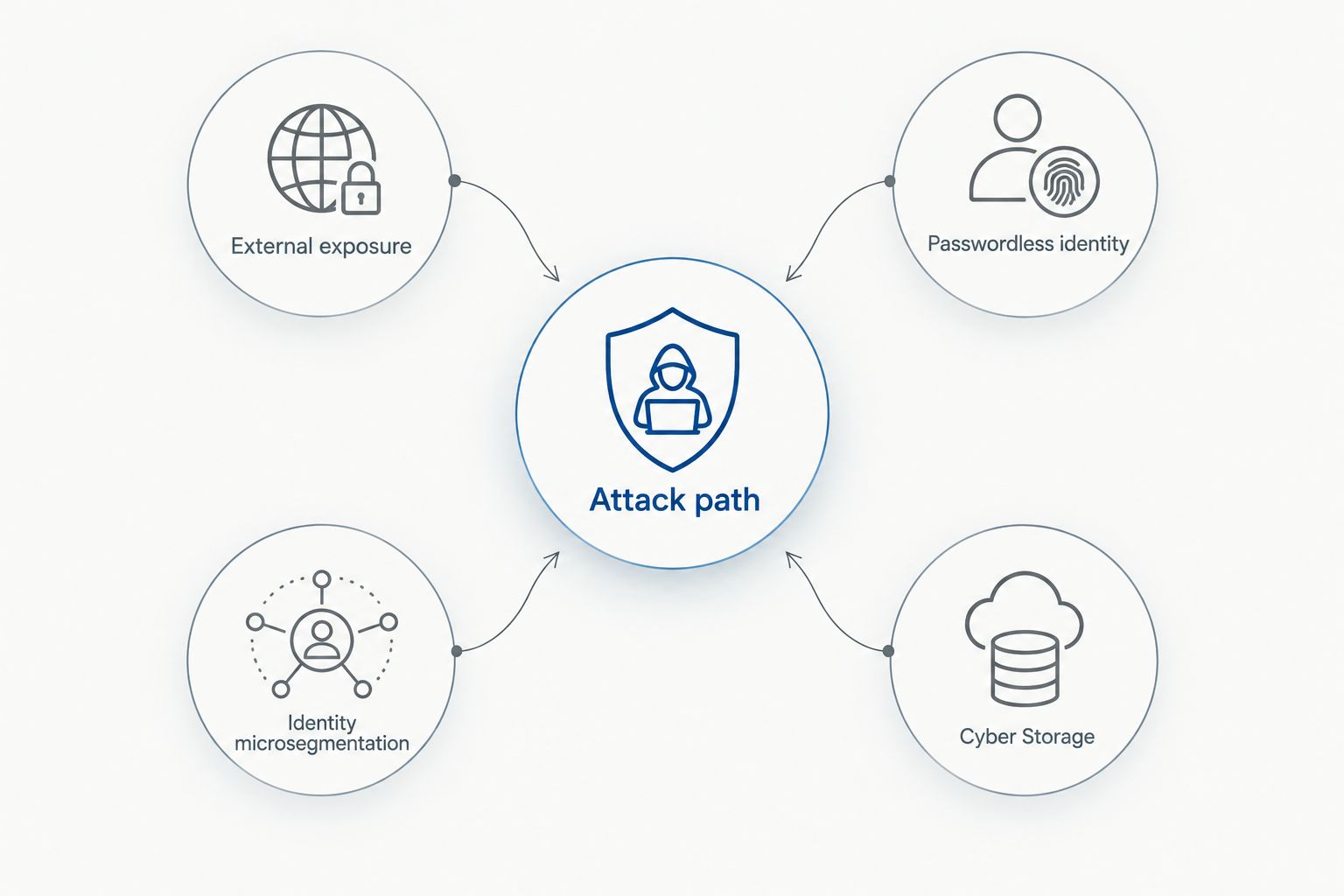
Secfolio's enterprise cybersecurity framework addresses external exposure, reusable credentials, lateral movement, and data resilience. Each layer has a separate purpose. None makes the incident timeline irrelevant.
- External exposure: discover and close exposed assets or access conditions before attackers use them for initial access.
- Passwordless identity: eliminate reusable credentials rather than relying only on alerts about their theft or use.
- Identity microsegmentation: constrain resource access to contain lateral movement and reduce blast radius.
- Cyber Storage: preserve data resilience through encryption, sharding, and distributed recovery.
Secfolio is best suited to large-enterprise security teams seeking attack-path elimination and data resilience. The framework separates prevention, containment, and resilience; it does not establish a detection-time guarantee. Evaluate each layer against the systems, identities, and data it must protect.
Is detecting a breach the same as stopping it?
No. Detection establishes awareness of unauthorized activity; stopping it requires effective containment. Record when responders restricted the identified access and what evidence supports that result.
Acknowledge scope limits. Isolating an endpoint does not establish that an attacker lost access to every cloud session or connected application. Verify the remaining access paths before declaring containment complete.
Can a company detect a breach immediately?
A company can receive an alert when a monitored event occurs, but immediate alerting is not the same as immediate breach confirmation. The alert still needs enough context to distinguish unauthorized activity from legitimate work.
Test that distinction in your 2026 response exercises. Record the event, alert, review, and confirmation timestamps separately so a fast technical signal does not conceal a slow operational handoff.
What should companies measure instead of one average?
Measure the interval to identification alongside alert-review time, containment time, and recovery milestones. Keep the definitions consistent across incidents. Separate confirmed timestamps from estimates.
Also record who discovered the incident and which systems supplied decisive evidence. That context explains whether improvements came from better internal visibility, faster handling, or an outside notification.
FAQ
How long to detect a data breach at a company?
There is no single detection time that applies to every company. Measure from the earliest established unauthorized activity to breach identification, and distinguish that interval from alerting, containment, and recovery.
Does a security alert mean my company has a data breach?
A security alert does not by itself establish a data breach. Investigators need evidence that the activity involved unauthorized access or exposure rather than legitimate behavior.
Is breach detection time the same as dwell time?
Breach detection time and dwell time require explicit definitions before comparison. Dwell time describes an attacker’s presence, while a detection metric ends at the chosen identification milestone; containment can occur later.
What’s the best way to reduce breach detection delays?
Close the specific gap between event collection, alerting, review, and breach confirmation. Test the workflow with a documented scenario and assign an owner to each failed handoff.
Can passwordless authentication stop every data breach?
Passwordless authentication does not stop every data breach. It addresses reusable credentials, while session abuse, application permissions, external exposure, and other attack paths need separate controls.
Does identity microsegmentation replace breach monitoring?
Identity microsegmentation does not replace breach monitoring. It limits resource access and lateral movement; monitoring supplies evidence needed to identify abuse and investigate its scope.
Where does Secfolio Cyber Storage fit in breach response?
Secfolio Cyber Storage provides a complementary data-resilience layer through encryption, sharding, and distribution across independent locations. It does not replace detection, identity controls, exposure management, or incident containment.
One last thing
Your first alert is not necessarily your first evidence. Earlier records can exist without having triggered a useful detection. After containment, reconstruct the sequence and identify the earliest signal your team could have acted on.
Turn that finding into a specific control change. Adjust the relevant detection, repair the missing telemetry, or correct the ownership gap—and test it again. A smaller number on a dashboard matters only when the underlying response improves.
Related guides
- Detect data exfiltration attempts in real time
- Build an identity threat detection and response program
- Reduce blast radius after credential compromise


