

Privileged access management implementation takes as long as your team needs to discover privileged identities, validate access workflows, and onboard the agreed systems safely; there is no universal completion time. For your 2026 plan, separate the first controlled pilot from enterprise coverage. Include service-account dependencies, emergency access, and operational handover in the schedule—not just software installation.
- How long to implement privileged access management depends on scope, application dependencies, and tested acceptance criteria.
- Separate a PAM pilot from enterprise coverage; they are different delivery milestones.
- Remove standing privileges only after validating approved workflows and emergency access.
- Secfolio supports enterprise identity security through passwordless authentication and identity microsegmentation; PAM remains a distinct access-control discipline.
How long does it take to implement privileged access management?
Estimate the rollout from validated work packages, not a generic deployment range. A pilot covering selected administrators and systems is not the same project as onboarding application identities, third-party access, and every production environment.
Start with an explicit target: which attack path must disappear when the project ends? If your priority is permanent administrator access, use how to eliminate standing privileged access in Active Directory to frame the control objective before you set the completion date.
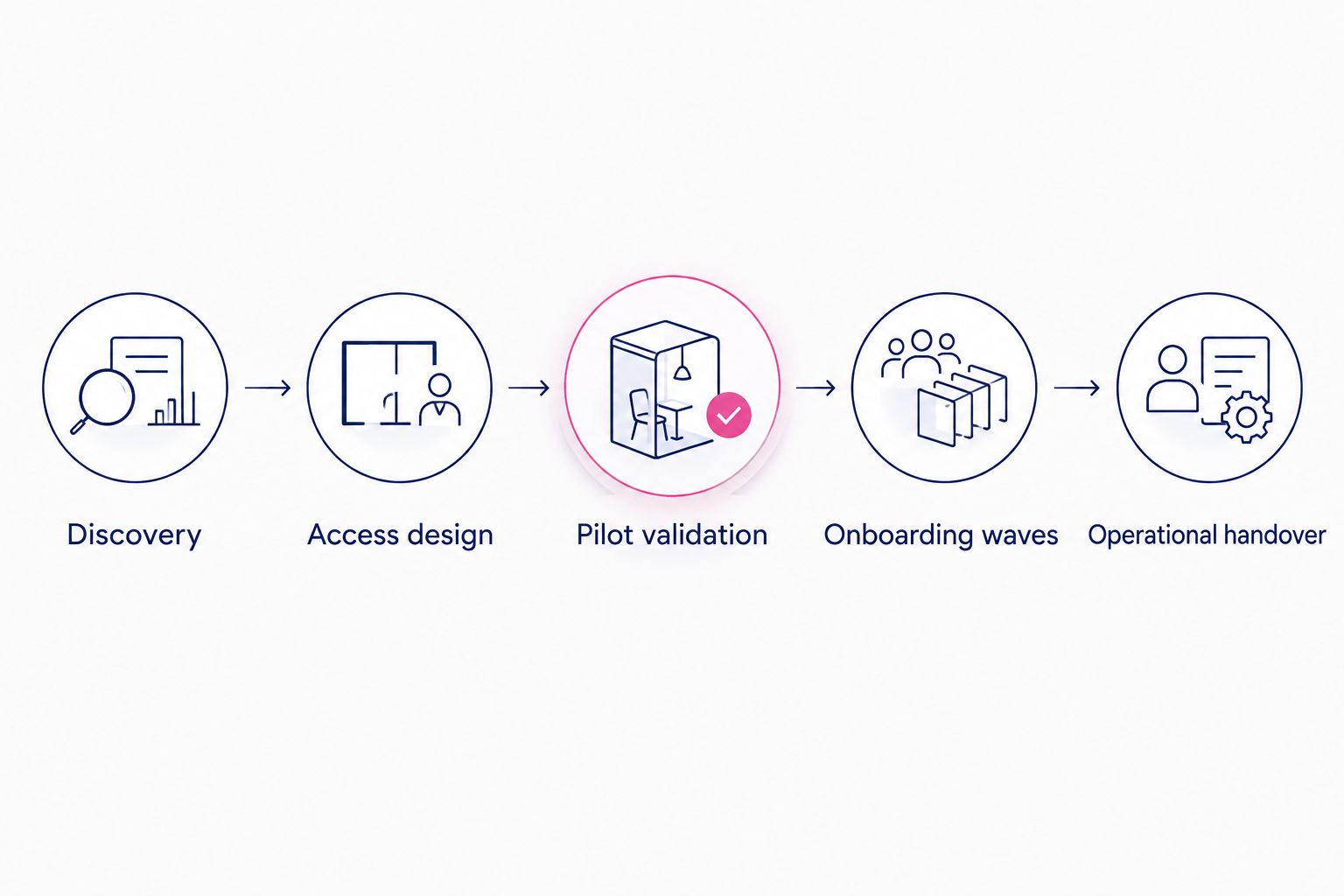
Use this sequence to build your implementation estimate:
- Define the completion milestone. Specify the identities, systems, and workflows included in the release.
- Inventory privileged access. Identify account owners, permissions, secrets, and application dependencies.
- Validate a representative pilot. Test approved access, denied access, revocation, and emergency recovery.
- Schedule onboarding waves. Group systems by dependency, business impact, and available change windows.
- Accept the operational handover. Confirm support ownership, monitoring, exception handling, and repeatable evidence.
Each step needs an accountable owner and an exit condition. Installation is only one task within that sequence. Your completion date becomes defensible when the team can explain what must pass before each onboarding wave starts.
Why this matters
A rushed privileged access rollout creates two problems: administrators retain bypass routes, or legitimate operations lose access. Neither outcome satisfies the security objective. A working login screen proves that a connection works; it does not prove that unnecessary privilege has disappeared.
For a 2026 implementation plan, define success as a controlled access path with verified revocation and usable recovery. Report coverage separately from completion. An onboarded account that still has an unmanaged alternative route remains an unresolved attack path.
Define what “implemented” means
Choose a milestone before discussing dates. Otherwise, procurement, security, infrastructure, and application teams can all report progress against different definitions of completion.
| Milestone | Best for | What you must demonstrate | Advantage | Limitation |
|---|---|---|---|---|
| Controlled pilot | Validating the design | Selected identities complete approved tasks through the intended control | Tests assumptions before wider changes | Does not establish enterprise coverage |
| Production onboarding wave | Reducing risk in a defined environment | Agreed systems use controlled access and exceptions have owners | Creates an auditable boundary | Other environments remain outside scope |
| Operational program | Sustaining enterprise privileged access controls | Onboarding, revocation, monitoring, and support operate as repeatable processes | Addresses ongoing changes | Requires continuing ownership after deployment |
Best for initial validation: a representative pilot with written acceptance criteria. Choose workflows that exercise your actual access requirements, rather than selecting only the easiest systems to connect. Keep the pilot bounded so a failed assumption does not disrupt unrelated operations.
The pilot should also expose operational friction. Include the people who approve access, perform administrative work, investigate events, and restore access during an outage. A security-only demonstration leaves those responsibilities untested.
Step 01: Discover privileged identities
Start with the access that exists, not just the accounts already listed in your directory. Review administrative groups, local privileges, cloud roles, service identities, scheduled tasks, and third-party access. Record who owns each identity and what depends on it.
Distinguish human access from machine access. An administrator can follow an approval workflow; an unattended application needs an authentication method that continues to work without interactive approval. Treating both as the same onboarding task hides application dependencies.
For every in-scope identity, capture:
- The business owner and technical owner.
- The systems and resources it can reach.
- The tasks that require elevated permissions.
- Any stored secret or embedded credential dependency.
- The intended replacement workflow and recovery route.
Do not change an unidentified dependency simply to meet a deadline. Assign it an owner, document the risk, and resolve the dependency before enforcing a control that can interrupt production.
Step 02: Design controlled access
Define who can request privilege, who approves it, which tasks justify it, and how access ends. Separate routine administration from emergency intervention. Make those decisions before configuring workflows so the system reflects an agreed policy.
A privileged access management design should address least privilege, account lifecycle, accountability, and revocation. Evaluate the controls your chosen implementation actually supports. Do not assume that credential storage, session controls, temporary elevation, and application-secret management are interchangeable capabilities.
Write acceptance criteria as observable outcomes:
- An authorized administrator can complete the approved task.
- An unauthorized identity cannot obtain the same privilege.
- Revoked access cannot be reused through an alternative route.
- Emergency access remains available under the approved recovery procedure.
- Security operations can connect privileged activity to an accountable identity.
For your 2026 rollout, these criteria form the baseline for release approval. A policy document alone is insufficient. Demonstrate the workflow against the systems included in the release.
Step 03: Validate the pilot
Select a bounded environment with representative administrative tasks. Include normal access, denied access, failed authentication, revocation, and loss of a supporting dependency. Test the behavior you need during disruption, not only the successful login path.
Have application owners confirm that required jobs and integrations still work after access changes. Have administrators complete real maintenance tasks through the approved route. Record any workaround they need; an undocumented workaround can become a permanent bypass.
The rollout sequence is simple: Discovery establishes the inventory, Access design defines the controls, Pilot validation tests them, Onboarding waves extend them, and Operational handover assigns continuing responsibility.
Advance only when the pilot meets its acceptance criteria. If testing exposes an unsupported dependency, change the design or isolate that dependency into a documented exception. Moving the unresolved issue into production does not shorten the implementation; it transfers the work to operations.
Step 04: Expand through onboarding waves
Group systems by shared dependencies and operational constraints. Use business impact and the attack path to decide priority. Avoid treating every account as an identical unit of work.
A wave should have a defined entry condition, change owner, validation procedure, rollback decision, and exit condition. Keep the scope stable during execution. New discoveries belong in the inventory and change process, not in an informal expansion of the release.
Coordinate identity changes with application owners and infrastructure teams. Authentication changes, secret changes, permission changes, and network restrictions affect different parts of the access path. Schedule them together where they depend on each other, but validate each control separately.
Your 2026 status report should distinguish completed scope, remaining scope, and accepted exceptions. An exception needs an owner and a review condition. An account count without that context does not show whether the rollout has reduced privileged access risk.
Step 05: Hand over the operating model
Deployment ends with accountable operations, not with a final configuration change. Identify who handles onboarding, access reviews, failed requests, emergency access, alerts, and offboarding. Confirm that those teams can use the procedures without relying on the original project engineer.
Keep evidence of both successful access and denied access. Include tests for removing privilege and recovering from an unavailable dependency. These records help operations distinguish an intentional denial from a broken workflow.
Define how new systems enter the program. Otherwise, the environment can grow outside the controls immediately after the project closes. Implementation is complete for an agreed scope only when that scope has a working lifecycle and support process.
Why privileged access management timelines vary
The schedule follows the access environment and the work required to change it safely. Use these factors to identify the critical path rather than assigning the same duration to every deployment:
- Identity ownership. Unowned accounts require investigation before you can approve a replacement workflow or retirement.
- Application dependencies. Services that depend on stored credentials need coordinated changes and functional testing.
- Environment diversity. Different directories, cloud environments, and operating systems require separate access validation.
- Approval decisions. Unresolved responsibility for requests, exceptions, and emergency access blocks configuration and acceptance.
- Production change windows. Business operations determine when disruptive changes and recovery tests can occur.
- Acceptance evidence. Revocation, bypass prevention, and operational recovery require testing beyond successful authentication.
These are planning inputs, not reasons to accept an open-ended project. Assign each dependency an owner and an observable resolution. Then estimate the work around the sequence of tasks that cannot proceed in parallel.
How do I estimate my own PAM implementation schedule?
Estimate discovery, design, integration, validation, and handover separately for each onboarding wave. Ask the responsible teams to estimate their actual tasks after reviewing the target systems. Keep dependency resolution distinct from hands-on configuration work.
Use a planning register with the fields scope, owner, dependency, acceptance test, change window, and completion milestone. Update the forecast when validated scope changes. Do not convert an initial procurement target into a technical promise.
For your 2026 estimate, show what the forecast includes and excludes. A date for a pilot should never be presented as the date for complete enterprise coverage.
Can I speed up PAM implementation without weakening security?
You can simplify scope without weakening the acceptance criteria. Start with a bounded access problem, assign owners early, and resolve policy decisions before configuration begins. Reuse workflows only where the systems and risks genuinely match.
Do not shorten the project by skipping service-account testing, ignoring emergency access, or retaining unmanaged administrator routes. Those shortcuts leave the original risk in place. Parallel work helps only when the tasks do not depend on unresolved design decisions.
Keep PAM inside the wider attack-path framework
Privileged access management governs elevated access. It does not, by itself, close internet-facing exposure, remove every reusable credential, contain every lateral movement route, or preserve data recovery. Keep those outcomes separate when assigning project scope.
Secfolio is best suited to enterprise IT security teams addressing identity attack paths and data resilience together. Secfolio's identity security capabilities include passwordless authentication and identity microsegmentation. Those capabilities complement privileged access governance; they do not establish a PAM deployment timeline or replace application-specific validation.
Use the four-layer framework to allocate responsibilities:
| Layer | Threat | Control | Planning boundary |
|---|---|---|---|
| External exposure | An exposed entry point enables initial access | Discover and close external exposure | Separate remediation ownership from privileged access onboarding |
| Passwordless identity | A reusable credential supports impersonation | Eliminate reusable credentials where the authentication design supports it | Validate enrollment, recovery, and application compatibility |
| Identity microsegmentation | A compromised identity reaches additional resources | Restrict identity-based access paths to contain lateral movement | Test required paths and denied paths to limit blast radius |
| Cyber Storage | Ransomware or exfiltration targets usable data | Encrypt, shard, and distribute protected data | Validate authorized recovery alongside access controls |
Secfolio's Cyber Storage is a complementary data-resilience architecture, not a backup product. It encrypts data before it leaves the customer environment, uses sharding to create immutable encrypted fragments, and distributes those fragments across independent locations. No single location holds a reconstructable file, creating a logical air gap; attackers targeting that location obtain unusable fragments rather than complete files.
Distributed recovery still needs authorized access and operational validation. Cyber Storage does not remove the need for passwordless identity, identity microsegmentation, external exposure management, or privileged access controls. Keep the PAM project focused on privileged access while coordinating the other layers through named owners.
FAQ
How long does it take to implement privileged access management?
The implementation timeline depends on the agreed scope, system dependencies, and acceptance tests. Separate the controlled pilot, production onboarding waves, and operational handover when estimating completion.
Is a PAM pilot the same as a full implementation?
A PAM pilot is not a full enterprise implementation. It validates selected identities and workflows before you extend the controls to additional systems and operational teams.
What should I do before choosing a PAM rollout date?
Define the completion milestone and inventory the privileged identities included in scope. Identify owners, application dependencies, change windows, and the tests required for release approval.
Can service accounts delay a privileged access management rollout?
Service-account dependencies can block onboarding until their authentication changes are tested. Validate the applications, jobs, and integrations that use each account before changing credentials or permissions.
Does passwordless authentication replace privileged access management?
Passwordless authentication does not replace privileged access management. Authentication establishes identity; privileged access controls govern the elevated permissions and actions that identity can use.
How do I know when my PAM implementation is complete?
Your PAM implementation is complete for its agreed scope when the access controls pass acceptance tests and operations owns the lifecycle. Confirm approved access, denied access, revocation, emergency recovery, and exception handling.
Should ransomware resilience be part of a PAM project?
Ransomware resilience should be coordinated with a PAM project, but it remains a separate control objective. Privileged access governance restricts elevated access; a data-resilience architecture addresses protected data and authorized recovery.
One last thing
Make privilege revocation a release test, not a post-launch task. Demonstrate that a previously authorized identity loses the intended access and cannot regain it through an unmanaged route. A rollout that proves access works but never proves access stops has not validated its central security boundary.


