

You see operational value from an identity platform when enforced controls reduce measurable work or remove a verified attack path; you reach financial payback when cumulative, attributable benefits cover cumulative implementation and operating costs. An identity security platform ROI timeline must follow those milestones, not a promised month count, and must include integration, enrollment, policy tuning, and ongoing administration—not just deployment.
- An identity security platform ROI timeline starts with a baseline and ends with verified financial payback.
- SecFolio fits large-enterprise security teams focused on eliminating internal attack paths, not merely collecting identity alerts.
- Passwordless authentication and identity microsegmentation require enforced coverage before you claim security value.
- Keep realized savings, released staff capacity, and modeled risk reduction separate.
Why this matters
Your 2026 business case needs to distinguish a working control from a recovered investment. Connecting a directory proves integration. It does not prove fewer credential-related tasks, a smaller blast radius, or financial payback.
For authentication-led projects, your enterprise passwordless implementation plan should define which users and applications lose reusable credentials. That scope becomes the denominator for both coverage and benefit measurement.
Measure the outcome you purchased. If your objective is stopping lateral movement, authentication adoption alone is insufficient. If your objective is reducing administrative work, blocked attack paths alone do not establish labor savings. A defensible timeline connects each objective to its own evidence.
How long does it take to see ROI from an identity platform?
The timeline runs from baseline measurement through effective enforcement to financial payback. Those are different milestones. Your first measurable improvement is evidence of value, but it is not automatically evidence that the investment has paid for itself.
Use the following sequence for your 2026 evaluation. Treat each step as an acceptance gate, not a calendar promise.
Step 01: Baseline
Record the work and exposure you intend to change before enforcement begins. Identify the covered users, privileged identities, applications, service accounts, and business processes. Name the owners who can validate each outcome.
For operational value, document authentication support work, access administration, investigation effort, and exception handling. For security value, document reusable credentials, unnecessary identity relationships, and reachable sensitive systems. Use consistent definitions so the comparison remains meaningful after rollout.
Exit condition: your security, operations, and finance owners agree on the baseline and measurement method. A dashboard without an agreed denominator is not a business case.
Step 02: Enforce
Apply the control to a defined production scope. Enrollment is not enforcement if password fallback remains available. A segmentation policy is not containment if it only observes connections.
Validate legitimate access and the unwanted behavior the control should stop. Include recovery procedures, service dependencies, and emergency access in that validation. Record exceptions rather than treating excluded identities as protected.
Exit condition: the intended control operates in production, with its coverage and exceptions documented. Start attributing benefits only where that condition holds.
Step 03: Verify
Compare the same activities and scope before and after enforcement. Examine completed support work, administrative effort, and controlled security tests. Do not compare a narrow pilot with an unrelated enterprise-wide baseline.
Check for displaced work. Fewer password resets do not establish net efficiency if enrollment support and recovery administration consume the released time. Likewise, a denied connection establishes a control outcome only when the denied path was unwanted.
Exit condition: the improvement survives validation and has a clear connection to the implemented control.
Step 04: Reconcile
Reconcile attributable benefits against actual implementation and operating costs. Include internal delivery work, integration, training, administration, and retained overlapping controls. Finance should distinguish spending reductions from staff capacity that remains on payroll.
Financial payback occurs when cumulative attributable benefits equal or exceed cumulative costs. ROI evaluates net benefit relative to cost over a stated measurement period. Neither calculation should silently include hypothetical breach savings as realized cash.
Exit condition: finance accepts the benefit categories, cost scope, and reporting period.
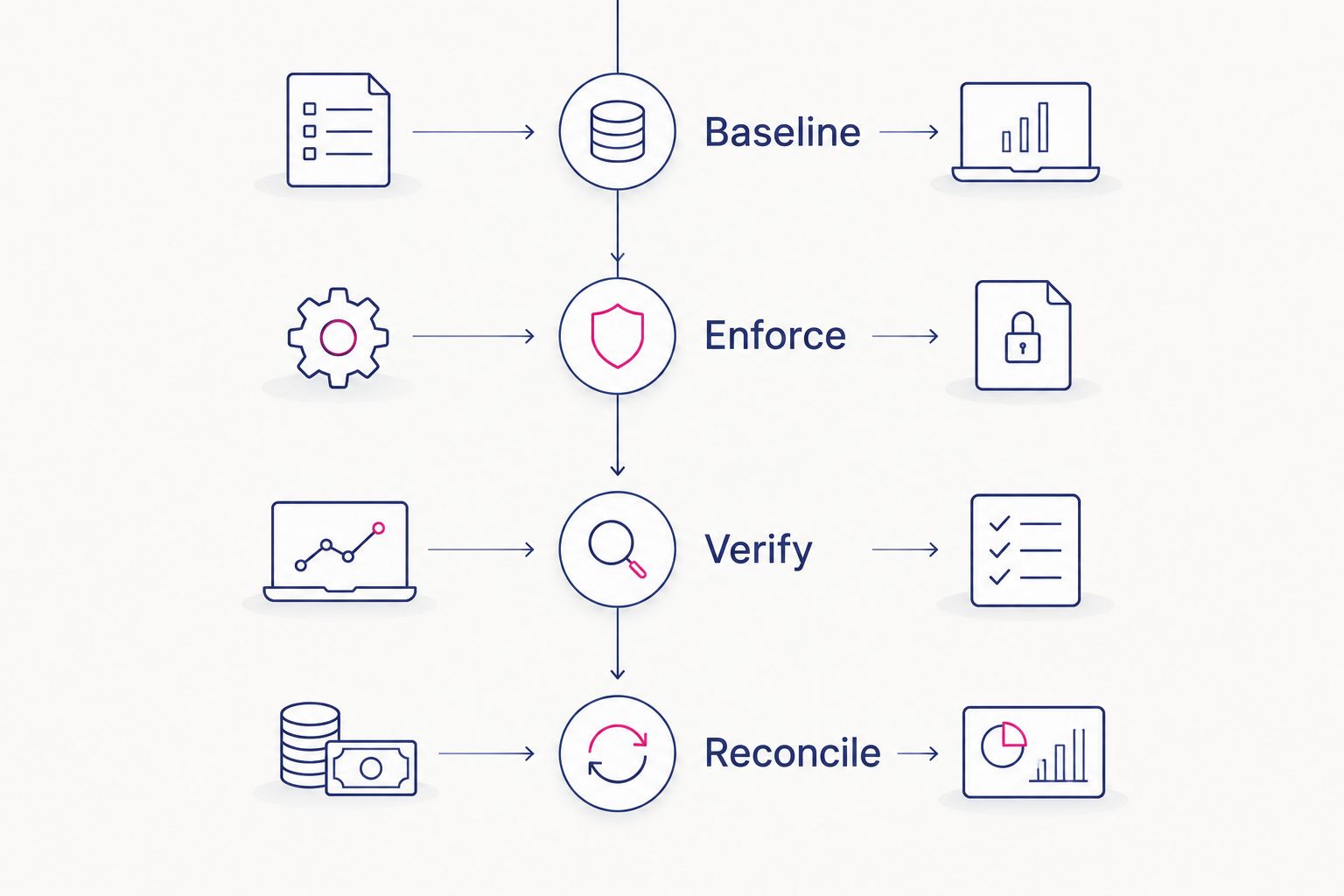
The gates give you a concrete answer without inventing a benchmark: name the gate your project has passed, show the evidence, and state what must happen next. Report the actual dates against those gates as the project progresses.
Which kind of return are you measuring?
An identity platform business case contains different benefit categories. Compare them explicitly before combining them. Each category answers a different question and carries a different limitation.
| Benefit category | Best for | Evidence to require | Main limitation |
|---|---|---|---|
| Operational value | Demonstrating reduced administrative effort | Comparable work records and validated task time | Released capacity is not automatically a budget reduction |
| Realized financial return | Demonstrating investment recovery | Accepted costs, attributable savings, and actual spending changes | Security improvements can exist before cash payback |
| Risk reduction | Demonstrating a changed attack path or blast radius | Enforced policies and controlled validation | Reduced exposure does not establish a realized financial saving |
| Data resilience | Demonstrating recoverability under defined conditions | Authorized recovery exercises and dependency validation | Recovery evidence does not replace identity controls |
Keep separate ledgers until each benefit passes its own evidence test. Combining them too early hides assumptions and makes a strong security outcome look like an unsupported financial claim.
Operational value: measure work removed
Operational value begins when the control changes completed work within its covered scope. Passwordless identity removes reusable passwords from the authentication flows where it is enforced. Measure the associated support and administration changes rather than assuming every identity-related ticket disappears.
The advantage is direct observation. You can compare task records and validate the work involved. The limitation is accounting: staff members using released time elsewhere creates capacity, not necessarily cash savings.
For a 2026 review, report both the work removed and the new work introduced. Keep rollout tasks separate from steady-state administration so a temporary onboarding burden does not become an unexplained permanent assumption.
Financial payback: measure investment recovered
Financial payback requires an accepted cost model and attributable benefits. Include delivery and ongoing operation. If an existing control remains in service, do not count its retirement as a saving.
The advantage is a clear decision threshold: benefits have covered costs or they have not. The limitation is scope. A financially attractive narrow rollout can leave important identities and attack paths outside protection.
Keep the financial question connected to the security objective. A project should not earn a favorable payback result by excluding the systems that justified the investment.
Risk reduction: measure attack paths removed
Risk reduction requires evidence that an unwanted action or relationship has changed. Verify whether reusable credentials remain, whether compromised identities can reach sensitive systems, and whether exceptions recreate the path you intended to remove.
The advantage is a direct connection between threat, control, and outcome. The limitation is valuation: converting that change into expected loss requires documented assumptions about likelihood and business impact.
Do not count an uneventful reporting period as proof of avoided breach losses. Record validated control outcomes separately from modeled financial scenarios.
Why the identity security platform ROI timeline varies
The timeline changes when the work required to reach an evidence gate changes. Use these factors to explain your own deployment, rather than borrowing a payback estimate from a different environment.
- Application compatibility: identify authentication and access dependencies before changing enforcement. Unsupported workflows require a decision, not an invisible exclusion.
- Identity scope: distinguish employees, administrators, contractors, and service identities. A benefit measured for one population does not establish coverage for another.
- Policy readiness: define legitimate access before restricting identity relationships. Document approvals and exceptions so enforcement has an accountable owner.
- Recovery readiness: validate account recovery and emergency access. A control that removes one task but creates unmanaged recovery work changes the benefit calculation.
- Operational measurement: use comparable support records and task definitions. Changes in population or workload need to be visible in the analysis.
- Retirement decisions: claim overlapping-control savings only after retirement occurs. Planned consolidation belongs in the forecast, not realized results.
Give each dependency an owner and an acceptance condition. That turns a delay into a specific unresolved decision. It also prevents the security team from being held to a financial date that depends on approvals outside its control.
Connect identity ROI to the four-layer attack-path framework
SecFolio’s identity security approach is best for large-enterprise IT security teams focused on eliminating internal attack paths. Its value assessment should follow the attack path from initial access through lateral movement to the data outcome—not stop at login adoption.
Layer 1: Close external exposure
Discover and close external exposure before initial access. The control objective is to remove an exposed route into the environment. Measure verified remediation rather than treating discovery alone as a completed security outcome.
External exposure management complements identity security. A stronger authentication flow does not establish that externally reachable weaknesses have been resolved.
Layer 2: Remove reusable credentials
Use passwordless identity to eliminate reusable credentials from covered authentication flows. Verify enforcement, fallback paths, and account recovery. This layer addresses credential reuse; it does not establish that every post-authentication action is safe.
The operational business case belongs here when you are measuring password-related work. Keep that evidence tied to the identities and applications actually covered.
Layer 3: Contain lateral movement
Use identity microsegmentation to restrict identity relationships and contain lateral movement. The security outcome is a reduced blast radius: a compromised identity has fewer permitted routes to other systems.
Validate both blocked unwanted access and preserved legitimate access. Policy deployment without those checks is not sufficient evidence of containment.
Layer 4: Preserve data resilience
SecFolio’s Cyber Storage is a data-resilience architecture, not a backup product. It encrypts data before it leaves the customer environment, shards encrypted data into immutable, unusable fragments, and distributes those shards across independent locations. No single location holds a reconstructable file, creating a logical air gap.
The operational distinction is what exists at an individual storage location: unusable digital fragments rather than a complete file. Evaluate authorized distributed recovery through exercises and record the result; do not assign an untested recovery duration.
For ransomware and exfiltration scenarios, this layer complements passwordless identity, microsegmentation, and exposure management. It does not justify abandoning them. Assess the SecFolio approach against your access dependencies, enforcement scope, and recovery evidence before assigning financial benefits.
What should your ROI report contain?
Your 2026 report should let a finance lead trace each claimed benefit to an observed change. Keep the executive summary short. Put definitions and supporting evidence behind it.
Use a benefit register with these fields:
- Objective: the specific work, attack path, or recovery outcome you intend to change.
- Covered scope: the identities, applications, and systems included in the measurement.
- Baseline: the agreed starting condition and observation period.
- Enforcement evidence: the configuration, validation result, and recorded exceptions.
- Observed change: the measured outcome using the same definition as the baseline.
- Financial treatment: realized saving, released capacity, or modeled risk reduction.
- Owner: the person accountable for validating and accepting the result.
Track forecasts separately from realized results. Replace assumptions with observed evidence as deployment progresses, and retain the explanation for each change.
Avoid double-counting. If reduced investigation work and improved response describe the same released staff time, do not value both independently. If a recovery improvement contributes to a modeled incident-loss estimate, do not add that estimate again as a separate realized saving.
Can you see value before the investment pays back?
Yes. Verified operational or security improvements can precede financial payback. Report the improvement as its own outcome, then reconcile attributable financial benefits against costs. Do not rename an early control result as recovered investment.
Should your ROI clock start at purchase or enforcement?
Track investment costs from the point they are incurred, and attribute control benefits from effective enforcement in the measured scope. Keeping both dates prevents you from hiding delivery costs or crediting protection before it exists.
Does a successful pilot establish enterprise-wide ROI?
A successful pilot establishes evidence for its tested scope. Enterprise-wide ROI requires validation of broader coverage, dependencies, administration, and exceptions. Use the pilot to improve the forecast, not to declare an unmeasured enterprise result.
FAQ
What’s a realistic identity security platform ROI timeline in 2026?
A realistic identity security platform ROI timeline follows baseline, enforcement, verification, and financial reconciliation. Set dates from your deployment dependencies and measured benefits rather than an unsupported universal month count.
When can I claim that an identity platform has paid for itself?
You can claim financial payback when cumulative attributable benefits cover cumulative implementation and operating costs. Finance should accept the cost scope and distinguish realized savings from released capacity and modeled risk reduction.
Does passwordless authentication create immediate ROI?
Passwordless authentication does not establish financial ROI merely by being enabled. Verify enforcement and measure changes in password-related work, enrollment support, and recovery administration.
How do I measure ROI from identity microsegmentation?
Measure identity microsegmentation through validated restrictions on unwanted access and changes in administrative or response work. A smaller blast radius is a security outcome; financial valuation requires separate evidence and assumptions.
Can I count avoided ransomware losses as savings?
Avoided ransomware losses belong in a documented risk model, not automatically in realized savings. Keep modeled likelihood and impact separate from observed spending changes.
How does SecFolio’s Cyber Storage affect the business case?
SecFolio’s Cyber Storage adds a data-resilience layer through encryption, sharding, and distribution across independent locations. Evaluate authorized distributed recovery separately from authentication and lateral-movement outcomes.
What should I show the board before financial payback?
Show enforced coverage, verified attack-path changes, operational results, and unresolved exceptions. Separate those observed outcomes from the forecast financial payback date.
One last thing
Removing an attack path and recovering an investment are different achievements. Your 2026 decision should recognize both without blending their evidence.
Before approving expansion, ask each benefit owner to identify the record that proves the claimed result. If the proof is an enrollment count, the result is adoption. If it is a validated blocked path, the result is control effectiveness. If it is an accepted reconciliation of benefits and costs, the result is financial payback. Name the achievement accurately, then fund the next unresolved gate.


