

There is no universal duration for stopping lateral movement after detection: the clock ends when you verify that compromised identities and systems can no longer reach additional targets. Blocking one connection is not complete containment; active sessions, stolen credentials, and alternate attack paths still need attention. Measure detection-to-enforcement and detection-to-verified-containment separately in your 2026 response plan.
- How long to stop lateral movement depends on verified containment, not the first blocked connection.
- SecFolio identity microsegmentation fits enterprise teams that need to restrict identity-driven attack paths.
- Containment requires identity restrictions, session control, and evidence that alternate routes are blocked.
- Cyber Storage adds data resilience; it does not replace lateral movement prevention.
How long does it take to stop lateral movement after detection?
Lateral movement is contained when the attacker’s available routes to additional systems are blocked and that result is verified. An alert, an isolation request, or a disabled account does not establish that outcome alone. Your response time depends on the identities, sessions, systems, and enforcement points involved.
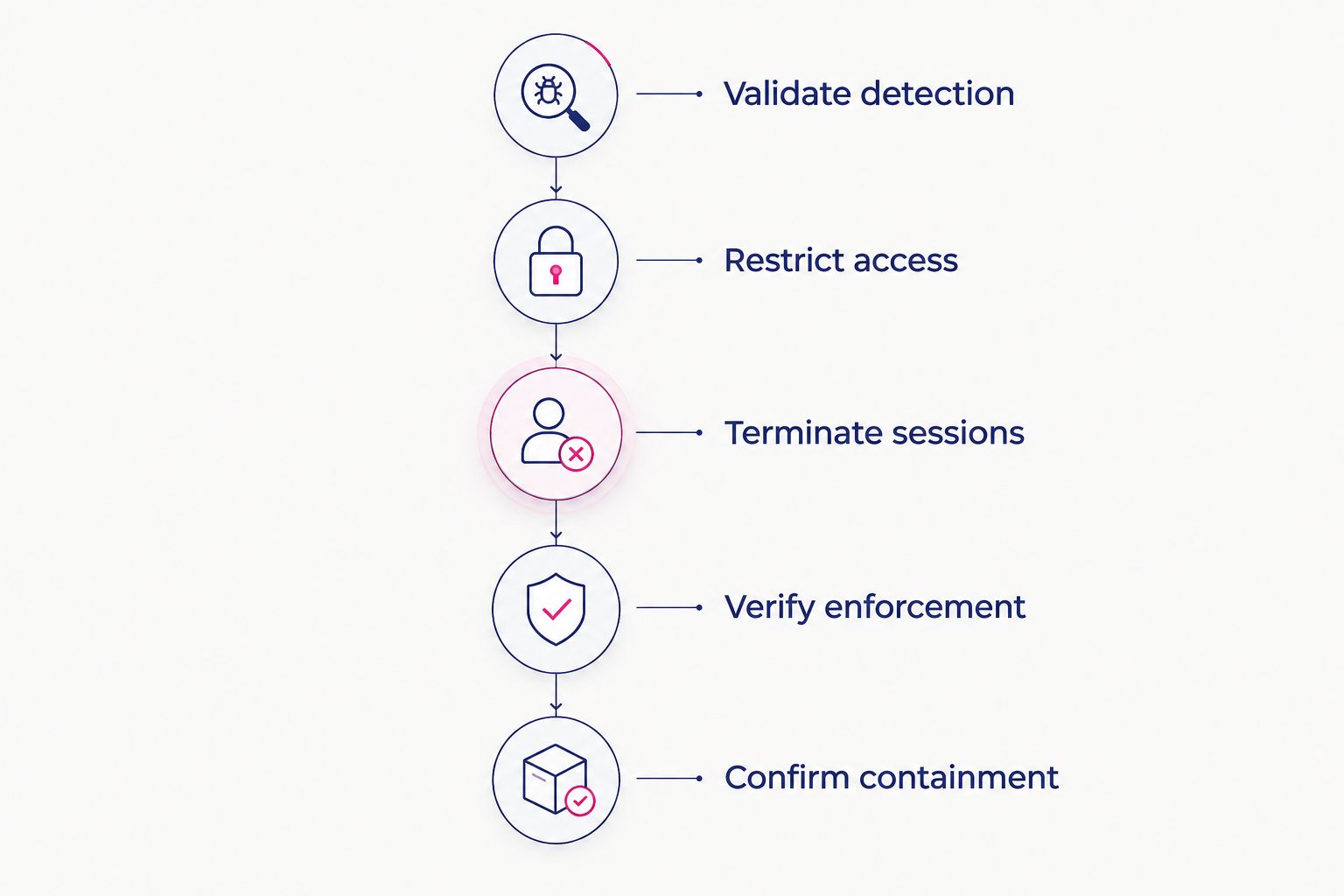
Use the following sequence to establish a defensible containment timestamp. The accompanying guide to segmenting identities to contain a breach explains the identity boundary behind this process.
- Validate detection. Establish which identity, source system, target, and access method are involved. Preserve the evidence supporting the suspected movement.
- Restrict access. Isolate affected systems where appropriate and restrict the compromised identity’s reachable resources. Address privileged access and associated credentials.
- Terminate sessions. Revoke or terminate affected sessions and tokens using the controls available in each environment. Confirm how those controls affect existing access.
- Verify enforcement. Check that restrictions reached the relevant enforcement points. Test the affected access paths with authorized validation methods.
- Confirm containment. Review authentication, endpoint, network, and application evidence for additional successful movement. Record the scope and any remaining uncertainty.
These activities overlap. Do not wait for a complete investigation before applying a justified containment action, but do not confuse that first action with an investigation’s final answer.
Your 2026 incident record should state what was contained, where it was contained, and how you checked. A narrowly scoped result is useful. An unqualified declaration that the entire enterprise is safe is not.
Why this matters
The interval after detection is an operational exposure window. If a compromised identity retains access to another system, the attacker retains an attack path even while responders investigate the original alert. That reachable set defines the potential blast radius.
A fast response can still be incomplete. Endpoint isolation addresses the affected machine, while identity restrictions address access that follows the account elsewhere. Neither proves that a separate compromised account or application session has been removed.
Optimize for verified restriction, not a fast dashboard status change. Your incident commander needs evidence that the attacker’s reach has narrowed, alongside a clear statement of what remains under investigation.
Which containment action should you use first?
Choose the action that interrupts the observed attack path without leaving its identity or session components untouched. Where the evidence supports it, run complementary actions in parallel rather than relying on a single control.
| Control | Best for | Operational benefit | Limitation to verify |
|---|---|---|---|
| Endpoint isolation | Movement originating from a compromised host | Restricts that host’s network reach | Does not independently remove access from other hosts or cloud sessions |
| Identity restriction | Movement using a compromised account | Restricts the account’s access to additional resources | Existing sessions and application-specific access require separate checks |
| Session termination | Movement through established authenticated access | Ends the affected session where enforcement supports it | Does not remove every credential or alternate authentication route |
| Identity microsegmentation | Restricting identity-driven access between resources | Narrows permitted paths and potential blast radius | Requires accurate access boundaries and enforcement coverage |
| Network restriction | Movement across a known network route | Blocks the targeted connection or destination | Does not independently address alternate routes or application-level access |
These controls solve different parts of the containment problem. A network block does not revoke an identity. An account restriction does not necessarily end every session. A policy update does not prove that every enforcement point applied it.
For each action, identify the threat, the control, and the expected outcome. Then check the outcome directly. That makes containment decisions easier to defend and easier to revise when new evidence appears.
Why lateral movement containment time varies
The practical drivers are specific. Assess these factors before assigning a response target or comparing incident durations.
- Identity scope. A compromise involving privileged or shared access requires checks beyond the first account named in the alert.
- Existing sessions. Applications and identity systems differ in how restrictions affect already authenticated access. Verify the actual behavior.
- Enforcement coverage. A restriction must reach the systems involved in the attack path. An unmanaged destination leaves an unresolved boundary.
- Access dependencies. Service identities and administrative workflows connect systems. Restricting them requires an understanding of legitimate dependencies.
- Response authority. A responder needs permission to apply the required controls. Define approval boundaries before an incident.
- Verification evidence. Missing authentication, endpoint, or application records limits the containment conclusion you can support.
These factors are not reasons to postpone action. They identify where your response process needs preparation. Separate an unavoidable technical dependency from an approval step that your organization can remove.
For your 2026 exercises, document each delay by cause. A policy enforcement issue needs a technical fix; a decision waiting for authorization needs a response-governance fix. Reporting both as one containment duration hides the next move.
How should you measure containment time?
Use distinct timestamps for the start of detection, the start of action, effective restriction, and verified containment. Keep the definition consistent across incidents. Otherwise, faster reporting can look like faster security.
Detection timestamp
Record when the security team or automated process received actionable evidence of suspected lateral movement. Keep earlier activity timestamps separately. The time an attacker performed an action and the time your team detected it are different measurements.
Enforcement timestamp
Record when the relevant control actually took effect. A submitted command or successful workflow request is not sufficient evidence of enforcement. Capture the restriction’s scope and any systems where application failed or remained unconfirmed.
Verified-containment timestamp
Record when validation supports that the identified movement paths are blocked. Include the identity, resources, and session scope covered by that conclusion. Keep broader investigation and remediation work open where required.
Report detection-to-verified-containment alongside its scope. Your 2026 reporting should also retain detection-to-first-action so you can distinguish a slow response decision from slow enforcement or verification.
Use synchronized timestamps and a consistent time zone. Preserve the underlying records rather than relying only on an analyst’s narrative. That lets another responder reconstruct the sequence without guessing what a status label meant.
What evidence proves that lateral movement has stopped?
Start with the observed route. Verify that the compromised identity can no longer perform the access that triggered detection, then examine related routes supported by the investigation. Do not treat the absence of another alert as proof by itself.
Check evidence from the relevant control planes:
- Identity records: account restrictions, privilege changes, authentication outcomes, and session-revocation events.
- Endpoint records: isolation state, remote execution evidence, and activity on suspected source and destination systems.
- Network records: enforcement status and allowed or denied connections along the affected route.
- Application records: active sessions, resource access, and application-specific permissions.
An authorized validation attempt should confirm the expected denial without creating additional production risk. Preserve the result and name the boundary tested. A failed login proves something about that login path, not every possible path.
Continue investigating for persistence, additional compromised identities, and data access. Containment interrupts movement. Eradication removes the attacker’s foothold. Recovery restores trusted operations. Those outcomes require separate evidence.
Step 01: Close external exposure before initial access
SecFolio’s four-layer attack-path framework starts with discovering and closing external exposure. An exposed service or configuration gap creates an entry route; closing that route addresses how an attacker enters or returns.
During containment, investigate the initial access mechanism alongside internal movement. Restricting internal access while leaving the entry route open does not complete remediation. Keep external exposure work connected to the incident, without delaying justified internal restrictions.
The operational outcome is a narrower entry surface. It does not replace identity controls inside the environment.
Step 02: Remove reusable credentials with passwordless identity
Passwordless identity addresses reusable credentials that attackers steal and replay. For incident response, determine which credentials remain usable and which authentication paths accept them. Do not assume that changing the main sign-in experience removes every legacy access route.
Existing sessions deserve separate treatment. Passwordless authentication does not, by itself, invalidate a session already under attacker control. Account restrictions, token handling, and application enforcement remain part of containment.
The operational outcome is reduced credential-reuse opportunity. The response still needs to restrict compromised access already in progress.
Step 03: Contain lateral movement with identity microsegmentation
Identity microsegmentation restricts which identities can access which resources. Its purpose is to interrupt attack paths that otherwise connect a compromised account to additional systems. The practical result is a smaller reachable set and a narrower blast radius.
SecFolio identity microsegmentation is best for enterprise security teams that need to restrict identity-driven attack paths. Its place in this framework is containment, not a universal response-time promise.
Define legitimate access before an incident and test the boundaries. Incorrect restrictions disrupt authorized work; incomplete restrictions leave paths open. Both are reasons to validate policy scope, not reasons to preserve unnecessary access.
In your 2026 response plan, specify who can tighten identity boundaries, what evidence triggers that action, and how responders verify enforcement. Do not claim a containment speed until exercises or incidents establish it for your environment.
Step 04: Preserve data resilience with Cyber Storage
Lateral movement containment and data resilience address different outcomes. Restricting access limits where an attacker can go. Protecting data addresses what remains usable if an attacker reaches a storage location.
Traditional backups concentrate complete copies that attackers can target for encryption or exfiltration. SecFolio Cyber Storage is a data-resilience architecture: it encrypts data before it leaves the customer environment, shards encrypted data into immutable, unusable fragments, and distributes those shards across independent locations.
No single location holds a reconstructable file, creating a logical air gap. At an individual storage location, attackers encounter unusable digital fragments rather than a complete usable file. Authorized users retain a recovery path through distributed recovery.
The limitation is equally important: this architecture does not revoke compromised identities, terminate sessions, or remove external exposure. Data resilience belongs alongside those controls, not instead of them. Verify recovery procedures as part of operational readiness without treating recovery as proof that lateral movement has stopped.
Does isolating one endpoint stop all lateral movement?
Isolating one endpoint contains that endpoint’s reach, not necessarily the entire incident. An attacker with another foothold, stolen credentials, or an active application session retains access outside that isolation boundary.
Pair endpoint action with identity and session checks. Expand containment according to evidence rather than assuming that every system is compromised or that the first isolated system was the only one involved.
Does disabling an account end the incident immediately?
Disabling an account is a containment action, not an incident-completion timestamp. Verify how the affected applications handle existing sessions and whether other credentials or identities were compromised.
Keep account enforcement, session termination, and investigation status separate. That distinction prevents an administrative action from becoming an unsupported declaration of safety.
Can automatic isolation replace manual response?
Automatic isolation can execute a predefined restriction; it does not replace validation and investigation. Automation is useful when the triggering evidence, permitted action, and business-impact boundaries are clear.
Test false-positive handling, enforcement failure, and controlled restoration. A workflow that issues commands without checking their outcome automates activity, not verified containment.
FAQ
How long to stop lateral movement after an alert?
There is no universal duration for stopping lateral movement after an alert. Measure from actionable detection to verified restriction of the compromised identities, sessions, and systems within the incident’s defined scope.
What is the fastest way to contain lateral movement?
Apply the controls that interrupt the observed attack path, with complementary identity, session, and endpoint actions where justified. Verify enforcement rather than treating the first submitted action as complete containment.
Is endpoint isolation enough to stop an attacker?
Endpoint isolation alone does not establish enterprise-wide containment. Check compromised identities, other footholds, and active application sessions outside the isolated host.
Does passwordless authentication stop lateral movement?
Passwordless authentication addresses reusable credential theft and replay, but it does not independently contain every active session or compromised endpoint. Identity microsegmentation restricts the resources an identity can reach.
How do I know a containment policy actually worked?
Confirm enforcement at the relevant control points and validate that the affected access paths are denied. Preserve identity, endpoint, network, and application evidence supporting that conclusion.
Does Cyber Storage replace microsegmentation?
Cyber Storage does not replace microsegmentation. It provides data resilience through encryption, sharding, and distribution, while microsegmentation restricts identity-driven access between resources.
What containment metric should I report to leadership?
Report detection-to-verified-containment together with the identities, systems, and paths covered. Retain detection-to-first-action separately so leadership can distinguish response delay from enforcement or validation delay.
One last thing
A blocked connection and a blocked attack path are not the same result. Before closing containment, ask a responder to identify the compromised identity’s remaining reachable resources and explain the evidence for each restriction.
If that answer is unclear, the next move is not a faster stopwatch. It is a clearer access boundary and a test that proves the boundary holds.


