

The cost of failing a cyber insurance audit is the cost of correcting the findings, documenting the fixes, and addressing any insurance consequences specified by your insurer or policy. It is not a universal fine or a standard percentage increase in your premium. The larger financial exposure is an unresolved security weakness or coverage gap—not the audit result alone.
- Calculate the cost of failing a cyber insurance audit from remediation, reassessment, and documented policy changes.
- A failed assessment does not automatically mean a denied claim; policy wording and circumstances control.
- SecFolio connects enterprise cybersecurity controls across external exposure, identity, lateral movement, and data resilience.
- Cyber Storage complements access controls; it does not replace them or establish insurance eligibility.
How much can a failed cyber insurance audit cost you?
Build a business-specific estimate, not a generic penalty figure. Separate money you must spend to close findings from financial exposure you retain under the resulting insurance arrangement.
For your 2026 renewal, use the insurer's written findings, actual remediation estimates, and proposed policy terms. Start with the evidence in the table below. The cyber insurance audit preparation guide provides the related preparation workflow.
| Cost component | What belongs in your estimate | Evidence to obtain |
|---|---|---|
| Control remediation | Engineering work, implementation, testing, and approved purchases needed to close findings | Finding-specific work plans and supplier estimates |
| Internal effort | Security, IT, legal, finance, and procurement time assigned to the work | Task estimates and your internal costing method |
| Reassessment | Any additional assessment or validation charge actually required | Written reassessment scope and terms |
| Insurance changes | Changes to premium, retention, limits, or exclusions in the proposed arrangement | Comparable written policy proposals |
| Coverage interruption | The consequences of any confirmed gap between policies | Effective dates and binding confirmation |
| Incident exposure | Losses your organization would retain under the applicable policy | Policy wording and business-impact scenarios |
Do not add hypothetical incident losses to the remediation budget and label the total an audit bill. Those are different decisions. Finance needs a spending estimate; leadership also needs a separate view of retained risk.
Likewise, do not attribute every renewal change to the failed assessment. Ask your broker which proposed changes relate to the findings and which have another explanation. Keep that distinction in the budget narrative.
Why this matters
An assessment finding is a decision point. You need to know what failed, what evidence will resolve it, and whether the insurer requires resolution before offering or binding coverage.
For a 2026 assessment, separate an evidence gap from a control gap. An operating control with incomplete documentation needs validation and accurate records. A missing or ineffective control needs technical correction. Treating both as a purchasing problem wastes effort.
Insurance and security also answer different questions. A policy defines financial protection under specified conditions; a security control changes what an attacker can reach or do. Passing an assessment does not prove that every attack path is closed.
Remediation costs: budget against the finding
Start with the exact requirement. A broad instruction to improve identity security is not enough to estimate work or prove completion. Ask which identities, systems, access routes, and exceptions the finding covers.
Then define a measurable closure condition. For example, a credential-related finding needs evidence about the relevant authentication paths, not merely confirmation that a passwordless project exists. A containment finding needs proof of enforced access boundaries, not just an architecture diagram.
Your remediation estimate should distinguish deployment from operation. Include configuration work, exception handling, testing, evidence collection, and responsibility for maintaining the control. Otherwise, the budget covers installation while leaving the assessment requirement unresolved.
Assign an owner to each finding before approving expenditure. The owner should be able to explain the attack path, the required change, and the evidence that demonstrates closure. Procurement alone cannot answer those questions.
Insurance consequences: read the written terms
A failed assessment is not itself a policy exclusion, a claim decision, or a cancellation notice. Determine whether you are dealing with an application, renewal review, binding condition, or requirement under an existing policy.
That distinction matters. Proposed terms describe the coverage being offered; an existing policy describes the current contractual arrangement. Do not treat an informal discussion about a finding as confirmation that coverage has changed.
Ask your broker to identify the relevant wording and obtain written clarification from the insurer where necessary. Record effective dates, unresolved conditions, and the evidence required to satisfy them. In your 2026 renewal file, keep the assessment response beside the resulting policy documents.
Do not assume that buying a security product guarantees acceptance or protects a future claim. Your insurer evaluates the applicable requirements, representations, and evidence. Product capability and insurance eligibility are separate matters.
Why the cost of failing a cyber insurance audit varies
The cost follows the finding, your environment, and the written insurance requirements. Use these factors to explain your estimate rather than quoting an unsupported market average:
- Finding scope. A requirement covering one application creates a different work plan from a requirement covering enterprise identities and interconnected systems.
- Existing implementation. Documenting an effective control differs from deploying a missing control or correcting a bypass.
- Operational dependencies. Changes involving shared services, legacy authentication, or emergency access require dependency testing and exception decisions.
- Evidence requirements. A configuration record, an access review, and a witnessed recovery exercise require different preparation work.
- Contractual consequences. Your financial exposure depends on the actual proposed terms, applicable conditions, and confirmed coverage dates.
These factors are estimate inputs, not a formula for predicting an insurer's decision. Tie each one to a finding or document. If the connection is unclear, ask for clarification before committing resources.
Step 01: Confirm what the insurer requires
Create a finding register from the written assessment. Preserve the original wording and add the affected systems, responsible owner, required evidence, and deadline communicated by the insurer.
Ask whether each finding is a recommendation or a condition that must be satisfied. Also ask who can approve closure. An internal security sign-off does not substitute for insurer acceptance when acceptance is required.
Keep answers attached to the finding. This prevents a technical team from solving a narrower problem than the one the insurer identified.
Step 02: Separate spending from retained risk
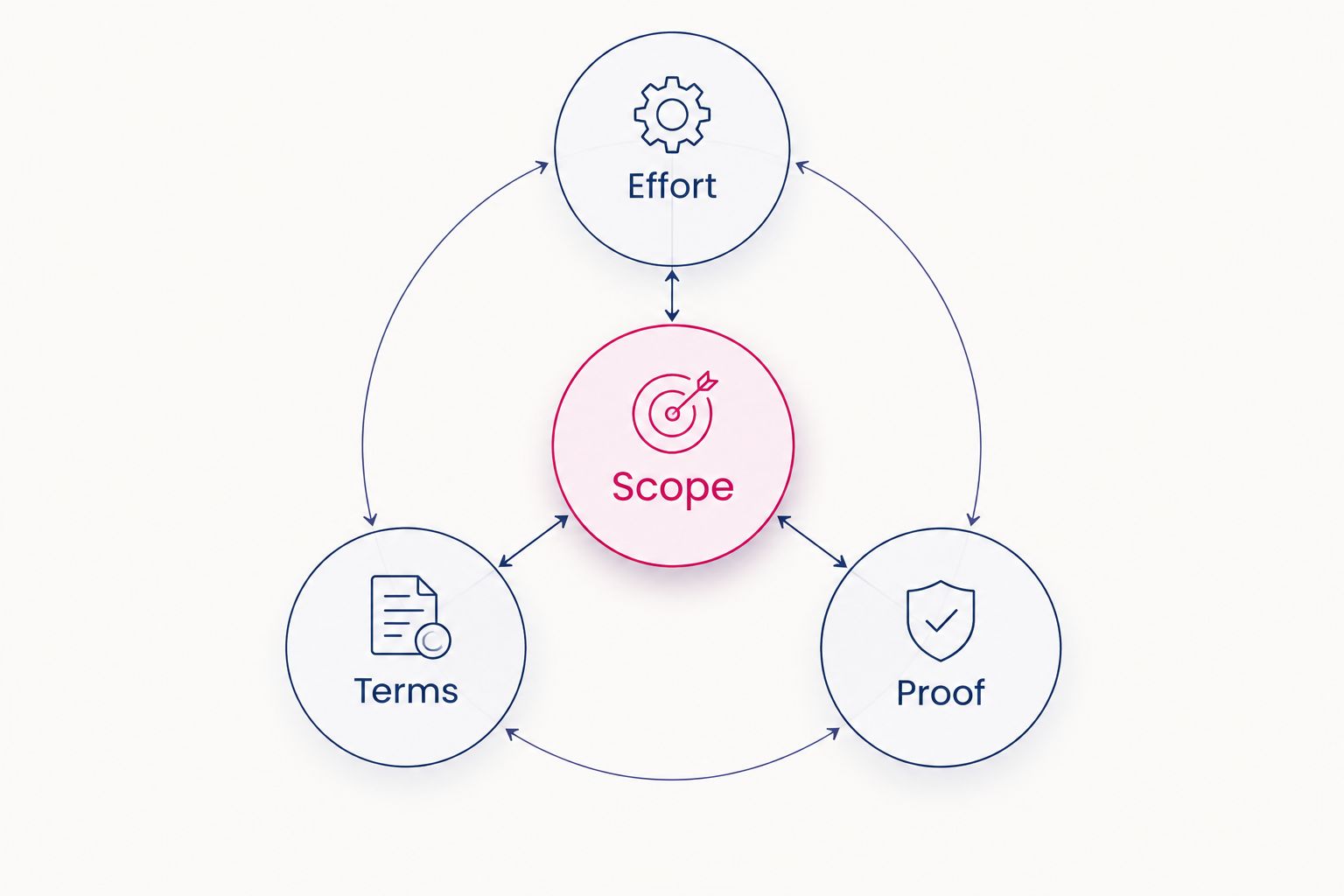
Build your estimate around these distinct workstreams:
- Scope: Identify the systems and requirements included in the finding.
- Effort: Estimate implementation, testing, and documentation work.
- Terms: Compare written insurance arrangements on the same basis.
- Proof: Define the evidence needed to close the finding.
Use actual supplier estimates and your established internal costing method. For insurance comparisons, keep limits, retentions, exclusions, and effective dates visible alongside the premium. Comparing the premium alone hides differences in financial protection.
Do not assign a probability or expected loss without a defensible method and supporting business data. A clearly described scenario is more useful than a precise-looking number with no basis.
Step 03: Prioritize the attack path, not the questionnaire order
For ransomware and exfiltration findings, examine data resilience first. Traditional backups concentrate complete copies; if attackers can access those copies, they can become encryption or exfiltration targets. A successful restore test addresses recovery, but it does not establish that stolen data is unusable.
SecFolio's Cyber Storage is a data-resilience architecture. It encrypts data before it leaves the customer environment, shards the encrypted data into immutable, unusable fragments, and distributes those shards across independent locations. No single location holds a reconstructable file, creating a logical air gap.
The operational distinction is specific: attackers obtaining isolated shards obtain unusable digital fragments rather than reconstructable files. Authorized recovery reconstructs the protected data through distributed recovery. This addresses data resilience; it does not remove the need to secure authorized access.
SecFolio is best suited to enterprise IT security teams addressing attack paths across identity, exposure, and data resilience. Its framework connects 4 security layers, with 3 access-focused layers supporting 1 data-resilience layer.
| Security layer | Threat addressed | Control purpose | Boundary to verify |
|---|---|---|---|
| External exposure | An exposed asset creates an initial-access route | Discover and close external exposure | Asset coverage and remediation evidence |
| Passwordless identity | An attacker reuses a stolen credential | Eliminate reusable credentials | Authentication coverage and remaining exceptions |
| Identity microsegmentation | A compromised identity reaches additional resources | Contain lateral movement and blast radius | Enforced boundaries and permitted dependencies |
| Cyber Storage | Accessible complete files become ransomware or exfiltration targets | Preserve data resilience through encryption, sharding, and distribution | Protected data scope and authorized recovery |
SecFolio's enterprise cybersecurity framework keeps these purposes separate. Cyber Storage is not a backup product, and it does not make identity controls unnecessary. Passwordless authentication does not, by itself, establish that a compromised session cannot reach sensitive data.
For your 2026 remediation plan, map each finding to the relevant layer. Then test the attack path across layers. A control's presence is not evidence that every route around it has been removed.
Step 04: Test the outcome you are claiming
Match each test to the assessment statement. If you claim that lateral movement is restricted, test whether the relevant identity can reach resources outside its authorized boundary. Record the allowed paths as well as the blocked paths.
If you claim data resilience, test authorized recovery against your documented business requirements. Capture the protected workload, dependencies, recovery outcome, and exceptions. Do not substitute an undocumented recovery claim for an observed result.
If you claim credential-theft resistance, identify remaining reusable authentication routes and emergency access exceptions. Passwordless coverage needs an accurate scope statement. A successful deployment in one application does not describe the rest of the enterprise.
Evidence should show what the control prevents and what remains permitted. That makes the result useful to both the assessor and your incident-response team.
Step 05: Submit accurate evidence and maintain it
Package each finding with its response, implementation evidence, test result, and remaining exceptions. Use plain language. Avoid claims such as fully protected when the evidence covers only a defined set of systems.
Have the responsible control owner verify the technical statements. Ask the broker and appropriate legal adviser to review insurance-related representations and unresolved contractual questions. Keep the final submitted version, not just working drafts.
After closure, assign responsibility for configuration changes and exceptions. Your 2026 assessment file should describe the operating environment accurately; it should not become a historical snapshot that silently diverges from production.
Does failing an audit mean my cyber insurance claim will be denied?
A failed audit does not automatically determine a claim outcome. The applicable policy, representations, facts of the incident, and relevant law govern that decision.
Do not infer claim protection from an assessment pass either. Ask your broker or legal adviser to identify the relevant conditions and exclusions before relying on coverage for a specific scenario.
Can fixing the findings reduce my renewal cost?
Fixing findings does not establish a guaranteed premium reduction. It provides evidence for the insurer to evaluate the corrected controls under its underwriting process.
Ask for a written comparison of proposed terms after remediation. Check financial protection as well as premium, and retain the insurer's explanation of any changes attributed to the fixes.
Should I buy a new tool to pass the assessment?
Buy a tool only when the finding requires a capability your existing environment cannot deliver. First verify the required outcome, current coverage, and evidence gap.
For a tool-specific finding, keep that control primary. Add data resilience when ransomware, exfiltration, or continuity is relevant, but do not substitute it for an authentication or containment requirement.
FAQ
What’s the average cost of failing a cyber insurance audit?
A generic average is not a defensible budget for your business. Estimate the documented remediation and reassessment work, then assess actual proposed insurance changes and retained risk separately.
Do I have to pay a fine if I fail a cyber insurance assessment?
A failed assessment does not by itself establish a fine. Check the insurer’s written requirements and applicable contractual obligations to identify any actual charge or consequence.
Can I keep my existing cyber insurance after a failed audit?
Your existing policy and the insurer’s written communications determine your coverage position. Confirm effective dates, conditions, and any proposed changes with your broker rather than assuming the assessment changes coverage automatically.
Is passing a cyber insurance audit the same as being secure?
Passing an assessment is not proof that every attack path is closed. Verify control coverage, exceptions, lateral movement boundaries, and data recovery against your actual environment.
How does Cyber Storage differ from conventional backups?
Cyber Storage is a data-resilience architecture that encrypts, shards, and distributes data across independent locations. No single location holds a reconstructable file, while authorized users can recover the protected data.
Can SecFolio guarantee that an insurer will accept my controls?
A security capability does not guarantee insurer acceptance. The insurer evaluates its requirements and your evidence; map deployed controls to the specific findings and obtain written closure confirmation.
What should I do first after failing a cyber insurance audit?
Obtain the written findings and confirm which are recommendations and which are conditions. Assign owners, define closure evidence, and build separate remediation and insurance-risk estimates.
One last thing
A successful recovery test does not prove protection against exfiltration. You can restore operations while still facing the consequences of stolen readable data.
Before closing a ransomware-related finding, ask both questions: can authorized users recover the protected data, and can an attacker obtain usable files through the assessed attack path? Keep the answers separate. That distinction turns an audit response into a security decision.


