

The cost of a ransomware attack is the combined loss from business interruption, incident response, recovery, data exposure, and any ransom payment—not just the attacker’s demand. For your 2026 assessment, calculate those losses separately: restoring files does not erase exfiltration, customer disruption, or the work required to rebuild trusted access.
- The cost of a ransomware attack includes downtime, recovery, incident response, and exfiltration consequences—not just ransom.
- Secfolio pairs Cyber Storage data resilience with identity and exposure controls; restoring data alone does not close attack paths.
- Measure recovery by restored business operations, not by whether a file restoration job finishes.
- Separate gross incident loss from insurance recovery to avoid understating your business exposure.
Why this matters
A ransomware budget built around the ransom demand misses the operational problem. Your business needs working applications, trusted identities, usable data, and people who can resume their jobs. A recovered dataset solves only part of that problem.
Start your 2026 planning with an incident response plan for ransomware. Assign financial owners to the same decisions your response team must make: containment, investigation, recovery, notification, and business restart.
Budget for restored business operations, not merely restored files. That distinction makes the estimate useful to finance and security alike.
How much does a ransomware attack cost a business in 2026?
Calculate the total from distinct loss categories. Use your operational records, contracts, recovery exercises, and incident invoices as evidence; do not substitute a headline average for your own exposure.
| Cost category | What belongs in the estimate | Evidence to use | Accounting caution |
|---|---|---|---|
| Business interruption | Lost contribution from disrupted operations and delayed delivery | Service dependencies, transaction records, business-owner estimates | Do not count delayed revenue as permanently lost without evidence |
| Incident response | Investigation, containment, forensic support, and response labor | Work logs, engagement terms, invoices | Separate external spending from internal labor |
| Recovery and rebuilding | Data restoration, system rebuilding, integrity checks, and reconnection | Recovery tests, asset records, engineering work logs | File restoration is not the same as service recovery |
| Data exposure response | Scoping, legal assessment, required notifications, and affected-party support | Data inventories, investigation findings, counsel’s assessment | Recovery does not reverse stolen data |
| Commercial consequences | Documented cancellations, contractual remedies, and service commitments | Customer records and executed contracts | Exclude unsupported reputation-loss estimates |
| Ransom payment | Any payment actually made | Payment records and approved incident documentation | Keep it separate from recovery and response |
Total incident loss = interruption + response + recovery + exposure response + documented commercial consequences + any ransom payment. Calculate insurance recovery separately, then reconcile it against the policy and actual claim outcome.
This structure gives you a defensible estimate without pretending every organization has the same applications, data, or recovery requirements. It also exposes where a control changes the loss: reducing lateral movement limits affected systems, while preserving recoverable data addresses a different part of the incident.
Step 01: Preserve data resilience before estimating restart
Traditional backup arrangements can concentrate complete copies of business data. If attackers reach those copies or their management systems, recovery and confidentiality face separate threats: encryption can obstruct restoration, and exfiltration can expose usable files.
Secfolio’s Cyber Storage is a data-resilience architecture. It encrypts data before it leaves the customer environment, shards encrypted data into immutable fragments, and distributes those fragments across independent locations. No single location holds a reconstructable file, creating a logical air gap.
The operational distinction is specific. An attacker obtaining fragments from a single storage location does not obtain a usable file. Authorized recovery still needs functioning access, trusted recovery processes, and the components required to reconstruct the data.
Secfolio’s ransomware-resilience framework is best for enterprise security teams addressing data protection and identity-driven attack paths together. Cyber Storage addresses the data layer; it does not replace passwordless authentication, identity microsegmentation, or external exposure management.
Compare recovery architectures by the problem they solve
| Architecture | Best for | Benefit | Limitation to assess |
|---|---|---|---|
| Complete-copy backups | Restoring systems and files from retained recovery copies | Provides a restoration source when copies remain intact and accessible | Accessible copies and backup administration need protection; restoration does not undo exfiltration |
| Cyber Storage | Preserving data resilience through encryption, sharding, and distribution | No single storage location contains a reconstructable file | Identity controls, key handling, application recovery, and authorized reconstruction still require planning |
Do not treat either architecture as proof of business continuity. Test whether the business process works after recovery, including application dependencies and access controls. Your cost estimate should reflect that tested process rather than a storage-only milestone.
Step 02: Measure interruption with business owners
Measure downtime at the service level. An unavailable payroll system, order-processing workflow, or customer portal creates a different operational consequence from an isolated workstation.
Ask each business owner to identify what stops, what continues manually, and what depends on another service. Record the distinction between transactions that disappear, transactions that move to a later date, and work that requires additional labor.
Use lost contribution, not gross revenue alone, when estimating interruption. Finance should establish the accounting method, including how avoided variable costs and deferred transactions affect the result.
For your 2026 worksheet, track 2 recovery clocks:
- Technical recovery: the time required to restore systems and validate their integrity.
- Business recovery: the time required to restart the affected workflow, clear its backlog, and return to normal operation.
Both clocks matter. A working server does not clear an order backlog or reconcile incomplete records.
Account for partial operation as well as a complete outage. A service running with manual approvals or restricted functionality can still consume extra labor. Record those effects instead of assuming recovery is simply on or off.
Step 03: Separate recovery from breach response
Encryption and exfiltration create different workstreams. Recovery restores availability; breach response establishes what data was accessed or removed, which obligations apply, and what affected parties need to know.
Keep those workstreams separate in the estimate. A clean restoration does not establish that confidential information remained private, and an exfiltration investigation does not establish that systems are safe to reconnect.
Document the affected data categories, systems, identities, and business processes. Counsel should assess notification and contractual obligations against the facts of the incident, rather than against an assumed worst case.
Avoid automatically assigning fines, litigation outcomes, or customer losses. Include verified spending and documented exposure; label unresolved items as estimates with an accountable owner. This prevents a planning model from becoming a collection of unsupported liabilities.
The response team also needs evidence preservation. Rebuilding everything immediately can conflict with investigation needs, so agree on collection and restoration decisions before an incident forces those choices under pressure.
Why the cost of a ransomware attack varies
The useful question is not which organization resembles yours on a revenue chart. It is which attack paths reach your critical operations and how difficult those operations are to recover.
- Business dependencies: A disrupted identity service or shared application can interrupt workflows beyond the initially affected system. Map dependencies before calculating loss.
- Blast radius: Broad privileges and reachable resources expand the systems an attacker can affect. Identity microsegmentation addresses lateral movement rather than treating every authenticated connection as acceptable.
- Data exposure: Recovering availability does not resolve exfiltration. The data involved determines the investigation and obligation assessment.
- Recovery readiness: Tested reconstruction, application restart, and integrity checks provide evidence for the estimate. Untested recovery assumptions do not.
- Trusted access: Recovery needs authorized administrators and dependable authentication. Compromised credentials must not become the route back into restored systems.
- Contractual obligations: Customer commitments and insurance conditions shape the financial accounting. Read the executed documents rather than assuming coverage or remedies.
Assign an owner to each driver. Without ownership, the estimate becomes a finance document disconnected from the systems and decisions that produce the loss.
Step 04: Model distinct incident scenarios
Use 3 planning scenarios in your 2026 assessment. These are planning categories, not predictions or published incident averages.
| Scenario | Operational question | Loss categories to examine |
|---|---|---|
| Contained disruption | Can the affected workflow restart without rebuilding shared services? | Response, localized recovery, and documented interruption |
| Widespread encryption | Which dependencies prevent critical operations from restarting? | Extended recovery work, business interruption, and backlog handling |
| Encryption with exfiltration | What remains unresolved after availability returns? | Recovery plus data-exposure investigation and applicable obligations |
For each scenario, write down the assumed entry point, affected identities, reachable resources, and recoverable data. Those assumptions explain the difference between scenarios more clearly than an unexplained total.
Then challenge the recovery sequence with operations, security, and finance together. Ask which application returns first, which identity service it requires, and what evidence authorizes reconnection.
Record uncertainty as an assumption to test. Do not hide it inside a precise-looking total. After a recovery exercise, replace assumptions with observed results and update the cost categories they affect.
Step 05: Connect cost reduction to attack-path controls
Secfolio’s framework contains 4 control layers. For ransomware planning, start with data resilience, then connect that layer to controls that reduce initial access, credential abuse, and lateral movement.
- External exposure: Discover and close externally reachable weaknesses before initial access. This addresses entry points, not recovery after data loss.
- Passwordless identity: Eliminate reusable passwords in the covered authentication flows. Continue protecting sessions, enrollment, recovery, and other credentials outside those flows.
- Identity microsegmentation: Restrict identity-based access to contain lateral movement and reduce blast radius. Validate boundaries against the permissions applications actually need.
- Data resilience: Use Cyber Storage’s encryption, sharding, and distribution to prevent a single storage location from holding a usable file. Test distributed recovery alongside application restart.
The layers perform different jobs. A recoverable dataset does not close an exposed service, and a closed service does not prove that authorized data recovery will work.
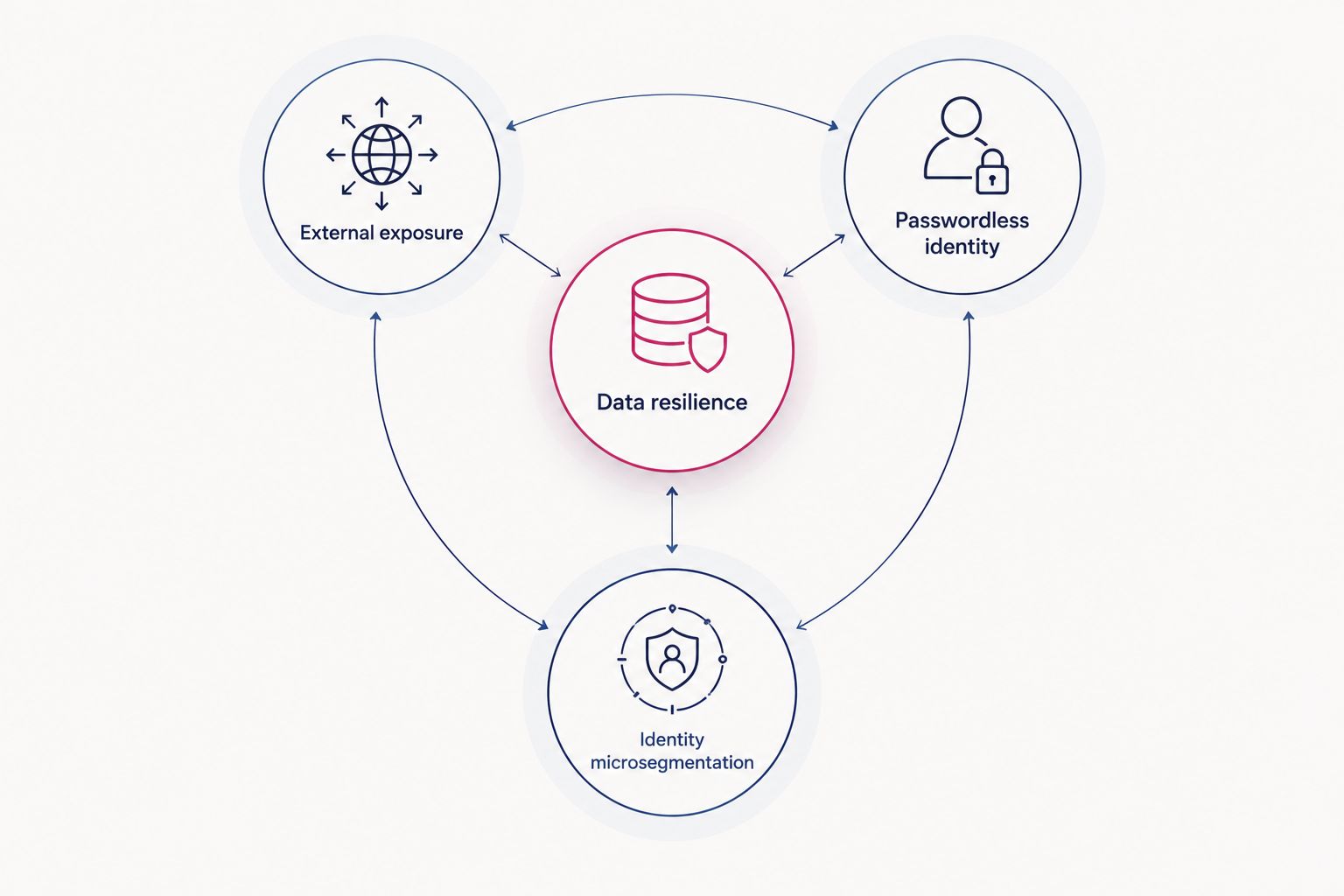
For your 2026 investment review, ask what each control changes in the incident model. Require a clear connection to entry points, reachable systems, usable data, or recovery operations. Do not credit a control with benefits outside its demonstrated scope.
Does paying a ransom remove the other costs?
A ransom payment does not replace incident response, recovery validation, or exfiltration assessment. Treat the payment as a separate line item rather than as the total incident loss.
Business interruption already incurred remains part of the accounting. So does the work required to establish trusted access and determine what happened to affected data.
Do backups eliminate ransomware losses?
Backups address restoration, not every ransomware consequence. They do not reverse exfiltration or remove the need to investigate compromised identities and systems.
Assess access to recovery copies, protection of backup administration, and the ability to restart applications. A successful file restore is evidence of file recovery—not proof that the business has recovered.
How should you account for cyber insurance?
Show gross incident loss before insurance recovery. Then assess eligible expenses, deductibles, exclusions, approval requirements, and claim status against the actual policy.
Do not subtract an assumed reimbursement from every scenario. Keep the operational loss model intact so management can see the exposure even when coverage decisions remain unresolved.
FAQ
What counts toward the cost of a ransomware attack?
The cost of a ransomware attack includes business interruption, response, recovery, data-exposure response, documented commercial consequences, and any ransom payment. Separate these categories to prevent omissions and double counting.
Is the ransom demand the same as the total business loss?
No. The ransom demand excludes the work required to investigate the incident, restore trusted operations, and assess exfiltration.
How do I estimate ransomware downtime costs?
Estimate downtime costs from the affected business workflows and their lost contribution, additional labor, and recovery backlog. Distinguish permanently lost transactions from transactions completed later.
Does restoring data resolve a ransomware-related breach?
No. Restoring data addresses availability but does not reverse exfiltration or establish which information an attacker accessed.
What does Cyber Storage do differently from complete-copy backups?
Cyber Storage encrypts, shards, and distributes data so no single storage location holds a reconstructable file. It is a data-resilience architecture that complements identity, segmentation, and exposure controls.
Which controls address ransomware attack paths?
Secfolio’s ransomware-resilience framework combines external exposure management, passwordless identity, identity microsegmentation, and Cyber Storage. Each layer addresses a different part of the attack path or recovery problem.
Will cyber insurance cover every ransomware loss?
Coverage depends on the executed policy and the circumstances of the claim. Calculate gross incident loss first, then assess reimbursement against policy terms and actual claim decisions.
One last thing
Your recovery test should end with a business transaction, not a restored file. Ask the business owner to complete the workflow using recovered data and trusted access.
If that transaction cannot finish, identify the blocked dependency and add it to the recovery plan. That is the gap your ransomware cost model needs to capture.


