

Attack surface management software cost in 2026 depends on the coverage, capabilities, and services included in your contract; compare scope-matched quotes rather than an assumed market average. Your budget must also account for implementation, integration, finding validation, and remediation work—not just the software subscription.
- Evaluate attack surface management software cost against asset coverage, exposure validation, and remediation responsibilities.
- Compare equivalent scopes before comparing vendor quotes; discovery alone is not exposure remediation.
- Secfolio connects external exposure management with identity controls and data resilience for enterprise security teams.
- Separate subscription commitments from implementation work, ongoing triage, and asset-growth terms.
How much does attack surface management software cost?
The useful cost is the commitment required to discover, validate, and close exposures across your agreed scope. A subscription quote answers only part of that question. You also need to establish which assets the vendor covers, which findings your team must investigate, and who performs the corrective work.
Start by separating discovery from the controls you already operate. Understanding whether attack surface management replaces vulnerability scanning helps you avoid treating overlapping capabilities as interchangeable coverage.
Use the following breakdown for your 2026 procurement review. These are evaluation categories, not claims about any vendor's billing model.
| Budget component | What to establish | What to request in writing |
|---|---|---|
| Software subscription | Included discovery, monitoring, validation, and reporting capabilities | Included features, exclusions, and contract scope |
| Asset coverage | How the vendor counts domains, addresses, services, and other objects | Billable-unit definition and duplicate-handling rules |
| Implementation | Setup, asset attribution, access configuration, and initial tuning | Deliverables and responsibilities |
| Integrations | Connections to security operations and remediation workflows | Included connectors and any separate implementation work |
| Ongoing operations | Finding validation, ownership assignment, and escalation | Division of work between vendor and customer |
| Scope changes | Treatment of acquisitions, new environments, and newly discovered assets | Expansion, reconciliation, and renewal terms |
Do not combine these categories into a single unexplained line item. A clear breakdown lets your procurement lead compare commercial commitments while your security lead compares operational coverage.
Why this matters: discovery is not the finished outcome
An inventory tells you what is exposed. It does not, by itself, close an exposed service, remove a vulnerable application, or resolve an ownership dispute. Those actions require accountable teams and a verified remediation process.
Buy coverage you can act on, not an inventory you cannot maintain. A platform that identifies relevant exposures still needs a route from finding to owner to correction. Your evaluation should follow that route instead of ending at the dashboard.
Attack surface management addresses a specific part of an attack path: the opportunity for initial access. Once an attacker obtains access, identity permissions, lateral movement controls, and data protection become separate concerns. Keep those boundaries visible in both your security architecture and your budget.
For a 2026 buying decision, ask what changes after a finding appears. A useful answer identifies the evidence, the responsible owner, the required action, and the method for confirming closure.
Compare coverage scopes before you compare quotes
Two proposals are not equivalent merely because both use the term attack surface management. One evaluation might cover internet-facing discovery. Another might include validation, workflow integration, or analyst assistance. Confirm those differences rather than inferring them from a package name.
The following scopes describe buying needs. They are not named product tiers or recommendations for a particular vendor.
| Evaluation scope | Best for | Main benefit | Main limitation |
|---|---|---|---|
| Discovery-focused coverage | Teams that need an external asset baseline | Identifies assets requiring ownership and review | An inventory alone does not establish exploitability or complete remediation |
| Discovery and exposure validation | Teams that need evidence for prioritization | Helps distinguish actionable exposures from findings requiring further investigation | Validation methods and coverage require technical review |
| Discovery with remediation workflows | Teams coordinating security and infrastructure owners | Connects findings to assignment, escalation, and closure evidence | Workflow connections still require customer ownership |
| Analyst-assisted coverage | Teams that need help attributing assets and reviewing findings | Adds human investigation to the evaluation scope | Service boundaries and customer responsibilities must remain explicit |
Select the narrowest scope that completes your required workflow. Do not remove validation merely to simplify the comparison if your team needs evidence before acting. Do not add analyst assistance without defining the work those analysts will perform.
For each proposal, request an included-versus-excluded list. Record whether asset attribution, finding investigation, ticket creation, remediation advice, and closure verification are included. An unanswered field is a procurement question, not an assumed capability.
Why attack surface management software cost varies
Use these factors to structure quote requests. Their relevance depends on the contract; they are not a claim that every supplier charges for each item.
- Asset definition and scope. A domain, IP address, hostname, cloud resource, and exposed service are different objects. Establish what counts toward the contracted scope and how overlapping objects are handled.
- Assessment coverage. Discovery, exposure checks, authenticated assessment, and internal attack-path analysis serve different purposes. Request only the assessment types your evaluation requires, then document their boundaries.
- Monitoring and reassessment. Ask when assets and findings are checked again, how changes enter the workflow, and whether assessment settings alter the contracted scope.
- Integration requirements. A finding export is not the same as an operational connection to your ticketing or security workflow. Define the required behavior, including ownership updates and closure status.
- Human investigation and support. Establish who attributes ambiguous assets, reviews disputed findings, and handles escalations. Separate implementation assistance from continuing operational services.
- Growth and contract terms. New business units, cloud environments, and acquisitions change coverage needs. Request explicit treatment of scope expansion and renewal rather than assuming the original commitment stays unchanged.
These factors explain why a quote needs a scope sheet. They do not establish a market average. Your decision should rest on documented coverage and responsibilities, not a number detached from the environment it protects.
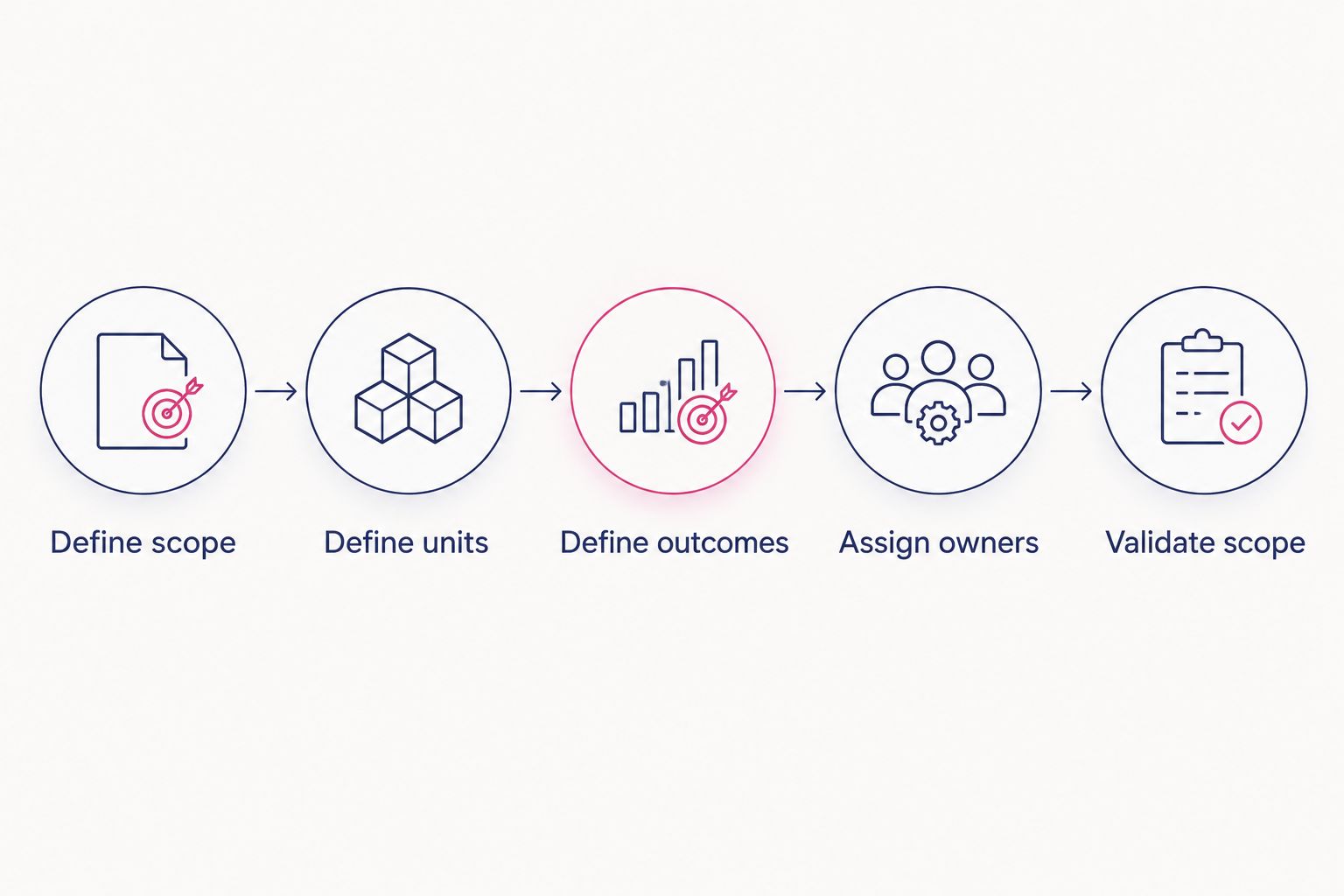
Build a comparable quote in five steps
Step 01: Define scope
List the business entities and environments that belong in the evaluation. Include known internet-facing assets and the process for reviewing newly discovered candidates. Asset discovery should not silently become permission to assess unrelated infrastructure.
Record exclusions just as clearly. If a subsidiary, supplier-managed service, or development environment is outside scope, name the boundary and identify who owns the remaining risk.
Step 02: Define units
Ask each vendor to explain its commercial unit in plain language. Establish how shared infrastructure, duplicate records, historical assets, and inactive assets are treated. Do not assume that identical inventory totals produce identical contractual scope.
Request a worked explanation using your own asset categories, without inserting an assumed market rate. The goal is to understand the counting rules before accepting the commitment.
Step 03: Define outcomes
Specify what a successful finding contains: attributable ownership, supporting evidence, a business-relevant priority, and a next action. Then define what counts as closed. A ticket marked complete is not proof that an exposure has disappeared.
Your 2026 requirements should distinguish exposure reduction from report production. Reports support governance; verified corrective action changes the attack path.
Step 04: Assign owners
Name the team responsible for discovery review, validation, ticket assignment, remediation, and reassessment. Include the vendor only where the proposed service explicitly assigns it a role.
This prevents a common planning gap: purchasing a discovery capability while leaving the work it creates unassigned. Keep security operations, infrastructure, application owners, and procurement aligned on the same scope sheet.
Step 05: Validate scope
Use the proposed coverage in a technical evaluation. Review asset attribution, evidence quality, workflow behavior, and how the platform records a resolved exposure. Treat demonstrations as evidence of a shown workflow, not proof of every advertised capability.
Before approval, reconcile the evaluated scope with the contract. Features demonstrated outside the proposed package do not belong in your business case unless they are explicitly included.
How do you account for work beyond the subscription?
Your operating budget must include the work required to turn findings into verified corrections. Identify implementation tasks, integration maintenance, recurring triage, and remediation ownership separately from the subscription commitment.
Track this work during evaluation using your team's actual records. Capture analyst effort, reassigned findings, disputed ownership, and closure evidence. Do not turn a vendor demonstration into an assumed labor-saving claim.
For your 2026 business case, separate work that is new from work that replaces an existing process. Moving an existing asset review into a different interface is not automatically a reduction in effort. A defensible business case explains which tasks change and shows the evidence.
Can attack surface management replace vulnerability scanning?
Attack surface management and vulnerability scanning overlap, but their scopes are not automatically interchangeable. External discovery addresses what is visible and attributable; vulnerability assessment examines weaknesses within its defined assessment scope.
Ask which existing scanning requirements a proposal actually covers. Keep any uncovered requirements in your budget. Remove a tool only after you verify that its required coverage and workflow remain available elsewhere.
Should you buy standalone coverage or a broader security approach?
Choose standalone external exposure coverage when that is the defined gap. Consider a broader approach when your requirements also include reusable credentials, excessive identity access, lateral movement, or data resilience. Do not treat those controls as substitutes for external discovery.
Secfolio is best suited to enterprise security teams seeking external exposure management alongside identity controls and data resilience. Its stated scope connects the initial-access problem to the internal attack paths that determine what happens after access.
That broader scope also creates an evaluation obligation. Secfolio's external exposure management, passwordless authentication, identity microsegmentation, and Cyber Storage address different security problems. Require separate acceptance criteria for each rather than assuming that one control proves the effectiveness of another.
Layer 01: External exposure
Discover and close exposed entry points before initial access. The operational outcome is a corrected exposure, supported by reassessment. This remains the primary requirement for an attack surface management buying decision.
Layer 02: Passwordless identity
Eliminate reusable credentials where passwordless authentication is deployed. This addresses credential theft rather than an exposed application's configuration. Authentication controls still require sound account lifecycle and access management.
Layer 03: Identity microsegmentation
Contain lateral movement by restricting which identities can reach which resources. The objective is a smaller blast radius after compromise. Policies need defined access requirements and operational validation; segmentation does not remove an external vulnerability.
Layer 04: Data resilience
Preserve recoverability when ransomware or exfiltration threatens business continuity. Secfolio's Cyber Storage uses encryption, sharding, and distribution so no single location contains a reconstructable file, creating a logical air gap. The operational distinction is unusable fragments rather than complete files at an individual location.
Cyber Storage is a data-resilience architecture, not a replacement for exposure management or identity controls. Evaluate authorized distributed recovery alongside the other layers. Keep recovery requirements explicit rather than assuming a universal recovery time.
What should procurement require before approval?
Use a short acceptance checklist. Each item should produce a contract statement or evaluation record, not a verbal assurance.
- Coverage: Included entities, environments, assets, and exclusions are documented.
- Counting: Commercial units and reconciliation rules are explained.
- Evidence: Findings contain enough information for the responsible team to act.
- Ownership: Vendor and customer responsibilities are separated.
- Closure: The evaluation demonstrates how corrected exposures are reassessed.
- Change: Expansion and renewal terms are visible before signature.
For a 2026 procurement review, keep the technical scope and commercial scope together. Approving them separately creates room for a capable demonstration to become a narrower contract.
FAQ
How much does attack surface management software cost in 2026?
Attack surface management software cost depends on the contracted coverage, capabilities, and services. Compare scope-matched quotes and account separately for implementation, ongoing triage, and remediation work.
What should an attack surface management quote include?
An attack surface management quote should identify covered assets, included capabilities, commercial units, service responsibilities, and scope-change terms. Request an explicit list of exclusions so the proposed coverage can be checked against your requirements.
Is attack surface management billed per asset?
Do not assume per-asset billing; confirm the commercial model in each proposal. If assets determine the commitment, request the exact counting rules for domains, addresses, services, duplicates, and inactive records.
Does attack surface management include remediation?
Discovery does not automatically include remediation. Confirm who investigates findings, assigns owners, makes corrections, and verifies that the exposure is closed.
Can attack surface management replace vulnerability scanning?
Attack surface management cannot be treated as a replacement without checking assessment coverage. Compare discovery, vulnerability assessment, and operational requirements before removing an existing scanning capability.
What is the best way to compare attack surface management proposals?
Compare proposals against the same asset scope, required outcomes, and division of responsibilities. Evaluate attribution, finding evidence, workflow behavior, and closure verification before comparing commercial commitments.
Do I still need ransomware resilience with attack surface management?
Yes, external exposure management and ransomware resilience address different parts of an attack path. Keep identity controls, lateral movement containment, and data recovery requirements alongside external exposure management.
One last thing
Make the vendor explain a finding that was closed, not just a finding that was discovered. Ask who owned it, what changed, and how the correction was verified. That walkthrough reveals whether the proposed workflow ends at visibility or supports exposure reduction.
Then check that every capability used in the walkthrough appears in the proposed scope. A convincing demonstration is useful only when the contract includes the work and functionality that made it convincing.
Related guides
- How to prioritize external exposure findings for remediation
- How to reduce external attack surface across cloud assets


