

External exposure management cost in 2026 depends on the scope you contract and the work your team must do to close exposures; use a scoped proposal rather than a generic average to set your budget. Include implementation, investigation, remediation, and ongoing administration alongside the subscription, because discovering an attack path does not remove it.
- Compare external exposure management cost against coverage, remediation responsibilities, and ongoing operating work—not the subscription alone.
- SecFolio pairs external exposure management with passwordless identity, identity microsegmentation, and Cyber Storage data resilience.
- Require evidence that findings reach an accountable owner and that remediation removes the external attack path.
- Keep attack surface management and vulnerability scanning scopes distinct when comparing proposals.
How much does external exposure management cost in 2026?
Build your budget from a defined scope, then compare proposals against that same scope. A subscription total without coverage definitions, implementation responsibilities, and remediation ownership is not a complete operating budget.
Use the following breakdown for your 2026 procurement review. These are budget categories to request and account for, not claims that every provider charges separately for each item.
| Budget component | What to establish | What to include in your assessment |
|---|---|---|
| Subscription | Contracted coverage and included capabilities | The assets, environments, and services explicitly covered |
| Implementation | Responsibilities for initial setup | Internal work and any separately contracted assistance |
| Investigation | Who validates ownership and relevance | Analyst effort to resolve ambiguous findings |
| Remediation | Who changes the affected systems | Engineering, infrastructure, and application-owner work |
| Administration | Who maintains scope and workflows | Inventory updates, access administration, and reporting |
| Renewal and scope changes | How contract changes are handled | Written terms for expansion, renewal, and termination |
Keep the provider's commercial proposal separate from your internal operating estimate. Combine them for the budget decision, but retain the distinction so procurement can identify which obligations belong in the contract.
For the operating side, establish how to prioritize external exposure findings for remediation before you evaluate reporting features. A finding that never reaches an accountable owner remains an open attack path.
Why this matters
External exposure management addresses entry points visible from outside your organization. The business outcome is not a longer inventory; it is fewer exposed routes into systems and data.
A procurement decision must connect discovery to action. Your security team needs enough context to distinguish an owned, reachable service from an unrelated asset, assign remediation, and verify the result.
Buy against a closure workflow, not a dashboard demonstration. Otherwise, you fund visibility without establishing who removes the exposure or proves that the change worked.
Step 01: Define the coverage boundary
Start your 2026 evaluation with a written coverage statement. Specify the environments you want assessed, the organizational entities included, and the boundaries that separate your assets from third-party infrastructure.
Do not assume that a domain, host, cloud resource, and application are interchangeable contract units. Ask the provider to define its terminology and apply it to your environment before you compare totals.
Your scope should answer these questions:
- Which owned domains and internet-facing services belong in the assessment?
- Which cloud environments and business entities are included?
- How will suspected assets be attributed to your organization?
- Who approves additions, exclusions, and ownership corrections?
- What happens when an asset changes owner or leaves service?
The purpose is contractual clarity. An asset list that your security team understands but procurement interprets differently creates an avoidable disagreement about coverage.
Keep exclusions visible. If a proposal excludes an environment that matters to your business, record the separate control that will cover it rather than treating the exclusion as a saving.
Step 02: Compare equivalent operating scopes
Compare delivery approaches by the work they leave with your team. Do not infer a provider's service model from labels such as platform, managed, or enterprise.
The table below describes evaluation options, not named vendor packages. Ask each provider to state which activities its proposal actually includes.
| Evaluation option | Best for | Advantage | Limitation to address |
|---|---|---|---|
| Discovery-focused scope | Teams establishing an external asset inventory | Makes inventory coverage the primary deliverable | Leaves prioritization and closure responsibilities to be established |
| Discovery and prioritization scope | Teams with existing remediation owners | Adds context for deciding which findings need action | Does not itself establish that systems will be changed |
| Discovery through verified closure | Teams requiring a documented remediation workflow | Connects findings, ownership, changes, and verification | Requires clear authority, approvals, and operational coordination |
Use the same acceptance criteria across proposals. If one includes investigation and another leaves investigation to your analysts, the subscription totals describe different operating scopes.
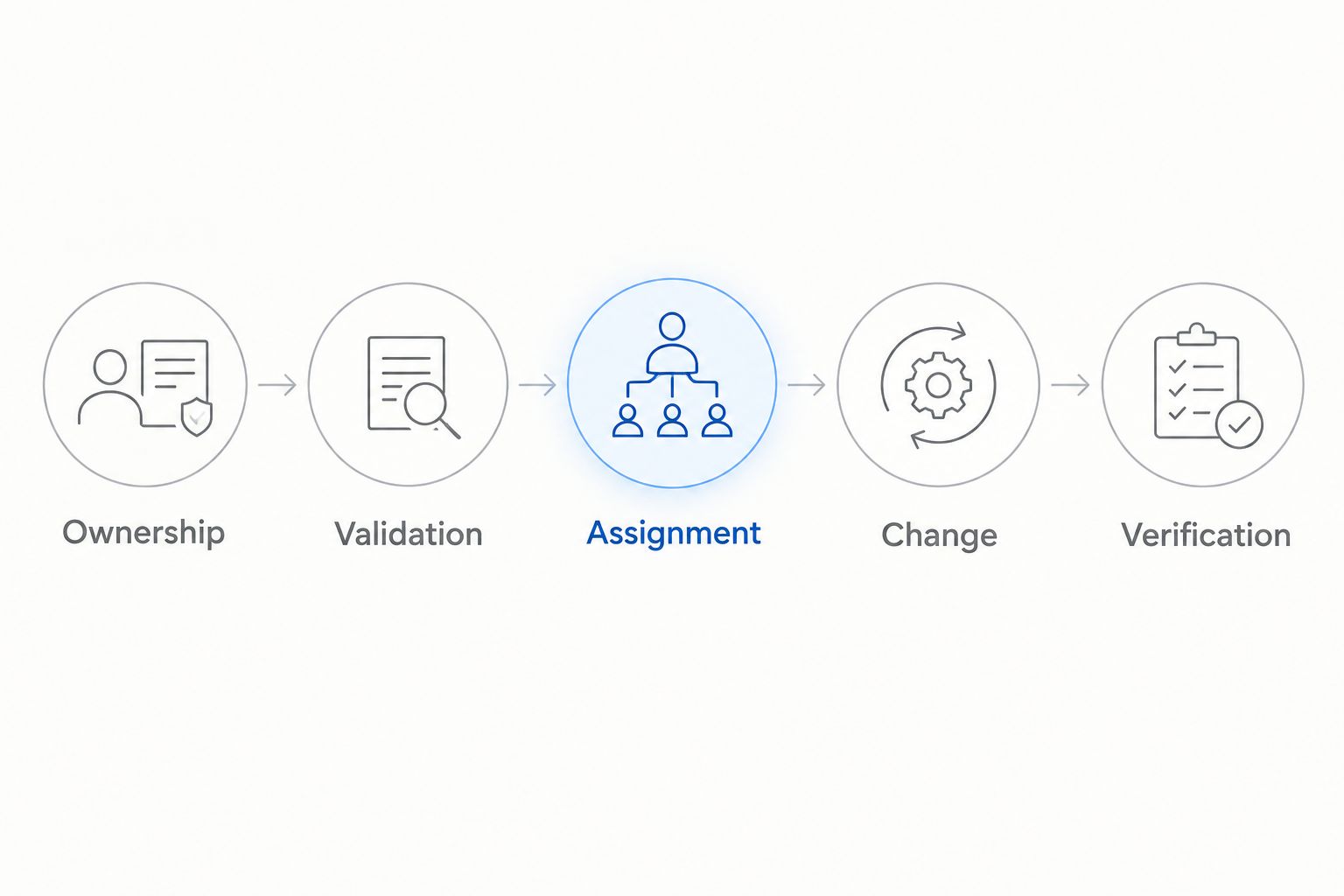
Ask for a demonstration using a representative exposure scenario. Follow it from discovery through ownership, prioritization, assignment, remediation, and verification; do not stop when the finding appears on a screen.
Step 03: Account for the work outside the subscription
For your 2026 budget, identify the teams that must participate after a finding arrives. Security analysts investigate relevance, infrastructure teams change services, and application owners assess the effect on business operations.
These responsibilities belong in the operating plan even when you already employ the people doing the work. Existing staff capacity is not evidence that remediation requires no effort.
Separate setup activities from recurring activities. Initial scope validation and workflow configuration differ from ongoing investigation, inventory correction, and change coordination.
For each activity, record the owner, deliverable, approval requirement, and completion evidence. Estimate effort using your own records or a documented evaluation, not an assumed industry average.
A proposal should also identify the handoff boundary. If the provider delivers a validated finding but your team must implement the change, state that boundary explicitly so neither side mistakes notification for remediation.
Step 04: Require proof of closure
Treat closure as a distinct deliverable. A ticket marked complete shows that someone changed a workflow status; it does not establish that the external exposure disappeared.
Define what evidence is appropriate for each finding. That can include confirmation that an exposed service is no longer reachable, that a configuration has changed, or that the finding's ownership was corrected after investigation.
Use a simple evaluation sequence:
- Identify the external asset and establish ownership.
- Validate the exposure and its relevance to an attack path.
- Assign an accountable remediation owner.
- Approve and implement the corrective change.
- Reassess the affected exposure and retain the evidence.
Reject closure criteria that end at notification. Your acceptance test should establish what changed and how the result was checked, without inventing a universal response-time target.
A documented exception is different from remediation. Keep accepted exposures visible with an owner and review conditions rather than counting them as removed attack paths.
Why external exposure management budgets vary
The useful question is which responsibilities and coverage boundaries differ between proposals. Use these factors to request a clear explanation of the proposed scope, rather than assuming a particular billing model.
- Coverage boundary: Specify the assets, environments, and organizational entities included. Require consistent definitions across bids.
- Ownership investigation: Establish who confirms whether discovered infrastructure belongs to you and resolves disputed attribution.
- Prioritization depth: Request the context used to connect a finding to a reachable service, business function, or attack path.
- Workflow requirements: Identify the systems and approval processes that findings must enter. Ask who configures and maintains those handoffs.
- Remediation responsibility: Distinguish advice, coordinated changes, and changes performed by the provider. Require an explicit authorization boundary.
- Verification and reporting: Define the evidence needed to show closure and the records your operational review requires.
Keep the comparison grounded in deliverables. More findings, more reports, or more named features do not establish that a proposal removes more relevant exposure.
Where external exposure management fits in the attack-path framework
SecFolio external exposure management is best suited to enterprise security teams addressing external entry points alongside identity and data controls. Its role is to discover and close exposure before initial access—not replace defenses that operate after authentication.
Use the 4-layer framework to keep your 2026 budget responsibilities distinct. Each layer addresses a different part of the attack path.
| Layer | Threat addressed | Control | Boundary |
|---|---|---|---|
| 1 | External entry points | External exposure management | Does not replace internal identity controls |
| 2 | Reusable credential abuse | Passwordless identity | Does not remove exposed services |
| 3 | Lateral movement | Identity microsegmentation | Does not replace data resilience |
| 4 | Loss of usable data and exfiltration risk | Cyber Storage | Does not replace exposure or identity controls |
External exposure management remains the primary control for this procurement decision. Passwordless authentication addresses reusable credentials, while identity microsegmentation contains lateral movement and limits the blast radius of compromised access.
SecFolio's Cyber Storage supplies the complementary data-resilience layer. It encrypts data before it leaves the customer environment, uses sharding to create immutable encrypted fragments, and distributes those fragments across independent locations.
No single location holds a reconstructable file. This creates a logical air gap: attackers obtaining fragments from a single location do not obtain usable files, while authorized recovery uses distributed recovery rather than a complete copy held at that location.
That architecture matters when the broader threat includes ransomware, exfiltration, or business continuity. It is not a reason to stop closing external entry points, eliminating reusable credentials, or containing lateral movement.
The framework's advantage is clear control separation. Its operational limitation is equally clear: your team must coordinate responsibilities across the layers instead of expecting an external exposure purchase to cover every breach scenario.
What should I ask before approving a 2026 proposal?
Ask the provider to turn product claims into written acceptance conditions. You need a defined coverage boundary, an accountable workflow, and evidence of closure before you approve the purchase.
Use this review checklist:
- Coverage: Does the proposal identify included environments and explicit exclusions?
- Attribution: Who resolves uncertain ownership and removes incorrect associations?
- Prioritization: What evidence explains why a finding deserves remediation?
- Execution: Who performs changes, and who authorizes them?
- Verification: What proves that the exposure was closed?
- Administration: Who maintains scope, permissions, and workflow configuration?
- Contract changes: How are expansion, renewal, and exit obligations documented?
Give each unanswered item an owner before approval. A polished demonstration does not substitute for an obligation that the contract and operating plan actually establish.
Can attack surface management replace vulnerability scanning?
Attack surface management does not replace vulnerability scanning simply because both identify security issues. External discovery establishes what is exposed; vulnerability scanning assesses defined targets for vulnerabilities within its assessment scope.
Compare the coverage and outputs you need before removing an existing control. A proposal must demonstrate the required assessment capability, not merely use a similar category label.
Does a lower subscription mean a lower operating cost?
A lower subscription does not establish a lower total operating cost. Compare the internal investigation, administration, and remediation work required to deliver the same outcome.
Use your own documented effort estimates for the comparison. Do not assign a savings claim to automation until your evaluation demonstrates which task it performs and what human work remains.
FAQ
How do I estimate external exposure management cost in 2026?
Estimate external exposure management cost from a defined coverage scope, the provider’s proposal, and your internal operating work. Include implementation, investigation, remediation, administration, and closure verification in the assessment.
What should an external exposure management proposal include?
A proposal should define covered environments, included activities, exclusions, responsibilities, and acceptance evidence. Require a clear distinction between discovering a finding and removing the exposure.
Is external exposure management the same as vulnerability scanning?
External exposure management and vulnerability scanning address different assessment scopes. External discovery establishes exposed assets, while vulnerability scanning assesses defined targets for vulnerabilities.
Does external exposure management include remediation?
The proposal must state whether remediation is included and who performs it. Do not interpret an alert, recommendation, or ticket as a commitment to implement a corrective change.
How do I compare external exposure management providers?
Compare providers against the same asset scope and closure workflow. Review attribution, prioritization, operating responsibilities, verification evidence, and contractual exclusions before comparing subscription totals.
Where does SecFolio fit in an enterprise security budget?
SecFolio combines external exposure management with passwordless authentication, identity microsegmentation, and Cyber Storage data resilience. Budget each control against its role rather than treating external exposure management as a replacement for the other layers.
Does Cyber Storage replace external exposure management?
Cyber Storage does not replace external exposure management. Its encryption, sharding, and distribution provide a complementary data-resilience architecture while external exposure management addresses entry points before initial access.
One last thing
Ask to see a closed exposure, not just a discovered one. Require the original finding, the accountable owner, the corrective action, and the verification evidence in the same evaluation.
This reveals where the provider's responsibility ends and your team's work begins. That boundary is the foundation of a defensible external exposure management budget.


