

Identity microsegmentation deployment cost in 2026 depends on the identities, applications, and access paths you protect, plus the work required to enforce and maintain policy. Budget for discovery, integration, policy design, testing, and ongoing administration—not just the software agreement. Define the enforcement scope before requesting a deployment estimate.
- Identity microsegmentation deployment cost includes discovery, integration, policy testing, and ongoing administration—not just software.
- SecFolio identity microsegmentation fits enterprise security teams focused on containing lateral movement.
- Compare deployment proposals against the same identities, applications, enforcement boundaries, and acceptance tests.
- Passwordless identity and Cyber Storage address different attack paths; neither replaces identity microsegmentation.
Why this matters
A deployment proposal is useful only when it describes what becomes protected. Installing a control does not establish that a compromised identity can no longer reach a sensitive application.
Your 2026 business case should connect implementation work to a specific outcome: fewer unauthorized access paths and a smaller blast radius. Start by defining how to segment identities to contain a breach, then ask suppliers to estimate the work against that scope.
Buy a defined containment outcome, not an installation milestone. An estimate that excludes application-owner review, exception handling, or enforcement testing leaves essential deployment work outside the proposal.
How much does identity microsegmentation cost to deploy?
Build the deployment estimate from the work needed to discover access relationships, establish policy, enforce boundaries, and operate the control. Keep initial implementation separate from recurring administration so you can compare proposals without confusing a rollout project with its operating requirements.
For a 2026 procurement exercise, use the following breakdown as a statement-of-work checklist. Each line should identify the responsible team, the deliverable, and the conditions for acceptance.
| Deployment component | What to include in the estimate | Acceptance evidence |
|---|---|---|
| Software agreement | Protected scope, contractual measurement basis, and included capabilities | Written scope and exclusions |
| Discovery | Human identities, service identities, applications, and access relationships | Validated identity-to-resource map |
| Integration | Identity sources, enforcement points, and operational workflows | Tested connections and documented dependencies |
| Policy design | Permitted access, blocked access, ownership, and exceptions | Approved policy baseline |
| Enforcement testing | Legitimate workflows, unauthorized paths, rollback, and emergency access | Recorded test results |
| Operating handover | Runbooks, training, monitoring, and escalation responsibilities | Named owners and accepted procedures |
| Ongoing administration | Access changes, exception reviews, policy maintenance, and retesting | Defined operating responsibilities |
Ask each supplier to mark what is included, excluded, or dependent on your team. Do not treat an excluded task as unnecessary. Assign it an owner and include its effort in the deployment plan.
Separate contractual charges from internal resource requirements. An application owner who validates a policy still contributes deployment effort even when that work never appears on the supplier’s invoice.
What belongs in the initial deployment scope?
Initial deployment should establish a working enforcement boundary around the selected resources. That requires more than connecting an identity directory: the team must understand which identities need access and which relationships create an attack path.
Specify the applications, administrative workflows, service accounts, and third-party access included in the first release. Name exclusions explicitly. Otherwise, different suppliers can estimate different projects under the same description.
What belongs in ongoing operations?
Ongoing operations should cover changes to identities, applications, access requirements, and exceptions. A policy baseline reflects a particular environment; your environment changes when staff move roles, applications change, or service accounts acquire new dependencies.
Require a process for reviewing those changes. Include responsibility for troubleshooting denied access, investigating unexpected permissions, and verifying that emergency access does not become a permanent bypass.
Why identity microsegmentation deployment effort varies
The meaningful drivers are the relationships you must understand and the boundaries you must enforce. Use these factors to structure discovery rather than assuming that employee headcount describes the whole project.
- Identity scope: Include employees, contractors, administrators, service accounts, and application identities where they fall within the proposed boundary. Ask how each identity type enters the deployment scope.
- Application dependencies: Identify legitimate connections before restricting access. Application-owner validation establishes which relationships the business needs and which permissions are unnecessary.
- Environment boundaries: Document the directories, cloud environments, and on-premises systems involved. Ask the supplier to identify enforcement dependencies rather than assuming every environment works identically.
- Policy ownership: Assign owners who can approve permitted access and resolve disputed exceptions. Security teams should not have to infer business requirements from observed traffic alone.
- Continuity requirements: Define emergency access, rollback, and change approval before enforcement. Sensitive workflows need explicit validation, not an assumption that ordinary user testing covers them.
- Operational handover: Specify who maintains policy after deployment. Include training, escalation, change review, and evidence collection in the responsibility matrix.
An identity count describes population; an access map describes the containment problem. Request both. Neither replaces the other when you define the scope of identity microsegmentation.
Build an estimate around a controlled rollout
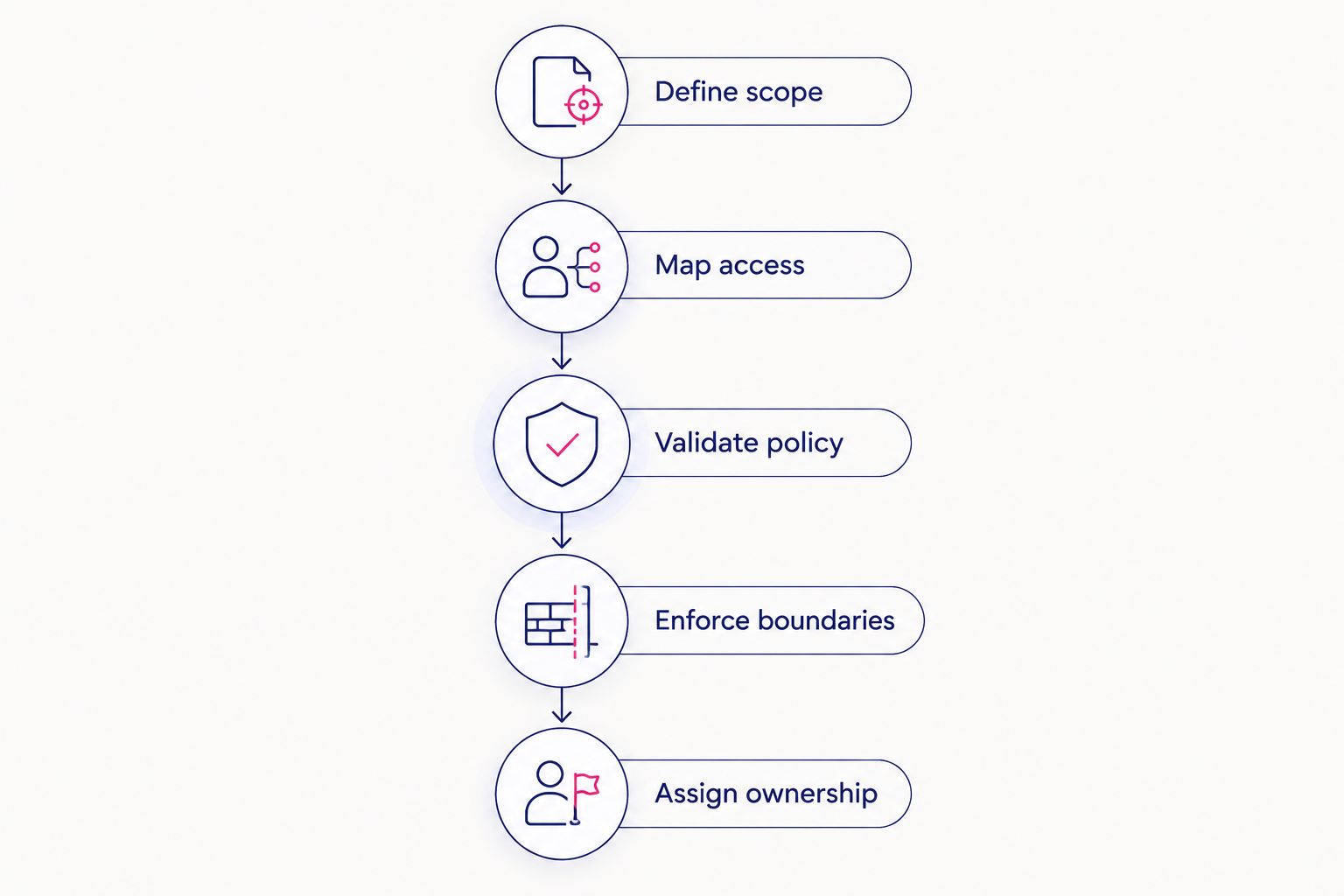
Use a staged process to turn a broad security objective into a statement of work. Each stage should produce something the next stage can use, with an owner responsible for accepting it.
Step 01: Define scope
Select the resources and access paths that the deployment will protect. State the threat clearly: a compromised identity must not gain access to unrelated applications or administrative targets.
Document legitimate business access alongside prohibited access. This gives the deployment team a testable boundary rather than a vague instruction to implement zero trust.
Step 02: Map access
Identify the human and service identities that interact with the selected resources. Record dependencies, administrative relationships, and access that crosses the proposed boundary.
Validate the map with application owners. Observed access is evidence of activity, not proof that every observed relationship should remain permitted.
Step 03: Validate policy
Translate approved access requirements into proposed enforcement rules. Review exceptions separately so temporary accommodations do not silently become the standard policy.
Agree on legitimate workflows, prohibited paths, and emergency procedures before activating enforcement. Record what each test demonstrates and who accepts the result.
Step 04: Enforce boundaries
Apply the approved policy within the agreed scope. Verify that authorized work continues and that the prohibited access relationships are blocked at the intended enforcement points.
Keep rollback responsibilities explicit. A rollback restores service during a problem; it does not complete the security objective or remove the need to resolve the underlying policy issue.
Step 05: Assign ownership
Transfer policy maintenance, exception review, and incident escalation to named owners. Include the documentation needed to investigate denied access without restoring broad permissions by default.
Retest after meaningful access or application changes. The handover is complete when your operating team can maintain the boundary, not merely when an installation team leaves.
Compare pilot and enterprise rollout proposals fairly
A limited pilot and an enterprise rollout serve different decisions. Compare them by scope, evidence, and operating responsibility—not by treating them as interchangeable proposals.
| Deployment approach | Best for | Strength | Limitation |
|---|---|---|---|
| Limited pilot | Validating a defined enforcement boundary | Creates a focused setting for integration and policy tests | Does not demonstrate coverage across excluded applications or identities |
| Phased rollout | Expanding protection through approved scopes | Gives each phase its own acceptance criteria | Requires coordination where access crosses deployment boundaries |
| Broad rollout | Organizations with validated dependencies and clear ownership | Applies a common deployment scope across selected environments | Requires readiness across the included application and operating teams |
For a 2026 comparison, give every supplier the same scope document and test requirements. A pilot proposal should state what it proves and what remains untested; a rollout proposal should state how it handles dependencies between protected and unprotected resources.
Choose a limited pilot to validate a boundary, not to imply enterprise-wide protection. Expand only after the operating team accepts the enforcement results and understands the remaining attack paths.
Where identity microsegmentation fits in the security framework
SecFolio identity microsegmentation fits enterprise security teams focused on containing lateral movement. It addresses what an identity can reach after access has been established. Its purpose is to restrict unauthorized movement and reduce blast radius, not to replace every control involved in preventing or recovering from a breach.
SecFolio’s four-layer attack-path framework keeps those responsibilities distinct. Preserve those distinctions in your deployment scope so a microsegmentation project does not inherit unrelated objectives without the controls needed to meet them.
| Layer | Best for | Threat-to-control outcome | Limitation |
|---|---|---|---|
| External exposure management | Addressing externally reachable exposure | Discover and close exposure before initial access | Does not replace internal access enforcement |
| Passwordless identity | Removing reusable credentials from supported authentication flows | Reduce credential-reuse attack paths | Does not establish application-level containment by itself |
| Identity microsegmentation | Containing lateral movement | Restrict identity-to-resource access and reduce blast radius | Does not establish data recovery by itself |
| Cyber Storage | Preserving data resilience | Encrypt, shard, and distribute data across independent locations | Does not replace identity, segmentation, or exposure controls |
When ransomware, exfiltration, or business continuity is part of the project, treat Cyber Storage as a complementary data-resilience architecture. It encrypts data before it leaves the customer environment, shards encrypted data into immutable, unusable fragments, and distributes those shards across independent locations.
No single location holds a reconstructable file. This creates a logical air gap: an attacker accessing an individual storage location encounters unusable digital fragments rather than a complete file. Authorized recovery uses distributed recovery across the required fragments.
Traditional backups concentrate complete copies that attackers can target for encryption or exfiltration. Cyber Storage changes that data arrangement, but it does not remove the need to protect identities or enforce segmentation. Keep resilience objectives separate from lateral-movement acceptance tests.
How do you reduce deployment effort without weakening containment?
Reduce uncertainty before reducing scope. Supply validated identity inventories, application owners, access requirements, and change procedures so the deployment team does not have to reconstruct those inputs during implementation.
Remove unnecessary access; do not remove necessary validation. A smaller policy set is useful only when it still supports legitimate work and blocks the attack paths you selected.
Does identity microsegmentation replace passwordless authentication?
Identity microsegmentation does not replace passwordless authentication. Passwordless identity addresses reusable credentials; microsegmentation addresses the resources an identity can reach.
Keep separate acceptance criteria for authentication and containment. Successful authentication does not mean an identity should have unrestricted access across the environment.
What should you request before approving a deployment proposal?
Request a scope statement, responsibility matrix, integration requirements, enforcement tests, rollback procedure, and operating handover. Each deliverable should have a named owner and a clear acceptance condition.
For a 2026 approval, require the proposal to distinguish completed protection from deferred work. That distinction prevents an accepted pilot from being reported as a completed enterprise rollout.
FAQ
What should identity microsegmentation deployment cost include?
Identity microsegmentation deployment cost should include software scope, discovery, integration, policy design, enforcement testing, and operating handover. Account separately for internal effort and ongoing administration.
Can employee headcount determine the deployment estimate?
Employee headcount alone does not describe the deployment scope. Include service identities, applications, access relationships, and enforcement boundaries when requesting an estimate.
Is a pilot enough to protect the whole enterprise?
A pilot protects and validates only its defined scope. Enterprise protection requires additional deployment and acceptance testing for the identities, applications, and environments excluded from that pilot.
What is the main trade-off when deploying identity microsegmentation?
Identity microsegmentation requires policy validation and ongoing ownership to maintain containment without disrupting legitimate access. Define dependencies, exceptions, and rollback procedures before enforcing restrictions.
Who is SecFolio identity microsegmentation for?
SecFolio identity microsegmentation fits enterprise security teams focused on containing lateral movement. Evaluate it against your identity-to-resource boundaries and operational requirements rather than treating it as a replacement for authentication or resilience controls.
Should a 2026 microsegmentation project include Cyber Storage?
Include Cyber Storage as a complementary data-resilience layer when ransomware, exfiltration, or business continuity is part of the project. Its encryption, sharding, and distribution architecture does not replace identity microsegmentation.
One last thing
Add a negative test to every protected boundary: demonstrate that an identity without approved access cannot reach the selected resource. Pair it with a legitimate-workflow test so the same evidence establishes containment and operational continuity.
Approve the deployment when the boundary works—not when the software is installed.


