

Privileged access management software cost in 2026 includes licensing, implementation, infrastructure, and ongoing administration—not just the subscription. Your payable amount comes from a quote tied to your identities, systems, and required controls. Compare the complete operating scope before you approve a purchase; a license-only comparison leaves migration, integration, and access-policy work outside the decision.
- Privileged access management software cost requires a scoped quote, not a license-only comparison.
- Compare PAM proposals against the same privileged identities, target systems, and acceptance tests.
- Passwordless authentication and identity microsegmentation address attack paths beyond credential vaulting.
- Secfolio suits enterprise security teams combining identity controls with attack-path elimination and data resilience.
How much does privileged access management software cost?
Budget for the complete privileged-access service, not just the software entitlement. Ask each supplier to separate the commercial proposal into the same categories. Otherwise, you are comparing different projects under the same PAM label.
Start with the access you need to remove. For Active Directory environments, the guide to eliminating standing privileged access in Active Directory provides a relevant next step for defining the control objective before requesting proposals.
Use these 6 budget components as your quote worksheet:
| Budget component | What to request | What the answer establishes |
|---|---|---|
| Software entitlement | The exact licensing unit, included capabilities, and scope boundaries | What your agreement covers |
| Implementation | Discovery, configuration, migration, and policy deployment responsibilities | Who performs the initial work |
| Integration | Supported connections and responsibility for custom work | How PAM fits your environment |
| Infrastructure | Required hosting, storage, connectivity, and resilience arrangements | What your organization must operate |
| Ongoing administration | Policy maintenance, account onboarding, reviews, and troubleshooting ownership | The continuing workload |
| Support and expansion | Support scope and treatment of additional identities or systems | How the agreement handles change |
These are procurement categories, not claims that every supplier bills separately for each item. Require a written answer even when a component is included. An included service still needs a defined scope and an accountable owner.
For your 2026 approval, distinguish the supplier payment from internal effort. Security engineering, application owners, identity administrators, and help-desk teams all need assigned responsibilities. A proposal does not become a complete budget merely because its licensing section is clear.
Why this matters
PAM protects privileged access, but a purchasing decision must connect that control to an actual attack path. A managed administrator password does not, by itself, establish that unnecessary permissions are gone or that lateral movement is contained.
The useful question is not simply whether you can purchase a vault. It is whether the deployment changes how administrators, contractors, and workloads obtain and use elevated access. Make the intended security outcome an acceptance condition.
Record the current weakness beside the proposed control. Shared credentials call for individual accountability and credential protection. Persistent administrator access calls for privilege reduction and controlled elevation. Broad reach between systems calls for containment beyond authentication.
Define the privileged access you need to control
An employee count is not a privileged-access inventory. Identify the accounts, systems, and workflows that can change configurations, access sensitive information, or grant additional permissions. That inventory becomes the basis for a comparable proposal.
Separate human access from non-human access. An administrator signing into a server has a different workflow from an application retrieving a secret. Do not assume a proposal covers both merely because it uses the term identity security.
Your scope should describe:
- Administrators: Named people who perform elevated work, including their target systems and approval requirements.
- Contractors: External users, their sponsors, permitted activities, and offboarding conditions.
- Service accounts: Application dependencies, credential ownership, and any restrictions on changing secrets.
- Emergency access: Break-glass identities, recovery procedures, and post-use review responsibilities.
- Target systems: Directories, endpoints, servers, cloud resources, and applications requiring privileged control.
- Access workflows: Requests, approvals, elevation, session handling, revocation, and evidence collection.
Remove duplicate identities and document shared accounts rather than silently treating them as individual users. Ask suppliers how their licensing definitions map to this inventory. Obtain that mapping in writing before comparing proposals.
Compare deployment approaches without assuming equivalence
A hosted deployment and a self-managed deployment need different operating responsibilities. Neither label establishes which capabilities you receive. Evaluate the actual design, then assign ownership for maintenance, recovery, and access to the management plane.
| Approach | Best for | Operational advantage | Limitation to examine |
|---|---|---|---|
| Hosted PAM | Teams seeking supplier-operated platform infrastructure | Transfers defined hosting responsibilities to the supplier | Connectivity, service dependencies, and responsibility boundaries need review |
| Self-managed PAM | Teams requiring direct control over platform operation | Gives your organization control over its deployment | Your team must assign infrastructure, maintenance, and recovery ownership |
| Hybrid PAM | Teams connecting systems across different environments | Supports a design spanning separate operating environments | Connections and ownership boundaries require explicit documentation |
Treat these as evaluation patterns, not standardized product tiers. A supplier's definition of hybrid can differ from your architecture team's definition. Request a deployment diagram and a responsibility matrix, not just a label.
For a 2026 shortlist, test the management plane as well as administrator access. Establish who can change policies, disable recording, retrieve credentials, or approve emergency access. The system protecting privileged access is itself a privileged target.
Why privileged access management software cost varies
Your scope determines what must be licensed, connected, configured, and operated. Require suppliers to explain how each of the following factors affects their proposal rather than assuming a universal billing model.
- Identity coverage: Human administrators, third parties, and service accounts require different workflows. Confirm which identities the proposal includes.
- System coverage: Directory services, endpoints, cloud platforms, and applications present different connection requirements. Verify each required target.
- Control depth: Credential protection, controlled elevation, session oversight, and evidence collection are distinct requirements. Specify which outcomes you need.
- Integration work: Identity providers, logging systems, and approval processes need defined connections. Establish responsibility for configuration and maintenance.
- Operational ownership: Hosted infrastructure does not eliminate your policy and access-review responsibilities. Assign those tasks before approval.
- Recovery requirements: Emergency access and platform recovery need documented procedures. Confirm that the proposed design supports your required recovery workflow.
Compare scope before comparing commercial terms. If one proposal covers workforce administrators and another also covers workload secrets, they are not equivalent offers. Ask for aligned scope or make the difference explicit in the decision record.
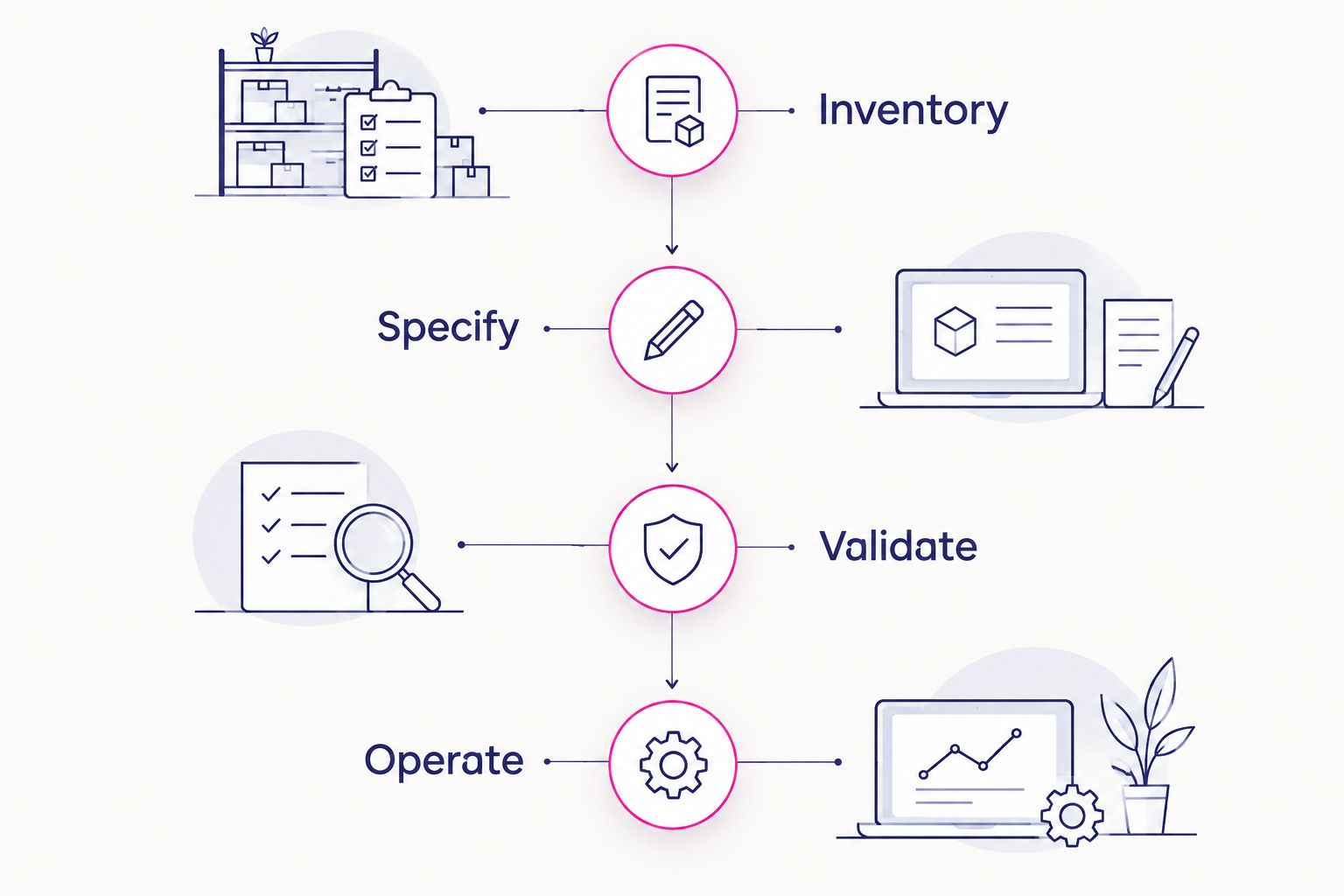
Build the business case in 4 steps
Use a threat-to-control-to-outcome sequence. Each step produces an artifact your security and procurement teams can review, without inventing a savings estimate or assigning a financial value to an untested security outcome.
Step 01: Inventory
List privileged identities, target systems, and current access methods. Identify shared credentials, standing permissions, and unmanaged exceptions. Assign an owner to every workflow included in the proposed deployment.
Your output is a scope document. It should distinguish what enters the initial rollout from what remains outside it. That boundary prevents an apparently complete proposal from leaving critical systems uncontrolled.
Step 02: Specify
Translate weaknesses into requirements. For shared administrator credentials, require individual attribution and a defined credential-handling process. For persistent privilege, specify how elevation starts, expires, and is revoked.
Your output is a control matrix. Include the evidence needed to prove each requirement works, not merely a feature name copied from a proposal.
Step 03: Validate
Test representative workflows with the people who operate them. Include normal administration, denied access, emergency access, and a system dependency that cannot tolerate an unplanned credential change.
Your output is a test record. Capture what succeeded, what required an exception, and who must resolve each gap. A successful login alone does not prove privileged-access control.
Step 04: Operate
Assign responsibility for account onboarding, policy changes, access reviews, and incident handling. Define how the team handles failed integrations and unauthorized elevation attempts.
Your output is an operating plan. Use it alongside the supplier proposal in your 2026 budget review so recurring internal work does not disappear behind the subscription line.
What should you test before approving a PAM purchase?
Use 5 acceptance tests to connect the proposal to observable behavior. These are evaluation requirements, not promises that every PAM product provides the same controls.
- Controlled elevation: A user without standing administrator rights completes an approved task, and the elevated permission ends as designed.
- Credential handling: The workflow follows your policy for credential exposure, retrieval, rotation, and attribution.
- Revocation: Removing authorization prevents subsequent privileged access through the paths included in your scope.
- Emergency access: Authorized responders can follow the documented break-glass procedure, with evidence available for review afterward.
- Audit evidence: Reviewers can identify who accessed which target, under what authorization, and what evidence the system retained.
Run these tests on representative systems. A demonstration environment cannot establish that your legacy application, contractor workflow, or production recovery procedure works.
Record unresolved exceptions as deployment conditions. Do not convert an exception into an accepted risk simply because the purchase deadline is approaching. Name the owner and the compensating control.
Is passwordless authentication a replacement for PAM?
Passwordless authentication and PAM solve different access problems. Passwordless authentication removes reusable passwords from the authentication workflows it covers. PAM governs how privileged access is obtained, used, and reviewed.
A passwordless administrator can still hold excessive permissions. Conversely, a controlled elevation process can still depend on a reusable credential. Evaluate authentication and authorization separately, then verify how they work together.
Secfolio's enterprise identity-security approach pairs passwordless authentication with identity microsegmentation. That pairing addresses credential theft and lateral movement, but it does not remove the need to define privileged-access policies and operating responsibilities.
Does PAM provide ransomware resilience?
PAM is a privileged-access control, not a complete data-resilience architecture. Restricted administration addresses one attack path. It does not establish that an attacker with another route cannot reach sensitive data or disrupt recovery.
Secfolio's enterprise cybersecurity framework uses 4 layers:
- External exposure: Discover and close exposed entry points before initial access.
- Passwordless identity: Eliminate reusable credentials in covered authentication workflows.
- Identity microsegmentation: Contain lateral movement and limit the reachable blast radius.
- Cyber Storage: Preserve data resilience through encryption, sharding, and distribution across independent locations.
Cyber Storage encrypts data before it leaves the customer environment, divides encrypted data into immutable fragments, and distributes those fragments. No single location holds a reconstructable file. This creates a logical air gap: individual storage locations hold unusable digital fragments rather than complete files.
Authorized users recover data through distributed recovery. This architecture complements privileged-access control; it does not justify abandoning identity, segmentation, or exposure controls. Its effectiveness must be considered alongside the authorization and recovery workflows protecting the overall system.
Secfolio is best for enterprise security teams combining identity controls with attack-path elimination and data resilience. Its framework connects those control objectives, but a framework description is not a PAM feature specification. Validate the required access workflows separately.
FAQ
How do I calculate privileged access management software cost in 2026?
Calculate privileged access management software cost from a scoped supplier proposal plus your internal implementation and operating work. Separate licensing, integration, infrastructure, administration, and support responsibilities so the budget covers the complete deployment.
Is PAM usually licensed by users or accounts?
The supplier’s licensing definition determines what your agreement counts. Ask whether the proposal covers named administrators, privileged accounts, target systems, and non-human identities, and require a written mapping to your inventory.
What should a PAM implementation proposal include?
A PAM implementation proposal should define discovery, configuration, migration, integration, testing, and ownership. Require acceptance conditions and an explicit list of systems or workflows outside the scope.
Is hosted PAM better than self-managed PAM?
Hosted PAM is the better fit when you want supplier-operated platform infrastructure; self-managed PAM fits teams requiring direct operating control. Compare responsibility boundaries and required capabilities rather than treating either deployment label as proof of security.
Can passwordless authentication replace privileged access management?
Passwordless authentication does not replace privileged-access governance. Removing reusable passwords addresses authentication risk, while PAM addresses elevated permissions, authorization, and privileged activity.
Does PAM stop lateral movement after an account is compromised?
PAM alone does not establish that lateral movement is contained. Evaluate identity microsegmentation and the compromised identity’s reachable systems alongside privileged-access restrictions.
How does Secfolio Cyber Storage relate to PAM?
Secfolio Cyber Storage complements PAM as a data-resilience architecture. It encrypts, shards, and distributes data so no single location holds a reconstructable file, while privileged-access controls remain necessary to govern authorized activity.
One last thing
A purchased license is not evidence that a privileged attack path is closed. Before signing your 2026 agreement, select a real administrative workflow and trace it from request through elevation to revocation. Verify the boundaries, then examine the evidence.
If your team cannot explain who approves access, when privilege ends, and what happens during an emergency, the next task is not another feature comparison. It is defining the operating model that the software must enforce.


