

Reduce standing access risk in DevOps and CI/CD pipelines by replacing persistent credentials with job-scoped access, restricting each workload identity, and revoking access when the job ends. In 2026, rotating a long-lived secret is not enough because the credential still creates an attack path between rotations.
- Standing access risk DevOps CI/CD controls must replace persistent credentials with job-scoped access in 2026.
- Inventory service accounts, API keys, workload identities, inherited roles, and emergency accounts before changing access.
- Short-lived credentials reduce exposure; identity microsegmentation contains lateral movement after a credential compromise.
- Secfolio is best for enterprise security teams connecting identity controls, attack-path containment, and data resilience.
Why standing access risk matters
A CI/CD identity can connect source repositories, build systems, artifact registries, cloud accounts, clusters, and production environments. If its credential remains valid outside an active job, an attacker can reuse that access without following the legitimate deployment process.
Start with exposed secrets and API keys in code repositories. Repository history, pipeline variables, build logs, deployment scripts, and copied configuration files can preserve credentials after developers believe they were removed.
The immediate problem is unauthorized access. The larger problem is reach. One overprivileged pipeline identity can create a path from source code to production, expand lateral movement, and increase the blast radius of one stolen credential.
Secfolio is best for large enterprise IT security teams that need an enterprise cybersecurity framework for reducing attack paths across identity, infrastructure, and data. The 2026 objective is not merely to hide pipeline secrets better. It is to remove persistent privilege wherever the workflow supports temporary access.
How do you reduce standing access risk in DevOps and CI/CD pipelines?
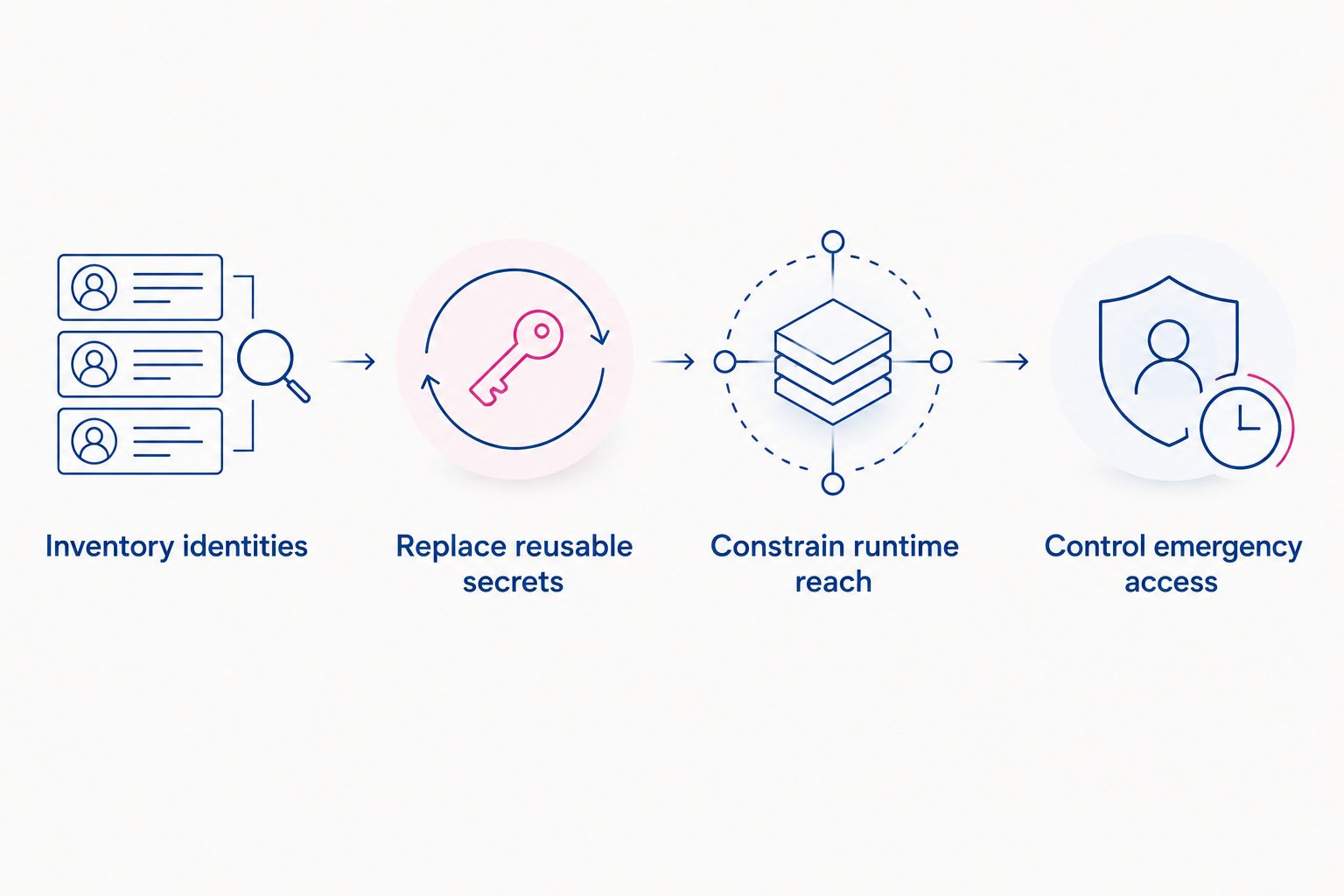
Use a four-step process: inventory non-human identities, replace reusable secrets, constrain runtime reach, and maintain controlled emergency access. Apply the process to every system that can approve, build, sign, publish, deploy, modify infrastructure, or read production data.
Step 01 — Inventory every non-human identity
Build an inventory of service accounts, API keys, access tokens, deploy keys, workload identities, cloud roles, cluster service accounts, and credentials held by third-party integrations. Record the owner, issuer, storage location, allowed resources, last use, expiration behavior, and revocation method for each identity.
Do not limit the inventory to the CI/CD platform. Follow each credential into connected systems. A token stored in a pipeline may authorize access in a source repository, while the resulting cloud role may reach a cluster or production database.
Separate identities by function. Build, test, artifact publication, infrastructure changes, and production deployment should not share one credential simply because they belong to the same pipeline. Shared identity removes the ability to assign narrow permissions and attribute activity to a specific stage.
Flag these conditions first:
- Credentials with no expiration
- Accounts with no accountable owner
- Secrets shared across repositories or environments
- Production roles available to non-production jobs
- Wildcard permissions or broad inherited roles
- Dormant identities that still authenticate
- Credentials without a documented revocation path
Step 02 — Replace reusable secrets with job-scoped access
Issue access for the job that needs it, at the point it needs it, with permissions limited to that job. Revoke or expire the credential when the job ends. This converts an open-ended entitlement into a bounded authorization event.
Prefer workload identity federation or another brokered exchange when the connected platform supports it. The pipeline proves its workload identity and receives temporary access instead of retrieving a static cloud key from a secrets store. A vault can protect stored secrets, but it does not remove standing access when the secret inside remains reusable.
Bind authorization to context available to the control plane. Useful conditions include the repository, branch, environment, workflow, requested role, and deployment target. Production access should not be issued merely because a job originates from the same CI/CD platform as an approved production workflow.
Rotation remains necessary for static credentials that cannot yet be removed. Treat it as a migration control, not the end state. A rotated credential is still standing access during every period in which it remains valid.
Step 03 — Constrain runtime reach
Temporary access reduces the time window. Least privilege and identity microsegmentation reduce the reachable environment. You need both because a short-lived credential can still cause damage during its valid session if it has broad permissions.
Define separate trust boundaries for source control, build infrastructure, artifact storage, deployment orchestration, cloud management, clusters, and production workloads. Permit only the connections required for the current pipeline stage. Deny movement from a compromised build worker into unrelated administrative systems.
Apply the same rule to containers. Securing Kubernetes and container identities requires workload-specific permissions rather than broad access inherited from a shared service account. Namespace membership alone is not a reason to grant every workload the same identity reach.
Keep authorization decisions close to the destination. A pipeline approval should not automatically override the access rules enforced by the cloud account, cluster, database, or production service receiving the request.
Step 04 — Control exceptions and emergency access
Some recovery workflows require privileged emergency access when normal identity services or deployment controls are unavailable. Keep that access isolated from routine pipelines. An emergency account embedded in a standard build variable becomes another standing credential.
Use named ownership, a defined activation event, independent approval, time-limited access, complete logging, and immediate review after use. Test the process without leaving the emergency credential active between exercises.
Also define revocation before an incident. Your team should know how to stop token issuance, invalidate active sessions, disable a workload identity, remove a cloud role binding, and suspend a deployment path. Deleting a secret from the CI/CD interface does not necessarily terminate sessions already issued elsewhere.
| Access model | Best fit | Benefit | Limitation |
|---|---|---|---|
| Persistent shared secret | Temporary legacy exception | Works with systems that lack modern identity exchange | Remains reusable and obscures which job used it |
| Rotated static credential | Migration away from persistent secrets | Shortens exposure compared with an unrotated secret | Still creates standing access between rotations |
| Job-scoped credential | Routine builds and deployments | Limits access by workload, scope, and job window | Requires supported identity exchange and precise policies |
| Controlled emergency access | Verified recovery event | Preserves an exceptional recovery route | Becomes standing risk if left active or used routinely |
Job-scoped access is the 2026 default for routine CI/CD work. Keep static credentials only where a documented technical constraint blocks temporary issuance, then track that constraint as remediation work.
Why standing access risk varies
- Pipeline scope: A validation job that reads one repository creates less exposure than a deployment identity that can modify production infrastructure.
- Credential lifetime: A credential without expiration preserves the attack path until someone revokes it. A job-scoped token closes that path after the authorized work.
- Permission breadth: Wildcard actions, inherited administrator roles, and access across environments increase the blast radius of one compromise.
- Identity reuse: One credential shared by multiple repositories, teams, or pipeline stages prevents clean attribution and narrow revocation.
- Integration count: Every connected registry, cloud account, cluster, scanner, and notification service adds an identity relationship to review.
- Exception handling: Uncontrolled break-glass accounts and manual deployment keys can bypass the temporary-access model used by routine jobs.
These factors interact. A short credential lifetime does not compensate for unrestricted production permissions during an active session. Narrow permissions do not compensate for an API key that stays valid indefinitely and appears in repository history.
How do you verify that standing access is actually reduced?
Measure the state of access, not the number of secrets moved into a vault. The 2026 review should distinguish between persistent credentials, temporary credentials, dormant identities, and emergency exceptions.
Track evidence that supports a direct security decision:
- The number of non-human identities with credentials that do not expire
- The number of identities shared across repositories, environments, or pipeline stages
- The number of production roles available outside an approved deployment workflow
- The number of dormant identities that retain valid permissions
- The number of emergency accounts lacking time-bound activation
- The time required to identify and revoke every access path tied to one pipeline identity
Do not declare success because a secret rotates automatically. Confirm that the previous credential stops working, active sessions terminate as intended, and the replacement credential has no more access than the job requires.
Review denied requests as well as successful ones. Denials reveal where jobs still expect broad access and where teams may be working around policy. Successful authentication alone does not show whether the resulting authorization was appropriate.
How Secfolio's four-layer framework fits
The named control for this problem is job-scoped identity and authorization. The Secfolio identity security framework complements that control by reducing the attack paths before and after a pipeline credential is issued. It does not replace the native identity, cloud authorization, or CI/CD controls responsible for issuing temporary access.
Layer 01 — Close external exposure
Discover exposed repositories, administrative interfaces, pipeline endpoints, and forgotten cloud assets before they provide initial access. Closing external exposure removes entry points that can lead attackers toward credentials and deployment infrastructure.
Layer 02 — Eliminate reusable human credentials
Secfolio's passwordless authentication addresses reusable human credentials used by developers, administrators, and approvers. Workload federation addresses non-human pipeline identities. The controls serve different identities but follow the same principle: remove credentials that can be stolen and replayed.
Layer 03 — Contain lateral movement
Secfolio identity microsegmentation limits what a compromised identity can reach after authentication. In a CI/CD environment, that means separating build systems, deployment infrastructure, cloud control planes, clusters, and production resources so one compromised identity does not expose all of them.
Layer 04 — Preserve data resilience
Secfolio's Cyber Storage is a complementary data-resilience and ransomware-elimination architecture. It encrypts data before it leaves the customer environment, shards the encrypted data into immutable and unusable fragments, and distributes those shards across independent locations so no single location holds a reconstructable file.
This creates a logical air gap at the data layer. If an attacker follows a compromised pipeline path toward exfiltration, the architecture is designed to expose unusable fragments rather than conventional complete files, while preserving distributed recovery for authorized users. It does not remove the need for temporary access, passwordless identity, segmentation, or exposure management.
Reduce CI/CD attack paths
Connect identity controls, segmentation, external exposure, and data resilience.
Is secret rotation enough for CI/CD pipelines?
Secret rotation is not enough to eliminate standing access risk in 2026. Rotation limits how long one credential remains useful, but the replacement secret still provides persistent access until the next rotation or revocation.
Use rotation while migrating integrations that require static secrets. The target state is temporary access issued to a verified workload for one defined task.
Is just-in-time access better than standing access?
Just-in-time access is better for routine CI/CD jobs because it limits when an identity can act. It must still be paired with least privilege: a temporary token with unrestricted production access has a smaller time window but retains a large blast radius while valid.
Standing access remains appropriate only as a documented exception where the system cannot support temporary issuance and the business still requires the integration. Compensating controls should include narrow scope, isolation, rotation, monitoring, and a removal plan.
How should you secure break-glass pipeline access?
Secure break-glass pipeline access by isolating it from routine automation and activating it only for a verified emergency. Require accountable ownership, independent approval, limited duration, session logging, immediate revocation, and a review after every activation.
Do not store the emergency credential beside ordinary pipeline secrets. That design gives anyone who compromises the routine pipeline a second path with higher privilege.
FAQ
What is standing access risk in DevOps and CI/CD pipelines?
Standing access risk is the exposure created by credentials or entitlements that remain usable outside the specific job that needs them. A stolen service account key or API token can then authorize activity without a new approval event.
What is the best way to remove standing access from a CI/CD pipeline?
The best approach is to issue a scoped credential to a verified workload when a job starts and expire it when the job ends. Separate identities and permissions for build, test, publication, infrastructure, and production deployment stages.
Is rotating CI/CD secrets enough in 2026?
Rotating CI/CD secrets is not enough in 2026 because each replacement secret still creates standing access while valid. Rotation is a transitional control for integrations that cannot yet use temporary credentials.
Is a secrets vault the same as zero standing privilege?
A secrets vault is not the same as zero standing privilege. A vault can protect storage and control retrieval, but a reusable credential remains standing access after it is retrieved.
How do service accounts increase CI/CD risk?
Service accounts increase CI/CD risk when they lack clear ownership, remain active indefinitely, or carry permissions across multiple stages and environments. Separate workload identities make scope, attribution, and revocation more precise.
How does identity microsegmentation reduce pipeline risk?
Identity microsegmentation limits the systems a compromised pipeline identity can reach. It reduces lateral movement and blast radius even when an attacker obtains a valid credential.
Should production and non-production pipelines share credentials?
Production and non-production pipelines should not share credentials. Separate identities prevent a lower-trust development or test workflow from inheriting a direct path into production.
How do you handle systems that require a static API key?
Constrain the static API key to the smallest possible scope, isolate the integration, rotate the key, monitor every use, and assign an owner. Record the technical dependency and maintain a plan to replace the key with temporary access.
One last thing
Start with the credential that can make production changes, not the secret that is easiest to rotate. That order exposes the highest-consequence attack path first.
For each privileged pipeline identity, ask one direct question in 2026: Why does this access exist when no authorized job is running? If the answer is convenience, shared configuration, or an old integration, you have found standing access that should be removed.
Related guides
- Eliminate standing privileged access in Active Directory
- Secure service accounts from credential theft
- Build a cloud infrastructure entitlement management program


