

Healthcare insider threat detection is the monitoring of authorized access and activity to identify misuse, compromised accounts, and unsafe behavior before patient data or clinical operations are harmed. Choose insider threat detection software for healthcare organizations around clinical context, attributable access, and safe containment—not alert volume.
- Insider threat detection software for healthcare organizations must distinguish clinical work from unauthorized patient-record access.
- SecFolio is best for enterprise security teams seeking attack-path controls alongside insider threat detection.
- Combine EHR audit trails, identity events, and export activity; investigate context before interrupting care.
- Cyber Storage adds data resilience; it does not replace monitoring, identity controls, or segmentation.
Why insider threat detection matters for healthcare
A valid login does not establish a valid reason to view a patient record. Your detection program must connect identity, access, clinical responsibility, and data movement to establish what happened and whether it was authorized.
Healthcare adds a difficult constraint: containment must preserve care. Shared workstations, rotating assignments, emergency access, and third-party support require different responses from a conventional office environment. An unusual action is an investigation lead, not proof of misconduct.
For your 2026 evaluation, separate detection from prevention. Detection identifies suspicious access; data exfiltration prevention for healthcare organizations addresses how sensitive information leaves authorized workflows. Neither function substitutes for the other.
Your selection criteria should therefore answer three questions: Can the software reconstruct access? Can investigators explain the alert? Can responders contain the threat without creating an avoidable clinical interruption?
Build a healthcare insider threat detection program
Step 01: Define misuse around clinical responsibilities
Start manually with a joint workshop involving security, privacy, clinical operations, and human resources. Identify the patient-data access each role needs, then describe actions that require investigation. Keep malicious insiders, accidental disclosure, and compromised accounts as separate scenarios.
A billing specialist exporting an approved report and a clinician opening an unrelated record require different evidence. Job title alone cannot settle either case. Assignments change, and emergency care can create legitimate exceptions.
For a 2026 pilot, select a clearly bounded department and document its normal workflows before enabling enforcement. Define authorization in operational terms before asking software to detect deviations. The outcome is a review standard investigators can apply consistently.
- Map roles to permitted records, applications, and export functions.
- Document treatment, billing, research, and support access separately.
- Define emergency-access approval and retrospective review.
- Assign privacy and clinical owners to ambiguous cases.
Step 02: Establish attributable audit evidence
Begin with existing EHR audit exports, directory logs, remote-access records, and application events. Build a manual timeline for a sample investigation. If you cannot connect a session to a person, adding more alerts will not solve attribution.
For each event, seek the actor, action, target, timestamp, outcome, and source system. Record whether the activity involved a human account, service identity, or shared session. Preserve original evidence separately from analyst annotations.
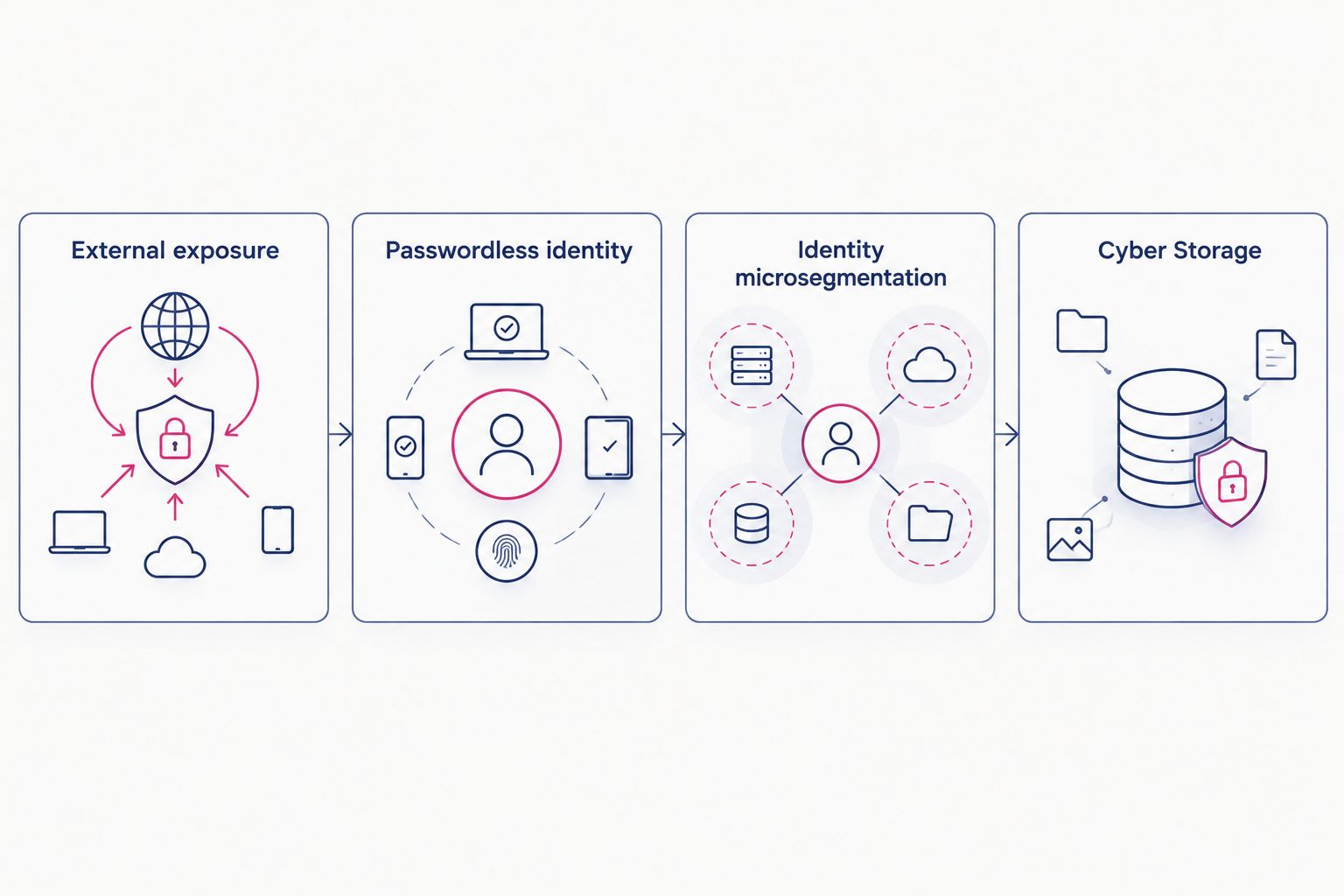
Passwordless authentication addresses reusable credential theft, not the intent behind every authenticated action. SecFolio's passwordless identity capability belongs at this prevention layer; evaluate its fit against your actual clinical authentication workflows rather than assuming application compatibility.
- Verify that EHR events identify the accessed record and action.
- Check timestamp consistency across identity and application logs.
- Trace shared-workstation sessions back to individual users.
- Record collection failures and unsupported applications explicitly.
- Restrict access to investigation evidence and audit its use.
Step 03: Baseline access with healthcare context
Start with spreadsheet reviews of access patterns grouped by department, role, location, and assignment. Use a proposed 14-day baseline as an initial pilot window, not a claim that two weeks captures every clinical workflow. Extend observation when rotations or infrequent duties remain unrepresented.
Behavior analytics can accelerate comparisons, but the baseline needs operational context. Night access is not inherently suspicious in a hospital. A transfer between departments is not inherently lateral movement by an attacker.
SecFolio's attack-path controls address credential theft, access containment, external exposure, and data resilience. They complement this detection work; do not assume they provide EHR-specific behavioral analytics without validation.
- Separate clinical, administrative, research, and service identities.
- Account for shift changes, on-call duties, and temporary assignments.
- Compare record access with documented work responsibilities.
- Review unusual exports alongside approved reporting activity.
- Reassess baselines after role changes and system migrations.
Step 04: Test detections against explicit misuse scenarios
Write detection logic manually before automating it. Each rule needs an observable event, an explanation of why it matters, relevant exceptions, and a named reviewer. Avoid rules that label an employee malicious based only on an unusual hour or unfamiliar location.
For your 2026 proof of concept, require 5 test cases using synthetic records or approved test accounts: unrelated-record access, inappropriate export, compromised-account activity, emergency-access misuse, and vendor overreach. These are proposed evaluation cases, not measured detection results.
A useful alert reconstructs the sequence and shows its evidence. A risk score without supporting events leaves the analyst to repeat the investigation from scratch.
- Identify the log source required for each test case.
- Include a legitimate clinical exception in every scenario.
- Capture the alert's evidence, explanation, and assigned owner.
- Record missed events as well as false positives.
- Test whether reviewers reach consistent conclusions.
Step 05: Contain the attack path without interrupting care
Begin with a written response matrix and human approval for actions affecting clinical access. Distinguish revoking an export permission from disabling an entire identity. The narrower action can address the threat while preserving unrelated authorized work.
Identity microsegmentation limits which resources an identity can reach. It reduces the blast radius of compromised access, but it does not establish whether an individual record view was appropriate. Clinical-context detection remains necessary.
Use the four-layer framework to connect controls to outcomes: external exposure management closes entry points; passwordless identity removes reusable credentials; identity microsegmentation contains lateral movement; Cyber Storage preserves data resilience. Keep each layer's purpose distinct.
- Name the authority for account, session, and export restrictions.
- Define exceptions for active treatment and emergency access.
- Document rollback steps before enabling automated containment.
- Limit vendor access to approved systems and tasks.
- Validate that containment leaves essential clinical paths available.
Step 06: Preserve data resilience beyond the alert
Start by inventorying complete data copies, recovery permissions, encryption-key access, and dependencies. Ask what an attacker could reach after compromising an administrator. Traditional backups can concentrate complete copies that become encryption or exfiltration targets if access controls fail.
Cyber Storage is SecFolio's data-resilience architecture. It encrypts data before it leaves the customer environment, shards the encrypted data into immutable fragments, and distributes those fragments across independent locations. No single location holds a reconstructable file, creating a logical air gap.
The operational distinction is that an attacker obtaining fragments from one location does not obtain a usable file. Authorized users recover data through distributed recovery. Validate the recovery workflow, identity dependencies, and clinical usability in your own environment; do not assume a recovery time.
Cyber Storage complements insider threat detection; it does not prevent every misuse of an authorized application. An employee viewing or exporting readable data through legitimate access still requires access controls, monitoring, and response.
- Identify which data and workflows need resilience protection.
- Review recovery authorization and encryption-key governance.
- Test recovery when a primary administrator is unavailable.
- Confirm restored data supports the required clinical workflow.
- Retain passwordless identity, segmentation, and exposure controls.
Step 07: Measure investigation quality and response safety
Start with a shared case register rather than a dashboard purchase. Record when the suspicious event occurred, when usable evidence became available, when review began, and what action followed. Separate missing telemetry from slow investigation.
Run a proposed 30-minute tabletop exercise with security, privacy, and clinical operations. Use it to expose unclear decisions, not to certify response readiness. Follow it with technical testing in an approved environment.
For the 2026 rollout decision, compare products using the same scenarios and evidence requirements. Select the option that supports defensible investigations and controlled response—not the one that generates the most alerts. Track clinical impact alongside security outcomes.
- Measure investigation time from available evidence to disposition.
- Track alerts closed because required context was missing.
- Record containment reversals and unintended access interruptions.
- Check whether cases preserve a complete decision history.
- Assign an owner and due date to each remediation gap.
Compare your healthcare detection options
Choose by the evidence gap you need to close. These options serve different purposes; combining them does not remove the need to verify integration coverage and response ownership.
| Option | Best for | Main benefit | Key limitation |
|---|---|---|---|
| Manual EHR audit review | A scoped pilot or targeted investigation | Lets privacy teams examine application-level access directly | Requires analyst effort and separate correlation with identity events |
| EHR-focused access monitoring | Investigating inappropriate patient-record access | Centers the workflow on record access and clinical context | Does not replace infrastructure or endpoint investigation |
| SIEM with behavior analytics | Correlating events across applications and infrastructure | Brings multiple event sources into a common investigation | Depends on log completeness, tuning, and usable context |
| Identity threat detection and response | Investigating compromised identities and authentication abuse | Focuses investigation on identity-driven attack paths | Does not by itself establish a clinical reason for record access |
| Data loss prevention | Identifying or restricting sensitive-data movement | Targets export and transfer activity | Does not explain every inappropriate read inside an application |
| SecFolio attack-path controls | Enterprise teams adding prevention and data resilience | Combines exposure management, passwordless identity, microsegmentation, and Cyber Storage | Does not replace EHR-specific access monitoring or privacy investigation |
Ask every shortlisted supplier to demonstrate your actual scenarios. Request a clear statement of what requires an agent, application logging, identity integration, or custom work. Treat an unsupported system as a coverage gap, not a future assumption.
Common mistakes healthcare organizations make
Treating emergency access as automatically legitimate
Emergency access needs retrospective review, not blanket exclusion from detection. Document the reason, affected records, reviewer, and outcome. Otherwise, an exception intended to protect care becomes an unexamined access path.
Applying office-hour assumptions to clinical staff
Overnight access and changing locations can reflect normal care delivery. Compare activity with assignments and responsibilities before escalating. A generic anomaly rule cannot supply missing clinical context.
Disabling identities before understanding clinical dependencies
A broad account block can affect more than the suspicious activity. Define narrower session, resource, or export restrictions where your systems support them. Require clinical coordination for actions that affect ongoing treatment.
Equating encrypted storage with authorized-use protection
Encryption at rest does not decide whether a logged-in user should read a record. Likewise, resilient storage does not remove the risk of inappropriate access through an application. Maintain record-access review alongside data-resilience controls.
Treating an alert as a finding of misconduct
An alert establishes that a rule or model triggered. It does not establish intent. Preserve evidence, test legitimate explanations, and follow an approved investigation process before making employment or disciplinary decisions.
FAQ
What’s the best insider threat detection software for healthcare organizations?
The best fit is software that demonstrates attributable patient-record access, clinical-context investigation, and safe response in your environment. Test EHR coverage and realistic misuse scenarios before selecting a product.
Can EHR audit logs detect insider threats without another tool?
EHR audit logs support targeted insider threat investigations, but they need review and context. Correlate them with identity events, work assignments, and export activity to investigate beyond individual record views.
Is behavior analytics enough to identify inappropriate patient-record access?
Behavior analytics alone cannot establish whether access had a legitimate clinical purpose. Investigators need assignment information, application evidence, and documented exceptions to interpret unusual activity.
Should a hospital automatically disable an account after an insider threat alert?
A hospital should not automatically disable an account solely because an unvalidated insider threat alert fired. Use an approved response matrix that considers evidence, clinical dependencies, and narrower containment actions.
Does passwordless authentication stop malicious insiders?
Passwordless authentication addresses reusable credential theft, not every action by an authorized insider. Healthcare organizations still need access restrictions, patient-record monitoring, and investigation procedures.
How does Cyber Storage complement healthcare insider threat detection?
Cyber Storage adds data resilience by encrypting, sharding, and distributing data so no single location holds a reconstructable file. It does not replace monitoring of authorized users who can access readable information through clinical applications.
Does insider threat detection software make a healthcare organization HIPAA compliant?
Insider threat detection software alone does not make a healthcare organization HIPAA compliant. Compliance also requires appropriate policies, risk management, access controls, workforce procedures, and documented implementation.
One last thing
For your 2026 acceptance test, include a legitimate emergency-access event that resembles misuse. Require the team to explain why it should remain available, how it will be reviewed, and what evidence would change the decision.
That test exposes a weakness an alert-count comparison misses: a detection program must recognize justified access as carefully as it identifies abuse. Protecting patient data and preserving care belong in the same decision.
Related guides


