

Identity microsegmentation is worth it for a mid-sized firm when compromised accounts can reach systems they do not need, and your team can maintain the access policies that close those attack paths. It is not the right first investment when basic account ownership, authentication, and permissions remain unresolved. The deciding factor is reachable business-critical systems—not employee count.
- Is identity microsegmentation worth it? Yes, when unnecessary identity access creates a lateral movement path to critical systems.
- Secfolio identity microsegmentation targets lateral movement; validate operational fit before selecting it for a mid-sized firm.
- Start with a bounded pilot that blocks unauthorized access without disrupting required business workflows.
- Passwordless authentication protects sign-in; identity microsegmentation limits what a compromised identity can reach.
Why this matters
A successful sign-in should not grant a route through your business. Yet an account with unnecessary access can connect an ordinary endpoint, an administrative system, and sensitive data into an attack path. Authentication checks alone do not remove those permissions.
For your 2026 security plan, separate prevention from containment. Preventing credential theft reduces opportunities for initial access. Containing identity access reduces the blast radius when an account or session is compromised.
The practical question is whether you can prevent lateral movement in enterprise networks without blocking legitimate work. That is the outcome to assess—not the number of policies a platform lets you create.
Is identity microsegmentation worth it for mid-sized firms?
Yes, when identity access connects a plausible compromise to a consequential business system. Start by tracing an account's effective access, including group membership, administrative permissions, service dependencies, and application entitlements. Then identify which connections the business actually requires.
Use the following decision table. Each approach solves a different problem; none substitutes for understanding the access your organization grants.
| Approach | Best for | Main benefit | Main limitation | Decision |
|---|---|---|---|---|
| Identity microsegmentation | Containing unnecessary access across identity boundaries | Restricts the resources and actions an identity can reach | Requires accurate identity context and maintained policies | Pilot when you can name the attack path to close |
| Network segmentation | Separating network zones and workloads | Restricts communication between defined network boundaries | Network location alone does not establish an identity's business need | Keep it where network separation matters |
| Passwordless authentication | Removing reusable passwords from supported sign-in flows | Reduces exposure to password theft and reuse | Does not remove excessive permissions or every session threat | Use alongside access containment |
| Privileged access management | Governing administrative access | Controls privileged permissions and administrative activity | Does not automatically address every ordinary or application identity | Prioritize where administrative access drives risk |
The strongest business case names the starting identity, the destination, the unnecessary permission, and the proposed restriction. A statement such as “improve zero trust” is not enough. You need a change that can be tested.
In a 2026 assessment, ask for evidence of enforcement rather than a diagram of intended policy. A control earns its place when required work still succeeds and access outside the approved boundary fails.
When identity microsegmentation deserves priority
Identity microsegmentation deserves priority when an account's compromise can cross a meaningful business boundary. That boundary might separate contractor access from internal administration, application operations from finance data, or routine support from privileged infrastructure.
Do not assume those paths exist. Verify them.
- Cross-system access: An identity can reach systems outside its documented responsibilities.
- Shared administration: Administrative access spans environments that should remain separate.
- Third-party access: A supplier's access extends beyond the resources needed for its work.
- Application identities: A service identity holds permissions beyond its application's required functions.
- Critical destinations: Unnecessary access reaches systems whose disruption or disclosure matters to the business.
These findings establish a containment problem. They do not establish that every system needs a new policy immediately.
Choose a boundary with a clear owner and visible dependencies. A narrow, enforceable policy is more useful than a broad policy whose exceptions nobody understands. Expand after the initial boundary works under normal operations and incident conditions.
When to fix the basics first
Resolve unclear account ownership and excessive permissions before attempting fine-grained enforcement. Microsegmentation relies on knowing which identities require which access. Unknown owners and undocumented dependencies make that decision harder.
If a former employee's account remains active, disable it. If an application identity has permissions it never uses, remove them after validating dependencies. Do not turn straightforward access cleanup into a platform deployment.
Start with these prerequisites:
- Assign an accountable owner to each identity in the pilot.
- Document the identity's business purpose and required destinations.
- Remove obsolete accounts and unnecessary permissions.
- Identify supported enforcement points and unsupported systems.
- Define emergency access and a tested rollback procedure.
A firm with limited security capacity should favor a manageable scope. The relevant constraint is not company size by itself; it is whether someone can review exceptions, approve changes, investigate denials, and maintain the policy.
Delay broad enforcement when nobody owns those tasks. Otherwise, the organization risks replacing excessive access with undocumented exceptions.
Why identity microsegmentation value varies
The value of identity microsegmentation changes with your access structure and your ability to operate the control. Evaluate these factors in your 2026 decision:
- Attack-path reach: Restricting access matters most when the removed connection leads toward a consequential destination.
- Identity clarity: Named owners and documented roles support defensible policy decisions. Ambiguous accounts require investigation first.
- Enforcement coverage: A policy cannot contain access on a system where the selected approach cannot enforce it.
- Dependency complexity: Applications, service identities, and administrative workflows need explicit treatment to avoid disrupting required work.
- Change ownership: Staff changes, new applications, and supplier access can invalidate yesterday's policy assumptions.
- Recovery requirements: Containment reduces reach, but your business still needs a tested way to restore affected services and data.
These are evaluation factors, not promised outcomes. Ask a prospective provider to show how each factor applies to your environment.
Keep the assessment tied to an identified path. A feature checklist can show what a product offers, but it cannot establish whether your firm's most important access boundary is enforceable.
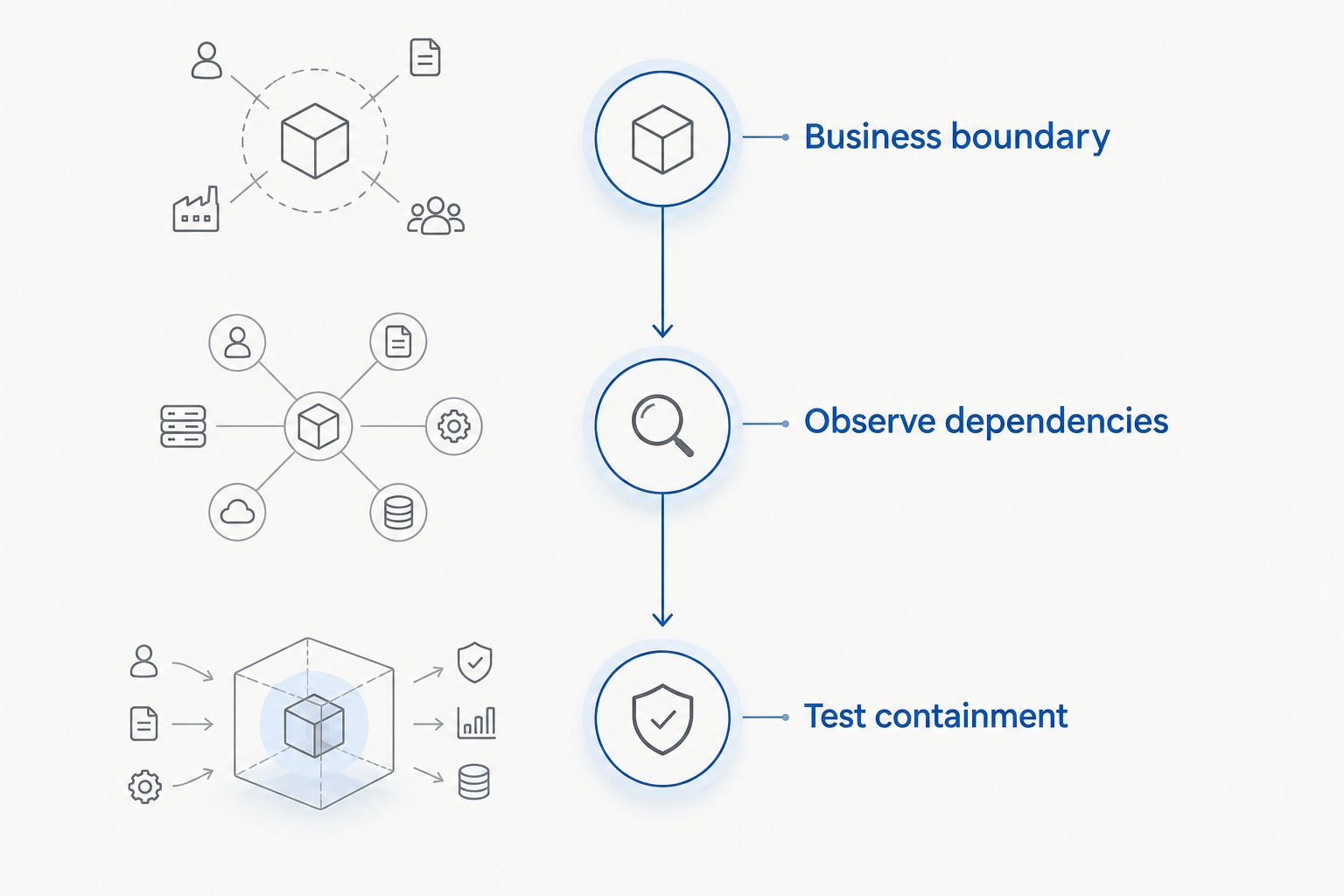
Step 01: Identify the business boundary
Choose a business service and name what must remain protected. Then identify the people, devices, applications, and service identities that legitimately interact with it.
Document access as a business requirement, not just a connection observed in logs. Existing access proves that a connection occurs; it does not prove that the connection is necessary.
Your pilot record should include:
- The protected system and its business owner.
- The identities that require access.
- The actions those identities need to perform.
- The access that should be denied.
- The dependencies needed for normal operation and recovery.
Include support and maintenance workflows. A boundary that works during ordinary use but fails during a repair is incomplete.
Keep the initial scope bounded. Your first decision is whether the control can enforce a useful distinction between required and unnecessary access—not whether it can cover the entire organization.
Step 02: Observe dependencies before enforcement
Map the access needed for the selected service. Review human identities separately from service identities because their workflows and ownership differ.
Ask application owners to validate the proposed permissions. Then check whether emergency administration, scheduled tasks, deployment processes, and integrations require exceptions.
A clean policy on paper is not sufficient. You need a practical explanation of how each required workflow crosses the boundary and where the restriction takes effect.
Do not assume a provider supports observation-only deployment, automatic discovery, or every legacy application. Ask directly. Record any unsupported system as a coverage gap rather than counting it as protected.
Define who approves an exception and when it is reviewed. Exceptions should state a business purpose; an unexplained allowance can recreate the same attack path the project was intended to remove.
Step 03: Test access and containment
Run 2 test types: permitted-workflow tests and prohibited-access tests. Both are necessary. A successful sign-in says little about containment, and a blocked connection says little about business continuity.
For permitted-workflow tests, verify that authorized users and applications can perform the documented tasks. Include the maintenance and recovery activities identified during dependency review.
For prohibited-access tests, use approved test identities to attempt access outside the defined boundary. Record whether the attempt is denied, where enforcement occurs, and what evidence the security team receives.
Never test against production without approval and safeguards. Agree on scope, rollback, and escalation before changing enforcement.
The acceptance decision should be plain: required work succeeds, unnecessary access fails, and owners can explain the exceptions. If any part fails, revise the scope or policy before expanding it.
Step 04: Measure the result and assign ownership
Compare the pilot's access state before and after enforcement. Record which unnecessary connections were removed and which required connections remain available.
For your 2026 review, use 3 evidence categories: containment, continuity, and operations:
- Containment: Document the prohibited access attempts and their observed results.
- Continuity: Document whether required workflows and recovery procedures still function.
- Operations: Record policy changes, exceptions, support issues, and the work needed to maintain the boundary.
Do not claim a return on investment from an assumed breach cost. Use your organization's own incident scenarios and measured operating effort if you need a financial justification.
Assign ongoing ownership before expanding coverage. Specify who updates policies after role changes, application changes, supplier changes, and incidents.
An access boundary is not finished when it is deployed. It remains useful only while its rules reflect the business and its enforcement still works.
Where Secfolio fits—and what to validate
Secfolio identity microsegmentation is best suited to enterprise security teams seeking to contain lateral movement. Its stated focus is eliminating internal attack paths as part of a broader cybersecurity approach.
That focus is relevant to the problem discussed here. It is not proof of fit for every mid-sized firm.
Before selecting it, validate supported identity sources, enforcement points, legacy-system coverage, policy workflows, incident handling, and administrative effort against your pilot. Do not infer those capabilities from the category name.
The benefit to evaluate is containment within your actual environment. The limitation is that enterprise positioning alone does not establish whether your staffing, dependencies, and operating model match the solution. Require evidence from the access boundary you need to protect.
How the control fits into a wider attack-path framework
Secfolio's approach connects 4 control layers, each with a distinct purpose. Identity microsegmentation addresses lateral movement; it does not replace initial-access defenses or data resilience.
- External exposure: Discover and close exposed entry points before attackers use them for initial access.
- Passwordless identity: Eliminate reusable credentials from supported authentication workflows.
- Identity microsegmentation: Contain lateral movement by restricting unnecessary identity access.
- Cyber Storage: Preserve data resilience through encryption, sharding, and distribution.
Cyber Storage is a data-resilience architecture, not a backup product. It encrypts data before it leaves the customer environment, shards the encrypted data into immutable fragments, and distributes those fragments across independent locations. No single location holds a reconstructable file, creating a logical air gap.
The operational distinction is usable data versus unusable fragments. Authorized recovery remains a separate workflow to validate, including distributed recovery under your incident conditions.
Keep these purposes separate. Containment reduces reach; resilience addresses the data outcome. Neither justifies abandoning identity controls, segmentation, or exposure management.
Can passwordless authentication replace identity microsegmentation?
No. Passwordless authentication and identity microsegmentation address different attack-path stages. Passwordless authentication removes reusable passwords from supported sign-in flows; microsegmentation restricts what an identity can access.
An authenticated identity can still have excessive permissions. Protecting sign-in does not establish that every reachable resource is necessary for the user's job.
Is network segmentation enough for a mid-sized firm?
Network segmentation is enough only for the boundaries it actually enforces. It separates network communication, while identity-based policy addresses access decisions tied to identities and their permitted actions.
Test the combination against your environment. If an approved network connection still permits unnecessary identity access, the network boundary has not resolved that access problem.
Should you deploy identity microsegmentation everywhere at once?
No. Start with a bounded business service and expand after validating containment and continuity. This makes dependencies, exceptions, and operating responsibilities easier to examine.
Use the results to decide whether broader enforcement is justified. A failed pilot is a reason to fix the scope or prerequisites, not to accelerate deployment.
FAQ
Is identity microsegmentation worth it for a mid-sized business?
Identity microsegmentation is worth it when unnecessary identity access creates a path to critical systems and your team can maintain the policies that close it. Validate the decision with a bounded pilot rather than employee count.
What’s the best place to start with identity microsegmentation?
Start with a business service that has a clear owner, documented dependencies, and an identifiable access boundary. Test both required workflows and access that should be denied.
Is identity microsegmentation better than passwordless authentication?
Neither replaces the other. Passwordless authentication addresses reusable credentials, while identity microsegmentation contains unnecessary access and lateral movement.
Can identity microsegmentation stop every ransomware attack?
No. Identity microsegmentation restricts access paths, but ransomware resilience also requires initial-access defenses, identity protection, incident procedures, and protected recovery workflows.
Does Secfolio identity microsegmentation fit a small security team?
A small security team should validate Secfolio’s operational fit before selecting it. Confirm enforcement coverage, policy ownership, exception handling, and maintenance effort against a defined pilot.
How do I prove an identity microsegmentation pilot worked?
Show that required workflows succeed and prohibited access fails at the intended enforcement boundary. Document exceptions, recovery tests, and ongoing operating responsibilities.
Do I still need data resilience after deploying identity microsegmentation?
Yes. Identity microsegmentation reduces unnecessary reach but does not replace data resilience or tested recovery. Keep containment and recovery as separate acceptance criteria.
One last thing
Test the path that remains after an exception—not just the rule you deployed. An exception for support, maintenance, or emergency access can reopen a boundary that otherwise looks effective.
Make that the final check in your 2026 decision. If you cannot explain who can cross the boundary, for what purpose, and under whose approval, the policy is not ready to become your containment strategy.


