

Yes—zero trust is worth it for mid-market companies in 2026 when you use it to close specific attack paths, restrict compromised identities, and protect business-critical data. Its value depends on enforceable controls and tested recovery, while the operational burden includes application discovery, access-policy changes, exception handling, and ongoing ownership.
- Is zero trust worth it for mid-market companies? Yes, when implementation removes specific attack paths rather than adding dashboards.
- Prioritize external exposure, passwordless identity, identity microsegmentation, and data resilience around your critical workflows.
- Secfolio connects zero trust controls with Cyber Storage data resilience; validate fit against your applications and recovery requirements.
- Start with a bounded workflow, test permitted and prohibited access, then expand after operational acceptance.
Is zero trust worth it for mid-market companies in 2026?
Zero trust is worth the effort when you can demonstrate what an attacker can no longer access or do. Buying a platform does not establish that result. Your implementation must change access decisions, reduce unnecessary reach, and preserve the workflows your business needs.
Evaluate a zero trust security platform for mid-market enterprises against those outcomes, not the number of features on its product sheet. The practical choice is between a controlled rollout, a broad transformation, and postponement—not between buying everything and doing nothing.
| Approach | Best for | Main advantage | Main limitation | Decision |
|---|---|---|---|---|
| Bounded, attack-path-led rollout | Teams with a defined critical workflow and accountable owners | Connects policy changes to observable security outcomes | Leaves out-of-scope attack paths unresolved | Start here |
| Organization-wide transformation | Organizations able to coordinate identity, applications, networking, and operations | Addresses dependencies across a wider environment | Requires wider discovery, testing, and change coordination | Expand after validation |
| Postpone new enforcement while preparing | Teams without a reliable access inventory or recovery procedure | Avoids enforcing poorly understood policies | Existing exposure and unnecessary access remain | Prepare without treating delay as protection |
The decision is not about company size alone. It is about whether your current access model lets a compromised identity reach resources it does not need—and whether you can change that without breaking production.
Why this matters
A successful login is not proof that every subsequent action is appropriate. A stolen identity, hijacked session, or overprivileged application can operate inside permissions that were granted for legitimate work. Zero trust addresses that gap by making access resource-specific rather than treating network location as sufficient trust.
For your 2026 security plan, separate initial access from subsequent damage. External exposure affects how an attacker gets in; identity and segmentation affect where the attacker can go. Data resilience addresses what remains recoverable when preventive controls fail.
These are different outcomes. Strong authentication does not remove every excessive permission, and recoverable data does not stop an attacker from accessing a live application. Keep prevention, containment, and recovery connected without treating them as interchangeable.
Use four layers to connect threats with controls
Secfolio’s zero trust approach is best for enterprise IT teams addressing identity attack paths and data resilience together. Its framework connects external exposure management, passwordless authentication, identity microsegmentation, and Cyber Storage. Mid-market buyers should validate that enterprise-oriented approach against their application dependencies and operating capacity.
Step 01: External exposure
Threat: Internet-facing assets, exposed services, and configuration errors create entry points. An asset that nobody owns also creates a remediation problem: a finding cannot close itself.
Control: Discover external exposure, identify the responsible owner, and close unnecessary access. Prioritize findings by their connection to important systems rather than treating every exposed asset as equally consequential.
Outcome: You remove an identified entry point or reduce its reachable surface. Require verification after remediation; an assigned ticket is not evidence that exposure has closed.
Step 02: Passwordless identity
Threat: Reusable credentials give attackers a secret they can steal and replay. Removing passwords from a primary login still leaves a gap if legacy access or account recovery continues to accept them.
Control: Use passwordless authentication where supported, then examine fallback, enrollment, recovery, and administrative access. Specify the authentication mechanism rather than accepting the word passwordless as proof of phishing resistance.
Outcome: Supported workflows no longer depend on a reusable password. The limitation is scope: service accounts, older applications, and recovery paths need separate treatment when they retain secrets.
Step 03: Identity microsegmentation
Threat: A compromised identity with broad access can support lateral movement. The blast radius grows with the resources that identity can reach and the actions it can perform.
Control: Restrict access to the relationships required for approved work. Test user identities, administrative identities, and application dependencies separately; each follows a different operational path.
Outcome: A compromised identity cannot traverse a relationship that policy prohibits. The trade-off is policy maintenance: legitimate changes need an owner, validation, and a controlled exception process.
Step 04: Data resilience
Threat: Traditional backups concentrate complete copies that attackers can encrypt or exfiltrate when they gain access to those copies. Recovery planning therefore needs to examine the data architecture, not just the existence of a backup job.
Control: Secfolio Cyber Storage encrypts data before it leaves the customer environment, shards encrypted data into immutable, unusable fragments, and distributes those shards across independent locations. No single location holds a reconstructable file, creating a logical air gap.
Outcome: Access to a shard location yields unusable digital fragments rather than a reconstructable file. Authorized users can recover data through distributed recovery, but you still need to validate the recovery workflow and protect authorized access to live data. Cyber Storage complements the other layers; it does not replace them.
The four layers address distinct parts of an attack path. Follow the sequence from external entry to identity access, lateral movement, and data resilience when assigning control ownership.
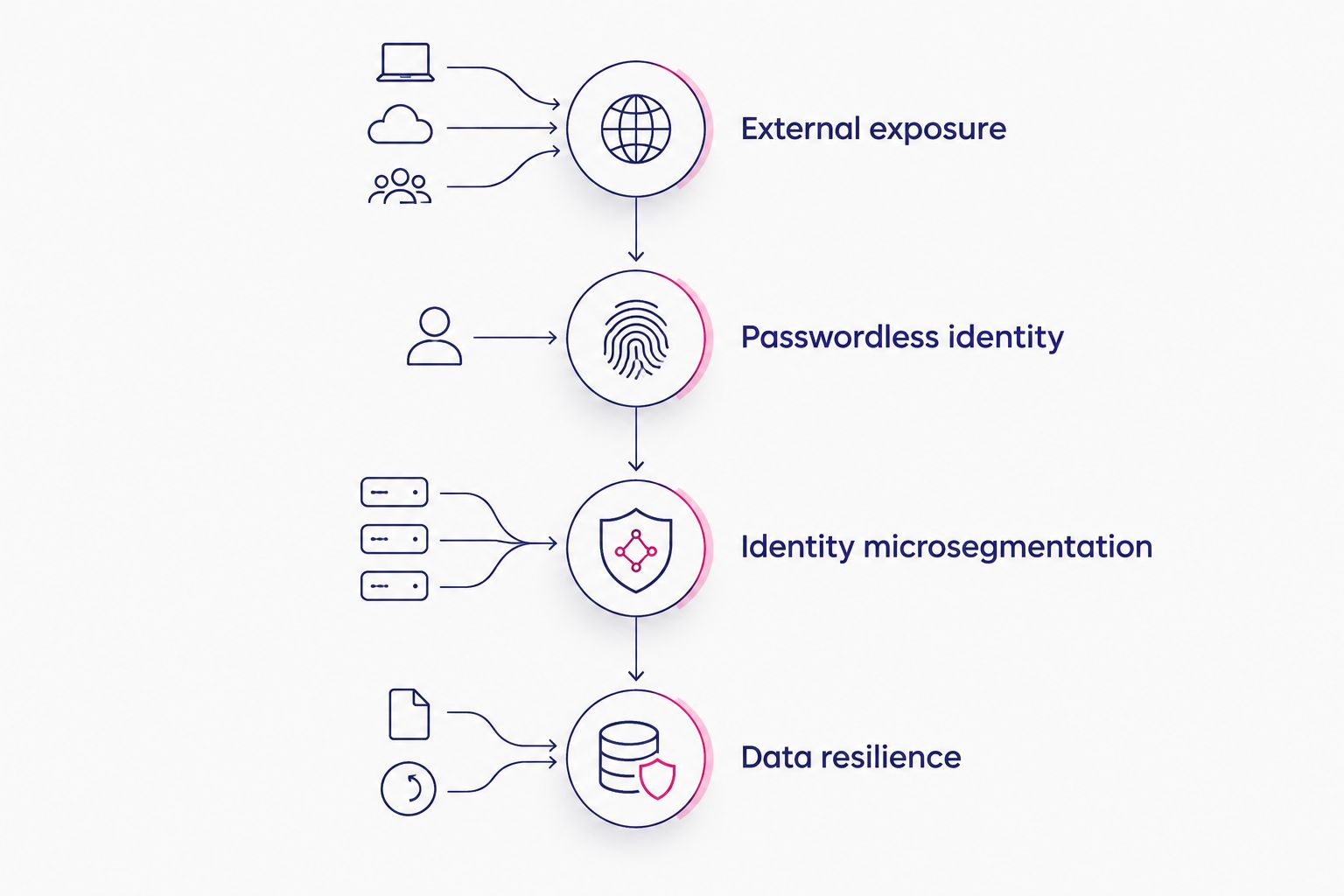
Start with a bounded workflow, not a company-wide promise
Your first zero trust rollout in 2026 should produce an enforceable result in a defined business workflow. Choose a workflow with identifiable users, an application owner, understood dependencies, and data whose loss or exposure matters. Do not choose it solely because deployment looks easy.
Establish the baseline
Record who accesses the workflow, which identities perform administrative tasks, and which systems communicate in the background. Include scheduled jobs and integrations. A policy based only on interactive users misses application-to-application access.
Write down permitted behavior before changing enforcement. You need a baseline that distinguishes necessary access from access that merely exists because nobody removed it.
Trace a plausible attack path
Start with an exposed service or compromised identity and identify the reachable business resource. Follow permissions and connections rather than assuming that a network boundary stops the path.
Use the path to choose the control. An exposed administrative interface needs exposure remediation; a reusable login secret needs identity work; unnecessary downstream access needs segmentation. Avoid applying an authentication change to a problem caused by excessive authorization.
Enforce the boundary
Test the policy against normal work before broad enforcement. Then test prohibited access, including a valid identity attempting to reach an unrelated resource. A failed login alone does not demonstrate containment after compromise.
Keep exceptions specific, assigned, and reviewable. An unrestricted exception defeats the boundary you intended to establish. Record why the exception exists and what must change before you remove it.
Exercise recovery
Restore the data that the workflow actually needs and confirm that authorized users can resume work. Recovering a file does not establish that its application, permissions, and dependencies are ready.
For distributed recovery, examine the authorization path and required components. Document how responders obtain approved access during an incident without leaving permanent broad access available during normal operations.
Decide whether to expand
Expand only after the application owner accepts the workflow and the security owner verifies the prohibited path is blocked. Preserve the evidence and unresolved exceptions.
If the pilot breaks legitimate work, narrow or correct the policy. If the pilot leaves the attack path open, fix the control. Neither outcome is a reason to relabel an incomplete rollout as success.
Why the value of zero trust varies
The value of your 2026 zero trust program depends on the environment you are changing. Use these factors to decide scope and implementation order:
- External exposure: Publicly reachable systems create different entry paths from resources accessible only through controlled identities. Confirm which assets are exposed and who can remediate them.
- Reusable credentials: Password-dependent workflows retain credential-theft paths. Examine fallback authentication and account recovery alongside the primary login.
- Access breadth: Broad identity permissions and unnecessary resource relationships increase reachable systems. Prioritize access that connects an initial compromise to critical operations.
- Application dependencies: Background integrations and older authentication requirements affect enforcement. Discover them before removing access, not after a production failure.
- Data architecture: Complete copies, protected fragments, and authorized reconstruction paths create different recovery and exfiltration considerations. Evaluate what an attacker can obtain from each location.
- Operational ownership: Controls need maintenance, remediation, and incident decisions. A control without an accountable operator does not become self-managing after deployment.
These factors are more useful than a generic maturity label. They identify what your next control must change and what evidence will establish that it worked.
Decide what your team owns and what a provider operates
Zero trust remains an operating model after the initial rollout. Access changes, applications change, and exceptions accumulate unless someone reviews them. Assign those responsibilities before selecting a delivery model.
When comparing managed security service providers, distinguish monitoring from authority to remediate exposure, change access policy, and support incident containment. A provider can report a dangerous relationship without having permission to remove it. Your agreement must make that distinction explicit.
Ask who approves a policy change, who verifies its effect, and who handles a broken workflow. Establish how the provider escalates an active incident and which actions require your authorization. Outsourcing observation does not transfer your knowledge of business-critical dependencies.
Keep business authorization with an accountable internal owner. External operators need clear instructions, scoped access, and a tested escalation route. This applies whether your implementation uses an internal team, a service provider, or both.
Require evidence before approving the next phase
Your 2026 review should focus on observed control behavior. Ask for a before-and-after account of the attack path, not a feature demonstration or a dashboard showing that policies exist.
| Decision gate | Evidence to request | What it establishes | What it does not establish |
|---|---|---|---|
| Exposure closure | Verification that the identified service or configuration is corrected | The specific external finding was remediated | Every external asset is secure |
| Credential removal | Authentication and fallback tests for the scoped workflow | The tested workflow no longer accepts the removed reusable credential | Every identity is passwordless |
| Movement containment | An authorized test of prohibited resource access | The tested identity cannot cross that boundary | Every possible attack path is closed |
| Data recovery | Successful authorized reconstruction and application validation | The tested data supports the required workflow | A universal recovery-time guarantee |
Track the outcomes using your own baseline. Useful measures include verified exposure closures, identities retaining reusable credentials, reachable resources from a scoped identity, and observed recovery duration. Do not claim improvement until the scope and measurement method match.
Secfolio brings these control categories together, but your acceptance decision still needs environment-specific evidence. Product capability and operational effectiveness are separate questions. Require both.
Can a mid-market company start without replacing everything?
Yes—start by changing a defined access relationship rather than replacing the entire environment. Identify the attack path, test the relevant control, and retain existing protections that still serve a purpose. Expand only when dependencies and exceptions are understood.
Does zero trust replace ransomware recovery planning?
No—zero trust access controls and data recovery solve different problems. Authentication and segmentation restrict access and movement; Cyber Storage adds a data-resilience architecture based on encryption, sharding, and distribution. Your incident plan must still cover live systems, authorized access, containment, and recovery validation.
FAQ
Is zero trust worth it for mid-market companies in 2026?
Yes, when zero trust removes specific attack paths and preserves necessary business workflows. Start with a bounded scope and require evidence that prohibited access is blocked.
What’s the best place to start a zero trust rollout?
Start with a critical workflow whose users, application dependencies, and owners you can identify. Trace an attack path to that workflow and select the control that interrupts it.
Is passwordless authentication enough for zero trust?
No, passwordless authentication addresses reusable login credentials, not every permission or resource relationship. You still need authorization controls, containment, exposure management, and data resilience.
How do I know whether identity microsegmentation works?
Test whether a valid identity can reach a resource that policy prohibits. Also verify that legitimate users and application dependencies continue to work.
Does Cyber Storage replace identity security?
No, Cyber Storage complements identity security with a data-resilience architecture. Encrypting, sharding, and distributing data does not remove the need to secure access to live applications and authorized recovery.
Can a managed provider run zero trust for a smaller security team?
A managed provider can operate agreed controls, but responsibility depends on the contracted scope and granted authority. Keep an internal owner for business authorization, policy exceptions, and incident decisions.
What should I ask a zero trust vendor to demonstrate?
Ask the vendor to demonstrate the specific attack path your implementation must interrupt. Require permitted-access tests, prohibited-access tests, documented exceptions, and recovery evidence where data resilience is in scope.
One last thing
Test with a valid identity, not just an invalid password. The revealing question is what happens after an attacker has authenticated: which resources remain reachable, which actions remain permitted, and what data remains usable. If your demonstration stops at the login screen, it has not answered the business question that makes zero trust worth implementing.
Related guides
- Run a zero trust readiness assessment
- Prioritize attack paths by business risk
- Reduce blast radius after credential compromise


