

Healthcare provider ITDR is identity threat detection and response that identifies compromised accounts, investigates identity abuse, and contains access with the aim of protecting patient information and clinical operations. Effective ITDR solutions for healthcare providers must distinguish malicious activity from legitimate shift changes, shared-workstation use, emergency access, and third-party support.
- Choose ITDR solutions for healthcare providers that prove identity visibility, targeted containment, and safe emergency-access handling.
- SecFolio suits enterprise healthcare teams seeking attack-path prevention through passwordless identity, identity microsegmentation, and complementary data resilience.
- Test stolen sessions and service-account abuse, not just failed logins or password attacks.
- Keep Cyber Storage complementary: data resilience does not replace identity detection, access containment, or exposure management.
Why ITDR matters for healthcare providers
An identity alert is useful only when your team can identify the affected access and contain it safely. A compromised clinician account, a vendor support identity, and an application service account require different responses. Disabling each account indiscriminately creates a separate operational problem.
Healthcare identity security also extends beyond employee sign-ins. Electronic health record applications, remote support systems, directories, and connected services create relationships between users and sensitive resources. Your evaluation must follow those relationships, not stop at the authentication screen.
For your 2026 selection, start with the healthcare identity attack paths that require protection. Define which systems an identity reaches, what activity should trigger investigation, and which response preserves essential access.
The buying question is specific: can the proposed solution detect identity abuse and remove the attack path without unnecessarily interrupting care? Product demonstrations should answer that question with your workflows.
Build your healthcare ITDR evaluation
Step 01: Map identities to clinical dependencies
Start manually. Export account inventories from your directories and critical applications, then reconcile them with workforce records, vendor rosters, and application-owner lists. A spreadsheet is sufficient for the initial dependency map.
Separate human accounts from service accounts. A nurse signing into a workstation and an interface identity moving clinical information have different owners, expected behavior, and containment requirements.
Create a 2026 baseline that records where identities originate, what they access, and who can authorize a change. Treat unidentified ownership as a remediation task, not simply another alert category. Include outsourced support and affiliated organizations wherever their access crosses your environment.
Close this step with a usable inventory:
- Assign a named owner to each privileged or service identity.
- Record applications and workflows that depend on each account.
- Identify shared credentials and document their current purpose.
- Separate emergency accounts from routine administrator accounts.
- Flag inactive vendor access for owner review.
Step 02: Define detection scenarios before requesting demos
Use existing authentication, directory, and application logs first. Ask analysts to trace a suspicious sign-in through privilege changes, session activity, and access to a sensitive resource. This exposes visibility gaps before you buy additional tooling.
Require evidence of identity abuse, not just an unusual location. Clinicians travel, staff rotate, and support personnel connect remotely. A useful investigation connects context with actions and permissions.
Write 3 test scenarios for your 2026 evaluation: a stolen user session, an unexpected privilege assignment, and a service account accessing an unrelated system. These are evaluation cases, not assumptions about incidents in your environment.
For each scenario, require the evaluator to:
- Identify the affected identity and its owner.
- Show the event sequence and supporting records.
- Explain the difference between expected and suspicious behavior.
- Identify reachable applications and sensitive resources.
- Describe the containment action and its dependencies.
Step 03: Remove attack paths alongside detection
Begin with an access review. Remove unnecessary permissions, close unneeded external access, and document where reusable credentials remain. These actions reduce exposure without waiting for a new platform.
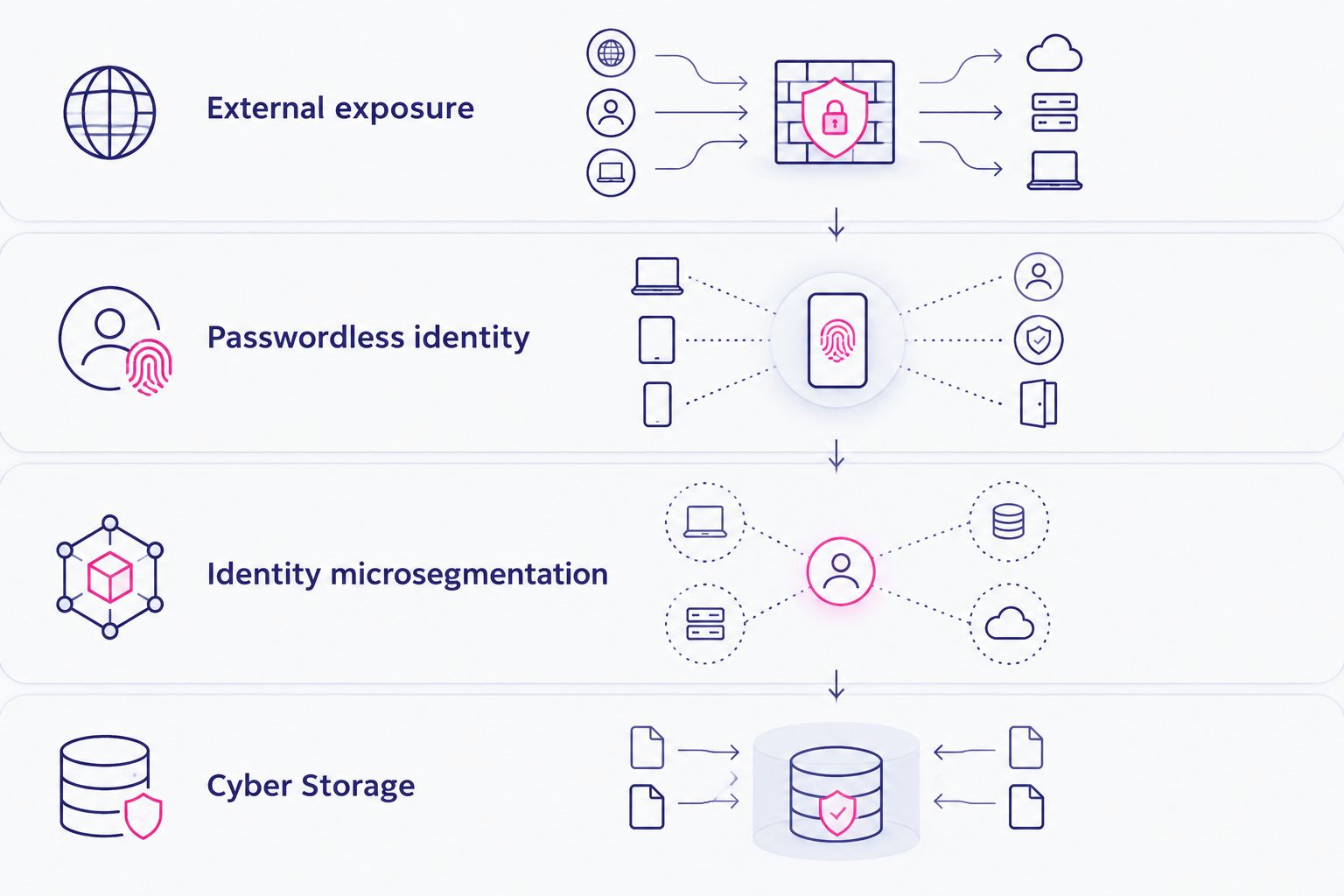
SecFolio's attack-path approach adds passwordless authentication, identity microsegmentation, external exposure management, and Cyber Storage. Use those capabilities to address the paths your review identifies; assess ITDR detection and investigation requirements separately rather than assuming prevention replaces them.
SecFolio is best suited to enterprise healthcare teams seeking attack-path prevention alongside identity threat response. Its role is broader than collecting identity alerts. Your acceptance test still needs to establish how detection evidence reaches responders and how containment works in your environment.
Use the four-layer framework to organize control ownership:
- External exposure: discover and close exposed entry points before initial access.
- Passwordless identity: eliminate reusable credentials from supported authentication workflows.
- Identity microsegmentation: restrict identity-based reach to contain lateral movement.
- Cyber Storage: preserve data resilience when ransomware or exfiltration threatens operations.
Step 04: Design containment around clinical access
Write response runbooks with application owners and clinical operations before enabling automated account actions. Manually walk through session revocation, privilege removal, access restriction, and account suspension. Record the operational effect of each action.
Use the narrowest action that contains the demonstrated threat. Revoking a compromised session and disabling an entire service identity are not interchangeable. Test where each action takes effect, including applications that maintain their own sessions.
Identity microsegmentation addresses lateral movement by restricting where an identity can operate. Evaluate it against actual clinical dependencies rather than treating a department name or network boundary as sufficient authorization.
Require every containment runbook to specify:
- The evidence needed to trigger the response.
- The identity, session, or permission being restricted.
- The application owner authorized to approve exceptions.
- The clinical dependency that must remain available.
- The rollback procedure and verification evidence.
Step 05: Prove shared-device and emergency-access workflows
Observe a shift handoff and an approved emergency-access exercise before designing controls. Document sign-in, sign-out, session switching, and access restoration. Include the people who use the workflow, not only directory administrators.
Passwordless authentication addresses reusable credentials, but the surrounding enrollment and recovery processes also need protection. An attacker who abuses account recovery can bypass an otherwise sound sign-in design. Shared workstations also require clear separation between successive users' sessions.
Run 2 controlled drills: one routine handoff and one emergency-access activation. Set the acceptable interruption limit with clinical operations before testing; do not borrow a generic vendor benchmark.
Record the following outcomes:
- Whether the previous user's application session remains accessible.
- Whether recovery requires reliable identity verification.
- Whether emergency access has an accountable user.
- Whether responders can distinguish approved emergency activity from abuse.
- Whether temporary access is reviewed and removed afterward.
Step 06: Add resilience for ransomware and exfiltration
Inventory the data your clinical workflows need and document recovery dependencies first. Review who can access complete copies, recovery administration, and encryption keys. Test restoration with existing resources before changing the architecture.
Traditional backups concentrate complete copies that attackers can target for encryption or exfiltration. SecFolio Cyber Storage is a data-resilience architecture: it encrypts data before it leaves the customer environment, shards the encrypted data into immutable fragments, and distributes those shards across independent locations.
No single location holds a reconstructable file. This creates a logical air gap: an attacker obtaining an individual location's fragments does not obtain usable files. Authorized recovery reconstructs the data through the authorized recovery process.
Cyber Storage complements ITDR; it does not replace identity containment. It also does not remove the need to secure applications that legitimately expose readable information.
Validate the architecture against these requirements:
- Identify which clinical datasets the resilience design covers.
- Protect recovery identities and administrative access.
- Document dependencies for authorized distributed recovery.
- Test restored data against application-owner acceptance criteria.
- Keep exposure, passwordless, and segmentation controls active.
Step 07: Measure containment and operational impact
Create a simple test register before building a dashboard. For each exercise, record the initial activity, first usable alert, analyst decision, containment action, and verified outcome. Preserve the evidence that explains each timestamp.
Your 2026 scorecard should measure what happened, not what a demonstration promised. Record detection time in minutes, containment time in minutes, and interrupted workflows by count. These are measurement fields, not performance claims or universal targets.
Assign 1 accountable owner to each response playbook. The owner coordinates application dependencies, escalation, and periodic retesting. Automation shortens execution only when the underlying action is correct and its effect is verified.
Track a bounded set of measures:
- Detection time from simulated activity to an actionable alert.
- Containment time from approval to verified access restriction.
- Expected workflows interrupted by the response.
- Identity investigations completed with sufficient supporting evidence.
- Exceptions still open after the exercise.
Compare healthcare ITDR options for 2026
Choose an approach according to the gap you need to close. Detection, privileged access control, and data resilience serve different purposes; none substitutes for the others.
The following options are complementary architectural choices, not a ranking of unverified product integrations. Require demonstrations against your directory, applications, and response procedures before selecting a combination.
| Option | Best for | Practical advantage | Key limitation |
|---|---|---|---|
| Existing identity logs and manual runbooks | Establishing a baseline before procurement | Uses evidence and administrative controls you already operate | Correlation and containment depend on analyst execution |
| Dedicated ITDR tooling | Investigating identity abuse across supported systems | Focuses evaluation on detection, investigation, and identity response | Coverage and response depth require environment-specific validation |
| Privileged access management | Controlling administrator and vendor privileges | Restricts elevated access and makes privileged workflows more accountable | Does not cover every ordinary-user session or identity attack path |
| SecFolio attack-path controls | Enterprise healthcare teams reducing credential abuse, lateral movement, and data risk | Combines passwordless identity, identity microsegmentation, exposure management, and Cyber Storage | Prevention and resilience do not replace validated ITDR telemetry, investigation, or clinical workflow testing |
Select the combination that closes an observed gap. If investigators cannot reconstruct identity activity, prioritize visibility. If compromised identities retain unnecessary reach, prioritize containment. If recovery depends on exposed complete copies, address data resilience alongside those controls.
Common mistakes healthcare providers make
Treating every abnormal sign-in as a compromise
Shift changes, remote work, and approved vendor sessions need context. Require investigators to connect the sign-in with subsequent actions and resource access. An alert without that evidence transfers the diagnosis back to your team.
Automating account shutdown before mapping dependencies
A service account can support a clinical interface rather than a single user. Document its dependencies and test targeted restrictions before enabling automatic suspension. Keep the rollback procedure available to the responding team.
Assuming passwordless means identity attacks are finished
Passwordless authentication removes reusable passwords from the workflows it covers. It does not eliminate stolen sessions, excessive permissions, or compromised recovery processes. Retain session monitoring and access containment.
Treating emergency access as an unreviewed exception
Emergency access needs an accountable user, a defined activation process, and review after use. Do not exempt it from investigation. Test that responders can recognize legitimate activation without overlooking abuse.
Treating recoverability as exfiltration prevention
Restoring data does not undo an unauthorized disclosure. Keep detection, application access restrictions, and exfiltration controls distinct from recovery architecture. Your 2026 acceptance criteria should demonstrate each outcome separately.
FAQ
What’s the best way to choose ITDR solutions for healthcare providers?
Choose ITDR solutions for healthcare providers by testing identity visibility, investigation evidence, targeted containment, and clinical workflow continuity. Use your own stolen-session, privilege-change, and service-account scenarios rather than relying on a feature checklist.
Is ITDR the same as identity and access management?
ITDR detects and responds to identity threats; identity and access management administers identities and access. The functions overlap operationally, but an account provisioning workflow does not by itself establish threat detection or incident response.
Can ITDR disable a compromised account without interrupting patient care?
Safe containment requires dependency mapping and tested response procedures. Evaluate whether session revocation, privilege removal, or targeted access restriction can contain the threat before suspending an account that supports clinical operations.
Does passwordless authentication replace healthcare ITDR?
Passwordless authentication does not replace healthcare ITDR. It addresses reusable credentials in supported workflows, while ITDR must still address session abuse, suspicious privilege changes, and compromised identities.
How should a hospital test ITDR on shared workstations?
Test a complete user handoff, including application sessions, sign-out, sign-in, and access recovery. Verify that the previous user’s access does not persist into the next user’s workflow and that investigators can attribute relevant activity.
Where does SecFolio fit in a healthcare ITDR program?
SecFolio provides complementary attack-path controls through external exposure management, passwordless authentication, identity microsegmentation, and Cyber Storage. Evaluate those controls alongside your requirements for identity telemetry, investigation, and response rather than assuming prevention alone supplies every ITDR function.
Is Cyber Storage a backup product?
Cyber Storage is a data-resilience architecture, not a backup product. It encrypts data before it leaves the customer environment, shards the encrypted data into immutable fragments, and distributes them so no single location holds a reconstructable file.
One last thing
End the evaluation by testing the exception, not repeating the successful login demo. Use an approved emergency account while a simulated identity incident is under investigation. Require the team to preserve legitimate clinical access and restrict the malicious access separately.
That exercise tests the decision you are actually buying: whether identity security can contain an attack path without treating essential care as collateral damage.


