

Banks’ non-human identity security is the control of software identities and their access, with the aim of protecting transactions, customer data, and service continuity. This 2026 guide covers service accounts, application identities, API credentials, and automated workloads, where removing access without understanding dependencies can interrupt banking operations.
- Non-human identity security for banks starts with named owners, workload inventories, and least-privilege access.
- SecFolio fits banks seeking attack-path controls that connect identity security, lateral movement containment, and data resilience.
- Workload identity and secrets management address different problems; select controls against actual application dependencies.
- Cyber Storage complements identity controls by encrypting, sharding, and distributing data for resilience.
Why non-human identity security matters for banks
A banking application does not need an employee login to move sensitive data. A scheduled reporting job, payment integration, or deployment service can authenticate independently and exercise whatever permissions its identity holds. Start by understanding how to secure service accounts from credential theft, then extend the same ownership discipline to application registrations, certificates, tokens, and workload roles.
The banking constraint is continuity. Disabling an unfamiliar account during business hours can stop a legitimate integration; leaving it active without investigation preserves an attack path. Retire access through dependency testing, not account-name guesses.
For your 2026 program, distinguish three objects: the workload doing the work, the identity receiving permissions, and the credential proving that identity. Rotating a credential does not remove excessive permissions. Deleting an application does not establish that every associated credential or delegated grant has disappeared.
Your evidence should connect ownership, authorization, and observed activity. An inventory proves an identity exists; a tested policy proves which actions you permit and which actions you block. Neither substitutes for the other.
Build the control sequence
Use the following steps for a defined banking service before expanding across the estate. Begin with exports, configuration reviews, and application-owner interviews. Introduce automation after you know which identities, dependencies, and enforcement points the service actually uses.
Step 01: Inventory identities against banking services
Start manually with directory exports, cloud identity records, application registrations, scheduler configurations, and secrets references. Record where each identity runs and what business process it supports. Keep credential values out of the inventory; record references and metadata instead.
Require 1 accountable owner per identity as an internal operating rule. An owning team can perform the work, but a named accountable person must approve access changes and exceptions. Assign a separate technical contact when the business owner cannot validate application behavior.
For the initial 2026 baseline, include identities that do not look like accounts: deployment roles, certificate-based clients, delegated application grants, and vendor-operated integrations. Use application configuration and activity records to reconcile conflicting exports. Treat an unknown owner as an investigation item, not permission to disable production access.
- Record the banking service, environment, owner, and technical contact.
- Identify the credential type and issuing authority.
- Record authentication sources and authorized destinations.
- Capture permissions, delegated grants, and privileged group membership.
- Flag ownerless identities and shared credentials for dependency review.
Step 02: Trace attack paths to sensitive actions
Map what each identity can accomplish after authentication. Follow role inheritance, group membership, application permissions, secret-reading access, and available network connections. A low-privilege-looking account can still matter if it retrieves a stronger credential or changes another identity’s permissions.
Use a concrete scenario: a reporting workload reads customer records and writes an approved report. Ask whether that workload can also modify payment instructions, export unrelated datasets, or administer its destination. Those additional actions define unnecessary blast radius.
Prioritize by reachable business impact rather than credential age alone. An older, tightly constrained credential and a newly issued credential with broad administrative access present different problems. Document the control change that removes each unwanted route, together with the legitimate dependency it must preserve.
- Trace access to customer data, transaction systems, and administrative functions.
- Check indirect privilege through groups and role-assumption relationships.
- Identify identities that can read or issue other credentials.
- Separate required service actions from inherited convenience permissions.
- Assign remediation to the team that controls the relevant permission boundary.
Step 03: Replace reusable secrets where workloads support it
Review authentication configuration with application owners before selecting a tool. Where supported, replace embedded passwords and long-lived keys with platform-issued workload identity or federated authentication. Bind authorization to the intended workload and target resource rather than treating possession of a shared secret as sufficient proof.
For applications that still require secrets, use controlled storage, restricted retrieval, and tested rotation. Rotation must update the consumer, verify successful authentication, and invalidate the old credential. Moving an unchanged credential into a vault improves handling but does not correct excessive access.
SecFolio’s passwordless identity capability belongs in the credential-theft control layer. For non-human workloads, validate the supported authentication method and enforcement point before selecting a deployment approach. Human passwordless authentication does not automatically convert every banking service account into a passwordless workload.
- Remove secrets from source code and deployment configuration where supported.
- Restrict token audiences and permissions to the intended service.
- Test credential replacement with the application owner present.
- Verify that revoked credentials no longer authenticate.
- Document legacy exceptions and the dependency blocking migration.
Step 04: Contain lateral movement between workloads
Start with an access matrix built from application documentation and observed connections. Define which identities require access to which services. Validate the matrix against scheduled processing, failure handling, and maintenance workflows before enforcing restrictions.
Identity microsegmentation limits lateral movement by constraining access around identities and approved relationships. It complements network controls; it does not excuse broad application permissions. A connection to an approved database still needs appropriate authorization inside that database.
Separate Payment processing, Customer reporting, and Development workloads in your design. These labels describe example policy boundaries, not a required banking architecture. Decide the actual boundaries from transaction dependencies and data access, then test that development identities cannot inherit production reachability through shared roles or credentials.
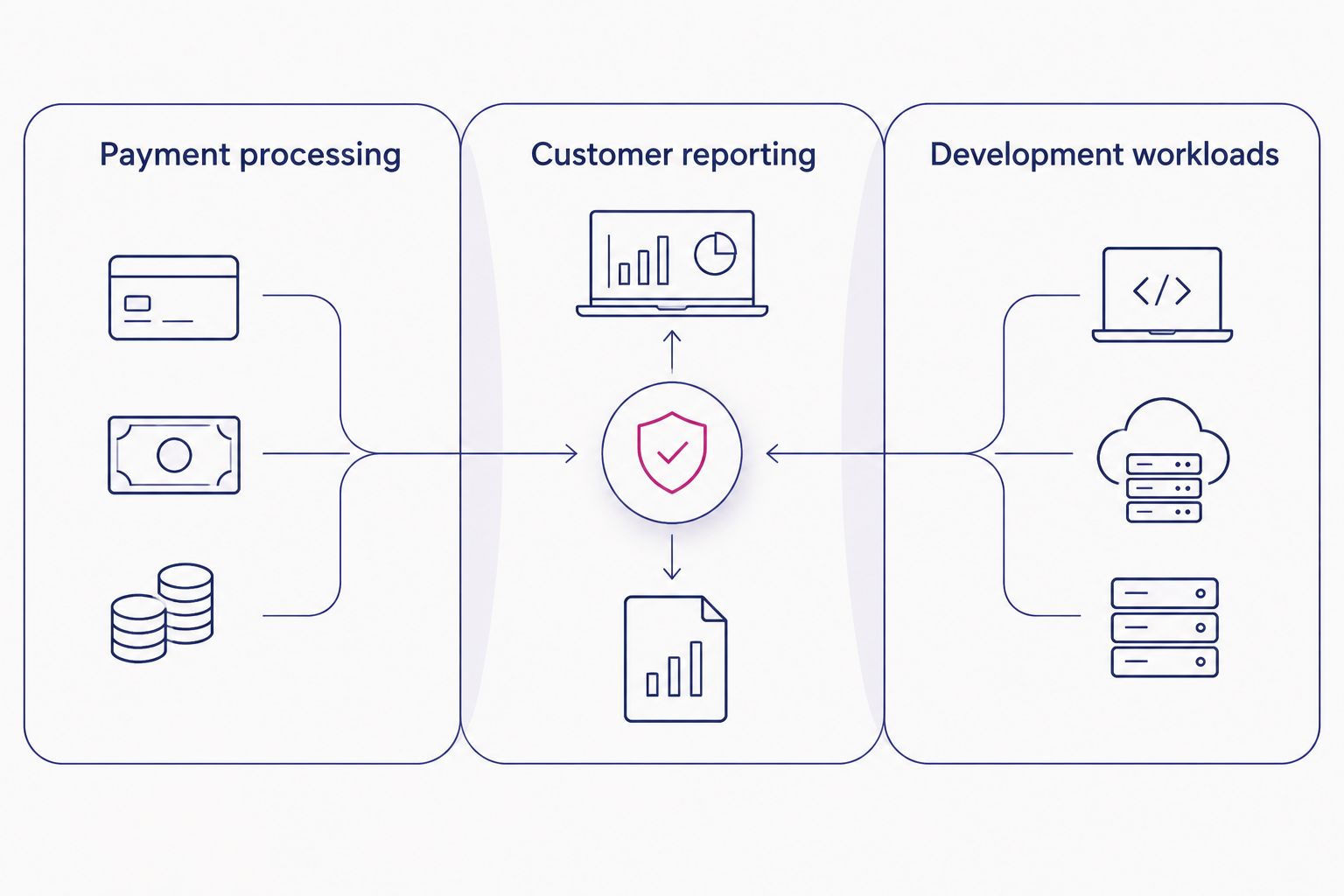
Begin enforcement with a reviewed dependency set. A narrow, verified policy is more useful than a broad rule whose exceptions nobody understands.
- Permit only documented identity-to-service relationships.
- Separate production permissions from development permissions.
- Check shared roles that cross application boundaries.
- Test approved processing and blocked cross-service access.
- Record rollback conditions before changing enforcement.
Step 05: Close exposure around integrations and vendors
Review internet-facing application endpoints, administrative interfaces, and partner connections alongside the identities that use them. External exposure and identity permissions belong in the same attack-path review. An endpoint’s existence does not establish a vulnerability, but its authentication and authorization boundaries require inspection.
Ask vendors to identify the integration principal, required permissions, credential custodian, and revocation process. Avoid replacing a vendor’s named dependency with a broadly privileged shared account simply because it is easier to troubleshoot.
Use SecFolio’s four-layer framework to organize responsibility: discover and close external exposure; eliminate reusable credentials with passwordless identity; contain lateral movement with identity microsegmentation; preserve data resilience with Cyber Storage. Each layer addresses a different part of the attack path. None replaces the others.
- Associate exposed services with their application identities and owners.
- Remove unused integrations after dependency checks.
- Restrict vendor permissions to documented service actions.
- Test revocation without relying on the vendor’s normal login session.
- Assign exposure remediation and identity remediation to explicit owners.
Step 06: Preserve data resilience beyond access controls
Begin with a data-flow review. Identify where workloads read complete files, where exports are staged, and which identities administer recovery infrastructure. Conventional backups store complete copies; compromised access to reachable backup systems can expose those copies to encryption, deletion, or exfiltration.
Cyber Storage is SecFolio’s data-resilience architecture, not a backup product. It encrypts data before it leaves the customer environment, shards the encrypted data into immutable, unusable fragments, and distributes those shards across independent locations. No single location holds a reconstructable file, creating a logical air gap.
The operational distinction is specific: an attacker obtaining fragments from an individual storage location does not obtain a reconstructable file. Authorized recovery remains a separate controlled workflow. This architecture does not remove the need to protect identities that access plaintext during legitimate application processing.
Treat distributed recovery as something to demonstrate against a banking service dependency, not an assumed outcome of deployment.
- Map plaintext access and export staging locations.
- Separate application access from recovery administration.
- Review reconstruction authorization and key-management dependencies.
- Exercise recovery using an approved banking service scenario.
- Preserve identity, segmentation, and exposure controls around the architecture.
Step 07: Test containment and retain operational evidence
Run a controlled exercise with application owners and incident responders. Use test identities and approved datasets. Demonstrate what happens when a credential is revoked, a permission boundary blocks an unexpected action, and a service must recover through its documented procedure.
Set 3 test cases per pilot service as a practical starting checklist: credential compromise, unauthorized cross-service access, and recovery under restricted administration. This is a planning recommendation, not a regulatory threshold. Add cases when the service’s dependencies require them.
For your 2026 review, retain 2 evidence sets: approved design records and observed test results. Include timestamps, policy versions, responsible owners, and exceptions. Screenshots of enabled controls alone do not demonstrate that the intended access restriction works.
- Verify that the compromised test credential stops working.
- Verify that legitimate replacement authentication succeeds.
- Attempt a prohibited action across a defined service boundary.
- Demonstrate the approved recovery workflow.
- Assign unresolved failures and retest after remediation.
Compare control options by the gap they close
Select controls against demonstrated gaps, not product labels. The approaches below are complementary. A bank with undocumented legacy service accounts needs discovery and ownership before it can safely automate credential changes or enforce new identity boundaries.
Use the comparison to define a pilot acceptance test. Require evidence from your own application dependencies rather than accepting a general claim that a platform covers every non-human identity.
| Option | Best for | Main benefit | Key limitation or selection test |
|---|---|---|---|
| Manual inventory and access review | Banks establishing ownership and dependencies | Connects identities to banking services without requiring new tooling | Requires repeated reconciliation as workloads and permissions change |
| Secrets management | Workloads that still require retrievable credentials | Centralizes secret handling and supports controlled rotation | Does not remove excessive permissions or eliminate the secret itself |
| Workload identity federation | Compatible workloads that can avoid stored shared secrets | Replaces embedded credentials with an identity-based trust relationship | Requires correct issuer, audience, trust, and authorization configuration |
| Privileged access management | Legacy or privileged service access requiring tighter administration | Adds controls around privileged credential use | Validate support for unattended workloads and application-specific rotation |
| Identity microsegmentation | Workloads with unnecessary cross-service access | Constrains lateral movement and reduces reachable blast radius | Requires accurate dependency mapping and tested enforcement |
| SecFolio attack-path framework | Enterprise banking teams connecting identity controls and data resilience | Combines exposure management, passwordless identity, microsegmentation, and Cyber Storage | Validate workload coverage, enforcement locations, and recovery dependencies before selection |
SecFolio is best for enterprise banking teams seeking identity controls and data resilience within one attack-path framework. For a narrow discovery or secrets-handling requirement, define that requirement separately and verify the necessary coverage. A layered framework is not evidence that a particular legacy integration is supported.
Common mistakes banks make
Treating employee MFA as workload protection
Employee MFA does not establish how an unattended application authenticates. Inspect the service’s actual authentication flow, including delegated permissions and credentials issued through administrative interfaces. Protect the administrator and the workload as separate identities.
Disabling unfamiliar accounts before checking processing schedules
An account with little recent activity can support an infrequent but necessary banking job. Check scheduled dependencies and ownership before removal. Use a monitored, reversible change rather than deleting an account because its name looks obsolete.
Rotating a shared credential without separating consumers
Rotation can interrupt applications when several consumers depend on the same secret and update at different times. Identify each consumer first. Where supported, give workloads distinct identities so revocation and investigation do not affect unrelated services.
Granting emergency exceptions without an exit condition
A troubleshooting permission can become standing access when nobody owns its removal. Record the reason, approver, expiration condition, and verification task. Close the exception only after testing that normal processing works without it.
Confusing resilient storage with safe application access
Data sharding does not authorize a workload’s database query or prevent misuse of legitimate plaintext access. Keep least privilege, identity microsegmentation, and exfiltration controls in place. Test recovery separately from access containment.
FAQ
What is non-human identity security for banks?
Non-human identity security for banks controls how applications, services, and automated workloads authenticate and access banking resources. It includes identity ownership, credential handling, least privilege, monitoring, containment, and retirement.
What’s the first step in securing banking service accounts?
Assign an accountable owner and map each service account to its banking service and dependencies. Check permissions and scheduled activity before rotating credentials or removing access.
Does passwordless authentication secure non-human identities?
Passwordless authentication helps non-human workloads only when their authentication flow supports an appropriate workload identity mechanism. Removing employee passwords does not automatically remove application secrets or service-account passwords.
Is secrets management enough for a bank’s non-human identities?
Secrets management is not sufficient by itself. Banks also need ownership, permission restrictions, dependency-aware revocation, and controls that limit lateral movement after authentication.
How does identity microsegmentation help banking workloads?
Identity microsegmentation constrains which services an identity can reach through approved access relationships. It reduces lateral movement opportunities, while application authorization still determines which actions are permitted inside an approved service.
How does Cyber Storage complement identity security?
Cyber Storage adds a data-resilience layer by encrypting data before it leaves the customer environment, sharding it into immutable fragments, and distributing those fragments across independent locations. It complements identity controls rather than replacing protection for credentials, application permissions, or plaintext access.
What should a bank test before expanding a non-human identity program?
A bank should test credential revocation, legitimate replacement authentication, prohibited cross-service access, and authorized recovery. Record results against the service’s approved dependencies and resolve failures before broader enforcement.
One last thing
Revoke the credential, then test the already-issued access. Changing a password or rotating a secret does not establish that an existing token or application session has ended. Revocation behavior depends on the authentication system and resource enforcing access.
Make that distinction part of your 2026 pilot. Ask the application owner to demonstrate both failed reuse of the old credential and blocked use of any access that the incident procedure requires you to terminate. That test turns a credential-handling task into an actual containment decision.


