

TL;DR:
- Access controls regulate who can access, modify, or view resources within an enterprise.
- They enforce policies that limit over-privileged accounts and support compliance efforts.
What access controls actually do in enterprise security
Access control is the mechanism that governs which subjects — users, devices, or processes — can view, modify, or consume specific organizational resources. Think of it as the policy layer that sits between authenticated identity and actual system access. Authentication answers “who are you?” Access control answers “what are you allowed to do?”
The distinction matters in practice. A user who successfully logs in has proven identity, not earned permission. Access control enforces the boundaries that follow, covering confidentiality, integrity, and availability across every system your organization runs. Regulatory frameworks including GDPR, HIPAA, and PCI DSS all mandate effective access controls as a baseline requirement, not an optional enhancement.
Key functions access controls perform:
- Govern resource access by defining which subjects interact with which objects and under what conditions
- Enforce least privilege so users operate with only the permissions their role requires
- Support auditability by creating traceable records of who accessed what and when
- Contain breach spread by limiting lateral movement when one account or system is compromised
- Drive compliance with federal mandates and industry regulations that carry real financial and legal consequences
How the four primary access control models compare
Enterprises deploy access controls through four main models, each suited to different risk profiles and operational contexts.
- Mandatory Access Control (MAC): The system classifies every object and assigns clearance levels to every subject. No user can override these assignments. MAC is favored in government and military environments precisely because it removes human discretion from the equation. The tradeoff is administrative overhead — it requires careful design and continuous monitoring.
- Discretionary Access Control (DAC): Resource owners set their own permissions. DAC is flexible and easy to customize, but the lack of centralized control creates risk. A user who can grant access to others can inadvertently expose sensitive data, making DAC a poor fit for environments with strict compliance requirements.
- Role-Based Access Control (RBAC): Permissions attach to roles, not individuals. A nurse gets access to patient records; a billing clerk gets access to billing data. RBAC in healthcare demonstrates this cleanly — it restricts patient record access by job function, satisfying HIPAA while keeping workflows functional. RBAC is the dominant enterprise model for good reason.
- Attribute-Based Access Control (ABAC): A rules engine evaluates contextual attributes — user department, device type, time of day, location — to issue access decisions. ABAC handles scenarios RBAC cannot, like granting a contractor read-only access only during business hours from a managed device.
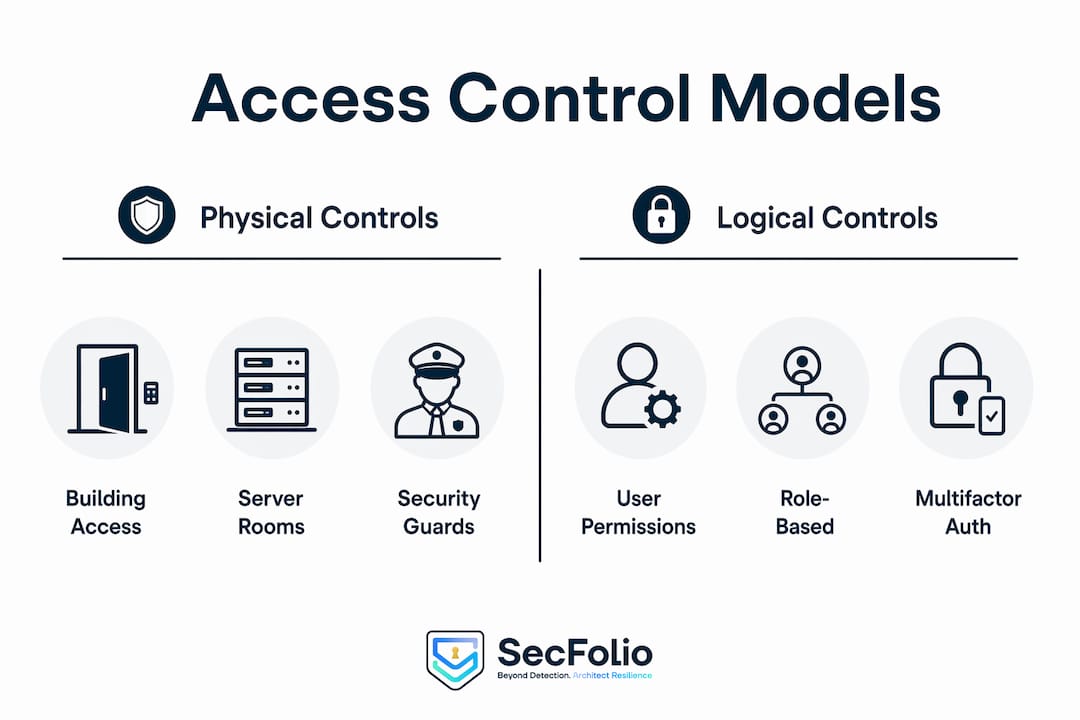
Physical and logical access controls operate in parallel. Physical controls restrict entry to buildings, server rooms, and hardware. Logical controls govern network connections, file systems, and applications. A complete enterprise security posture requires both, and they should share a unified policy framework rather than operate as separate silos.
Why access controls are critical for managing internal risk
Broken access control ranks among the most significant software security risks identified by the OWASP Foundation, and most breaches trace back to misuse of over-privileged accounts rather than sophisticated external attacks. The threat is frequently internal, whether through malicious insiders or compromised credentials that give attackers the run of a system.

Privilege creep compounds the problem. As employees change roles or take on projects, permissions accumulate rather than reset. Without regular access reviews, accounts carry far more access than their current responsibilities justify. That gap between policy intent and actual permissions is where attackers operate.
Effective access controls address this by limiting each user to only the data and resources their role requires. When a breach does occur, well-implemented controls contain it. Without them, a single compromised account can cascade across systems, expanding the blast radius well beyond the initial point of entry. The legal and financial consequences of that cascade — regulatory fines, breach response costs, reputational damage — dwarf the cost of maintaining strong controls.
Access management best practices that hold up under pressure
Strong access control systems do not emerge from a single policy document. They require layered implementation and ongoing maintenance.
- Apply least privilege at provisioning time. Grant the minimum access a role requires from day one. Permissions are far easier to add than to claw back after they have been in place for months.
- Combine RBAC with ABAC for defense in depth. Layering control models avoids the mathematical undecidability that comes with relying on any single model to cover every access state. RBAC handles the structural baseline; ABAC handles context-sensitive exceptions.
- Integrate with IAM platforms. Automated provisioning and de-provisioning through an Identity and Access Management system eliminates the manual gaps where stale accounts persist. When an employee leaves or changes roles, access adjusts automatically.
- Conduct regular access reviews. Quarterly reviews of role assignments catch privilege creep before it becomes a liability. Tie reviews to HR events — role changes, departures, project completions.
- Monitor in real time. Modern access control systems generate alerts on suspicious activity, time-stamp every access event, and support remote management. That audit trail is what makes forensic investigation possible after an incident. For documentation standards that hold up in investigations, forensic documentation practices provide a useful framework.
- Adopt zero trust architecture. Zero trust treats every access request as untrusted by default, regardless of network location. Combined with biometric authentication and continuous session validation, it closes the gaps that perimeter-based models leave open.
Pro Tip: The most common implementation failure is not a policy gap — it is the gap between policy and enforcement. An access control policy that exists only in documentation provides no protection. Audit your enforcement mechanisms, not just your written policies, on a regular schedule.
How Secfolio extends access control into identity-level protection
Traditional access control models govern permissions at the system level. What they cannot fully address is what happens when a legitimate identity is compromised. Credential theft, privilege escalation, and lateral movement all exploit valid credentials to bypass access controls entirely.
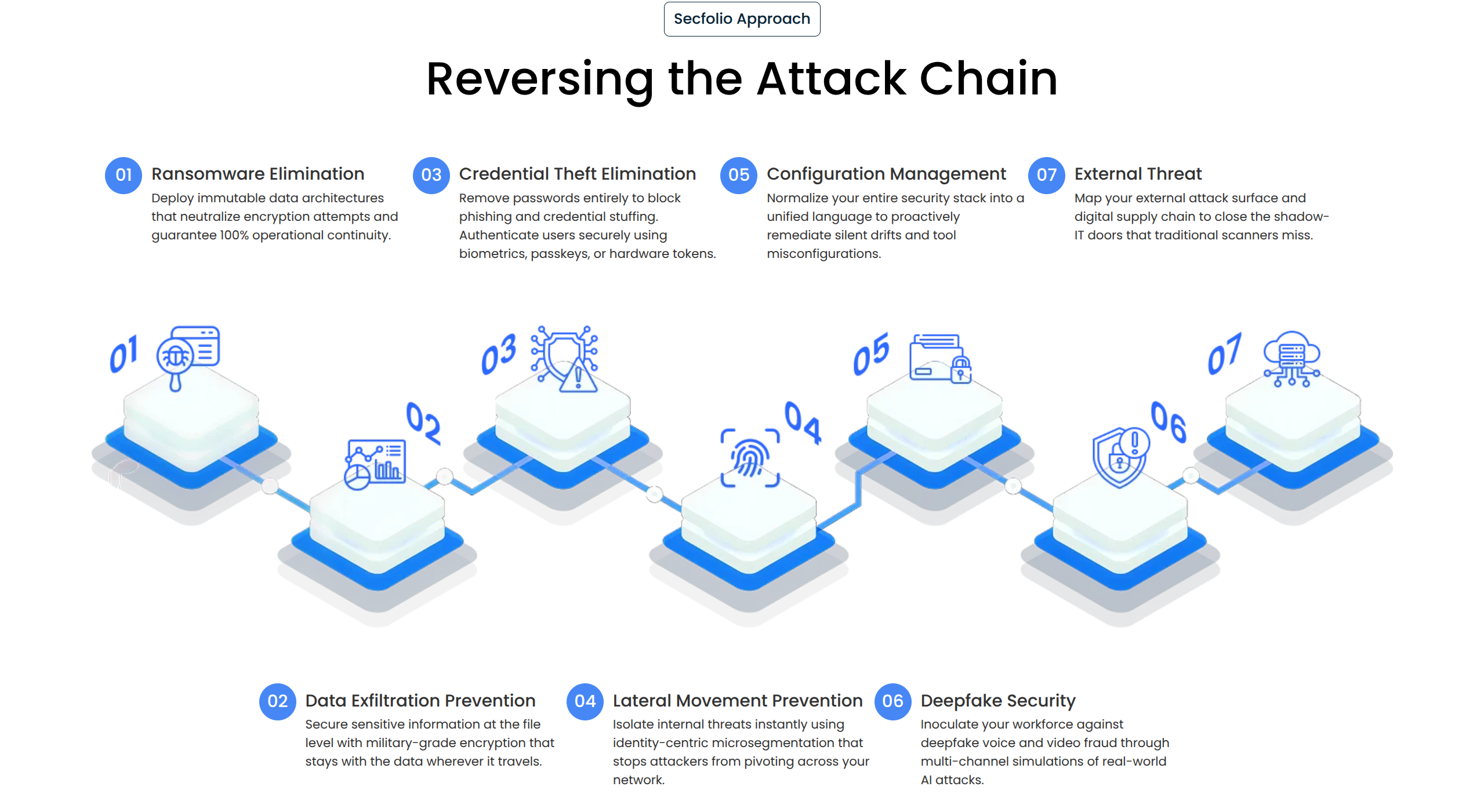
Secfolio’s approach targets that gap directly. Through Identity Microsegmentation, Secfolio creates granular access boundaries at the identity level, preventing a compromised account from moving freely across systems even after it has cleared initial authentication. The attack pathway that would normally allow an attacker to pivot from one system to the next gets closed before it can be used.
AI-driven Defensive Automation continuously maps and eliminates attack pathways rather than waiting for a breach to reveal them. This proactive posture reduces data exfiltration and ransomware incidents by addressing the conditions that make those attacks possible. Secfolio also offers passwordless identity solutions that eliminate credential theft as an attack vector, removing one of the most reliable tools in an attacker’s kit.
The result is a security architecture where access controls define the policy layer and identity protection enforces it at the level where modern attacks actually operate. For enterprises running an internal vulnerability assessment, integrating identity microsegmentation alongside traditional access control models is the step that converts a compliance-driven program into a genuinely resilient one.
Key Takeaways
Access controls are the foundational mechanism that determines who can reach what inside your enterprise, and their effectiveness depends on combining the right models, enforcing least privilege consistently, and extending protection to the identity layer where modern attacks occur.
| Point | Details |
|---|---|
| Authentication vs. authorization | Authentication confirms identity; access control governs what that identity is permitted to do. |
| RBAC as the enterprise standard | Role-based access control assigns permissions by job function, reducing over-provisioning across large user populations. |
| Broken access control risk | OWASP identifies broken access control as one of the most exploited vulnerability classes, driven by over-privileged accounts. |
| Least privilege and privilege creep | Regular access reviews are required to prevent accumulated permissions from expanding the internal attack surface. |
| Identity microsegmentation | Extending access control to the identity layer stops lateral movement even when valid credentials are compromised. |


