

How AI reshapes vulnerability detection in cybersecurity
AI has fundamentally changed how security teams find and prioritize weaknesses in their environments. Where traditional scanners run scheduled sweeps and hand analysts a flat list of CVEs, AI-driven vulnerability management processes large volumes of telemetry continuously, correlates findings across systems, and ranks what actually needs fixing first. The result is a shift from periodic, reactive discovery to something closer to real-time threat awareness.

The industry term for this practice is AI-assisted vulnerability management, and it covers three distinct phases: discovery, prioritization, and remediation guidance. Tools like SentinelOne Autonomous Detection and Response and IBM AI-powered Vulnerability Management represent the current benchmark, combining machine learning models with behavioral analysis to surface exploitable weaknesses that static scanners routinely miss.
Two organizations shaping how defenders think about this shift are ENISA (the EU Agency for Cybersecurity) and CSIS (the Center for Strategic and International Studies). Both have published guidance urging security teams to move beyond quarterly assessments and toward continuous, AI-assisted triage.
“What makes the latest generation of models particularly dangerous is not just the volume of vulnerabilities they find. It is their ability to chain findings across multiple steps, reason about application logic, and produce exploitation paths that previously required deep specialist knowledge. This is what turns a list of individual flaws into a working attack.” — ENISA, 2026
Key capabilities AI brings to vulnerability detection:
- Continuous scanning across cloud, on-premises, and hybrid environments without manual scheduling
- Behavioral baselining that flags deviations from normal activity, not just known signatures
- Risk-based prioritization that weights exploitability, asset criticality, and attack path context
- Automated triage that reduces alert volume before it reaches human analysts
- Integration with SOAR platforms for coordinated response workflows
How AI improves on conventional vulnerability management
Traditional vulnerability management has a structural problem: it moves at human speed while attackers increasingly do not. A quarterly scan produces a snapshot. By the time the report reaches the remediation team, the environment has changed and new exposures have appeared. AI closes that gap by running continuously and adapting to new data.
The most concrete improvement is speed. AI-based vulnerability detection systems achieve higher accuracy than traditional static analysis tools, catching complex flaws that pattern-matching scanners miss entirely. Static analysis works by comparing code against known vulnerability signatures. AI models, particularly those using large language models (LLMs) combined with fuzzing, can reason about application logic and identify novel attack paths that have no prior signature.
Prioritization is where AI earns its keep most visibly. A typical enterprise environment generates thousands of vulnerability alerts per week. Without AI, analysts triage manually, often defaulting to CVSS scores that say nothing about whether a flaw is actually reachable in your specific architecture. AI models assess exploitability in context, filtering out the noise and surfacing the handful of findings that represent genuine risk. Filtering for reachability reduces wasted remediation effort and keeps teams focused on what matters.
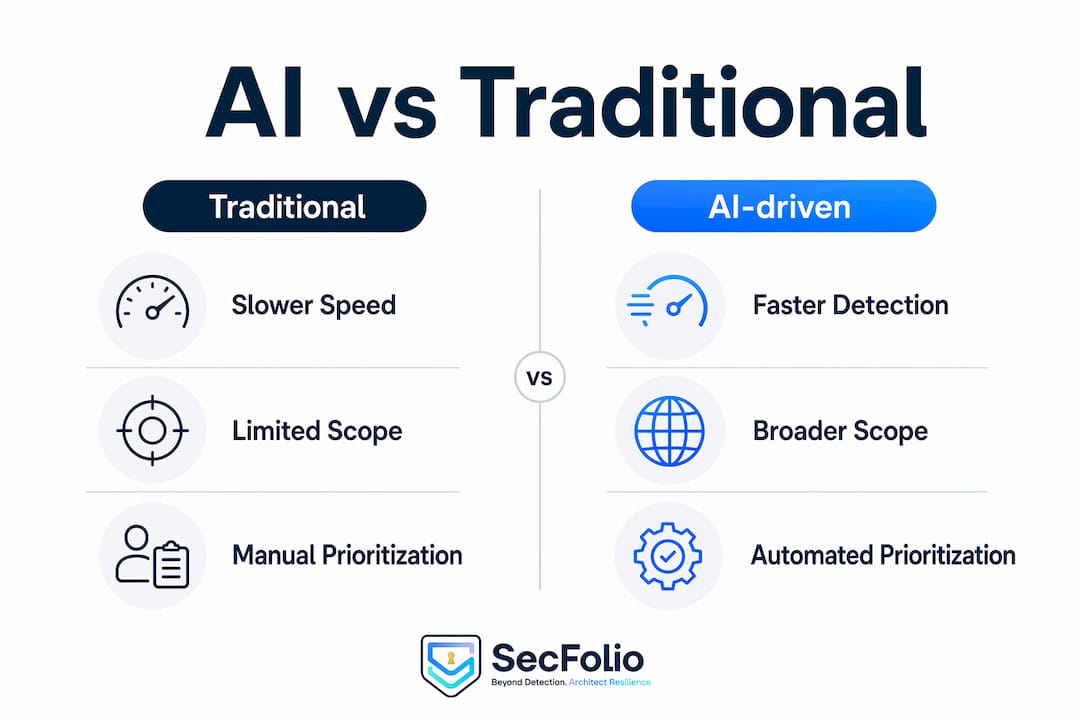
AI also supports a proactive security posture rather than a reactive one. By integrating with CI/CD pipelines, AI tools can flag vulnerabilities during development, before code ever reaches production. That “shift left” capability, where security moves earlier in the software development lifecycle, is one of the more underappreciated benefits of AI in cybersecurity.
Improvements AI delivers over conventional tools:
- Detection of zero-day variants through behavioral and semantic analysis, not just signature matching
- Automated false-positive reduction, cutting analyst workload on low-risk alerts
- Dynamic risk scoring that updates as the threat environment changes
- Faster mean time to detect (MTTD) and mean time to respond (MTTR)
- Code-level vulnerability discovery integrated directly into development workflows
Pro Tip: Run AI-assisted scanning in parallel with your existing tools for at least 60 days before replacing anything. The overlap period reveals which findings each approach misses, giving you a real baseline for comparison.
Risks and challenges AI introduces to vulnerability detection
AI accelerates discovery, but it also accelerates the problems that come with discovery. LLM agents can speed vulnerability discovery but pose serious risks when deployed without proper guardrails and human review. Three failure modes show up repeatedly in production environments.

First, false positives at scale. AI models generate more findings than traditional scanners, and not all of them are valid. Without a human review layer, teams can end up chasing phantom vulnerabilities while real ones go unaddressed. Second, model explainability. Most production AI vulnerability tools operate as black boxes. When a model flags a critical finding, analysts often cannot trace the reasoning, which makes validation difficult and creates friction with compliance teams that need documented justification for remediation decisions.
Third, and most underappreciated: AI-generated patches can break things. ENISA’s 2026 guidance notes that autonomous patching creates a new risk category. Automated updates can accidentally cause system instability, and verifying AI-generated fixes may become a major operational bottleneck as discovery outpaces remediation capacity.
Common risks to plan for:
- Alert overload when AI discovery runs faster than human review capacity
- Over-reliance on AI outputs without validating findings against live telemetry
- Model poisoning, where adversaries manipulate training data to blind detection
- Integration failures when AI tools connect to legacy SIEM or SOAR infrastructure
- Compliance gaps when AI decisions lack the audit trail regulators require
Pro Tip: Never remove human review from the remediation approval chain, even when AI confidence scores are high. Treat AI outputs as a prioritized queue for analysts, not an autonomous action list. Deterministic guardrails on what AI can modify without approval are non-negotiable.
What AI-powered vulnerability detection tools actually do
The gap between entry-level AI scanning tools and mature enterprise platforms is wide. Entry-level tools typically bolt an AI scoring layer onto a traditional scanner, improving prioritization without changing how discovery works. Enterprise platforms like SentinelOne Autonomous Detection and Response and IBM AI-powered Vulnerability Management go further, combining behavioral detection, threat intelligence feeds, and automated response workflows into a unified pipeline.
The most technically advanced approach pairs LLMs with traditional fuzzing. LLM orchestration with fuzzing enables faster discovery of complex flaws by having the model generate test harnesses, analyze coverage gaps, and refine its approach iteratively. This combination catches vulnerabilities that neither fuzzing alone nor LLM analysis alone would surface, particularly in large codebases where manual configuration of fuzzing harnesses is impractical.
Deterministic tools follow fixed rules and produce consistent, auditable outputs. Probabilistic AI tools reason about context and can surface novel findings, but their outputs vary between runs. Production environments typically need both: deterministic tools for compliance-driven scanning and probabilistic AI for deep discovery on high-value assets.
Integration points that matter most:
- SOAR platforms for automated ticket creation and response orchestration
- Risk-based vulnerability management (RBVM) systems for exploitability scoring
- CI/CD pipelines for pre-production code analysis
- SIEM platforms for correlating vulnerability data with live threat telemetry
- Asset inventory systems to ensure coverage across the full attack surface
Secfolio’s configuration management capabilities complement AI detection by maintaining continuous visibility into security drift, ensuring that the environment AI tools are scanning reflects current reality rather than a stale asset inventory.
Pro Tip: Before deploying any AI vulnerability tool in production, run it in a sandboxed replica of your environment. Measure false-positive rates and coverage gaps against your existing scanner before making any changes to your primary detection stack.
Practical steps for deploying AI in vulnerability detection
Getting AI into your vulnerability management workflow without creating new problems requires a phased approach. The biggest mistake teams make is treating AI deployment as a product installation rather than an architectural change.
- Assess your current architecture. Map every asset, data flow, and existing detection control before introducing AI tooling. AI tools are only as good as the inventory they work from. Gaps in asset visibility become gaps in AI coverage.
- Run threat modeling sessions. Identify which asset classes carry the highest business risk and prioritize AI deployment there first. Not every system needs AI-assisted scanning; focus initial deployment on crown-jewel assets and internet-facing infrastructure.
- Deploy in a sandboxed environment. Test AI tools against a realistic replica of your production environment. Measure detection rates, false-positive volumes, and integration behavior before any live deployment.
- Maintain foundational scanning. AI excels with strong foundational controls in place. Keep your existing scanners running alongside AI tools during the transition. Zero-trust segmentation and behavioral baselining make AI detection more accurate, not less necessary.
- Implement risk-based prioritization. Configure AI tools to score findings by exploitability and asset criticality, not just CVSS severity. Filtering vulnerabilities for reachability is the single most effective way to reduce wasted remediation effort.
- Establish human review gates. Define which AI-recommended actions require analyst approval before execution. Automated patching of non-critical systems may be acceptable; changes to production databases should always require human sign-off.
- Measure MTTD and MTTR continuously. Set baseline metrics before AI deployment and track improvement over time. If AI is not moving these numbers, the configuration or integration needs adjustment.
Additional workflow considerations:
- Integrate AI findings directly into your ticketing system to avoid alert silos
- Schedule quarterly reviews of AI model performance, including false-positive rates
- Train analysts on how to interpret and challenge AI outputs, not just act on them
- Document AI decision logic for compliance and audit purposes
For a structured starting point, Secfolio’s vulnerability assessment guide covers the foundational steps that AI tools build on.
What the future of AI-driven vulnerability management looks like
The trajectory is clear: the window between vulnerability discovery and exploitation is closing fast. Attackers can weaponize new vulnerabilities within 15 minutes of disclosure, and the median time from initial access to data exfiltration has compressed to 72 minutes. Security operations centers that still rely on human-speed triage will not be able to keep pace.
Security teams now aim for single-digit-minute MTTD and MTTR metrics as frontier AI compresses the entire vulnerability lifecycle from discovery to exploitation.
Cybercrime costs are projected to reach $10.5 trillion annually by 2025, a figure that makes the business case for AI-driven automation straightforward. The cost of not automating detection and response is no longer theoretical.
ENISA’s 2026 strategic guidance calls on defenders to build dynamic incident response pipelines using AI-assisted triage for real-time telemetry validation and blast-radius containment, while keeping human review in the loop. CSIS echoes this, recommending that organizations treat AI as a continuous red-team capability rather than a periodic scanning tool. The shift from static quarterly assessments to near real-time AI-assisted triage is the defining operational change for security teams in 2026.
Forward-looking capabilities shaping vulnerability management:
- Autonomous AI agents that chain vulnerability discovery, exploit verification, and patch generation end-to-end
- Real-time dynamic risk scoring that updates as new threat intelligence arrives
- AI-assisted coordinated vulnerability disclosure, accelerating the time from report to patch
- LLM-driven fuzzing at scale, applied continuously to open-source dependencies in critical infrastructure
- Agentic AI integrated into production-ready development pipelines to catch vulnerabilities before deployment
The structural imbalance ENISA flags is worth noting: AI-enabled discovery is advancing faster than AI-assisted remediation, giving attackers a temporary advantage. Closing that gap is the central challenge for security engineering teams through 2027.
What the research shows about AI effectiveness in vulnerability detection
The evidence for AI’s advantage over traditional methods is strongest in two areas: detection accuracy and response speed. AI-based detection systems outperform traditional static analysis on complex vulnerability classes, particularly those involving multi-step logic flaws that signature-based tools cannot model. The combination of LLM reasoning with traditional fuzzing, as demonstrated in recent research, surfaces vulnerabilities that neither approach finds independently.
| Dimension | Traditional tools | AI-assisted tools |
|---|---|---|
| Detection scope | Known signatures and patterns | Novel variants, logic flaws, chained exploits |
| Scan frequency | Scheduled (weekly or quarterly) | Continuous |
| Prioritization basis | CVSS score | Exploitability, reachability, asset criticality |
| False-positive handling | Manual analyst review | Automated filtering with human escalation |
| Patch generation | Manual | AI-assisted, with human approval gate |
| Integration depth | Point-in-time reports | Live telemetry correlation |
The research also surfaces a consistent limitation: AI models suffer from explainability gaps and output variability that require cautious adoption. A model that flags a critical vulnerability cannot always show its work, and the same codebase analyzed twice may produce different findings. That variability is manageable with proper validation workflows, but it means AI outputs should never be treated as ground truth without analyst review.
ENISA’s guidance reinforces this directly: in 75% of breaches, logging existed that should have flagged anomalous behavior, but signals were fragmented across tools and not acted upon. AI helps correlate those signals, but only when the underlying logging and monitoring infrastructure is solid. Secfolio’s approach to lateral movement prevention addresses exactly this gap, using Identity Microsegmentation to contain the blast radius when a vulnerability is exploited before detection catches up.
The practical takeaway from the research is that AI works best as a layer on top of mature security fundamentals, not as a substitute for them. Teams that deploy AI without behavioral baselining, zero-trust segmentation, and solid logging will get faster noise, not faster signal.
Key Takeaways
AI-driven vulnerability detection delivers its greatest value when layered on top of strong security fundamentals, continuous logging, and human review gates rather than replacing them.
| Point | Details |
|---|---|
| AI compresses detection timelines | Frontier AI models compress the vulnerability lifecycle to single-digit-minute MTTD and MTTR targets. |
| Prioritization beats volume | Filtering vulnerabilities by reachability and exploitability reduces wasted remediation effort more than scanning more frequently. |
| Human review is non-negotiable | LLM agents speed discovery but require human validation gates to prevent AI-generated patches from causing instability. |
| Foundational controls amplify AI | Behavioral baselining and zero-trust segmentation make AI detection more accurate and reduce false-positive rates. |
| Cybercrime costs justify investment | Projected cybercrime costs of $10.5 trillion annually make the business case for AI-driven automation clear. |
How Secfolio helps you act on AI-driven vulnerability insights
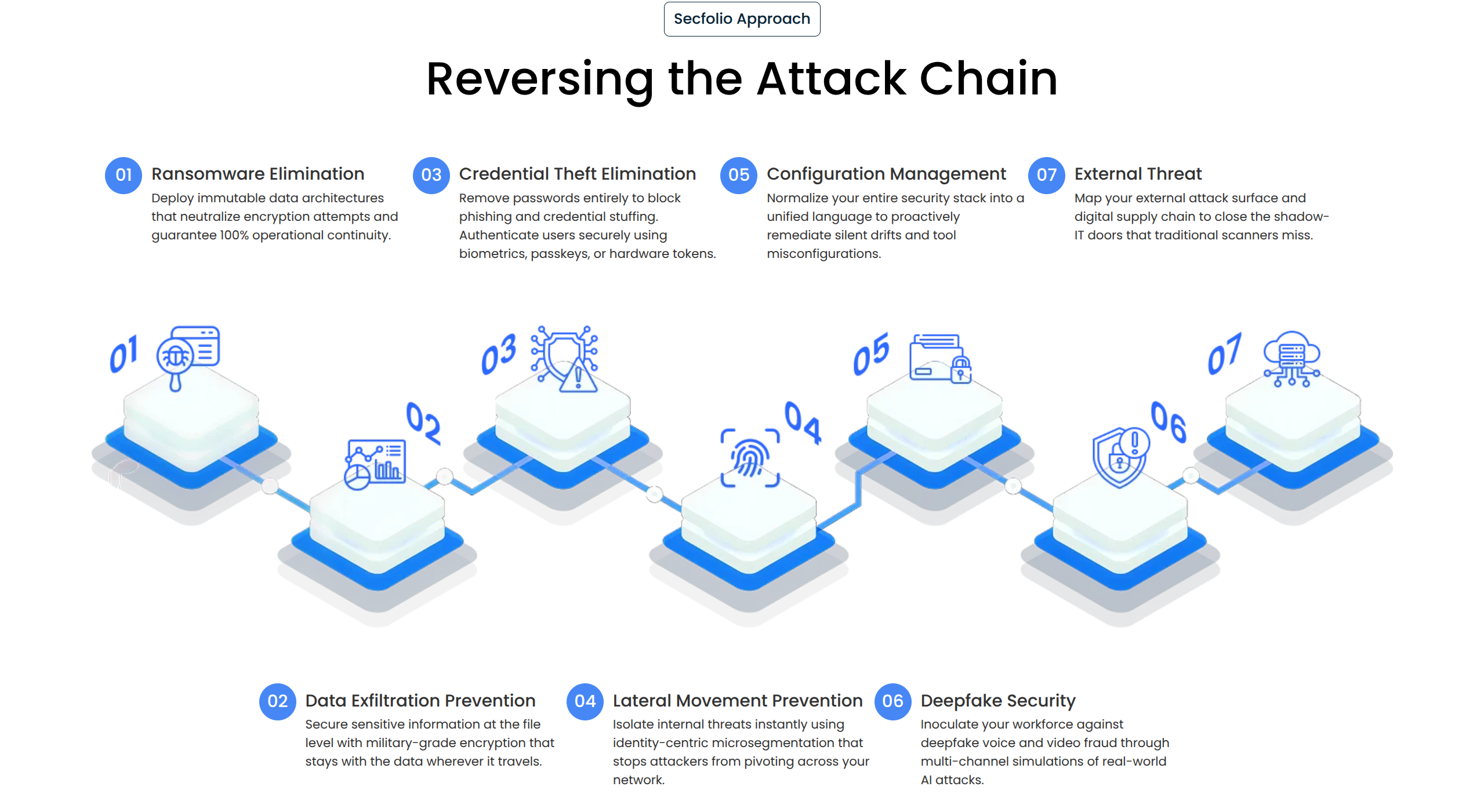
Finding vulnerabilities faster only matters if you can contain the damage when one gets exploited. Secfolio’s Identity Microsegmentation and Defensive Automation stop lateral movement at the identity layer, cutting off the attack paths that AI detection surfaces before they reach critical assets. If your security team is building out an AI-assisted vulnerability management program, the lateral movement prevention capabilities Secfolio provides are the containment layer that makes detection actionable. Explore Secfolio’s external threat management approach to see how AI-driven attack surface visibility fits into a complete defense architecture.


