

Finding identity microsegmentation software that truly blocks lateral movement across complex environments remains difficult for enterprise security teams. Many options lack transparent pricing, demand long onboarding, or rely on integrations that miss critical legacy systems. This comparison shows which platform aligns policy automation, environment compatibility, and procurement realities so security teams can make a confident choice.
Table of Contents
- Secfolio
- Elisity Microsegmentation Platform
- Zero Networks
- Whiteswan Security
- Comparison of alternatives
Secfolio
At a Glance
Secfolio includes identity microsegmentation and passwordless security as core parts of its offering. The platform targets internal attack paths that enable lateral movement inside enterprise environments. That focus shifts effort from detection to removing the routes attackers use to reach critical data.
Core Features
Secfolio performs attack path analysis and vulnerability discovery to map how identities and services can be abused. It pairs that mapping with threat pathway elimination and control, reducing exposure inside the environment rather than only flagging incidents. The company also uses AI driven defensive automation, deepfake and AI generated social engineering defense, and external exposure management to cut shadow IT risk.
Key Differentiator
The single distinguishing feature is proactive elimination of attack paths through AI driven analysis and automated defense. Secfolio identifies infrastructure weaknesses and converts findings into controls that close lateral movement vectors. This prevents many attacks at the architecture level rather than relying solely on detection and alerting.
Pros
Secfolio centers on internal vulnerabilities, which helps security teams reduce lateral movement and stop attackers before they reach high value assets. Its AI driven defensive automation reduces manual effort for repetitive containment tasks and speeds response. The product specifically addresses modern social engineering vectors such as deepfakes and AI generated scams. External exposure management and shadow IT reduction help teams find hidden pathways that otherwise go unprotected. The vendor describes ransomware elimination and passwordless security among its specialized solutions.
Cons
- Implementation complexity and required integration with existing security infrastructure may slow deployments for some large environments.
Who It’s For
Secfolio fits IT security teams in large enterprises that need proactive threat prevention and architectural control of internal attack paths. Teams with mature identity and network inventories will get the most value from identity microsegmentation and automation. Organizations without centralized security operations or with minimal integration resources may struggle to complete rollout quickly.
Unique Value Proposition
Identity microsegmentation combined with an “impact inward” approach lets Secfolio remove attack pathways at the system level. The vendor states that organizations adopting this method see heightened protection and significant cost savings on recovery efforts. That means security teams can reduce the probability of lateral movement and lower downstream breach containment expenses.
Real World Use Case
An enterprise maps internal attack pathways and finds a set of services that allow credential pivoting. Secfolio helps the team block those pathways and apply passwordless controls to key accounts. After remediation, the environment limits lateral movement and reduces the blast radius for simulated ransomware attempts.
Pricing
Pricing is not publicly specified. The product listing shows pricing as not applicable and informational only, so procurement requires direct engagement with Secfolio for a quote. The absence of published tiers can make preliminary budget planning harder for procurement teams.
Website: https://secfolio.com
Elisity Microsegmentation Platform
At a Glance
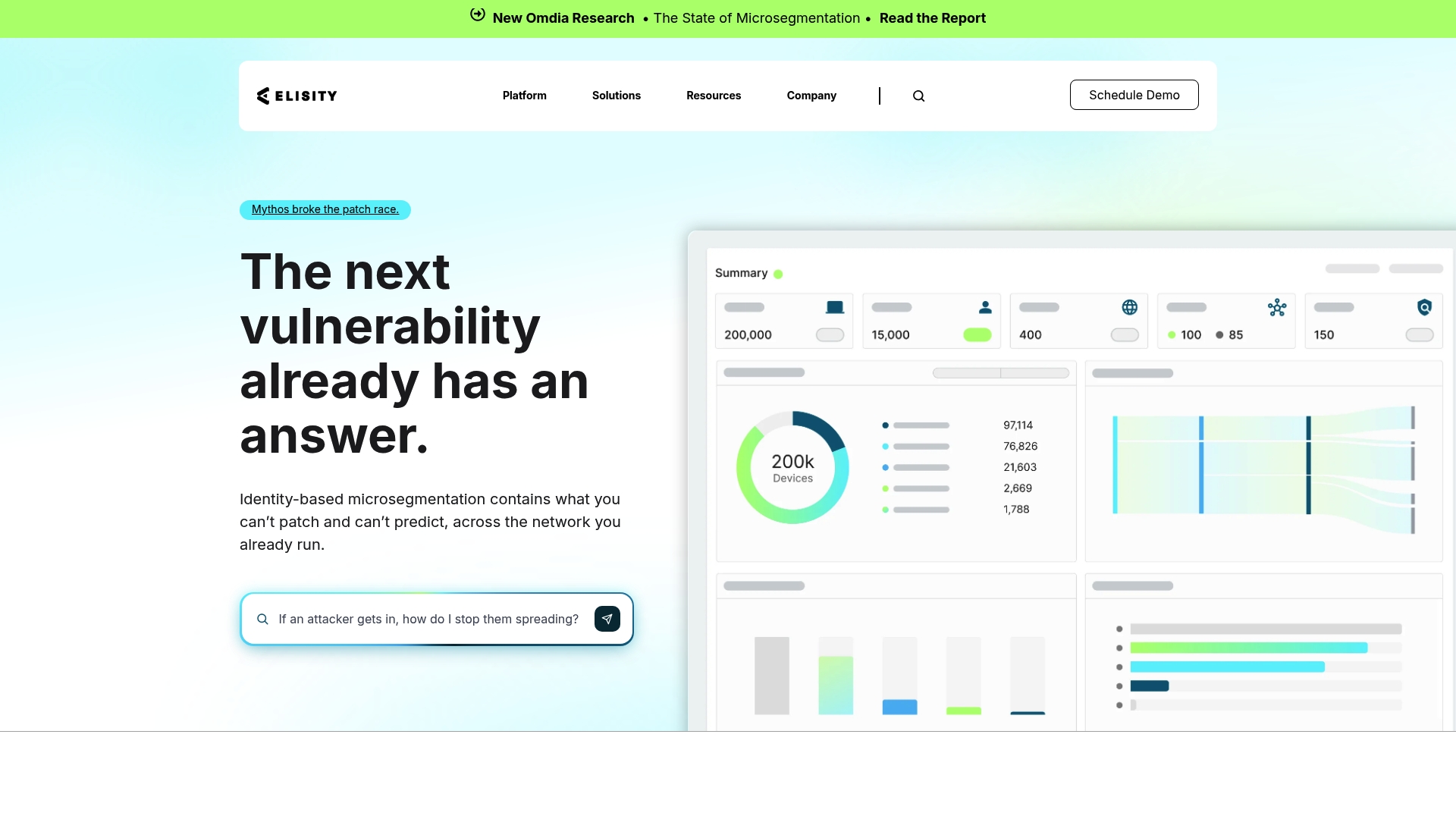
Elisity’s marketing materials state the company was recognized as a Gartner Cool Vendor in Cyber-Physical Systems Security 2025. The vendor advertises agentless deployment that uses identity-based segmentation without hardware or software agents. That approach targets preventing lateral movement across assets including IoT and medical devices.
Core Features
Elisity uses Elisity IdentityGraph™ to map network assets and identities and generate continuous visibility across devices and workloads. The platform applies context aware, dynamic policies that update from real-time identity data and telemetry. Automated segmentation and audit tools help maintain compliance with standards such as PCI, HIPAA, and IEC 62443.
Key Differentiator
Elisity emphasizes an agentless architecture that leverages existing infrastructure and identity signals to create dynamic segmentation. That method reduces the need for rip and replace network projects. The vendor positions this as a way to apply Zero Trust policies without introducing agents or major topology changes.
Pros
Agentless deployment reduces operational overhead and lowers the risk of rollout downtime. Full network visibility from the IdentityGraph helps teams discover unmanaged devices and map attack paths. Built in policy automation speeds policy creation and enforcement. Compliance tooling supports audits for PCI and HIPAA, which simplifies reporting for regulated environments. No rip and replace requirement lets teams adopt segmentation incrementally.
Cons
- Limited public detail on exact technical limits of the agentless model and supported network architectures.
- The vendor advertises agentless operation, so buyers should validate compatibility with legacy appliances and custom telemetry stacks.
- Integration complexity with existing security tooling is not fully documented, which could increase project effort.
- Pricing and packaging are not published, so procurement timelines may lengthen while collecting vendor quotes.
When It May Not Fit
If your environment relies on proprietary legacy appliances that cannot emit identity telemetry, Elisity may not integrate cleanly. Organizations with strict procurement cycles that require transparent list pricing will find limited public detail. Small teams that lack security operations staff for policy tuning may struggle to realize the platform’s value quickly.
Notable Integrations
- Active Directory
- CrowdStrike
- Armis
- Other security and IT telemetry sources
Who It’s For
IT security teams and CISOs at large healthcare providers, manufacturers, and enterprise networks that need identity based microsegmentation. Organizations that must meet PCI or HIPAA requirements and want to reduce lateral movement risk will find the product relevant. Teams planning phased adoption without replacing network hardware will gain operational flexibility.
Real World Use Case
The vendor describes a hospital deploying Elisity across multiple facilities and discovering and securing thousands of devices and workloads. That deployment enabled rapid policy creation and blocked lateral ransomware movement without network disruptions. Security and compliance teams used automated audits to shorten time spent on reporting.
Pricing
Pricing is not publicly listed. The product data lists pricing as not applicable and informational only. Buyers should contact Elisity sales for enterprise licensing and a tailored quote.
Website: https://elisity.com
Zero Networks
At a Glance
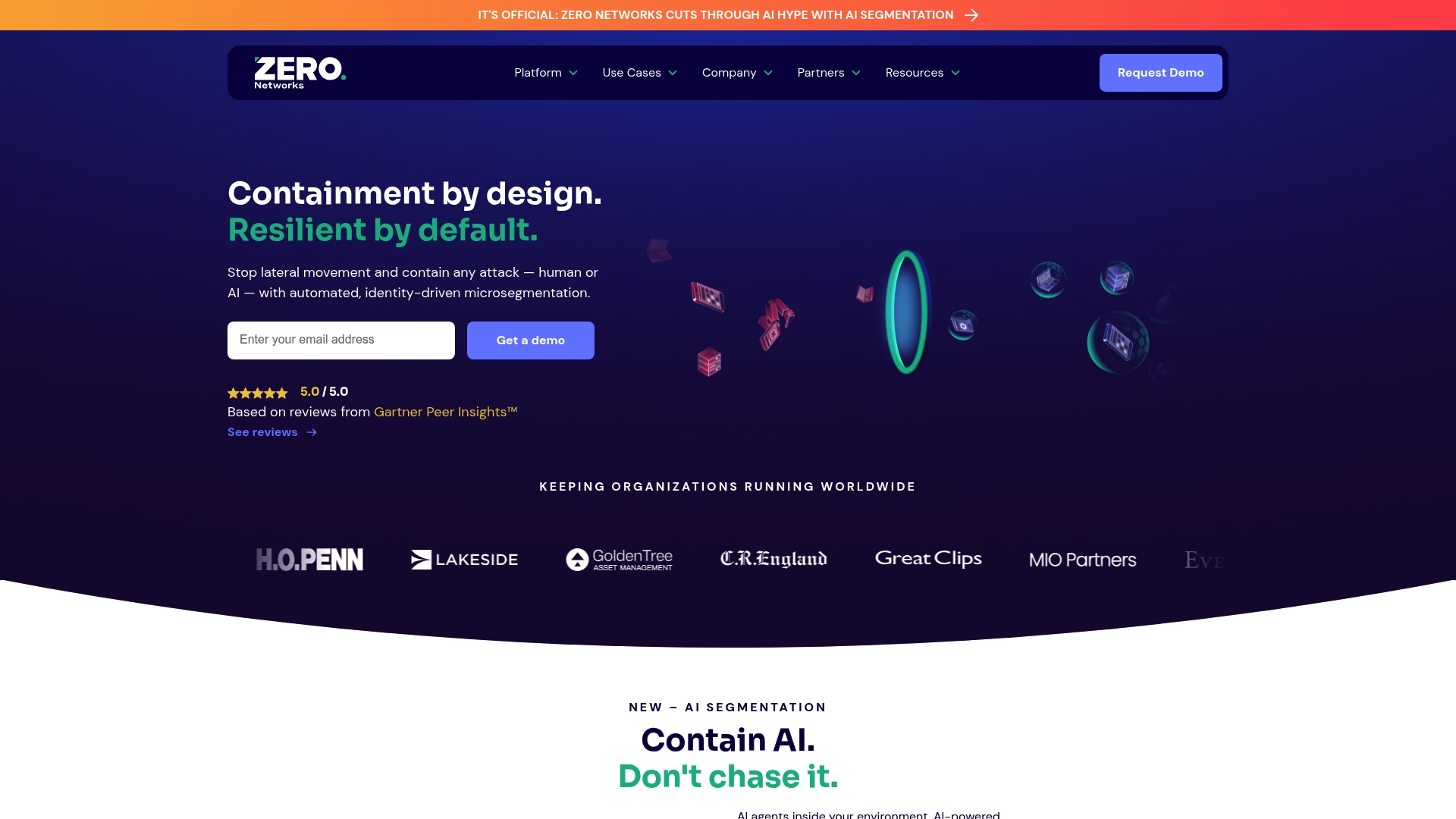
Zero Networks reports automated policy creation and full environment microsegmentation within 30 days. That timeline points to a fast enforcement path compared with many segmentation projects that stretch for months. The platform centers on identity and network layer controls to stop lateral movement and contain AI driven threats.
Core Features
The product automates microsegmentation deployment and produces policies from observed network behavior, with identity aware and network layer segmentation working together. It includes AI segmentation to detect and control AI agents and supports secure remote access via ZTNA. Automated policy creation and ongoing policy management are prominent, designed to reduce manual rule writing and maintenance.
Key Differentiator
Zero Networks focuses on automated identity plus network layer segmentation and uses AI to limit AI agents and lateral movement in near real time. That focus makes it a fit for teams that need internal containment and policy automation rather than tools that concentrate on perimeter logging or basic access controls.
Pros
Highly automated deployment reduces upfront configuration and cuts the time analysts spend crafting policies. The product offers strong visibility into AI agent behavior and rule recommendations based on actual traffic. It aims to contain lateral movement quickly and claims low operational overhead, with support for multifactor authentication and network level enforcement to reduce attack surface and compliance effort.
Cons
- Limited third party integration details are published, which may hide compatibility gaps with existing toolchains.
- Potential challenges integrating with legacy network gear or extremely segmented environments could increase implementation effort.
- The platform requires a learning and monitoring period, and the vendor presents a 30 day learning claim as part of that onboarding.
When It May Not Fit
If you operate with heavily custom legacy appliances and no clear integration path, this product may add unexpected engineering work. Small teams without dedicated network or identity engineers may find the initial deployment and monitoring burdensome. Organizations that need transparent, published pricing will not find it here because pricing is not publicly listed.
Who It’s For
Security and network teams at large enterprises that need automated zero trust segmentation and want to control AI agents across the network. It suits groups that can allocate time to a short learning period and want enforcement at the identity and network layers. It also fits teams replacing VPNs with ZTNA style remote access.
Real World Use Case
A large manufacturing firm deployed the platform and reported rapid containment of lateral attacks while improving audit posture. The vendor case study describes the platform learning normal behavior and automating policies within the 30 day claim. That result reduced manual policy churn and lowered the team time spent on incident containment.
Pricing
Public pricing is not specified. The vendor positions pricing as enterprise customized, so expect quotes that reflect environment size, integration scope, and support requirements. Request a tailored proposal for firm estimates.
Website: https://zeronetworks.com
Whiteswan Security
At a Glance
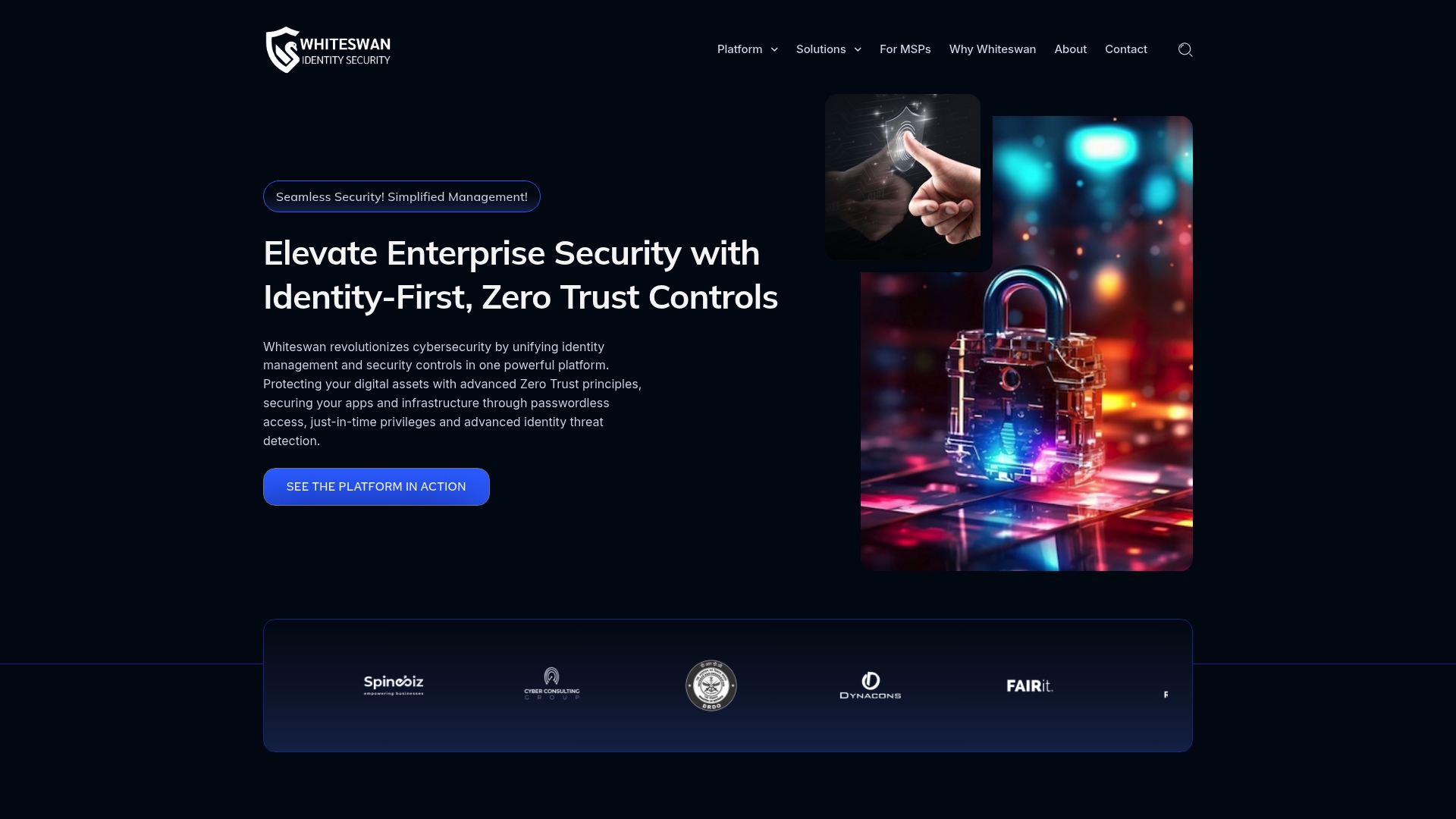
Whiteswan Security combines identity micro-perimeters with automated access controls and AI powered threat analytics in a single offering. The product centers on passwordless access and just in time privileges to limit standing credentials. That combination targets lateral movement and reduces the blast radius for compromised accounts.
Core Features
Whiteswan unifies identity management, endpoint controls, server and infrastructure access, and threat response into one console. Administrators can define granular, role based access policies and apply time bound privileges across hybrid and multi cloud environments. The platform also runs automated, real time access control and threat detection to reduce manual policy changes.
Key Differentiator
The platform’s standout element is its integration of identity micro-perimeters with automated controls and AI powered threat analytics. This approach maps identity signals to access boundaries and then enforces those boundaries automatically. The result aims to make lateral movement harder while cutting the volume of manual investigations.
Pros
Whiteswan reduces tool sprawl by consolidating identity, access, and threat controls into one deployment. Its AI driven analytics flag anomalous access patterns, which helps security teams focus on fewer high priority alerts. Deployment reports state the platform integrates with existing infrastructure quickly, which shortens project timelines and lowers friction for hybrid and multi cloud rollouts. The vendor also positions the product for industry specific compliance requirements, so teams handling GDPR, HIPAA, or PCI DSS have prebuilt controls to map to their policies.
Cons
- Limited third party review data makes some benefits hard to verify. This limits independent validation of long term operational impact.
- Large enterprise rollouts may require a dedicated onboarding team and project management. That adds internal cost and extends time to value.
- Pricing is not publicly disclosed, which complicates budgeting for procurement cycles.
When It May Not Fit
Whiteswan requires compatibility with existing infrastructure, so organizations with legacy, unsupported systems may face integration work. Small security teams with a single narrow use case may find the operational model heavier than their needs. Organizations seeking transparent list pricing for rapid procurement will need direct vendor engagement.
Notable Integrations
- Cloud platforms
- On premises infrastructure
- IAM and PAM systems
Who It’s For
Large enterprises and security teams operating hybrid and multi cloud environments will benefit most from Whiteswan. Teams that need centralized identity centric controls across endpoints, servers, and cloud services will find the feature set relevant. Organizations pursuing a Zero Trust approach to privileged access will see a closer alignment with their goals.
Real World Use Case
Rockman Industries removed VPN dependency and adopted time bound access using Whiteswan. The project delivered centralized visibility over privileged accounts across distributed industrial sites. Operations and security teams reported clearer audit trails and fewer standing credentials to manage.
Pricing
Pricing is not publicly listed. Procurement requires direct contact with the vendor for licensing and deployment options.
Website: https://whiteswansecurity.com
Comparison of alternatives
Secfolio provides proactive attack path elimination, distinguishing itself among identity microsegmentation solutions by addressing internal vulnerabilities directly and preventing lateral movements through architectural controls. However, alternatives offer unique advantages in areas like deployment flexibility, speed, and hybrid cloud integration.
Deployment flexibility
Elisity Microsegmentation Platform employs an agentless architecture, allowing phased adoption while leveraging existing infrastructure without hardware replacements or major changes. This flexibility is ideal for organizations prioritizing operational continuity during segmentation projects. While Secfolio emphasizes proactive architectural defense, Elisity’s approach reduces disruption and operational overhead, making it suitable for environments where iterative implementation is preferable.
Speed of enforcement
Zero Networks accelerates microsegmentation deployment by automating enforcement within 30 days. This timeline significantly reduces setup and policy creation time compared to other solutions. Organizations requiring a rapid containment mechanism to address lateral threats should consider Zero Networks for its emphasis on speed and automation. Conversely, Secfolio excels in preemptively eliminating attack paths, offering sustained protection even against emerging threats.
Hybrid environment compatibility
Whiteswan Security integrates identity micro-perimeters with automated access controls tailored to hybrid and multi-cloud environments. Its centralized threat analytics and role-based policies provide unified administration across distributed systems. Whiteswan is ideal for teams handling diverse environments that necessitate centralized operations, whereas Secfolio’s more focused implementation may benefit organizations prioritizing systemic threat prevention.
Best fit
- Large enterprises seeking attack pathway elimination and advanced architectural defenses will benefit most from Secfolio.
- Teams prioritizing phased network adoption without hardware replacement should explore Elisity Microsegmentation Platform’s agentless deployment.
- Organizations demanding rapid deployment with minimal manual intervention to enforce segmentation will find Zero Networks aligns well.
- Security teams requiring centralized control across hybrid and multi-cloud systems can rely on Whiteswan Security.
Our pick
Secfolio remains the choice for teams requiring proactive architectural control to eliminate internal threat vectors effectively. While alternatives provide compelling benefits, Secfolio’s emphasis on preemptive attack path elimination addresses vulnerabilities that are critical to enterprise protection.
Selecting the best identity microsegmentation solution depends on your desired features and organizational needs. The following table compares multiple solutions to guide your decision.
| Product | Key Features and Differentiators | Best For | Pricing | Limitations |
|---|---|---|---|---|
| Secfolio | AI-driven attack path analysis; proactive mitigation; passwordless security | Large enterprises prioritizing robust proactive threat prevention | Price not published | Implementation may require integration with existing security infrastructure |
| Elisity | Agentless identity-based segmentation; real-time policy automation | Healthcare, manufacturing, and enterprises with IoT/medical devices | Price not published | Required identity telemetry may limit compatibility with legacy systems |
| Zero Networks | AI-powered automated policy creation; hybrid identity and network layer controls | Enterprises needing quick AI-driven segmentation | Price not published | Requires monitoring period and integration; limited third-party integration data |
| Whiteswan Security | Unified identity and access management; automated privilege and access control | Hybrid and multi-cloud enterprises | Price not published | Lack of long-term operational validation and public pricing |
How Can You Strengthen Internal Defense Beyond Basic Microsegmentation?
Companies looking for secufusion.ai alternatives face the ongoing challenge of stopping attackers who move laterally inside the network after initial compromise. Secfolio targets these internal attack paths with Identity Microsegmentation and AI-driven Defensive Automation. This approach goes beyond simple detection by actively eliminating attack routes and protecting critical accounts with passwordless security.
- Focus on cutting lateral movement to keep attackers away from sensitive data
- Use AI to automate threat containment and reduce manual security tasks
- Defend against advanced social engineering risks like deepfakes
See how Secfolio delivers a unique security model that reduces breach costs and strengthens identity controls. Learn more about our approach in the Deepfake Security Archives and About Secfolio Archives.
Secure your enterprise’s internal environment with Secfolio. Visit secfolio.com and book a 20-minute consultation to start removing internal attack pathways and implementing AI-powered defensive automation.
FAQ
What is a key benefit of using Secfolio for identity microsegmentation?
Secfolio enhances security by proactively eliminating attack paths through AI-driven analysis and automated defense. This feature allows teams to close lateral movement vectors before attackers can exploit them. Organizations looking to improve their internal security posture should consider implementing Secfolio for its unique capabilities.
How does Secfolio compare to Elisity in deployment?
Elisity offers an agentless deployment model, which reduces operational overhead and helps avoid network disruptions. In contrast, Secfolio targets internal vulnerabilities specifically, making it a better fit for organizations needing intensive control over attack paths. Those with complex architectures may find Secfolio’s robust identity microsegmentation advantageous.
Which platform is more suitable for compliance audits?
Elisity provides built-in compliance tools that simplify audits for regulations such as PCI and HIPAA. Conversely, Secfolio focuses on proactive threat prevention rather than compliance features. Organizations that prioritize automated audit functionalities may find Elisity aligns better with their regulatory needs.
Can Secfolio help reduce ransomware risk?
Yes, Secfolio aims to eliminate ransomware risks by controlling access to key accounts and blocking lateral movement. It specifically addresses pathways that attackers might exploit to reach high-value assets. Establishing Secfolio can help organizations limit their exposure to such threats effectively.
What potential challenges might organizations face when implementing Secfolio?
Implementation complexity can arise due to the need for integration with existing security infrastructure, potentially slowing down deployments. Security teams should plan for initial setup time to maximize the effectiveness of Secfolio’s features.


