

Security drift is defined as the gradual, cumulative divergence of an organization’s live security state from its intended secure baseline. The formal industry term is configuration drift, though security drift has become the broader operational term covering identity, network, and compliance deviations together. Every untracked change, emergency fix, or undocumented exception moves your environment further from the state your security controls were designed to protect. The NIST Cybersecurity Framework treats baseline integrity as a core control requirement, and CISSP exam bodies now include drift as a distinct risk category. Understanding security drift means recognizing it as a process, not a single event.
What is security drift and why does it happen?
Security drift is a gradual, cumulative divergence from an organization’s intended secure baseline caused by many low-risk but untracked changes that aggregate over time. No single change breaks your security posture. The problem is that dozens of small changes, each individually justifiable, compound into a live environment that bears little resemblance to your documented secure state.
The mechanics are straightforward. A firewall rule gets opened for a vendor during a weekend incident. A cloud storage bucket gets made public to meet a deadline. A privileged account gets created for a contractor and never removed. Each change feels minor in isolation. Together, they lower the effort required for an attacker to gain access.

Human error accounts for over 50% of security incidents in dynamic environments, with temporary exceptions frequently becoming permanent. That statistic reflects a governance failure, not just a technical one. When teams bypass change management under pressure, the exception becomes the new normal.
Dynamic cloud infrastructures accelerate this problem significantly. Auto-scaling, containerized workloads, and infrastructure-as-code pipelines create configuration changes at machine speed. Periodic security assessments cannot keep pace with environments that change hundreds of times per day.
Common causes of security drift include:
- Ad-hoc changes made outside formal change management processes
- Emergency fixes applied during incidents that are never rolled back
- Cloud infrastructure scaling that introduces new default configurations
- Stale user accounts and excessive privileges left after role changes
- Undocumented integrations between systems that bypass security controls
- Temporary firewall exceptions that outlive their original purpose
Pro Tip: Tag every emergency change at creation with an expiration date and owner. Unowned, undated exceptions are the single largest source of drift in most enterprise environments.
What are the risks of unchecked security drift?
Unchecked drift does not just weaken your defenses. It actively creates attack opportunities that did not exist in your original design. Attackers exploit the difference between expected and live system states, using stale privileges, open ports, and undocumented access paths as low-effort entry points. This is a critical insight: most breaches do not require zero-day exploits. They require finding the gap between what you think your environment looks like and what it actually is.
The consequences of drift accumulate across three distinct dimensions:
- Baseline decay. Your documented security controls no longer reflect reality. Audit reports certify a state that does not exist in production. Security teams make decisions based on outdated maps.
- Visibility erosion. As configurations diverge, monitoring tools generate more noise and miss more signal. Alerts tuned for your baseline fire incorrectly against your drifted state, or miss threats entirely.
- Control fragmentation. Compensating controls that relied on each other stop working together. A network segmentation rule that assumed a specific firewall configuration becomes ineffective when that configuration silently changes.
“Compliance certification snapshots mask real-time security posture decay. Continuous compliance monitoring is necessary to close this gap.” — Ampcus Cyber
External drift, such as DNS record changes or firewall rule modifications, is immediately visible to attackers. Internet scanners and botnets detect exposed services within hours. Internal drift, such as excessive privileges or misconfigured identity policies, can go unnoticed for months. That asymmetry is what makes internal drift so dangerous. Your team may not know about it. The attacker will eventually find it.
Compliance drift compounds the risk further. Environments diverge between audits, creating invisible security gaps despite certified status. A SOC 2 or ISO 27001 certification reflects a point-in-time snapshot. The live environment may have drifted significantly before the next audit cycle begins.
How is security drift detected and monitored effectively?
Detecting security drift requires continuous validation, not periodic audits. The gap between those two approaches is where most organizations get compromised. A quarterly vulnerability scan tells you what your environment looked like on the day of the scan. Continuous monitoring tells you what changed in the last 15 minutes.
| Detection approach | Scope | Frequency | Drift visibility |
|---|---|---|---|
| Periodic vulnerability scans | Known CVEs, patch levels | Weekly or monthly | Low. Misses configuration and identity drift |
| Configuration audits | File, registry, network settings | Quarterly | Medium. Catches drift but not in real time |
| Continuous automated monitoring | Identity, cloud config, network state | Real time | High. Detects deviations as they occur |
| Runtime baseline comparison | Live state vs. declared state | Continuous | Highest. Flags any divergence immediately |
Continuous automated monitoring compares your live environment against a declared secure baseline at all times. When a configuration deviates, an alert fires immediately rather than waiting for the next audit cycle. This approach covers three critical drift vectors: identity drift (stale accounts, privilege creep, orphaned service accounts), network drift (firewall rule changes, open ports, routing modifications), and cloud configuration drift (storage permissions, IAM policy changes, security group modifications).
Most organizations lack full visibility into live configuration states. Research shows 96% store secrets insecurely and 97% carry excessive privileges that fuel drift risks. Those numbers explain why drift is so common and so hard to detect without purpose-built tooling. Manual reviews simply cannot cover the surface area.
Pro Tip: Integrate configuration state checks directly into your CI/CD pipeline. Catching drift at deployment time costs a fraction of what it costs to remediate it after production exposure.
Traditional scanning tools were built to find known vulnerabilities, not to track configuration state over time. They answer the question “is this system patched?” not “has this system drifted from its secure baseline?” Those are fundamentally different questions requiring different tooling.
What strategies prevent or mitigate security drift?
Preventing security drift requires operational discipline backed by automation. Neither alone is sufficient. Discipline without automation fails at scale. Automation without discipline produces alerts that no one acts on.
Shifting from point-in-time checks to continuous validation with automation is the core requirement for effective drift mitigation. Manual, case-by-case fixes actually increase drift over time because they introduce additional undocumented changes. Systematic, automated correction is the only approach that scales.
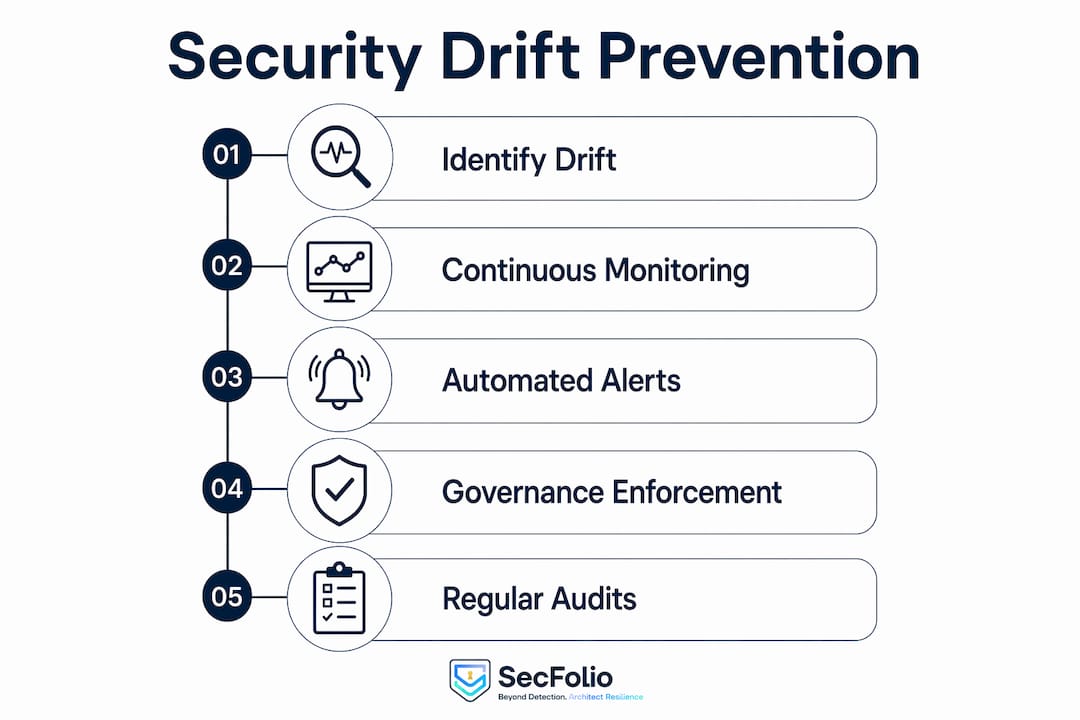
Effective drift prevention strategies include:
- Define codified secure baselines. Document your intended security state in machine-readable formats such as CIS Benchmarks or NIST SP 800-53 control catalogs. A baseline you cannot compare against automatically is not operationally useful.
- Automate detection and remediation. Deploy tools that continuously compare live state against baseline and either alert or auto-remediate deviations. Auto-remediation is appropriate for low-risk drift. High-risk drift should trigger human review.
- Enforce change management without exceptions. Every change, including emergency changes, must go through a documented process. Emergency changes should be reviewed and either formalized or rolled back within 24 hours.
- Integrate drift detection into DevOps pipelines. Security checks at the infrastructure-as-code level catch drift before it reaches production. Policy-as-code tools enforce configuration standards at deployment time.
- Conduct continuous compliance monitoring. Replace annual or quarterly compliance reviews with automated control monitoring that flags deviations in real time. This closes the gap between audit snapshots and live posture.
- Manage identity drift explicitly. Audit privileged accounts, service accounts, and API keys on a continuous basis. Privilege creep is one of the fastest-growing sources of drift in cloud environments.
Security drift is fundamentally an operational process failure, caused by bypassing or ignoring governance rather than purely technical failure. Temporary fixes become permanent exposures when no one owns the remediation. Assigning explicit ownership to every exception, with a defined expiration, is the single most effective governance control most organizations are not using.
Secfolio’s Identity Microsegmentation approach directly addresses the identity and privilege drift that enables lateral movement after initial access. By continuously mapping and enforcing identity boundaries, it eliminates the stale access paths that drift creates.
Key Takeaways
Security drift is an operational governance failure that compounds silently until attackers find the gap between your declared security state and your live environment.
| Point | Details |
|---|---|
| Drift is cumulative, not sudden | Small, untracked changes aggregate into significant exposure over weeks or months. |
| Internal drift is the most dangerous | Excessive privileges and stale accounts go undetected far longer than external configuration changes. |
| Periodic audits are insufficient | Continuous automated validation against a declared baseline is the only effective detection method. |
| Governance failures drive drift | Emergency fixes that are never rolled back are the primary operational cause of persistent drift. |
| Automation must back discipline | Systematic automated remediation scales where manual case-by-case fixes fail and increase drift. |
The “secure once” mindset is the real problem
Most security teams I have worked with understand drift conceptually. The harder problem is organizational. Security gets treated as a project with a completion date. You deploy a new firewall policy, pass the audit, and move on. Six months later, three emergency exceptions have been added, two cloud accounts have been created outside the provisioning process, and a contractor’s admin account is still active. The environment has drifted substantially. Nobody planned for it. Nobody noticed.
The uncomfortable truth is that attackers exploit live exceptions created by drift rather than novel zero-day vulnerabilities. They are not looking for the sophisticated attack. They are looking for the gap between what you think is locked down and what is actually open. That gap is almost always created by operational shortcuts, not technical failures.
The teams that manage drift well share one characteristic: they treat security as a continuous operational state, not a certification milestone. They have automated baselines, they review exceptions weekly, and they have made “no undocumented changes” a cultural norm rather than a policy aspiration. That shift is harder than buying a new tool. It requires changing how security work gets prioritized and measured.
One overlooked drift source I see consistently: service account proliferation in cloud environments. Every new integration creates a new service account. Those accounts accumulate permissions over time. Nobody reviews them because they are not human identities. They sit quietly, accumulating privilege, until an attacker finds one with excessive access to a critical system. Treating service accounts with the same rigor as human privileged accounts closes this gap faster than almost any other single control.
— James
How Secfolio addresses security drift in enterprise environments
Security drift is a continuous problem that requires a continuous response. Secfolio’s configuration management platform enforces declared security baselines across identity, network, and cloud configurations in real time, flagging deviations before they become exploitable gaps.

Secfolio’s Defensive Automation continuously compares live environment state against your codified baseline and triggers remediation workflows without waiting for the next audit cycle. For identity drift specifically, Secfolio’s credential and privilege management tools eliminate stale access paths and excessive permissions that attackers rely on after initial access. Organizations using Secfolio’s continuous validation approach reduce their mean time to detect configuration drift from weeks to minutes.
FAQ
What is the security drift definition in cybersecurity?
Security drift is the gradual divergence of an organization’s live security configuration from its intended secure baseline, caused by accumulated untracked changes over time. The formal industry term is configuration drift, though security drift encompasses identity, compliance, and network deviations as well.
What causes security drift to accumulate?
The primary causes are emergency fixes that are never rolled back, ad-hoc changes made outside change management, cloud infrastructure scaling, and privilege creep from unreviewed user accounts. Human error accounts for over half of incidents in dynamic environments where temporary exceptions become permanent.
How is security drift detected effectively?
Continuous automated monitoring that compares live system state against a declared secure baseline detects drift in real time. Periodic audits and vulnerability scans miss configuration and identity drift because they only capture a point-in-time snapshot.
Why is internal drift more dangerous than external drift?
External configuration changes, such as open firewall ports, are detected by internet scanners within hours. Internal drift, including stale privileges and misconfigured identity policies, can go unnoticed for months, giving attackers extended time to exploit access paths.
How do you prevent security drift long-term?
Preventing drift requires codified secure baselines, automated continuous monitoring, strict change management with no undocumented exceptions, and integration of configuration checks into DevOps pipelines. Operational discipline and automation must work together for drift prevention to scale.


