

Why internal vulnerabilities cause breaches more often than external attacks
Internal vulnerabilities are the leading driver of data breaches in modern enterprises, not sophisticated nation-state hackers probing your perimeter. The Verizon DBIR 2026 found that 60% of malicious-insider breaches fall into the “convenience” motivation category, meaning most insider damage comes from people cutting corners, not plotting sabotage. Separately, exploited vulnerabilities now account for 31% of all breach initiation vectors, surpassing stolen credentials at 13%. The pattern is consistent: attackers find the path of least resistance, and that path runs through your own systems.
Three factors make internal vulnerabilities uniquely dangerous:
- Insider threats (malicious and accidental): Employees, contractors, and service accounts already hold legitimate access, so their activity blends with normal traffic and rarely triggers alerts.
- Human error: Misconfigured storage buckets, misdirected emails, and weak password practices create openings that external attackers exploit before your team notices.
- Privilege escalation: Once an attacker or rogue insider gains a foothold, unpatched flaws and loose access controls let them climb to administrator level and move laterally across systems.
- Detection delays: Valid credentials accessing systems as designed produce no anomalous signal, giving attackers months of undetected dwell time.
- Perimeter-only thinking: Organizations that invest heavily in firewalls and endpoint detection while neglecting internal monitoring leave the interior of their network largely unwatched.
What a data breach actually is, and why internal factors drive severity
A data breach is any incident in which unauthorized parties access, exfiltrate, or expose protected information, whether that is customer records, financial data, or internal strategic documents. The definition sounds simple, but the breach landscape is not split evenly between inside and outside threats.

Internal data, including emails, strategic plans, and internal reports, appeared in 67% of breaches, while personal data appeared in only 23%. That gap is striking. Attackers prioritize what is most valuable to them, and internal operational data often carries more leverage for extortion, competitive espionage, or further infiltration than a list of customer emails.
Why do internal vulnerabilities amplify severity so dramatically? Three reasons stand out. First, internal actors already know where sensitive data lives, so exfiltration is faster and more targeted. Second, breaches originating internally tend to go undetected longer, giving attackers more time to extract data or deploy ransomware. Third, the blast radius is wider: an insider with broad access can reach finance, HR, and product systems simultaneously, whereas an external attacker typically needs to chain multiple exploits to get there.
The practical implication for cybersecurity teams:
- Perimeter defenses stop external entry attempts but do nothing once a threat is already inside.
- Internal monitoring, data classification, and access controls are the controls that actually limit breach severity.
- Compliance-driven data classification, which focuses on personal data under frameworks like HIPAA or PCI DSS, misses the internal operational data that attackers actually target most.
Common types of internal vulnerabilities that lead to data breaches
Internal security vulnerabilities span a wider range than most security teams formally catalog. The categories below are the ones that show up repeatedly in breach post-mortems.
- Malicious insiders: Employees or contractors who deliberately steal data, sabotage systems, or sell access. These actors are the minority of insider incidents but cause disproportionate damage because their actions are intentional and targeted.
- Accidental insiders: The far more common category. A developer who pastes credentials into a public repository, an HR manager who emails a spreadsheet to the wrong address, or a finance analyst who clicks a phishing link all qualify. The Verizon DBIR data on convenience-driven breaches reflects this group heavily.
- Third-party contractors with excessive access: Vendors and managed service providers often receive broader permissions than their work requires. When their credentials are compromised, attackers inherit that access wholesale.
- Unpatched legacy systems: The median time to patch a critical vulnerability rose to 43 days in 2025. Every day in that window is an open door. Legacy systems that cannot accept modern patches extend that window indefinitely. Secfolio’s analysis of legacy system risks covers this in depth.
- Misconfigurations: Cloud storage left publicly accessible, overly permissive IAM roles, and default credentials on internal services are among the most common entry points for both insiders and external attackers who have gained a foothold.
- Shadow IT: Employees adopt SaaS tools outside IT’s visibility, creating data flows that bypass DLP controls and logging infrastructure entirely.
- Insecure access controls: Flat network architectures where any authenticated user can reach any resource let a single compromised account become a full network compromise.
- Metadata exposure: Repository names, OAuth application labels, and service account naming conventions reveal privilege relationships and system architecture without exposing a single credential. Attackers use this context to plan targeted moves before touching anything that would trigger an alert.
Pro Tip: Map your SaaS application inventory quarterly. Shadow IT tools discovered during a breach investigation are almost always tools IT knew nothing about. A lightweight IT governance practice of requiring employees to register new tools before use catches most shadow IT before it becomes a liability.
Real-world examples of breaches caused by internal weaknesses
The gap between theory and practice closes fast when you look at what actually happened in documented incidents. Internal vulnerabilities are not abstract risks; they are the mechanism behind some of the most damaging breaches on record.
The pattern of credential-based internal access enabling long dwell times appears across breach categories. Consider what that means operationally: an attacker who compromises a single employee account through phishing, then uses that foothold to escalate privileges, can spend weeks mapping the environment before exfiltrating anything. By the time forensics teams reconstruct the timeline, the damage is complete.
| Breach category | Internal vulnerability exploited | Typical outcome |
|---|---|---|
| Insider data theft | Excessive access permissions, no DLP controls | Targeted exfiltration of strategic or financial data |
| Accidental exposure | Misconfigured cloud storage or misdirected email | Regulatory notification, reputational damage |
| Credential compromise | Phishing leading to valid session hijack | Lateral movement, ransomware deployment |
| Vendor/contractor breach | Overprivileged third-party accounts | Supply chain compromise, data exfiltration |
| Unpatched system exploitation | Known CVE on internal-facing server | Privilege escalation, persistent backdoor |
The financial consequences follow a predictable arc. Regulatory fines under frameworks like GDPR or HIPAA compound the direct remediation costs. Legal liability from affected customers or partners adds another layer. Organizations that experience a breach driven by an internal misconfiguration or an unpatched system often discover that their cyber insurance policy excludes coverage for “known vulnerabilities,” meaning the patch they deferred becomes a multi-million-dollar decision in hindsight.
Internal vulnerability assessments run before a breach, not after, are the practical countermeasure. They surface the exact misconfigurations and access control gaps that show up in these breach categories.
Strategies for preventing and mitigating internal vulnerabilities
Prevention requires layering controls that assume internal threats exist, not just external ones. The zero-trust model is the right architectural frame: verify every user and device continuously, grant the minimum access needed for each task, and never extend implicit trust based on network location.
- Role-based access control (RBAC) with least privilege: Every account should hold only the permissions its role requires. Quarterly access reviews catch privilege creep before it becomes a liability.
- Continuous verification: Zero-trust architecture means re-authenticating and re-authorizing sessions based on behavior, device health, and context, not just a login event from hours ago.
- Patch management on a defined SLA: With the median patch window now at 43 days for critical vulnerabilities, teams need a formal service-level agreement that treats critical CVEs as P1 incidents requiring remediation within 24–72 hours.
- Configuration hardening: Automated configuration management tools detect drift from security baselines in real time, catching misconfigurations before attackers do.
- Data classification beyond compliance: Only 33% of organizations know where all their sensitive data resides. Expanding classification to include strategic plans, M&A documents, and internal reports aligns protection with what attackers actually target.
- Technical controls at the data layer: Policies that rely on user compliance fail against accidental insiders and shadow IT. DLP controls enforced at the data layer, not the user layer, catch exfiltration regardless of intent.
- Immutable audit logs stored independently: Audit logs controlled by the same administrators who manage system access can be edited or deleted. Independent log aggregation removes that conflict and preserves forensic integrity.
Pro Tip: Deploy AI-driven user and entity behavior analytics (UEBA) tools that baseline normal activity per user and per role. An insider moving data at 2 AM on a Saturday looks identical to a legitimate user to a static rule engine. A behavioral baseline catches it within minutes.
How privilege escalation turns internal vulnerabilities into full breaches
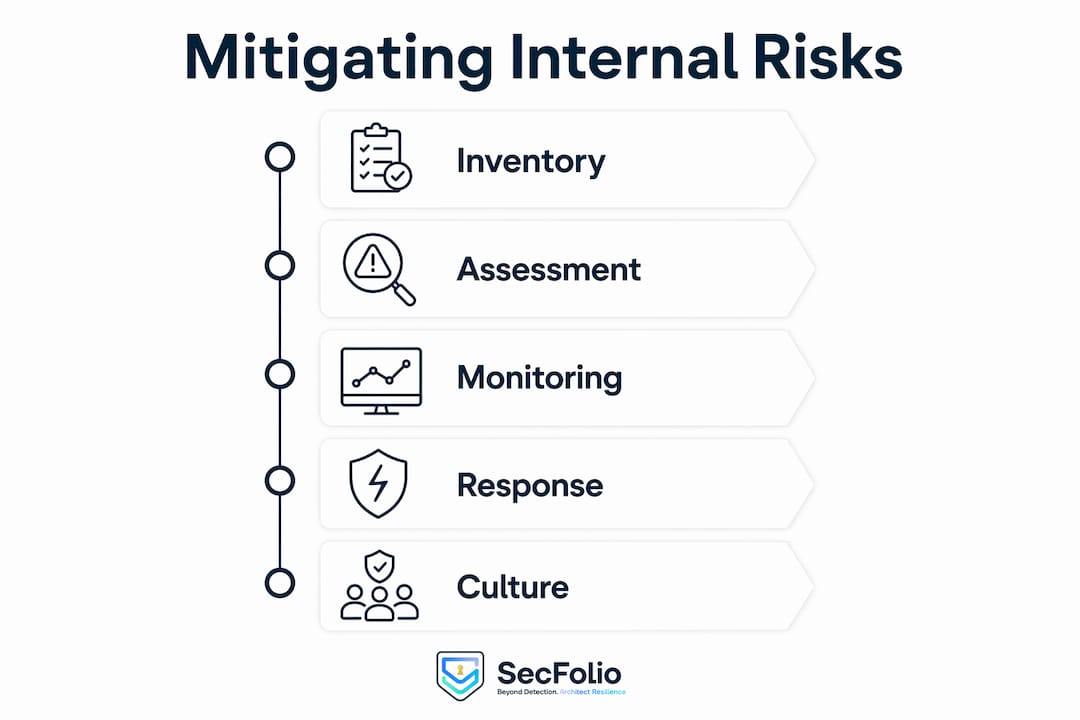
Privilege escalation is the mechanism that converts a minor internal vulnerability into a catastrophic breach. An attacker or malicious insider who starts with standard user access can, through a single unpatched flaw, reach administrator-level control over the entire environment.
Over 55% of internal security threats involve exploiting vulnerabilities to reach administrator access. The escalation path typically follows a predictable sequence: initial access through a compromised credential or phishing, lateral movement across systems using that access, exploitation of an unpatched internal service to gain elevated permissions, and finally persistence through backdoors or scheduled tasks that survive credential resets.

| Escalation stage | Technique commonly used | Detection opportunity |
|---|---|---|
| Initial access | Phishing, credential stuffing | Email gateway, MFA enforcement |
| Lateral movement | Pass-the-hash, SMB relay | Network segmentation, UEBA alerts |
| Privilege escalation | Unpatched CVE exploitation, token manipulation | Vulnerability scanning, privilege monitoring |
| Persistence | Scheduled tasks, registry modification | Endpoint detection, log review |
| Exfiltration | Encrypted channel, cloud sync abuse | DLP, egress monitoring |
What makes this sequence so damaging is that each stage uses legitimate system features. Pass-the-hash uses Windows authentication. Cloud sync abuse uses approved SaaS tools. Without lateral movement prevention controls that segment the internal network and restrict east-west traffic, an attacker who completes the escalation sequence faces no meaningful barrier to reaching any system in the environment.
Pro Tip: Run internal vulnerability scans on the same schedule as external scans. Most teams scan their perimeter weekly but scan internal systems monthly or quarterly. The gap is where privilege escalation chains live.
Detecting breaches that originate from internal vulnerabilities
Detection is harder for internal-origin breaches than for external attacks, precisely because the activity looks legitimate. A user accessing files they are authorized to access, at a time they sometimes work, from a device they own, generates no alert in a rule-based system.
Effective detection requires layering multiple signals:
- User and entity behavior analytics (UEBA): Establishes behavioral baselines per user and role, then flags deviations like bulk downloads, off-hours access, or access to systems outside normal job function.
- Audit log monitoring with independent aggregation: Logs stored in the same environment they monitor can be tampered with. Shipping logs to an independently aggregated system outside administrator control preserves their evidentiary value.
- Real-time privilege misuse alerts: Any attempt to access resources outside a user’s assigned role, or any privilege escalation event, should trigger an immediate alert, not a daily digest.
- Data loss prevention (DLP) on egress paths: Monitor email, cloud sync, USB, and web upload channels for data matching classification policies. DLP catches accidental insiders as effectively as malicious ones.
- Correlation of internal and external scan results: A vulnerability flagged in an external scan that also appears on an internal-facing system is a priority target. Cross-referencing both scan outputs closes the gap.
The challenge is alert fatigue. Security operations centers that generate thousands of alerts daily train analysts to ignore them. The solution is not more alerts; it is better prioritization. Behavioral analytics tools that score risk per user and surface only the top anomalies give analysts something they can actually act on.
Pro Tip: Build an insider threat-specific incident response playbook before you need it. Generic IR plans assume an external attacker. An insider threat scenario requires different containment steps, including preserving HR records, coordinating with legal counsel, and managing the investigation without tipping off the subject.
How organizational culture shapes internal vulnerability risk
Culture is not a soft factor in cybersecurity. It is a hard control. Organizations where security is treated as IT’s problem rather than everyone’s responsibility consistently show higher rates of accidental insider incidents, shadow IT adoption, and phishing susceptibility.
The connection between culture and breach risk runs through behavior. Employees who feel that security policies are obstacles rather than protections find workarounds. They email files to personal accounts to work from home. They use unapproved SaaS tools because the approved ones are slow. They share passwords because the MFA process is cumbersome. Each workaround creates an internal vulnerability that no technical control was designed to catch.
Security awareness training helps, but only when it is specific, frequent, and tied to real consequences. Annual compliance training that covers phishing in the abstract does not change behavior. Simulated phishing campaigns with immediate feedback, role-specific training that shows a finance analyst exactly what a wire fraud attempt looks like, and visible leadership commitment to security norms all move the needle. The insider threat landscape includes careless and negligent employees as prominently as malicious ones, and culture is the primary lever for that population.
One underappreciated dynamic: security teams that punish employees for reporting mistakes create environments where errors go unreported until they become breaches. A no-blame reporting culture, where an employee who clicks a phishing link immediately reports it rather than hoping no one notices, cuts dwell time dramatically.
Case studies: when overlooked internal vulnerabilities became major breaches
The most instructive breach cases share a common thread: the vulnerability was known, or at least knowable, before the incident. Post-mortems consistently reveal that the warning signs were there.
The 2020 SolarWinds supply chain attack is the canonical example of how internal trust relationships become weapons. Attackers compromised SolarWinds’ build pipeline, a deeply internal process, and used that access to distribute malicious updates to thousands of customers. The internal vulnerability was not a misconfigured server; it was an implicit trust relationship between the build system and the update delivery mechanism that no one had formally reviewed.
The 2022 Uber breach followed a different path. A contractor’s credentials were compromised through social engineering, and the attacker used those credentials to access Uber’s internal systems. The critical failure was not the phishing itself but the absence of MFA enforcement and the excessive access the contractor account held. Once inside, the attacker found an internal network share containing scripts with hardcoded credentials for privileged systems, a textbook case of how metadata and poor secrets management combine to amplify a single compromised account into a full environment compromise.
Healthcare organizations provide a steady stream of accidental insider cases. Employees accessing patient records outside their care relationship, often out of curiosity rather than malice, represent a category of breach that technical controls like attribute-based access control can prevent but that most organizations have not deployed. The regulatory consequences under HIPAA are identical whether the access was malicious or accidental.
The pattern across these cases: the internal vulnerability that enabled the breach was not exotic. It was a known gap that had been deprioritized, deferred, or simply not inventoried.
Legal and compliance implications of internal vulnerabilities
Internal vulnerabilities carry legal exposure that extends well beyond the breach itself. Regulators do not distinguish between breaches caused by external attackers and those caused by internal failures when assessing penalties. The question they ask is whether the organization had reasonable controls in place.
Under GDPR, organizations face fines up to 4% of global annual turnover for failures to implement appropriate technical and organizational measures, a standard that explicitly covers internal access controls, data classification, and employee training. HIPAA’s Security Rule requires covered entities to implement safeguards against internal threats, including workforce training, access management, and audit controls. The FTC’s Safeguards Rule, updated in 2023, requires financial institutions to implement multi-factor authentication, encrypt sensitive data, and monitor for unauthorized access, all of which directly address internal vulnerability categories.
The litigation exposure compounds the regulatory risk. Class action suits following breaches routinely allege that the organization failed to implement industry-standard controls. When discovery reveals that a known vulnerability went unpatched for 43 days, or that audit logs were stored in a location administrators could modify, those facts become evidence of negligence rather than bad luck.
Cyber insurance is the third dimension. Policies increasingly exclude coverage for breaches attributable to known, unpatched vulnerabilities or to failures in documented security controls. An organization that cannot demonstrate a functioning patch management program, access review process, and incident response plan may find its policy pays out far less than expected.
The practical takeaway for compliance teams: frame internal vulnerability management as a legal obligation, not a best practice. The controls that reduce breach risk are the same controls that demonstrate due diligence to regulators, plaintiffs’ attorneys, and insurers.
How Secfolio addresses internal vulnerabilities before they become breaches
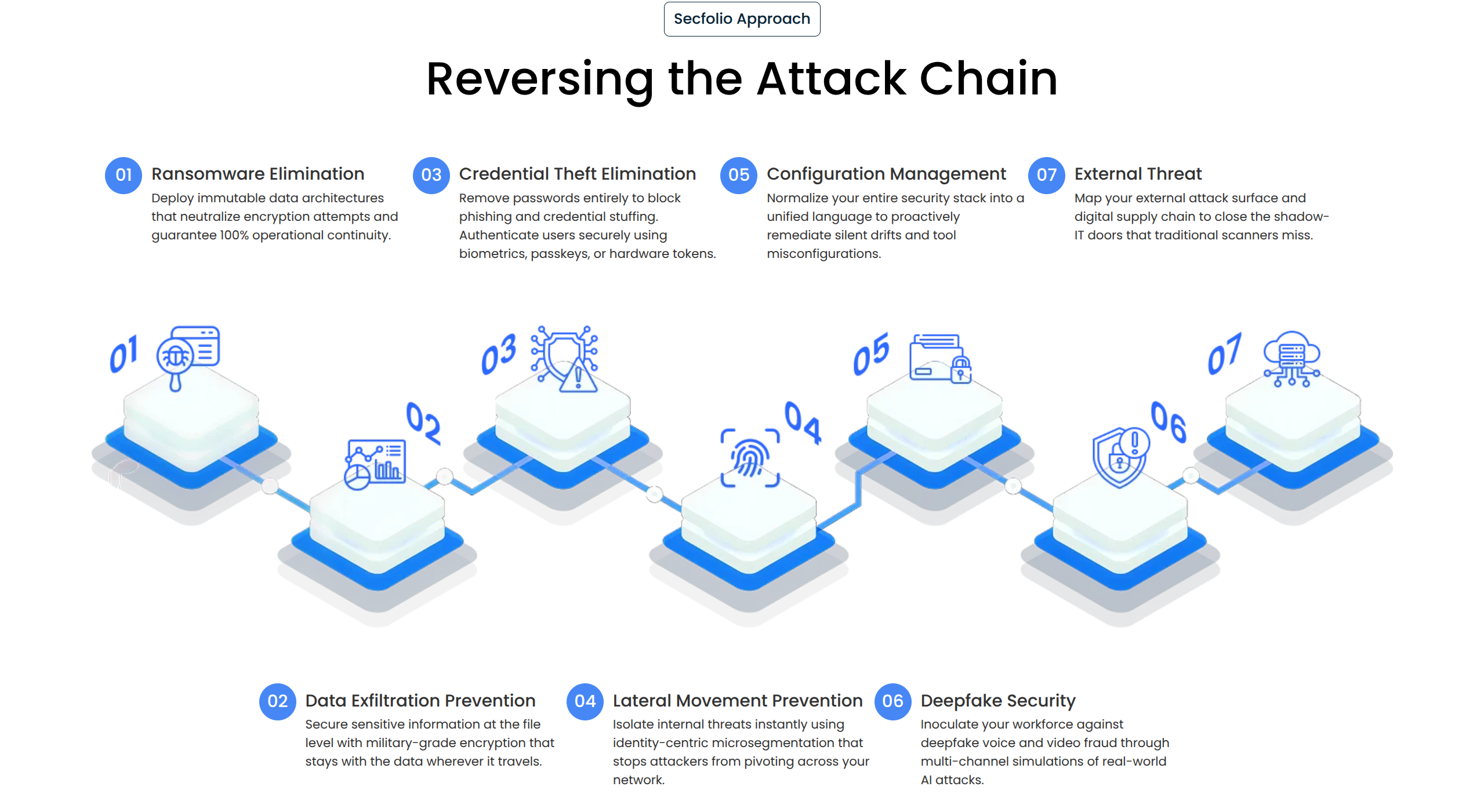
Secfolio’s approach starts from a premise most security frameworks still resist: the threat is already inside. Identity Microsegmentation limits what any single account can reach, so a compromised credential or a malicious insider cannot traverse the environment freely. Defensive Automation powered by AI continuously maps attack pathways and eliminates them before exploitation occurs, rather than waiting for an alert after the fact.
For teams dealing with privilege escalation risk, Secfolio’s lateral movement prevention controls segment east-west traffic at the identity layer, not just the network layer. That distinction matters because network segmentation alone does not stop an attacker who holds valid credentials for multiple systems. Identity-layer controls do.
Organizations that want to understand their current internal exposure can start with Secfolio’s internal vulnerability assessment methodology, which surfaces misconfigurations, access control gaps, and unpatched systems in a structured, prioritized format.
Key Takeaways
Internal vulnerabilities, including insider threats, human error, privilege escalation, and unpatched systems, cause the majority of data breaches and are harder to detect than external attacks because they exploit legitimate access and trusted credentials.
| Point | Details |
|---|---|
| Internal data is the primary target | Internal data appears in 67% of breaches, while personal data appears in only 23%. |
| Privilege escalation drives severity | Over 55% of internal security threats involve exploiting vulnerabilities to reach administrator-level access. |
| Patch windows create exploitation gaps | The median time to patch critical vulnerabilities has increased significantly, leaving systems exposed. |
| Detection requires behavioral baselines | Valid credentials generate no alerts in rule-based systems; UEBA and immutable logs close the gap. |
| Legal exposure is direct and documented | Regulators treat internal control failures the same as external breaches when assessing penalties. |


