

Legacy systems are defined as IT infrastructure that has passed vendor end-of-life status and no longer receives security patches or active support. This is the core reason why legacy systems increase vulnerabilities at a rate that modern environments simply do not face. End-of-life software accumulates 218 new vulnerabilities every six months after support ends, and those flaws go unaddressed indefinitely. CISA’s Known Exploited Vulnerabilities catalog documents hundreds of these flaws actively targeted in the wild. The Verizon Data Breach Investigations Report consistently links unpatched systems to the majority of confirmed breaches, and breach costs from legacy compromises average $4.8 million per incident.
Why legacy systems increase vulnerabilities: the primary security risks in 2026
The single biggest driver of legacy system risk is the absence of vendor-issued patches. Once a product reaches end-of-life, known flaws accumulate without any official fix. Legacy system vulnerabilities are 4 times more likely to be weaponized by attackers than flaws in actively supported software. That gap explains why aging infrastructure consistently appears at the center of major breach investigations.
The threat window has also narrowed dramatically. The mean time to exploit a disclosed vulnerability has dropped from 32 days in 2022 to roughly 5 days in 2026, with 32% of exploits appearing at or before the public disclosure date. For a legacy system with no patch pipeline, that 5-day window is effectively zero. There is no patch coming, so the exposure is permanent.
The structural architecture of legacy systems compounds the problem further. These platforms were designed before Zero Trust, before microsegmentation, and before modern identity controls existed. They assume implicit network trust, use outmoded protocols like Telnet or NTLMv1, and cannot integrate with modern security tooling without breaking core workflows.
Key risk factors driving legacy software vulnerabilities include:
- No patch pipeline. Known CVEs accumulate indefinitely after end-of-life.
- Weak authentication. Legacy systems often rely on single-factor or shared credentials that cannot support modern identity controls.
- Flat network architecture. Most legacy environments lack internal segmentation, giving attackers free lateral movement once inside.
- Ransomware targeting. Ransomware groups prefer legacy environments because weak detection and operational criticality pressure organizations into fast ransom payments.
- Regulatory exposure. Running unsupported software violates PCI DSS, HIPAA, and NIST SP 800-53 requirements, creating legal liability alongside technical risk.
Pro Tip: Map every legacy asset against CISA’s Known Exploited Vulnerabilities catalog quarterly. Any CVE on that list affecting your environment is an active threat, not a theoretical one.
68% of security incidents tie directly to exploitation of known, unpatched vulnerabilities. That statistic means most breaches involving legacy systems are preventable in theory but structurally unavoidable in practice without modernization.

How do legacy systems create invisible vulnerabilities?
The risks associated with old IT systems go well beyond missing patches. Legacy environments generate a category of invisible vulnerability that standard scanning tools frequently miss entirely.
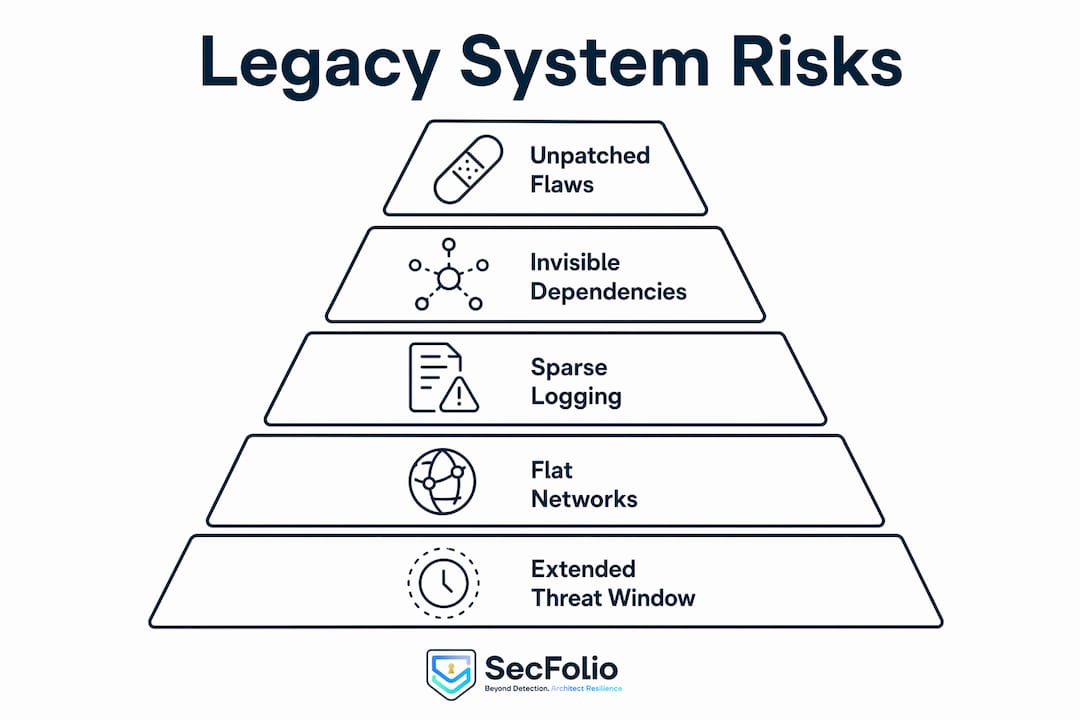
Sparse and inconsistent logging is one of the most dangerous characteristics. Legacy systems produce non-standard log formats that modern SIEM platforms cannot parse reliably. Attackers exploit these monitoring blind spots to move laterally or exfiltrate data without triggering any alert. A threat actor inside a legacy environment can operate undetected for weeks because the telemetry simply does not exist.
Silent dependencies create a second category of invisible risk. Legacy backends often support modern integrations in ways that are undocumented and unknown to current staff. Touching one component to apply a security fix can cascade into failures across connected systems. This makes even partial remediation dangerous without thorough dependency mapping first.
The operational catch-22 is the third invisible problem. Adding modern security controls such as granular identity and access management or multi-factor authentication to legacy systems frequently breaks tightly coupled workflows. Security teams face a choice between accepting the vulnerability or accepting the downtime. Neither option is acceptable in a production environment.
The four most common invisible vulnerability patterns in legacy applications are:
- Monitoring gaps. Non-standard logs create detection blind spots that attackers exploit for lateral movement.
- Undocumented dependencies. Silent connections between legacy and modern systems cause cascading failures during any remediation attempt.
- Brittle security integrations. Applying MFA or IAM controls breaks legacy workflows due to tightly coupled architecture.
- Documentation decay. Systems accumulate fragility quietly as staff turnover erodes institutional knowledge and documentation drifts from reality.
Pro Tip: Before touching any legacy system for security purposes, run a dependency discovery exercise using network traffic analysis. Assume every undocumented connection is load-bearing until proven otherwise.
What mitigation strategies effectively reduce legacy system vulnerabilities?
Patching alone does not solve legacy risk. Legacy systems operate on security assumptions fundamentally incompatible with Zero Trust principles, meaning even a fully patched legacy platform still carries structural risk. Effective mitigation requires a layered approach that combines compensating controls with a credible modernization roadmap.
Microsegmentation and network isolation are the highest-impact compensating controls available. Placing legacy assets in isolated network segments prevents attackers from using them as pivot points into modern infrastructure. Secfolio’s Identity Microsegmentation approach applies this principle at the identity layer, not just the network layer, which closes the lateral movement paths that flat legacy architectures leave open. Teams can explore lateral movement prevention as a direct control for legacy-influenced environments.
Zero Trust governance reduces the attack surface even when full modernization is not yet possible. Requiring explicit verification for every access request, regardless of network location, removes the implicit trust that legacy systems rely on. This does not fix the underlying architecture, but it limits what an attacker can do after gaining initial access.
Active monitoring enhancements compensate for legacy logging gaps. Deploying network-level detection tools, deception technologies, and out-of-band monitoring around legacy assets captures attacker behavior that the legacy system itself cannot log. Addressing security drift prevention through continuous configuration monitoring also catches unauthorized changes before they become breaches.
Phased retirement planning is the only permanent solution. Organizations should classify legacy assets by criticality and exploitability, then build a retirement timeline that prioritizes the highest-risk systems first. The goal is not to patch legacy systems into safety. The goal is to replace them before attackers exploit the structural gaps that patching cannot close.
| Mitigation approach | Effectiveness | Addresses root cause |
|---|---|---|
| Patch management only | Low for EOL systems | No |
| Network microsegmentation | High as compensating control | No |
| Identity microsegmentation | High, closes lateral movement | Partially |
| Zero Trust governance | Moderate to high | Partially |
| Phased modernization and retirement | Definitive | Yes |
How do threat actors exploit legacy vulnerabilities?
Attackers do not stumble onto legacy systems by accident. Automated reconnaissance tools now identify legacy assets and match them to known exploits in minutes. The combination of public CVE databases, AI-accelerated scanning, and unpatched legacy environments has made targeting these systems a low-effort, high-reward activity for threat actors.
Ransomware groups have built entire operational playbooks around legacy environments. The logic is straightforward: legacy systems lack modern endpoint detection, carry high operational criticality, and have no patch available. Organizations running critical business processes on legacy infrastructure face enormous pressure to pay ransoms quickly rather than accept extended downtime. That pressure is exactly what ransomware operators count on.
“Legacy systems are not just outdated. They are structurally designed to fail against modern attack techniques. Every day they remain in production without compensating controls is a day an attacker can exploit assumptions that were made before modern threats existed.”
Attackers also exploit specific technical weaknesses unique to legacy environments:
- Outmoded authentication protocols. NTLMv1, basic HTTP authentication, and shared service accounts are trivial to exploit with credential-stuffing tools. Teams managing credential theft risks in legacy environments face this problem directly.
- Unencrypted internal traffic. Legacy systems frequently transmit data in plaintext over internal networks, making packet capture a viable attack technique.
- Integration weaknesses. API connections between legacy backends and modern front ends often bypass modern authentication entirely, creating a direct path into the legacy system.
- Known exploit availability. Public exploit frameworks like Metasploit contain modules for vulnerabilities that are years or decades old but remain unpatched on legacy systems.
The impact of these attacks is not theoretical. Organizations running legacy ERP platforms, industrial control systems, and healthcare record systems have all faced ransomware campaigns that specifically targeted the legacy components of their infrastructure.
Key takeaways
Legacy systems increase vulnerabilities structurally, not just technically, because they combine unpatched known flaws, architectural incompatibility with modern controls, and monitoring blind spots that make detection nearly impossible.
| Point | Details |
|---|---|
| Patching is insufficient | EOL systems accumulate flaws permanently; structural risk requires modernization, not just patches. |
| Exploitation window is 5 days | Mean time to exploit dropped from 32 days in 2022 to 5 days in 2026, leaving no buffer for unpatched systems. |
| Invisible risks amplify exposure | Sparse logging, silent dependencies, and brittle integrations create attack paths that scanners miss. |
| Microsegmentation limits damage | Isolating legacy assets at the network and identity layer prevents lateral movement even when flaws exist. |
| Phased retirement is the only fix | Compensating controls reduce risk temporarily; replacing legacy systems eliminates the structural problem. |
The uncomfortable truth about legacy risk that most teams avoid
Most security teams I have worked with treat legacy systems as a known problem they will address “next quarter.” That quarter never comes. The real issue is not technical debt. It is organizational inertia dressed up as risk acceptance.
The documentation decay problem is worse than most teams admit. When the engineer who built the system leaves, the institutional knowledge leaves with them. What remains is a system that nobody fully understands, running processes nobody wants to touch, connected to things nobody has mapped. That is not a security posture. That is a liability waiting to be triggered.
The invisible dependency problem is what keeps me up at night more than the CVE count. I have seen organizations attempt to decommission a legacy system, only to discover it was silently powering three other systems that nobody knew about. The decommission fails, the legacy system stays, and the risk compounds. Dependency mapping before any remediation is not optional. It is the work.
The Zero Trust framing matters here too. Legacy systems do not just lack patches. They were built on a fundamentally different threat model, one where the network perimeter was trusted and internal traffic was assumed safe. Grafting modern controls onto that architecture without a modernization plan is like installing a deadbolt on a screen door. The effort is real, but the protection is not.
My practical advice: stop treating legacy risk as a patching problem and start treating it as an architectural problem. Build the retirement roadmap now, apply microsegmentation as a bridge control, and use active monitoring to catch what the legacy system cannot log itself.
— James
How Secfolio addresses lateral movement in legacy environments
Legacy systems create the exact conditions that make lateral movement attacks so effective: flat networks, weak authentication, and monitoring gaps that hide attacker activity for days or weeks.

Secfolio’s Identity Microsegmentation isolates legacy assets at the identity layer, not just the network perimeter. This means an attacker who compromises a legacy endpoint cannot use it to pivot into modern infrastructure, even when the legacy system itself cannot be patched or hardened. Secfolio’s Defensive Automation continuously maps attack pathways and eliminates them before they can be used, reducing the window of exposure that unpatched legacy flaws create. For organizations managing mixed environments, this approach provides measurable protection without requiring full modernization before security improves. Learn more about Secfolio’s prevention approach and how it applies to legacy-influenced enterprise environments.
FAQ
Why are legacy systems more vulnerable than modern systems?
Legacy systems no longer receive vendor security patches after end-of-life, so known vulnerabilities accumulate permanently. They also use outdated protocols and trust models that are incompatible with modern security controls.
What is the average cost of a legacy system breach?
Breach costs from legacy system compromises average $4.8 million per incident, driven by extended dwell times, limited detection capability, and the operational disruption of systems that cannot be quickly replaced.
Can patching fix legacy system security risks?
Patching reduces risk on supported systems but cannot eliminate it on legacy platforms. Legacy systems operate on security assumptions incompatible with Zero Trust principles, meaning structural risk remains even after all available patches are applied.
How do ransomware groups target legacy environments?
Ransomware groups use automated tools to identify legacy systems, then exploit known unpatched CVEs to gain access. They target legacy environments specifically because weak detection tools and high operational criticality pressure organizations into paying ransoms quickly.
What is the fastest way to reduce legacy system exposure?
Network and identity microsegmentation is the fastest compensating control. Isolating legacy assets prevents lateral movement, limiting the blast radius of any compromise while a longer-term modernization plan is executed.


