

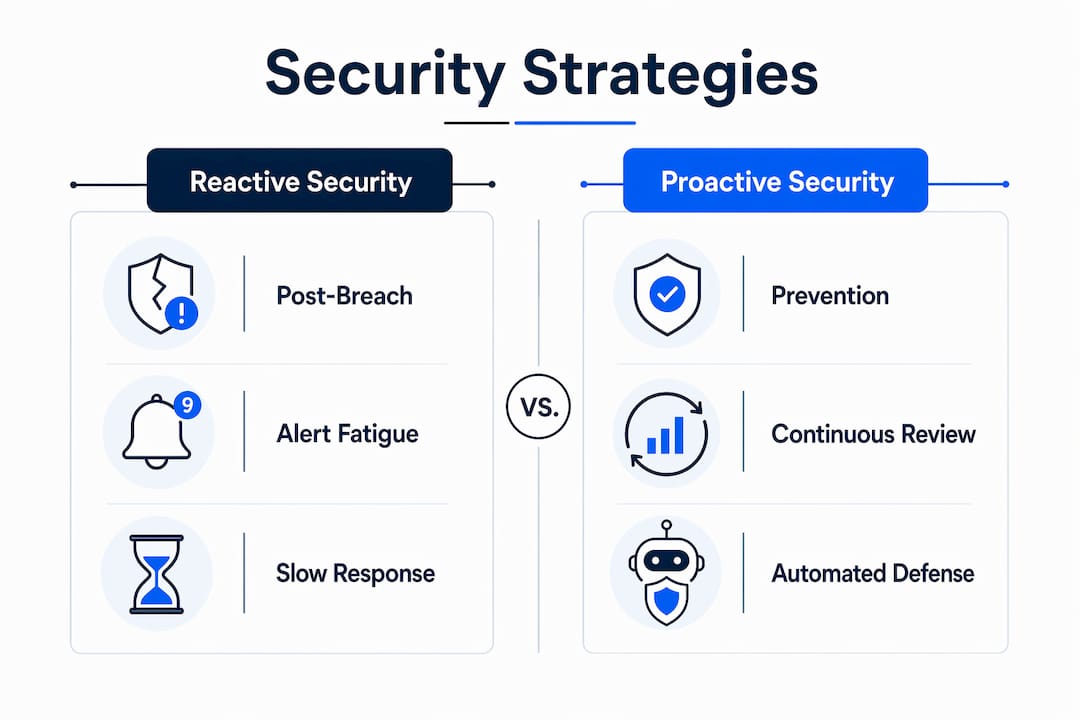
Reactive security is defined as a defense model that responds to threats only after a breach or attack has already occurred. This approach is structurally misaligned with modern cyber threats, and the gap is widening. As of Q2 2026, 75 zero-day vulnerabilities were identified in 2024 alone, with 44% targeting enterprise and cloud platforms. That number tells you one thing: attackers are not waiting for your patch cycle. Understanding why reactive security strategies fail is no longer an academic exercise. It is the difference between a manageable incident and a catastrophic breach.
Why reactive security strategies fail at the structural level
Reactive security fails because it is built on a false assumption: that defenders can respond fast enough to limit damage after a threat enters the environment. Defenders play catch-up to attackers whose speed and sophistication have outpaced traditional defenses for over 20 years. The structural problem is not a lack of tools or talent. It is a model that places response after compromise, not before it.
The cost of this misalignment is not just operational. Reactive IT approaches appear cost-effective on paper but carry a hidden crisis tax: unplanned downtime, emergency fixes, and data loss that routinely exceed the predictable cost of proactive investment. Security teams that operate reactively spend most of their budget on detection and incident response, leaving almost nothing for upstream controls that would have prevented the incident entirely.
The industry term for the alternative is proactive security, sometimes called defense-in-depth or shift-left security. These frameworks prioritize identifying and eliminating attack pathways before adversaries can use them. Secfolio’s approach, built around Identity Microsegmentation and Defensive Automation, operationalizes exactly this model by continuously mapping attack surfaces and removing pathways rather than waiting for alerts.
What are the common pitfalls of reactive security approaches?
Six tactical errors consistently drive reactive security failures in practice. Each one creates a blind spot that attackers exploit with precision.
-
Reliance on legacy antivirus. Signature-based antivirus tools detect known malware. They miss novel variants, fileless attacks, and living-off-the-land techniques entirely. Attackers know this and design campaigns around it.
-
Fractured tool stacks. A disconnected “Franken-stack” of best-of-breed tools that lack integration forces analysts to manually correlate alerts across multiple consoles. The result is alert fatigue and critical delays in response time.
-
Weak or misconfigured MFA. Multi-factor authentication is only as strong as its configuration. Push-bombing attacks and SIM-swapping bypass poorly implemented MFA routinely. Deploying MFA without validating its configuration is a false sense of security.
-
Ignoring shadow IT. Employees use unauthorized SaaS applications, cloud storage, and collaboration tools constantly. Each one is an unmonitored entry point that reactive teams never see until after a breach.
-
Static configuration policies. Static “set it and forget it” configurations become obsolete rapidly as threat actors evolve their strategies daily. A firewall rule written in 2022 may actively create risk in 2026.
-
Inaccessible incident response plans. Incident response plans stored on internal servers become unreachable the moment ransomware encrypts the environment. Teams arrive at a crisis with no playbook they can actually open.
Pro Tip: Store incident response plans in an out-of-band location, such as a printed binder or an isolated cloud account with separate credentials, so they remain accessible during an active ransomware event.
The consequences of these errors compound each other. Alert fatigue from a fractured tool stack means analysts miss the shadow IT alert that would have flagged the credential theft that enabled the ransomware. Reactive security does not fail at one point. It fails across a chain.
How do evolving cyber threats outpace reactive security models?
Modern threats operate at machine speed. Human analysts cannot match that pace, and reactive models that depend on human-limited response collapse under the volume and velocity of current attack campaigns. The defender’s window between initial compromise and lateral movement has shrunk from days to minutes in many documented intrusions.

Three threat categories illustrate this gap most clearly.
AI-assisted phishing generates personalized lure content at scale, bypassing traditional email filters that rely on known patterns. A reactive team that investigates phishing reports after users click is always one step behind a campaign that already harvested credentials.
Supply chain attacks compromise a trusted vendor or software update mechanism to reach thousands of downstream targets simultaneously. By the time a reactive team detects anomalous behavior in one environment, the same payload has already executed across the entire customer base of the compromised vendor.
Living-off-the-land techniques use legitimate system tools like PowerShell, WMI, and certutil to execute malicious actions. Signature-based detection generates no alert because no malicious file ever touches disk. Reactive teams have nothing to respond to until the damage is visible.
“The gap between defender capabilities and attacker speed is widening rather than closing. Reactive security forces organizations to absorb damage before they can act. That is not a defense posture. It is a recovery posture.”
Reacting after a breach is also expensive in ways that extend beyond remediation costs. Regulatory penalties under frameworks like GDPR and HIPAA apply from the moment of unauthorized access, not from the moment of detection. A reactive team that discovers a breach weeks after it began faces a much larger compliance exposure than one that prevented the breach entirely.
Why do legacy patch cycles and static configurations create security vulnerabilities?
Critical systems typically require 30 to 90 days to patch after a vulnerability is disclosed. During that window, attackers with knowledge of the CVE have free movement inside any unpatched environment. Reactive security has no answer for this gap. The patch cycle is a structural vulnerability, not a process failure.
The table below maps the most common static configuration failures to their real-world consequences.
| Configuration failure | Attack vector enabled | Typical detection lag |
|---|---|---|
| Overpermissioned service accounts | Privilege escalation, lateral movement | Weeks to months |
| Unchanged default credentials | Unauthorized access, backdoor persistence | Often never detected |
| Misconfigured MFA policies | Credential bypass, account takeover | Days to weeks |
| Stale firewall rules | Unauthorized outbound data transfer | Months |
| Unreviewed admin group memberships | Insider threat, privilege abuse | Rarely audited |
Each row in that table represents a gap that a reactive team discovers after an incident, not before it. Continuous revalidation of security configurations is the only way to close these gaps before attackers find them. Static configurations do not just become outdated. They become invitations.
Pro Tip: Schedule quarterly configuration reviews as a standing calendar item with a named owner. Configurations that have no scheduled review date will not be reviewed.
Insider threats exploit these gaps with particular effectiveness. A former employee whose access was never revoked, or a contractor whose permissions were never scoped down, represents a standing vulnerability that a reactive model will not surface until damage is done. Proactive credential protection and continuous access review are the controls that close this exposure before it becomes an incident.
How can organizations shift from reactive to proactive security?
Shifting to proactive security does not require an overnight overhaul. The most effective path is a gradual reorientation of resources from detection and response toward prevention and attack surface reduction. Most organizations over-invest in downstream response and under-invest in upstream controls that would have made the response unnecessary.
The practical steps below reflect where security teams see the fastest return on reorientation.
- Reallocate budget upstream. Move a portion of incident response spending toward threat intelligence subscriptions, attack surface management, and design-time security controls. Prevention is cheaper than remediation at every scale.
- Consolidate your tool stack. Replace disconnected point solutions with integrated platforms where alerts correlate automatically. Fewer consoles mean faster detection and less analyst burnout. Secfolio’s lateral movement prevention capabilities are built on this integration principle.
- Implement continuous verification. Replace periodic audits with continuous monitoring of configurations, identities, and access rights. Any change to a privileged account or firewall rule should trigger an automated review, not a quarterly spreadsheet check.
- Test your incident response plan before you need it. Run tabletop exercises at least twice per year. Verify that the plan is accessible from outside your primary network. Assign a specific owner to each action item.
- Address shadow IT systematically. Deploy a cloud access security broker or equivalent visibility tool to discover unauthorized SaaS usage. You cannot protect what you cannot see.
- Adopt a Zero Trust architecture. Zero Trust, as defined by NIST SP 800-207, assumes no implicit trust for any user or device regardless of network location. This framework is the clearest industry standard for operationalizing proactive security at scale.
Pro Tip: Start your proactive shift with a single high-value asset, such as your identity provider or your most critical cloud workload. Prove the model works there, then expand. A focused win builds organizational support faster than a broad initiative.
The cultural shift matters as much as the technical one. Security teams that measure success by incident count will always optimize for faster response. Teams that measure success by attack surface reduction will optimize for prevention. The metric you track determines the behavior you get.
Key takeaways
Reactive security fails because it is structurally designed to absorb damage rather than prevent it, and modern threats move faster than any human-limited response model can match.
| Point | Details |
|---|---|
| Structural misalignment | Reactive security responds after compromise, giving attackers free movement during the response window. |
| Six tactical pitfalls | Legacy antivirus, fractured tool stacks, weak MFA, shadow IT, static configs, and inaccessible IR plans each create exploitable gaps. |
| Patch cycle exposure | A 30 to 90 day patch window gives attackers documented, uncontested access to unpatched systems. |
| Machine-speed threats | AI phishing, supply chain attacks, and living-off-the-land techniques outpace human-limited reactive defenses. |
| Proactive shift is gradual | Reorienting toward prevention starts with budget reallocation and tool consolidation, not a full program rebuild. |
The uncomfortable truth about reactive security
I have spent years watching organizations invest heavily in detection tools and then express genuine surprise when a breach still costs them millions. The surprise is the problem. Reactive security feels like security because it generates activity: alerts, investigations, incident reports, post-mortems. That activity creates the illusion of control.
The reality is that every post-mortem is an admission that the model failed. You are documenting what went wrong after the damage is done. The attacker already won that round.
What I find most frustrating is the persistence of the “we’ll respond when it happens” mindset in organizations that have already been breached. A breach should be the event that forces a structural rethink. Too often, it triggers a tool purchase instead. A new SIEM or an additional endpoint agent gets added to an already fractured stack, and the underlying model stays the same.
The shift to proactive security is not comfortable. It requires admitting that your current investment is misallocated. It requires measuring success differently. And it requires patience, because prevention does not generate the visible activity that reactive tools do. But the organizations I have seen make this shift consistently report fewer incidents, lower recovery costs, and security teams that are not burned out from chasing alerts they can never fully clear.
The threat landscape is not going to slow down. The only viable response is to stop playing catch-up.
— James
Secfolio’s approach to proactive cybersecurity
Security teams that are ready to move beyond reactive defense need tools built for continuous prevention, not just faster detection.

Secfolio addresses the core failures of reactive security directly. Its Identity Microsegmentation stops attackers from moving laterally after initial access, eliminating the free-movement window that reactive models leave open. Its configuration management capabilities continuously monitor and correct security drift before it becomes a vulnerability. And its AI phishing defense counters the AI-assisted campaigns that signature-based tools miss entirely. For security teams building a proactive posture, Secfolio’s technical resource library is a practical starting point.
FAQ
What is the main reason reactive security strategies fail?
Reactive security strategies fail because they respond to threats only after a breach occurs, giving attackers free movement during the gap between compromise and detection. Modern threats operate faster than human-limited response models can match.
How does proactive security differ from reactive security?
Proactive security identifies and eliminates attack pathways before adversaries can use them, while reactive security waits for an incident to trigger a response. Frameworks like Zero Trust (NIST SP 800-207) and continuous configuration monitoring are core proactive practices.
Why do patch cycles create security vulnerabilities?
Critical systems typically require 30 to 90 days to patch after a vulnerability is disclosed. During that window, attackers with knowledge of the CVE have documented, uncontested access to unpatched environments.
What is alert fatigue and why does it matter?
Alert fatigue occurs when disconnected security tools generate more alerts than analysts can investigate, causing critical signals to be missed or delayed. It is a direct consequence of fractured tool stacks and a primary reason reactive security teams fail to respond in time.
Can organizations shift to proactive security without rebuilding their entire program?
Yes. The shift is typically a gradual reallocation of resources from detection and response toward prevention and attack surface reduction. Starting with a single high-value asset and expanding from there is the most effective approach for most organizations.


